


Choosing university courses is a journey you and your teen take together. It's about exploring who they are, what makes their heart beat a little faster, and then finding a path that honours their unique spirit. This works best as a supportive, open conversation—one that champions their dreams over a narrow focus on league tables or future salaries.
Starting the University Conversation with Your Teen
That first mention of "university" can land with a thud. For parents, it's a confusing mix of immense pride and a sudden, heavy pressure to get it right. For your teen, it can feel like being asked to draw a map for a future they can barely imagine. The weight of that expectation can be crushing for them.
The key is to transform this pressure into a warm, open conversation.
This initial stage isn't about shortlisting universities or finalising personal statements. It's about creating a safe, judgement-free zone where your child feels truly heard and understood. The goal is to gently shift the focus away from predicted grades and towards uncovering what genuinely makes them tick. You can learn more about how A-Levels work and their importance in our dedicated guide: https://queensonlineschool.com/how-do-a-levels-work/

Uncovering Passions in Unexpected Places
Often, a teenager's true passions don't look like traditional academic subjects. They might be hidden in hobbies, online communities, or weekend activities. Your role is to be a detective for their heart, helping them see the valuable skills and interests buried within the things they love.
Let's take a common example: a teen who spends hours on video games. It’s easy to feel a pang of worry, but if we look with curiosity, we can find real clues about who they are. What is it about gaming they enjoy so much?
- Is it the storytelling? A fascination with complex narratives and character development could point towards a love for English, Creative Writing, or even History. Perhaps they're the one who feels a genuine connection to the hero's journey.
- Is it the visual design? Maybe they’re captivated by the world-building, the art style, and how the user interface works. This is the foundation for courses like Graphic Design, Animation, or Digital Media, where they could build worlds of their own.
- Is it the strategy and logic? Perhaps they get a thrill from solving intricate puzzles or mastering game mechanics. This analytical mindset is central to degrees in Computer Science, Mathematics, or even Economics.
By asking these sorts of questions, you reframe their hobby as a source of legitimate skills. You're not just validating their interest; you're showing them that the thing that brings them joy could be the key to their future. To guide teens effectively, parents can explore resources that offer comprehensive advice on course and university selection.
Creating a Safe Space for Exploration
For this to work, your teen has to feel safe enough to be honest—without fear of your disappointment. This is especially true if their interests don't align with the future you may have pictured for them. Letting go of our own dreams for our children is one of the hardest parts of parenting.
The most powerful thing a parent can do is listen more than they talk. Ask open-ended questions like, "What was the most interesting thing you learned this week?" or "If you could spend a whole day doing anything you wanted, what would it be?" These questions invite exploration, not a simple "yes" or "no."
This first phase is all about building a foundation of trust. It’s about reassuring them that their future is a collaborative project, not a solo mission they have to figure out all at once. By championing their unique interests, you transform the daunting task of choosing a future into an exciting journey of self-discovery you can embark on together.
Connecting Passions to Practical Career Paths
You've listened, you've asked questions, and you're starting to see those sparks of genuine interest. That’s a huge, heartfelt step. Now comes the exciting, and sometimes tricky, part: connecting those passions to real-world university courses and tangible career paths. This is where your child's dreams meet a little bit of practical planning.
It’s one thing for your child to love a subject; it’s another for them to see how that love can translate into a fulfilling, stable future. Your role here is to be a supportive co-researcher, helping them build a bridge between what they enjoy today and what they could be doing tomorrow.

From Abstract Passion to Concrete Courses
Let’s say your teen is deeply passionate about social justice. They're always talking about fairness, equality, and making a difference. This is a powerful motivator, but "social justice" isn't a degree you can just select on a UCAS form. The task is to break it down and find the course that speaks to their heart.
What aspects of social justice really fire them up?
- Championing individual rights? Imagine them fighting for someone's freedom. This could lead them to explore a Law (LLB) degree, with modules in human rights, criminal justice, or family law.
- Understanding societal structures? Do they wonder why things are unfair? A degree in Sociology or Politics would let them analyse the very systems that create inequality.
- Tackling global issues? Does their empathy extend across borders? This points towards International Relations or Development Studies, where they could examine global poverty, conflict, and humanitarian aid.
Each of these courses offers a different lens through which to view their passion. By digging into the specific modules within each degree, you help your teen move from a vague feeling to a concrete academic direction. This process is absolutely vital, especially when deciding which subjects to focus on for their final school years.
For more on this, check out our guide on how to choose A-Level subjects to align with these potential university paths.
Researching Real-World Outcomes
Once you have a shortlist of potential courses, the next question is a big one: "But what job can they actually get with that degree?" This is where many parents feel a flicker of anxiety, especially with subjects that aren't obviously vocational.
Fortunately, there are fantastic tools available to demystify career paths. Think of yourselves as career detectives. Your mission is to find out what graduates actually do.
Don't just rely on university prospectuses. The real stories are found by looking at the career journeys of actual graduates. It’s the most authentic way to see where a degree can really lead, giving your child tangible role models to look up to.
A brilliant place to start is LinkedIn. Use the search function to look for a university and a specific course (e.g., "University of Manchester Sociology"). You can then filter by "Alumni" to see a huge database of graduates. Here you can find out:
- Where they work: Are they in the public sector, charities, private companies, or have they started their own businesses?
- What their job titles are: Look for roles like 'Policy Advisor', 'Charity Fundraiser', 'Social Researcher', or 'Community Outreach Manager'.
- Their career progression: How did they get from graduation to their current role?
This simple exercise can be incredibly reassuring. It provides solid proof that a degree in Sociology doesn't just lead to one job; it opens doors to hundreds of different possibilities. It helps both you and your teen see a viable, exciting future.
Choosing the right course is a key step towards future success. UK enrolment data shows that many students are already aligning their studies with market needs. For instance, Business and Management is currently the most popular field, with 595,620 students enrolled for the 2023/24 academic year, driven by the strong demand for skills in finance and management.
Ultimately, the goal is to help your child find a career that brings them satisfaction and purpose. For more strategies on guiding this journey, explore advice on how to find a job you truly love. This process isn't about forcing a passion into a pre-defined box. It's about empowering your teen with knowledge, showing them that their interests have real value and can lead to a meaningful life and career.
Looking Beyond the Course Title

It’s an easy mistake to make. You see "Business Management" or "Psychology" in a prospectus and assume it’s the same course everywhere. But the name on the tin tells you very little about what’s actually inside.
A degree with the exact same title can be a completely different experience from one university to the next. The reality is, the details are what matter.
This is where you and your teen become detectives. It’s time to dig deeper than the polished marketing to understand what their day-to-day life as a student will truly feel like. This isn’t just about choosing a subject; it’s about choosing an experience that fits who they are and how they learn best.
Deconstructing the Course Content
The first and most important job is to look at the course modules. These are the individual topics that make up the degree. Don’t just skim the first-year list; look ahead to the second and third years, as this is where students often get to specialise and find their niche.
Imagine your teen is drawn to studying Law. At one university, the modules might be heavily focused on corporate and commercial law. At another, the focus could be on human rights and criminal justice. Both are 'Law' degrees, but one will ignite your child's passion while the other could leave them feeling cold and uninspired.
To help your teen get to the bottom of this, sit down together and ask:
- Which of these modules genuinely excite you? Get them to highlight the ones that make them think, "I can't wait to learn about that!"
- Are there compulsory modules you really dislike? A mandatory statistics module might be a dealbreaker for a creative student who freezes up at the sight of numbers. Honouring that feeling is important.
- What are the optional choices in the final year? This shows how much freedom they’ll have to tailor the degree to their specific interests as they develop.
This process turns an abstract concept into a tangible reality. It's about picturing themselves in those lectures and seminars, engaging with topics they genuinely care about.
Understanding Teaching and Assessment Styles
How a course is taught and assessed can be just as important as what is taught. Every student learns differently, and finding a course that aligns with your child's natural strengths can be the key to their success and, crucially, their happiness.
Think about your child's personality. Do they thrive in collaborative environments, or do they prefer to work independently? Do they excel under the pressure of a final exam, or do they produce their best work through long-term projects? The answers are clues that point towards the right learning environment.
A course structure that complements a student's learning style doesn't just improve their grades; it builds their confidence. Finding this match is one of the most powerful things you can do to support their transition to higher education.
This is where you need to investigate the small print on the university website. Look for the balance between different teaching and assessment methods.
- Lecture-Heavy: Common in the first year, with large groups and less interaction. Ideal for students who are good at absorbing information and working independently.
- Seminar-Based: Involves smaller groups, discussion, and debate. Perfect for those who learn by talking through ideas and feel energised by human connection.
- Practical Workshops/Labs: Hands-on sessions essential for science, engineering, and creative arts. A must for students who learn by doing.
A creative, hands-on learner might feel stifled in a course that is 70% exam-based but would flourish in one centred around practical projects and a final-year portfolio.
The way a student is graded is just as varied. Understanding these differences helps you match the course to your child’s strengths.
Comparing Course Assessment Methods
| Assessment Method | Best For Students Who… | Potential Challenges | Example Course Type |
|---|---|---|---|
| Final Exams | Perform well under pressure and have a strong memory for facts. | Can be stressful; a single bad day can disproportionately affect a final grade. | Law, History, Economics |
| Coursework & Essays | Are organised, enjoy in-depth research, and can build an argument over time. | Requires consistent effort and excellent time management skills. | English Literature, Sociology |
| Group Projects | Are collaborative, have good communication skills, and enjoy teamwork. | Can be frustrating if group members don't pull their weight. | Business Studies, Marketing |
| Presentations | Are confident public speakers and can articulate complex ideas clearly. | Can be daunting for shy or anxious students. | Media Studies, Drama |
| Practical Portfolios | Are hands-on, creative, and want to showcase tangible skills and work. | Often requires significant time and effort outside of scheduled classes. | Fine Art, Architecture, Graphic Design |
By looking at this table, you can quickly see how a student who loves research but dreads public speaking would be much happier on an essay-based course than one filled with group presentations.
Exploring Different Modes of Study
The traditional image of university involves moving away to a campus, but that’s no longer the only option. The rise of excellent online and blended programmes offers new flexibility that might be a perfect fit for your child's needs and your family's circumstances.
- On-Campus: The full residential experience. This is best for social students who want independence and thrive on the energy of a physical community.
- Blended Learning: A mix of online lectures and on-campus seminars. This offers more flexibility and can be great for students who need to balance study with work or who prefer a quieter home environment for independent learning.
- Fully Online: Provides the ultimate flexibility, allowing students to learn from anywhere. This is an outstanding option for self-motivated, independent learners or those with health needs that make campus life challenging.
Choosing the right mode of study is a deeply personal decision. It’s about being honest about your child's personality, maturity, and support needs. An anxious student might find the structured support of an online school, with its smaller class sizes and direct teacher access, a much better fit than a sprawling, anonymous campus.
The goal is to find an environment where they don't just survive, but truly thrive.
Finding a University That Feels Like Home
A degree is earned in the lecture hall, but a university experience is lived in all the moments in between. The right university isn’t just a place to study; it’s a community, a support system, and often the first place your teen will build their adult life from the ground up. The ‘feel’ of a place is one of the most critical, yet overlooked, factors in choosing a course.
That feeling often makes the difference between a student who flourishes and one who just gets by. It's that hard-to-define sense of belonging that turns a good academic decision into a great life choice. Your job, as their co-pilot, is to help them tune into their gut instincts and figure out what kind of environment will make them feel secure, inspired, and truly happy.
Campus Culture: Big City Dreams vs. Close-Knit Communities
The physical environment of a university has a massive impact on a student’s daily life. A buzzing city-centre campus offers endless energy and opportunity, while a quieter, self-contained campus provides a strong, often comforting, sense of community.
Neither is better than the other; they are just different. The right fit depends entirely on your child’s personality.
To get a sense of this, let's imagine two different students:
Meet Alex: Alex is fiercely independent and craves excitement. The thought of being in a big, diverse city like Manchester or London is a huge draw. They’re energised by the idea of anonymous crowds, endless cafes, and internship opportunities right on their doorstep. A large, sprawling city campus would be their playground.
Meet Chloe: Chloe is quieter and values deep connections. The idea of a huge, impersonal city feels overwhelming. She thrives in smaller groups and would feel much more comfortable on a campus where she recognises faces in the library and the student union. A university in a smaller town, like St Andrews or Lancaster, would offer the supportive, structured environment she needs to build her confidence.
A great way to figure this out is to ask your teen to imagine their ideal Saturday. Do they picture exploring museums and new neighbourhoods, or joining a society on campus followed by a quiet evening with a few close friends? Their answer is a powerful clue to what their heart wants.
Digging into the Support Systems
For many parents, this is the most important part. Knowing your child will be looked after when they're away from home brings immense peace of mind. Every university talks a good game about its support services, but the quality and accessibility of that support can vary dramatically.
Mental health support is particularly crucial. Research consistently shows that a significant number of students experience mental health difficulties during their university years. This isn't something to be afraid of, but it is something to prepare for.
Finding out how a university handles student wellbeing isn't being overprotective; it’s being a responsible parent. The best institutions see pastoral care as central to academic success, not just an optional extra. They understand that a happy student is a successful student.
When you're researching, go beyond the glossy brochures and look for hard facts:
- Mental Health Services: What's the average waiting time to see a counsellor? Do they offer drop-in sessions for when things feel urgent? Are the services free and completely confidential?
- Academic Support: Is there a dedicated personal tutor system in place? What help is available for students who are feeling lost with their coursework or drowning in exam stress?
- Specialist Support: If your child has specific learning needs (SEN) or social, emotional, and mental health (SEMH) challenges, what specific provisions are in place? Contact the disability and wellbeing teams directly to ask detailed questions. Their response will tell you everything about how much they truly care.
A university’s website will list these services, but student forums and open days are where you’ll get the unfiltered truth. Encourage your teen to ask current students what it’s really like to get help when you need it. Their answers will tell you everything you need to know about the institution's genuine culture of care. This focus on wellbeing is a cornerstone of choosing a course that will lead to a positive and successful experience.
Making the Final Decision with Confidence
So, you've done the hard yards. After weeks of open days, late-night chats, and tables piled high with prospectuses, the long list has finally become a short one. You’re down to a handful of serious contenders.
This is often the most charged part of the whole process. For both you and your teen, the weight of the decision can suddenly feel immense.
The goal now isn't to find some mythical "perfect" choice—it doesn't exist. Instead, it’s about turning that anxiety into quiet confidence. It's about helping your teen make a well-reasoned, heartfelt decision that they feel proud to own.
This flowchart maps out the key decision pathways, depending on whether your child is likely to thrive in an independent, big-city environment or a more supportive, close-knit community.
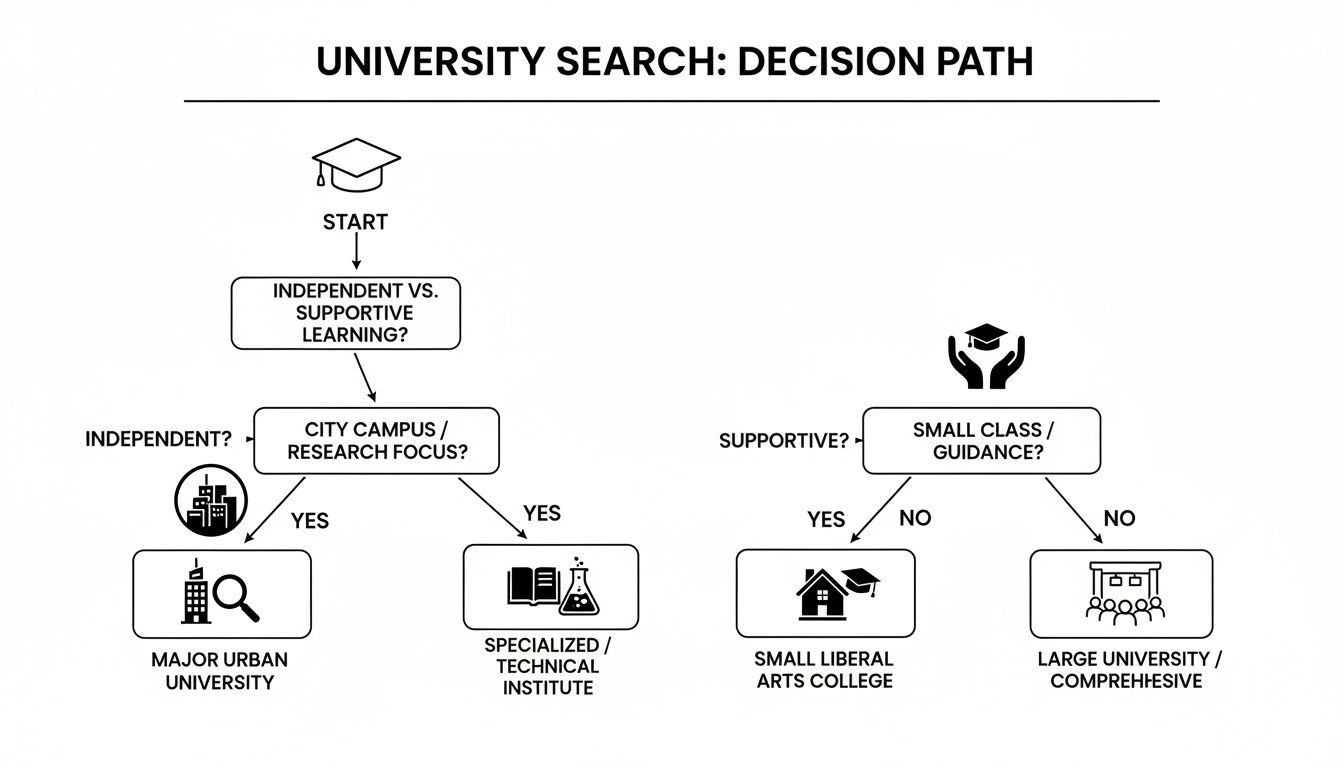
The key takeaway here is that the 'right' path is entirely personal. It’s defined by what a student truly needs, whether that’s complete autonomy or a more structured, supportive environment.
Creating a Decision Toolkit
To make this final choice feel less like a random gut feeling and more like a solid, informed conclusion, you need to get objective. A simple scoring system can work wonders here, translating vague feelings into something more concrete.
Grab a piece of paper or open a spreadsheet with your teen. List their final university choices across the top. Then, down the side, write down the factors that really matter to them, based on everything you've discussed so far.
This list might include things like:
- Course Content: How exciting are the modules in the second and third years?
- Assessment Style: Does it play to their strengths (e.g., more coursework than exams)?
- Campus Vibe: Did it feel welcoming? Like 'their kind of place'?
- Student Support: How good and accessible are the wellbeing services?
- Industry Links: Are there decent placement or internship opportunities?
Score each factor from 1 to 5. This simple act of assigning a number forces a bit of honest reflection. It can suddenly become crystal clear that while one university has a prestigious name, its low scores on student support and campus vibe are actually a major red flag for your child.
A Real-World Scenario: Prestige vs Personality
Let's imagine a family weighing up two offers for a Computer Science degree.
University A is a world-renowned, top-tier institution. The name alone carries a lot of weight. But the teaching is mostly done in huge, impersonal lectures, the campus feels overwhelming, and during the open day, the student wellbeing office seemed stretched thin. The student, who is naturally quiet and does better with one-to-one support, felt a knot of anxiety just walking around.
University B is less famous and sits lower in the league tables. But its Computer Science department has incredible links with a local game design studio, guaranteeing every student a third-year placement. The classes are small, the lecturers are known for being approachable, and the campus has a friendly, collaborative feel. The teen felt excited and at ease there.
The most prestigious path is not always the right one. True success comes from finding an environment where your child can flourish personally and academically, not just survive. Their happiness is the true measure of success.
In this scenario, the scoring system makes the choice obvious. University A might win on 'Prestige', but University B would score much higher on every other metric that actually matters to this specific student's happiness and future success. It empowers the family to confidently choose the "lesser-known" option, knowing it's the right option for their teen.
This whole process ensures the final decision is a shared one, built on logic, emotion, and a deep understanding of what your child really needs. It’s the final, empowering step in their journey toward independence.
Final University Choice Checklist
To pull all your thoughts together, use this checklist. It’s a great way to compare your final two or three options side-by-side and see which one truly comes out on top for your family.
| Decision Factor | University A Score (1-5) | University B Score (1-5) | Key Notes & Feelings |
|---|---|---|---|
| Course Content & Modules | |||
| Assessment & Teaching Style | |||
| Campus Vibe & Location | |||
| Accommodation Quality & Cost | |||
| Student Support & Wellbeing | |||
| Careers & Industry Links | |||
| Societies & Social Life | |||
| Financial Cost (Fees, Living) | |||
| Gut Feeling / Excitement Level |
Once you've filled this out, the right path forward often becomes much clearer. For more guidance on the final stages, our guide on how to apply to UK universities provides a complete step-by-step overview.
Common Questions from Parents and Teens
The journey to university is packed with questions, and it’s completely normal for both parents and teens to feel a bit lost and anxious along the way. Let's tackle some of the most common worries we hear.
What If My Teen Changes Their Mind?
This is a huge one, but it’s far more common—and manageable—than you might think. We put so much pressure on 18-year-olds to have their entire future mapped out, but that’s just not realistic. University is a place of discovery, after all.
Many degrees are designed to be quite broad, especially in the first year. A student diving into a Business degree, for instance, will likely cover everything from marketing and finance to human resources before they need to specialise. This built-in flexibility gives them a chance to figure out what they genuinely enjoy.
And what if they realise they're on the wrong path entirely? It can feel like a disaster, but it isn't. Most universities allow students to switch courses after the first year, provided they meet the academic requirements. It’s not a sign of failure; it’s a smart course correction based on real-world experience.
The best approach is to focus on choosing a course that feels right for now. The skills they’ll gain—critical thinking, research, and self-discipline—are valuable and transferable, no matter where their career eventually takes them. Reassure them that this decision isn't forever.
What If They Don't Get the Grades?
The pressure cooker of A-Level results day can feel immense. But not hitting those predicted grades isn't the end of the world. It’s just a detour. UCAS Clearing is a fantastic system that matches students without a firm offer to universities with available spots.
It’s not just about finding any place; it’s about finding the right one. For example, a student who is heartbroken after narrowly missing the grades for a competitive Law course might discover an amazing Criminology or Sociology degree through Clearing that sparks a whole new passion. Many students find that their Clearing choice turns out to be a perfect fit they hadn’t even considered.
Is It a Mistake to Choose a "Non-Vocational" Degree?
Absolutely not. Degrees in subjects like History, Philosophy, or English Literature are sometimes unfairly dismissed as not being "job-ready." In reality, these courses are specifically designed to develop the very skills that employers are desperate for.
Think about what your child, the history graduate, brings to the table:
- Analysis and Research: A history student knows how to sift through mountains of information to build a coherent, evidence-backed argument.
- Communication: An English graduate excels at writing clearly, persuasively, and with nuance.
- Problem-Solving: A philosophy major is trained to take apart complex problems, think logically, and see issues from multiple angles.
These aren't "soft skills"; they are foundational abilities essential for top careers in law, consulting, marketing, and the civil service. The trick is to help your teen learn how to articulate the incredible value of these skills to future employers.
At Queens Online School, we understand that the path to university is unique for every child. Our flexible, supportive online A-Level programmes are designed to help students build confidence, explore their passions, and achieve the grades they need for their first-choice university, all from a nurturing home environment. Discover how our personalised approach can make the difference.