
Making the right decision for your child's education can feel immense. You're not just choosing a school; you're shaping their future, their happiness, and their relationship with learning. If the traditional school system feels like it’s not quite clicking for your child, exploring home education online in the UK is a courageous and loving first step toward finding an environment where they can genuinely thrive.
Is Online Home Education Right for Your Child?
Does your child come home from school drained and withdrawn? Maybe they’re bright and curious, but the noise and pace of a busy classroom just seem to snuff out their spark. These aren’t trivial worries; they are the heart-wrenching signals that something isn't right for your child. You might have a gut feeling that they're getting lost in a class of thirty, or that the one-size-fits-all curriculum is either leaving them behind or holding them back.
These feelings are often what starts the search for an alternative. It’s not about giving up on the system, but about proactively fighting for a better fit for the unique, wonderful child you know best.
Why More UK Families Are Making the Switch
For a growing number of families, online home education is the answer. It creates a calm, focused space where learning can take centre stage again, free from the social pressures and constant distractions that can make school so tough. This isn't just about escaping a difficult situation; it's about moving towards a place of genuine joy and engagement for your child.
Online learning allows you to build an education that fits around your child, not the other way around. It’s about creating a nurturing environment where they feel safe, seen, and truly ready to learn.
The trend is undeniable. The UK home education sector has exploded in recent years, with student numbers more than tripling since the mid-2010s. Back in 2015, around 34,000 children were registered as home educated. By summer 2023, that figure had skyrocketed to 97,600—a staggering 187% increase. This isn't a niche choice anymore; it reflects a major shift in how families are putting their children's well-being first.
Putting Your Child’s Unique Needs First
Every child is wired differently. What works wonders for one can be a source of deep anxiety for another. The real beauty of online home education is its power to adapt to the individual.
- For the anxious child: Imagine a world where they don't have to face the daily dread of a crowded school. Online education offers a predictable, secure setting right at home, where they can finally breathe and focus.
- For the gifted learner: Instead of being bored and restless, they can accelerate their learning, diving deep into subjects that truly fascinate them without waiting for the rest of the class. A passion for astronomy can become a deep dive into astrophysics, not just a chapter in a textbook.
- For the child with specific needs: It allows for a truly tailored approach. If you suspect your child has ADHD, for example, understanding how to get an ADHD diagnosis in the UK is a crucial step in shaping an educational plan that supports their unique way of thinking, rather than fighting against it.
Think of this guide as your trusted companion on this journey. We’re here to help you unpack whether this path aligns with your family’s hopes and, most importantly, with your child’s happiness.
Understanding Your Legal Responsibilities
Dipping your toes into home education can feel a bit daunting, especially when you start thinking about the legal side of things. But here’s the good news: the framework for home education online in the UK is surprisingly flexible and built on trust. It puts your child's needs, not a rigid set of rules, right at the heart of their learning journey. You are absolutely not expected to recreate a school classroom in your living room.
Your main legal duty is simply to make sure your child gets a full-time education that is 'suitable' for their age, ability, and aptitude. That word 'suitable' is deliberately broad, giving you the freedom to design a learning experience that genuinely connects with your child.
What Does a 'Suitable' Education Actually Mean?
The law isn’t looking for a colour-coded timetable or formal lesson plans. A 'suitable' education is one that prepares your child for life in their community and the wider world. It’s all about nurturing their growth, not judging your methods.
This is a really important point, backed up by the official government guidance on home education.
As the guidance shows, while the local council has a duty to step in if a child isn't getting a suitable education, the whole process is meant to start with informal, supportive enquiries, not heavy-handed formal action.
So, what could this look like for your family?
- Project-based learning: Forget separate history and art lessons. A child fascinated by Ancient Egypt could build a diorama of a tomb (art, design), write a story about an archaeologist's discovery (English), and research the Nile's flooding cycles (geography, science). It's learning that feels like an adventure.
- Following their passions: If your child is obsessed with coding, a 'suitable' education could mean they spend a good chunk of their time on programming courses and logic puzzles. This isn't "time off"; it's deep, focused learning in a field that inspires them.
- Real-world skills: It could be as practical as learning maths by helping to budget for the weekly shop or exploring biology by caring for a pet and researching its needs.
The focus is on nurturing your child's natural curiosity and helping them develop in a way that’s far more meaningful than just ticking boxes on a curriculum checklist. You can find out more about the practical first steps in our guide on how to start homeschooling your child.
De-registering From School and Dealing with the Local Authority
If your child is currently at a mainstream school in England and Wales, the process is refreshingly simple. All you need to do is write a letter to the headteacher, informing them of your intention to de-register your child for Elective Home Education (EHE).
You don't need the school's permission. Once they get your letter, they are legally required to take your child's name off the school roll.
Simple De-registration Letter Example:
Dear [Headteacher's Name],
Re: [Your Child's Full Name], [Date of Birth]
After careful consideration, I am writing to inform you that I have decided to withdraw my child, [Child's Name], from the school roll to begin Elective Home Education, as is my right under section 7 of the Education Act 1996.
Please remove [Child's Name]'s name from the school register as of [Date].
Yours sincerely,
[Your Name]
Once that's done, the school will let your Local Authority (LA) know. The LA might then get in touch to make what they call 'informal enquiries' just to satisfy themselves that a suitable education is being provided. You are not legally required to have them visit your home or meet them in person.
Many families find it helpful to prepare a short report, a few samples of their child’s work, or a brief summary of their educational approach. It could be a scrapbook of photos from educational trips or a short write-up on a project they loved. The goal is just to show that you have a clear, thoughtful plan for your child's well-being and progress. Remember, this process is about protecting a child's right to an education, not about judging your choices.
Finding the Right Online Learning Model for Your Child
Choosing how to approach your child’s online education is a bit like picking the right shoes for them. What works best depends entirely on their personality and the journey ahead. There’s no single ‘best’ model for home education online in the UK; there's only the one that’s the most comfortable and supportive fit for your child.
This is a deeply personal decision. A child who thrives on routine and feels comforted by a clear structure might blossom in a full-time online school. For them, it provides predictability and a sense of community. On the other hand, a creative, self-motivated learner might feel constrained by that same structure. They might flourish with a more flexible programme that gives them the freedom to follow their curiosity down fascinating rabbit holes.
Comparing Your Main Options
To feel confident in your choice, it helps to see the main models laid out side-by-side. Each one strikes a different balance between structure, teacher interaction, social opportunities, and cost. Getting to grips with these differences is the first real step in matching a provider to your child’s unique personality and needs.
Here’s a look at the three main pathways families tend to take.
Comparing Online Home Education Models
Choosing an online education model is one of the most significant decisions a parent can make. The right fit can unlock a child's potential and reignite their love of learning, while the wrong one can lead to frustration. The table below breaks down the most common options to help you see which approach aligns best with your child's needs and your family’s life.
| Feature | Structured Online School | Flexible Distance Learning | Private Online Tutoring |
|---|---|---|---|
| Structure | Fixed timetable with live lessons | Self-paced with deadlines | Arranged ad-hoc by session |
| Teacher Interaction | Live, interactive classes & direct feedback | Pre-recorded lessons & email support | One-to-one, intensive support |
| Social Opportunities | Virtual common rooms, clubs & group work | Limited; mainly through forums | None; purely academic focus |
| Cost | Highest (full curriculum & support) | Moderate (materials & platform access) | Varies (hourly rates) |
| Best For | Children needing routine & community | Self-disciplined, independent learners | Targeted support in specific subjects |
As you can see, the trade-offs are clear. A dedicated online school offers a complete, supportive package, not unlike a traditional school but delivered online. The other options provide either targeted academic help or much greater freedom. Understanding how children learn in virtual environments can really help you weigh up which setting will bring out the best in your child.
Putting the Child at the Centre
Let's bring this to life with two different children. First, imagine Sophie, 14. She finds the social pressures of a big school overwhelming but loves having a clear schedule. For her, a structured online school with live classes would be a sanctuary. It provides the routine she needs and lets her interact with classmates in a controlled, academic setting—no playground politics, just a shared love for learning.
Then there’s Leo, who is 11. He’s obsessed with wildlife conservation. A standard curriculum bores him, but he could happily spend all day researching animal habitats. For Leo, a flexible distance learning programme would be a dream come true. It would give him the core materials for English and Maths but free up his afternoons to dive deep into a project on rainforest ecosystems, blending science, geography, and writing on his own terms.
Your child's emotional and academic well-being should be the compass that guides your decision. The goal is to find an environment that reduces stress and reignites their love for learning.
This child-first approach is why so many families are making the switch. In autumn 2024, an estimated 111,700 children were registered as electively home educated in the UK, a figure that shows just how much parental choice has shifted. This movement has been powered by new digital tools, especially after the UK education technology sector grew by a massive 72% in 2020 alone, opening up a world of high-quality online learning options.
Fortunately, the legal process for starting this journey is often much simpler than parents expect.
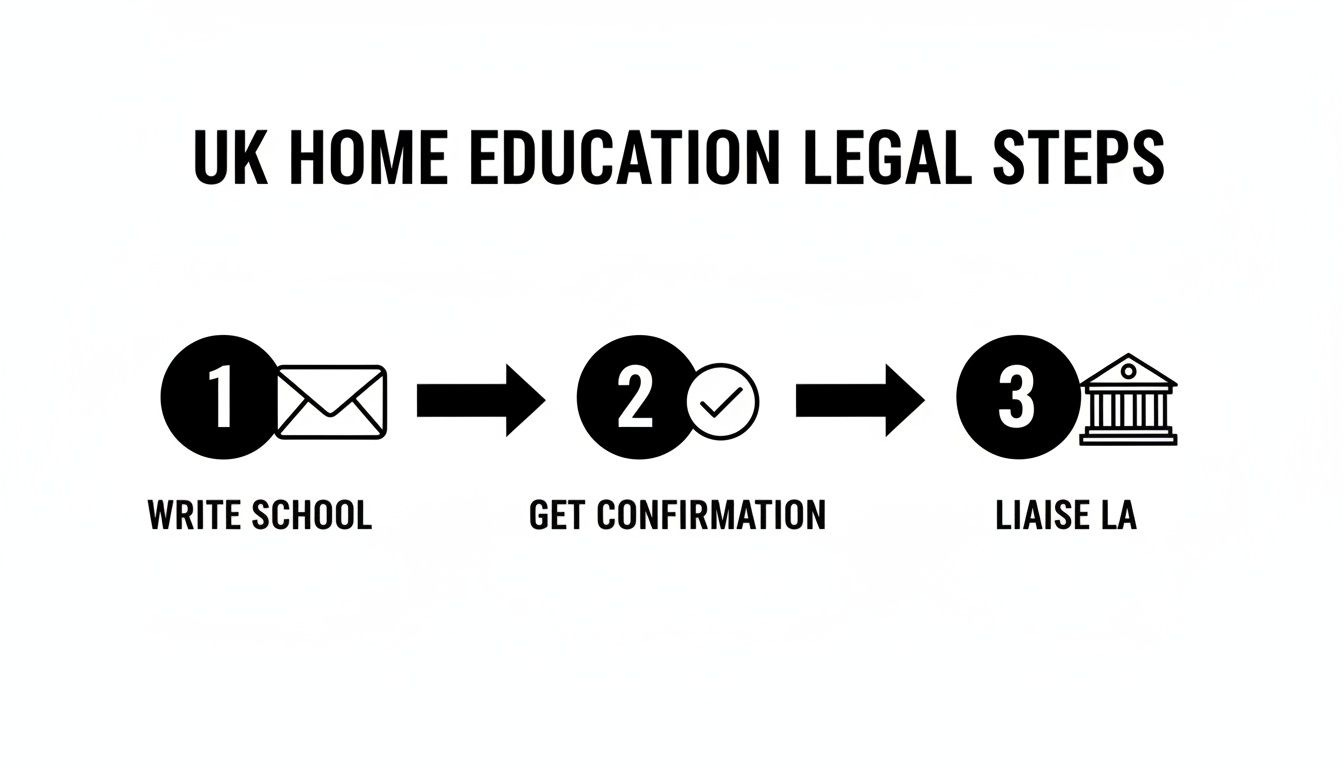
As this shows, the process is straightforward: you officially notify the school, then engage with your Local Authority. It’s all about empowering you to take control of your child's education with confidence.
Securing Qualifications and University Pathways
For many families exploring home education online in the UK, the biggest question mark is qualifications. It’s a completely understandable worry. How will my child sit their GCSEs and A-Levels? Will universities take their application seriously? It can feel like you’re stepping off the well-trodden path and into the unknown, and that can be scary.
The good news is that this path is now clearer and more established than ever. A high-quality online education doesn't close doors; it opens them, often leading to fantastic university and career opportunities. The whole process is surprisingly straightforward when you have an accredited online school guiding you, one that knows the system inside and out.
From Online Classroom to Examination Hall
Getting formal qualifications like IGCSEs and A-Levels is a core part of what any reputable online school does. They teach the official British curriculum, making sure your child covers all the required ground with specialist teachers, just as they would in a physical school.
The key difference is how they sit the final exams. Students learning online are registered as private candidates.
This simply means they sit their official exams at a registered exam centre, which is often a local school or college that accepts private candidates. An experienced online school will have a dedicated exams officer whose entire job is to take this weight off your shoulders.
A good online school takes all the stress out of exam logistics. They typically have established relationships with exam centres across the UK and can handle the registration process for you, making sure every deadline is met and all the paperwork is filed correctly.
This support is a real game-changer. It turns a potentially confusing administrative headache into a simple, managed step. It frees you and your child to focus on what actually matters: their studies, their revision, and their confidence.
Building a Powerful University Application
When it’s time to apply to university through UCAS, online school students are on an equal footing with their peers from traditional schools. In many ways, they’re even better prepared, having developed incredible self-discipline and independent study skills along the way.
A good online school provides critical support to make their application shine.
Here’s what they provide:
- Predicted Grades: The teachers who’ve taught your child in live, interactive lessons know their academic ability inside out. They will provide accurate, credible predicted grades based on continuous assessment, mock exams, and class participation.
- Teacher References: The headteacher or a senior staff member will write a detailed, personalised reference. This is their chance to highlight your child's academic strengths, work ethic, and unique character, giving universities a rich picture of the wonderful person behind the grades.
- Personal Statements: The journey of online learning often gives students a unique story to tell. They can write powerfully about a subject they’ve pursued in great depth or the resilience they’ve built as an independent learner. For example, a student who overcame anxiety through home education can write a compelling story of personal growth. For extra guidance, check out this excellent UK guide to writing UCAS personal statements.
Imagine the pride and confidence a child feels when submitting a powerful UCAS application, especially if they once felt lost or anxious in a busy school. This is the culmination of a learning journey that truly respected their needs and gave them the space to flourish. We've put together more information on how to apply to UK universities from an online school background in our detailed guide.
Ultimately, universities are looking for bright, motivated, and resilient students. A successful online education is compelling proof of all three, creating a clear and respected pathway to a bright future.
How to Vet and Choose an Online School
Choosing an online school is a decision filled with both hope and a little bit of fear. You’re not just picking a service; you’re entrusting a provider with your child’s education and, just as importantly, their happiness. The key is to look past the glossy brochures and dig into the details that truly matter for your child.
This isn’t about finding a mythical "perfect" school, but the right partner for your family's journey in home education online in the UK. It’s about finding a place where you feel confident that your child will be supported, challenged, and, above all, happy.
Look for Official Stamps of Quality
First things first: check their accreditation. This is your assurance that the school isn't just a collection of online resources but a genuine, recognised educational institution that meets rigorous external standards.
Look for accreditation from established UK and international bodies. These names are a sign that you're in safe hands.
- Pearson Edexcel: One of the largest awarding bodies in the UK. Their approval means the school is qualified to deliver IGCSE and A-Level courses, and the qualifications will be recognised worldwide.
- Cambridge International: As part of the University of Cambridge, their endorsement is a global benchmark for educational excellence.
- Ofsted: While most online schools aren't required to have Ofsted inspections, those that volunteer for it show a serious commitment to transparency and quality. It’s a huge green flag.
Seeing these logos on a school’s website gives you a baseline of trust. It confirms the qualifications your child earns will be respected by universities and employers, taking one big worry off your plate.
Go Beyond the Marketing Materials
Once you’ve confirmed they’re properly accredited, it’s time to find out what a day in the life of a student really feels like. The best way to do this is to experience the school firsthand.
Request a trial lesson or attend a virtual open day. This is non-negotiable. It allows you and your child to see the teachers in action and get a feel for the classroom dynamic. Does the teacher engage all the students, including the quieter ones? Is the platform intuitive and easy to use? Most importantly, does your child come away from it feeling excited?
The goal is to find a school that feels like a community, not just a content delivery service. Your child deserves to feel seen and heard, even through a screen. True engagement comes from real human connection.
Don't be afraid to ask if you can speak to current parents. Hearing directly from families who have already walked this path provides invaluable, unfiltered insight. They’re the ones who can tell you how the school really handles communication, supports a child who is struggling, or celebrates their unique successes.
Prioritise Your Child’s Happiness and Well-being
Academic results are important, of course, but they are only one part of the picture. A child who feels isolated or unsupported will never reach their full potential, no matter how fantastic the teaching is. Pastoral care—the school's commitment to your child's emotional well-being—should be a top priority in your evaluation.
This focus on a supportive, child-first environment is a key reason many families find this path so successful. In fact, research shows that home-educated children in the UK often achieve 15% to 30% higher on standardised academic tests. Perhaps more telling is that 66.7% of them successfully progress to university, proving that a nurturing approach can lead to outstanding long-term outcomes. You can learn more about these positive findings from the full homeschooling statistics report.
To make sure you find a school that truly nurtures your child, ask these specific questions:
- How are social connections fostered? Look for schools with virtual clubs, online common rooms, school assemblies, and even opportunities for in-person meetups. A simple online art club could be the place your creative child finally finds their tribe.
- What is the class size? Smaller classes (typically under 15 students) allow for more individual attention and make it much easier for quieter children to feel safe enough to participate.
- What is the safeguarding policy? Ask for a copy of their policy. It should be robust, clear, and actively implemented to ensure every child is safe online.
- Who is the dedicated contact for pastoral issues? There should be a specific person, like a form tutor or head of year, who is responsible for your child’s overall well-being. You want to know exactly who to call when your child is having a tough day.
Ultimately, choosing the right online school is an act of advocacy for your child. By asking the right questions and prioritising their emotional needs alongside their academic ones, you can find a true educational partner that helps them thrive.
Your Online Home Education Questions Answered
Stepping into the world of online home education is a journey filled with hope, but it’s completely natural for practical questions to start bubbling up. This is the part where we tackle the most common queries we hear from parents just like you. Our aim is to give you clear, straightforward answers that build your confidence and turn uncertainty into clarity.
Think of this as a friendly chat over a coffee, a chance to get into the nitty-gritty details that help you picture what this path could genuinely look like for your child and your family.
How Much Does Online Home Education Cost in the UK?
This is always one of the first questions, and for good reason. The honest answer is: it really depends on the model you choose. The costs for home education online in the UK aren't one-size-fits-all, which is actually a good thing as it gives families a lot of flexibility.
- A full-time, accredited online school with a complete timetable of live, interactive lessons for GCSEs will typically range from £3,000 to £8,000 per academic year. That fee covers specialist teaching, proper pastoral care, and a structured learning platform.
- If you lean towards more self-paced distance learning programmes, the costs drop significantly, often falling between £500 and £2,000 annually. For this, you’re generally getting learning materials and some level of tutor support, often via email.
- Finally, private online tutors can be a fantastic supplement, especially for a tricky subject like A-Level Maths. Costs here usually range from £25 to over £60 per hour, depending on their experience and the subject.
When you're budgeting, don't forget to factor in the extras. These will include exam fees (which are around £150-£250 per GCSE), textbooks or digital resources, and any tech upgrades you might need. For many families, these combined costs are often comparable to, or even less than, independent school fees.
But this is more than just an academic expense. It’s an investment in a learning environment that’s genuinely right for your child’s needs—and for many families, seeing their child happy and engaged again is priceless.
How Will My Child Socialise While Learning Online?
This is such a heartfelt and important concern for nearly every parent considering this path. The fear of isolation is completely understandable, but modern online schools are specifically designed to build a real sense of community and belonging.
Socialisation isn't just about being in a crowded building; it's about forming meaningful connections. A good online school creates multiple avenues for this to happen naturally.
- Interactive Classes: Imagine your child in a small group, debating a topic in a history lesson via a breakout room, or collaborating on a science project. Live lessons aren't passive lectures; they are spaces for real interaction and teamwork.
- Virtual Common Rooms and Clubs: Many schools have dedicated online spaces where students can just hang out between classes. They also run a huge variety of clubs—from chess and coding to creative writing and Dungeons & Dragons—letting children connect over shared passions and find their people.
- School-Wide Events: Things like virtual assemblies, guest speaker events, and themed weeks help create a cohesive school identity. It helps everyone feel like they’re part of something bigger.
Crucially, online learning often gives children more time and energy for real-world socialising. Without the long school day and commute, they have the freedom to join local sports teams, drama groups, or volunteer organisations. This allows them to build deep friendships based on genuine, shared interests, which can be incredibly powerful for their self-esteem.
What Does a Typical Day in an Online School Look Like?
Children thrive on routine, and a well-structured online school provides a predictable yet flexible daily rhythm. It combines the comfort of a timetable with the freedom to fit education around your family's actual life.
A typical day might kick off at 9 AM with a live online assembly or a form time check-in. This is followed by a couple of live lessons, usually lasting 45-60 minutes each, with proper breaks in between so your child can get up, stretch, and step away from the screen.
The afternoon could involve a few more classes, followed by time set aside for independent study, homework, or joining an online club. But the real game-changer is that all live lessons are recorded.
This is a feature that completely changes the dynamic. If your child has a doctor's appointment, a sports competition, or is simply having an off day and needs a mental health break, they don’t fall behind. The anxiety of "missing something important" is gone. They can just watch the recorded lesson later that day or week, making sure they never miss out on crucial learning.
This blend of structure and flexibility empowers your child to take ownership of their learning while allowing your family to live a much more balanced life.
Is Online Education Suitable for a Child with SEN Needs?
For many children with Special Educational Needs (SEN), the online environment isn't just suitable—it can be absolutely life-changing. It offers a solution to many of the challenges that make a mainstream school building feel so overwhelming.
The traditional classroom can be a sensory minefield, filled with constant noise, movement, and complex social cues. An online school removes these triggers, providing a calm, quiet, and controlled learning space at home where a child can finally lower their guard and focus.
This environment offers some very specific, practical benefits.
Key Advantages for SEN Students:
- More Personalised Attention: Small class sizes mean teachers genuinely have more time to provide individual support and get to know each child's specific needs and strengths. They can see when a child is struggling and offer help discreetly.
- Dedicated SEN Support: Reputable online schools have a dedicated SEN Coordinator (SENCO) who works with families to create personalised support plans and ensures teachers are using the right strategies.
- Empowering Communication: For a child who finds speaking up in class terrifying, being able to type questions in a chat box or message a teacher privately can be incredibly liberating. It gives them a voice.
- Reduced Anxiety: By removing social pressures and the fear of being seen as "different" in a large peer group, online learning allows a child's confidence to quietly grow. They can focus their energy on learning rather than just surviving the day.
By putting a child's emotional and academic needs at the absolute centre, online education can unlock the potential of a student who was struggling, allowing them to finally feel understood, supported, and successful.
At Queens Online School, we believe that every child deserves an education that sees them, supports them, and inspires them to succeed. Our live, interactive classes, dedicated pastoral care, and fully accredited British curriculum are designed to help your child flourish.
Discover how we can build a personalised learning journey for your child by exploring our approach at https://queensonlineschool.com.