

Social, emotional, and mental health isn't just another clinical term; it's the very foundation of your child's ability to learn, connect with others, and ultimately, thrive. Think of it as the inner toolkit they use every day to build resilience, show empathy, and understand the most important person in their life: themselves. It's the feeling of belonging they get when a friend shares a secret, the pride they feel after solving a tough problem, and the courage it takes to say "I'm sorry" after an argument.
Understanding Your Child’s Inner World
Every parent holds deep hopes for their child's happiness and success. You are the chief architect of their emotional strength, and supporting their social, emotional, and mental health (SEMH) is the bedrock of that work. Viewing SEMH not as a problem to be fixed but as a garden to be nurtured can change everything. It’s about helping your child make sense of their own inner world—that complex mix of thoughts, feelings, and social instincts that makes them who they are.
This journey starts when we realise that a child's behaviour is really a form of communication. When a young child throws their toys, it’s rarely just defiance; it’s often an explosion of frustration they don’t yet have the words for. They might be feeling overwhelmed because the blocks won't stack, or sad because playtime is over. When a teenager retreats to their room, it might not be rejection, but a cry for space to process the overwhelming sting of a critical comment from a friend. Putting their needs first means looking past the surface to understand the emotion driving the action.
The Landscape of Modern Wellbeing
Navigating wellbeing can feel more complex today than it ever has. Recent figures paint a stark picture of the UK's mental health, with nearly two-thirds of people (65%) reporting they have experienced a mental health problem. This number climbs to 7 in every 10 young adults, highlighting that our children are growing up in a world where these challenges are incredibly common. Only a small fraction, just 13%, are living with high levels of positive mental health. You can learn more about these national wellbeing trends and see how we compare.
These statistics aren't meant to cause alarm, but to empower. They confirm that if your child is struggling, they are not alone—and neither are you. It’s the feeling in the pit of your stomach when you see your child is hurting, and the quiet reassurance that comes from knowing other families are navigating this too. Understanding this reality is the first step toward proactive, compassionate support.
A child’s inner world is like a developing ecosystem. It needs the right conditions to flourish—safety to express feelings, encouragement to build connections, and the space to grow strong roots of self-worth.
Building Blocks of Social Growth
To truly get to grips with your child’s inner world, it helps to recognise the different stages of social growth. For toddlers, this might look like parallel play, where they play alongside another child rather than directly with them. Imagine two toddlers in a sandpit, each absorbed in their own world of digging and pouring, yet aware and comforted by the other's presence. This isn't anti-social behaviour; it’s a crucial developmental step where they learn by observing and get comfortable in the presence of others before they’re ready for direct interaction.
By appreciating these natural stages and creating a supportive environment, you help them build their 'wellbeing toolkit' one piece at a time. Modern learning environments, including forward-thinking online schools, are increasingly designed to honour this vital aspect of a child’s development, making it a core part of their educational experience.
The Three Pillars of Your Child's Wellbeing
To really support your child's inner world, it helps to see their wellbeing not as one big, vague concept, but as a structure held up by three distinct yet deeply connected pillars. Getting to grips with the unique roles of social, mental, and emotional health gives you a much clearer map for helping them navigate life.
Let's move past the dry, textbook definitions and look at what these pillars actually mean in your child's day-to-day life.
Think of it this way: if your child is building the 'house' of who they are, these three pillars are the foundation. They're what keeps everything standing strong, especially when the inevitable storms of disappointment or friendship troubles roll in.
To break it down even further, here’s a simple table showing how each pillar looks in practice.
Understanding the Three Pillars of SEMH
| Pillar | What It Looks Like (In Simple Terms) | A Real-Life Example |
|---|---|---|
| Social Health | How they get along with others and build connections. | A child comforting a friend who fell on the playground, putting an arm around them and asking if they're okay. |
| Emotional Health | How they understand and handle their own big feelings. | A child saying, "I feel sad because my tower fell," instead of throwing the blocks across the room in a burst of frustration. |
| Mental Health | Their inner strength, self-belief, and resilience. | A child who struggles with a new piece of music on the piano but practises every day, believing they can master it. |
Each pillar needs attention and care, but as you can see, they all work together to support your child's overall sense of self and their ability to thrive.
Social Health: Learning to Dance with Others
Social health is all about your child’s ability to build and maintain relationships. It’s the art of learning to ‘dance’ with others—knowing when to lead, when to follow, and how to move together without stepping on too many toes. It’s about feeling the warmth of connection, the comfort of communication, and the joy of feeling part of a community.
For a young child, this might look like the simple but profound act of sharing a favourite toy or taking turns on the slide, even when it feels hard to wait. It’s them learning that waiting for a friend to finish their drawing before showing them theirs makes that friend feel seen and respected. As they grow, this pillar supports their ability to navigate a group project at school, offer a shoulder to a heartbroken friend, and feel a genuine sense of belonging.
A child with strong social health can:
- Empathise with others, trying to imagine how a friend feels after falling over in the playground and scraping their knee.
- Communicate their needs clearly, saying "Can I have a turn now, please?" instead of just snatching a toy out of frustration.
- Cooperate towards a common goal, like building an epic cushion fortress with a sibling, sharing ideas and celebrating their creation together.
This infographic shows how skills like empathy, resilience, and self-awareness form a ‘Wellbeing Toolkit’ at the very heart of your child's development.
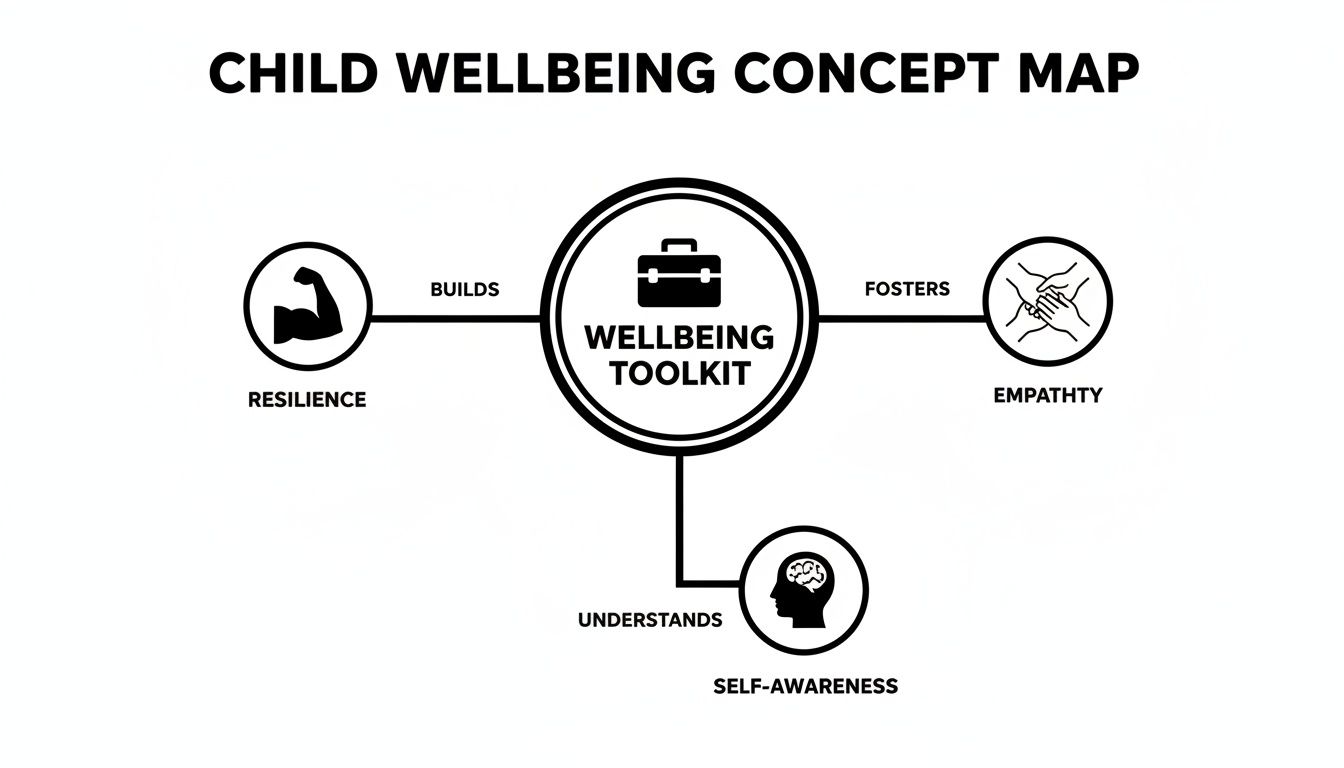
As the visual suggests, these core skills aren't isolated; they weave together to provide a strong foundation for your child's overall wellbeing.
Emotional Health: Understanding Their Inner Weather
Emotional health is your child's ability to understand and manage their own feelings. Imagine their emotions as an 'inner weather system'—sometimes it’s sunny and calm, other times it’s stormy and turbulent. Healthy emotional development isn’t about trying to prevent the storms. It's about giving them a sturdy umbrella and a good raincoat so they learn how to navigate the downpour without getting swept away.
This pillar is about recognising that swell of frustration after losing a board game and learning to take a deep breath instead of flipping the board. It’s about feeling the warmth of joy after a hug from you and knowing that this feeling is something to be treasured. It is the journey of naming feelings, understanding what triggers them, and finding healthy ways to express them. You can learn more about Social Emotional Learning in our detailed guide.
A child who can say, "I'm feeling really angry right now because my tower fell down," has developed a powerful emotional skill. They have managed to separate themselves from the feeling, observing it rather than being completely consumed by it.
Mental Health: The Scaffolding That Holds It All Together
If social health is about connecting outwards and emotional health is about understanding inwards, then mental health is the core scaffolding that supports it all. It’s your child’s cognitive and psychological resilience—their internal strength and their perspective on themselves and the world.
This pillar is what gives them the self-esteem to believe they are worthy of friendship and love. It’s the resilience that allows them to try again after messing up a spelling test, seeing it as a chance to learn rather than a final verdict on their intelligence. For a child, this looks like the quiet inner voice that says, "That was hard, but I can try again tomorrow," instead of, "I'm just bad at this."
Good mental health is also the focus needed to tackle a tricky maths problem and the coping skills to manage life's inevitable setbacks. It shapes their outlook, their self-belief, and their ability to function from one day to the next.
Recognising Signs of Struggle at Different Ages
It can be a gut-wrenching experience to think your child might be hurting, especially when they don’t yet have the words to tell you what’s wrong. Learning to spot the signs of struggle isn't about looking for problems; it’s about learning your child’s unique emotional language. Their behaviour is a powerful form of communication, and these signs are signals—invitations for you to look a little closer with compassion and curiosity.
This isn’t about playing armchair psychologist. A single bad day is just a bad day. What we’re looking for are patterns—a shift in their personality that lasts for weeks and just doesn't feel right. It's that nagging feeling in your heart that your bright, bubbly child seems to have a cloud over them that won't lift. The goal is to move from reacting to a crisis to proactively offering support before the storm fully hits.
Primary School Years (Ages 5-11)
In younger children, distress often bubbles up in physical or behavioural ways. Their vocabulary for complex emotions is still developing, so their bodies sometimes express the stress their minds can't yet put into words.
Think of these signs as puzzle pieces, not definitive proof of a problem.
- Physical Complaints: Are you hearing about frequent tummy aches, headaches, or a general feeling of being unwell, especially on school mornings? If a doctor can't find a cause, it could be your child's anxiety about a test or a playground disagreement showing up as a physical symptom.
- Big Emotional Outbursts: We all expect tantrums, but are they unusually intense or happening over seemingly tiny frustrations, like their toast being cut the wrong way? This could signal that their emotional 'cup' is already full to the brim from other worries.
- Social Withdrawal: A sudden loss of interest in playing with friends, avoiding birthday parties, or preferring to be alone when they were previously quite social is a significant change. It's the child who used to run to the park but now just wants to sit in their room.
- Changes at School: Has there been a sudden drop in concentration? Are they struggling with schoolwork they used to handle? Or are you getting feedback from teachers about them being disruptive or unusually quiet?
A child who suddenly stops wanting to go to their best friend’s house or begins complaining of a stomach ache every Sunday night is communicating something important. These changes are often the clearest indicators of their internal social, mental, and emotional health.
It’s crucial to see these behaviours not as acts of defiance to be disciplined, but as cries for help to be understood. Your child isn’t giving you a hard time; they are having a hard time.
The Teenage Years (Ages 12-18)
As children step into the teenage years, the signs of struggle can become more subtle and are often dismissed as 'typical teenage moodiness'. But a persistent change in their core personality and habits is something that warrants gentle attention.
The teenage brain is a construction site of massive changes, making this a period of heightened emotional vulnerability. Peer relationships and figuring out who they are take centre stage, bringing a whole new set of pressures. That comment on their social media post can feel earth-shattering; that friendship drama can feel like the end of the world.
Common Indicators in Teenagers:
- Withdrawal from Family: Spending more time alone in their room is standard, but actively avoiding all family interaction, meals, and conversations is a red flag. It's the difference between needing space and building a fortress.
- Shifts in Sleep or Eating: Look for drastic changes. Persistent insomnia, sleeping all day, or a significant loss or gain in appetite can signal underlying distress.
- Loss of Interest: A passionate football player who suddenly quits the team or an avid artist who lets their sketchbook gather dust might be struggling. When the joy drains out of the things that once lit them up, it’s time to pay attention.
- Increased Irritability or Anger: While some moodiness is normal, constant and explosive anger that feels out of character can be a sign of depression or anxiety bubbling beneath the surface.
These warning signs are particularly important in the context of what's happening more widely. Research shows a worrying increase in psychological distress among young people in Great Britain. Recent data reveals that 26% of young adults aged 16-29 experience moderate to severe depressive symptoms, compared to just 8% of those over 70.
Friendship dynamics, especially bullying, can also have a massive impact on a teenager's wellbeing. You can check out our guide on the signs of bullying to learn more about what to look for. By staying attuned to these shifts, you can open the door for conversation and support right when they need you most.
How to Build Emotional Resilience at Home
Your home is so much more than just four walls and a roof; it’s the emotional incubator where your child’s sense of self and resilience first take root. Building a strong foundation for their social, mental, and emotional health doesn’t happen through grand gestures. It’s forged in the small, everyday moments—the gentle conversations after a tough day, the consistent routines that make them feel safe, and the unwavering feeling that home is their safest harbour.
Think of this as your practical guide to creating an environment where your child can truly flourish emotionally. The goal isn't to shield them from ever feeling sad, angry, or anxious. It's about giving them the tools to navigate those feelings with strength and confidence, knowing you are right there with them, holding the umbrella in the rain.
Create an Emotionally Safe Space
The first and most critical step is to create an 'emotionally safe' space. This is an atmosphere where every feeling is acknowledged as valid, even if the behaviour attached to it needs a little redirection. It’s the difference between a home where feelings are a problem to be solved and one where they are simply an experience to be shared.
When your child comes to you with big emotions—crying after a falling out with a friend or fuming about a lost game—your response shapes their entire emotional world. Dismissing them with phrases like, "Don't be silly," or "You're overreacting," sends a clear message: your feelings are wrong. This can make a child feel ashamed and alone.
Instead, a little validation goes a long way. This is how you build trust and show them their inner world matters.
Simple Scripts for Tough Conversations:
- Instead of: "Stop crying, it’s not a big deal."
- Try: "I can see how much that hurt you. It's okay to be sad. I’m right here with you."
- Instead of: "You need to calm down."
- Try: "It looks like you're feeling really angry. Your body looks so tight. Let's take a deep breath together."
This simple shift from dismissal to validation teaches your child that their emotions aren't something to be ashamed of, but signals to be understood.
An emotionally safe home isn't one without conflict or negative feelings. It's a home where those feelings can be expressed without fear of judgment or rejection, laying the groundwork for true emotional resilience.
Build Routines of Connection and Coping
Resilience is built through consistent practice, and routines provide the perfect framework for this. Weaving small, intentional habits of connection into your family life can have a profound impact, making emotional sharing a normal part of your day-to-day rhythm.
A weekly family 'check-in', for instance, can be a powerful tool. It doesn’t need to be formal; it could just be over Sunday dinner. Everyone shares a 'high' (something good that happened that made them feel proud or happy) and a 'low' (something that was challenging or made them feel sad). This simple practice normalises talking about struggles and triumphs in equal measure. In developing a supportive home, understanding how to build emotional resilience and thrive is paramount.
Another powerful strategy is to model your own healthy coping skills. Children learn far more from what we do than from what we say.
- Model vulnerability: Say things like, "I'm feeling a bit stressed today, so I’m going to go for a short walk to clear my head." This shows them a practical way to manage stress.
- Share your process: Let them see you taking deep breaths before a tricky phone call or practising mindfulness for a few minutes.
- Apologise when you're wrong: Saying "I'm sorry I raised my voice earlier; I was feeling frustrated and I shouldn't have taken it out on you" teaches accountability and emotional regulation.
By showing them how you handle your own emotional weather, you give them a real-life roadmap to follow when their own storms roll in. This practical, lived experience is the most effective teacher they will ever have.
How Online Schools Champion Student Wellbeing
For many families, the word "school" conjures images of bustling corridors, noisy classrooms, and the constant social pressure that comes with it. But what if a school could be a sanctuary? A place intentionally designed to protect and nurture your child’s social, mental, and emotional health? This is the promise of a well-structured online school, which can become one of the most powerful partners in fostering your child’s wellbeing.
An online environment like Queen’s Online School isn't just about moving lessons onto a screen. It’s about completely reimagining the learning space to put a child's emotional needs at the very centre. For a student who feels lost in a sea of thirty classmates or finds the sensory overload of a busy building anxiety-inducing, this alternative can bring profound relief and a chance to finally breathe.

Creating Emotional Safety by Design
One of the core benefits of the online school model is the ability to create genuine emotional safety. Bullying remains one of the biggest obstacles to a child’s wellbeing, and its effects can shatter self-esteem. With a zero-tolerance anti-bullying policy, rigorously enforced in a moderated digital space, every single interaction is held to a high standard of respect.
This creates a haven where a child who has been hurt before can finally engage without the constant fear of social judgment or unkindness. It’s an environment where they can be their authentic selves, ask questions without worrying about being mocked, and focus all their energy on what matters: learning and connecting.
The goal is to build a community where kindness is the default setting. When a child feels safe, their mind is free to be curious, creative, and courageous.
Personalised Learning and Renewed Confidence
For a child whose confidence has been knocked by a rigid, one-size-fits-all curriculum, personalised learning paths can be a game-changer. Imagine a student who excels in creative writing but finds algebra completely baffling. In a traditional setting, their struggles in maths might overshadow their literary talent, leaving them feeling like a failure across the board.
Online schools, however, can tailor the pace and approach to suit the individual. A teacher in a small, live class can offer immediate, targeted support in algebra while also providing advanced resources to stretch their writing skills. This isn't just about academics; it's about rebuilding self-worth from the ground up. When a child sees they can succeed on their own terms, it rewires their belief in their own abilities.
- Example: A student who was once too anxious to put their hand up in a large classroom can now send a private message to their teacher during a live lesson. This small, brave act of reaching out is a huge step in rebuilding their confidence and academic independence.
This supportive structure is more important than ever. The mental health crisis among young people in the UK is growing, with rates of common mental health conditions for those aged 16-24 rising from 18.9% in 2014 to 25.8% in 2023/24. Educational settings must be part of the solution by providing proactive, not just reactive, support.
Actively Cultivating the Wellbeing Toolkit
A truly great online school doesn't just protect wellbeing; it actively cultivates it. Live, interactive classes and dedicated wellbeing programmes are specifically designed to fill that 'wellbeing toolkit' we talked about earlier. Smaller class sizes naturally encourage participation, helping shy students find their voice and build social skills in a low-pressure setting.
Teachers have the bandwidth to truly know each child, noticing subtle shifts in their mood or engagement and offering personalised attention. This is a world away from an environment where a quiet, struggling child might go completely unnoticed. To see how these principles come to life, you can explore more about learning in virtual environments. By making wellbeing a clear priority, online schools act as a proactive ally in your child’s emotional and mental development.
Answering Your Most Common Questions
As a parent, trying to understand your child's inner world can sometimes feel like navigating a dense fog. It's completely normal to have questions, worries, and moments of uncertainty. This section is here to offer clear, compassionate answers to some of the most common concerns we hear from parents, aiming to give you both reassurance and a practical way forward.
Your love and intuition are your most powerful guides on this journey. Feeling unsure is part of it. Let’s walk through some of these big questions together, keeping your child's experience right at the heart of every answer.
My Child Won't Talk About Their Feelings. How Can I Get Them to Open Up?
It’s a uniquely painful experience when your child shuts down, especially when you can see they’re hurting. Our first instinct is often to press with direct questions like "What's wrong?", but this can make a child retreat even further. The real key is to create gentle, low-pressure invitations for them to share when they feel ready.
One of the best ways to do this is through 'shoulder-to-shoulder' time. This is any activity where you aren't making direct, intense eye contact. Think about a drive in the car with music playing, preparing a meal side-by-side, or walking the dog. It’s in these quiet, shared moments, when the focus is on the activity, that thoughts and feelings often begin to bubble up to the surface without any prompting.
You can also lead by example. Sharing a simple, age-appropriate feeling from your own day can quietly open the door for them.
Saying something like, "I felt really frustrated at work today when my computer crashed, it made me want to sigh really loudly," shows them that it's normal and safe to talk about difficult emotions. It normalises the conversation without putting any pressure on them to reciprocate right away.
And when they finally do share, the most powerful thing you can do is just listen. Fight the urge to jump in with solutions. Acknowledging their feelings with a simple, "That sounds incredibly hard," validates their experience and builds the deep trust they need to open up again next time.
Is My Child's Behaviour a Normal Phase or a Deeper SEMH Issue?
This is perhaps the most common—and most anxiety-inducing—question for parents. Telling the difference between a typical developmental wobble and a sign of a deeper struggle can feel impossible. The distinction often comes down to three things: persistence, pervasiveness, and impact.
A 'phase' is usually temporary and often linked to a specific situation, like being moody for a few days after falling out with a friend. A more significant issue, however, tends to be persistent, lasting for several weeks or even months without showing signs of improving.
- Pervasiveness: Is the behaviour showing up everywhere? A child who is quiet at a new school but their usual chatty self at home is probably just adjusting. But a child who has withdrawn from friends, family, and school is showing a pervasive pattern that needs closer attention.
- Impact: Is the behaviour getting in the way of their daily life? This is a crucial distinction. A bad mood is normal. A bad mood that stops them from eating, sleeping, or engaging with their schoolwork for weeks on end is having a serious impact on their ability to function and feel happy.
Ultimately, trust your gut. You know your child better than anyone. If you have that nagging feeling that something is fundamentally 'off,' that intuition is worth listening to and gently exploring further.
What's the First Step if I Think My Child Needs Professional Help?
Taking that first step is a courageous act of love for your child. It can feel daunting, but remember, you’re not looking for a diagnosis—you’re building a team to support your child, and you are the most important member of that team.
A great place to start is with your family GP. They are trained to assess the situation without judgement and can be your gateway to more specialised support, like a referral to the Child and Adolescent Mental Health Services (CAMHS) if it's needed. They can also help rule out any physical reasons for the changes you’ve noticed and guide you on the best path forward.
At the same time, open up a conversation with your child's school. Schools are a vital part of your child's support network.
Schools like Queen's Online School have designated staff and wellbeing programmes specifically designed to support students' social, mental, and emotional health. They can work with you and healthcare professionals to create a joined-up plan that supports your child both in and out of the classroom.
The goal is not to carry this burden alone but to assemble a circle of care. By connecting with both health and education professionals, you ensure your child is being supported from every possible angle.
Can an Online School Truly Support My Child's Social Health?
It’s a fair question. We’ve been conditioned to associate socialising with noisy playgrounds and crowded classrooms. For many children, however, a high-quality online school can support their social health far more effectively than a traditional environment.
For a child who finds the unstructured chaos of a large school overwhelming, the moderated and purposeful social interactions in an online setting can be a lifeline. Live, interactive classes in small groups mean every student has a voice and is actively encouraged to contribute to discussions and collaborative projects. It's a space where a child who is often talked over can finally be heard, building communication skills in a safe, structured way.
Beyond the classroom, social connections are built around genuine, shared passions. Virtual clubs for everything from chess and creative writing to coding and art allow children to form deep, meaningful friendships based on common interests, not just who they happen to sit next to. This moderated environment allows them to build real social confidence without the background anxiety that might plague them in person, helping them to truly connect and thrive.
At Queen’s Online School, we believe that a world-class education must have wellbeing at its core. Our live, interactive classes, dedicated wellbeing support, and safe global community are designed to help your child flourish academically, socially, and emotionally. Discover how we champion student wellbeing.