

Deciding to homeschool can feel like stepping into a great, exciting unknown—a mix of deep hope for your child's future and, let's be honest, a touch of anxiety. You're imagining a future where they can truly thrive, and that's a powerful, emotional reason to begin. Using the UK curriculum for homeschooling isn't about recreating a stuffy classroom at your kitchen table. It's about having a flexible map to guide a learning adventure that truly honours your child and their unique way of seeing the world.
This guide is here to be your companion, holding a lantern on that journey.
Starting Your Homeschooling Journey with Confidence
Stepping away from the traditional school system is a huge, heart-led decision, and you are far from alone in making it. A growing wave of families are choosing to build a more personalised and supportive learning environment, one that nurtures their child's individual spirit and intellectual curiosity, protecting their mental well-being along the way.
This isn't just a small trend. In the UK, homeschooling has seen explosive growth as parents seek out an education that aligns with their values and, most importantly, their child’s needs. By summer 2023, an estimated 97,000 children in England were being home-educated. That’s a surge of more than 60% since the 2018–19 school year, driven by everything from concerns over classroom safety and inadequate SEND support to a simple, powerful desire for more tailored learning. You can explore more on why so many families are making the switch to home education.
Why a Curriculum Can Be a Comfort, Not a Cage
The very idea of a "curriculum" can sound restrictive, almost like you're trapping your child in rules you wanted to escape. It’s helpful to reframe it. Think of the UK National Curriculum not as a rigid rulebook, but as a well-stocked pantry. It provides all the essential ingredients for a brilliant education, but you—as the head chef—get to decide how to combine them to create a feast that actually excites and nourishes your child. You see what makes their eyes light up, and you get to serve more of that.
This guide is designed to hand you that creative control. We'll walk you through how to:
- Understand your freedoms: Get to grips with the legal basics without the jargon, so you feel secure and empowered in your choices for your child.
- Navigate the key stages: Break down the educational journey from the playful discoveries of Primary to the focused studies of GCSEs and A-Levels, always keeping your child's pace in mind.
- Adapt to your child's needs: Discover powerful ways to support children with SEN or those who just need a gentler, more flexible pace to feel safe and ready to learn.
- Plan with purpose: Create a rhythm for your days that balances learning with life, curiosity, and genuine joy.
The goal isn't to replicate school at home. It's to build something better for your child—an education rooted in connection, respect, and a deep understanding of who they are and how they learn best.
This path is about so much more than just academics; it’s about nurturing your child’s confidence, resilience, and love for learning. You already have what it takes to guide them, and we'll be here to support you every step of the way.
Understanding Your Legal Freedoms and Responsibilities
Let’s be honest: the idea of legal requirements can sound a bit daunting, bringing up feelings of being judged or getting it "wrong." But when it comes to home education in the UK, the law is actually built on a foundation of freedom, designed to empower you, not intimidate you. Think of it less as jumping through bureaucratic hoops and more as confidently taking the reins of your child's education to protect their well-being.
It all boils down to one core principle from the Education Act 1996: you have a legal duty to provide your child with a ‘suitable’ and ‘full-time’ education. Now, those words might seem vague, and that’s entirely on purpose. They give you the incredible freedom to design an education that genuinely fits your child, rather than forcing you to replicate a rigid, school-like structure at the kitchen table that may have caused them distress.
This flexibility is the heart and soul of the uk curriculum for homeschooling. It means ‘full-time’ doesn't have to mean a 9-to-3 schedule five days a week, and ‘suitable’ is measured by your child’s genuine progress, happiness, and well-being—not by how closely you can mimic a classroom.
What Does ‘Suitable Education’ Actually Mean?
So, what is a ‘suitable’ education? It’s one that prepares your child for life in their community and allows them to reach their potential. It’s an education that takes into account their age, their ability, and any special educational needs (SEN) they might have. It’s education that feels good to them.
Crucially, there is no legal requirement to follow the National Curriculum word-for-word. You are free to adapt it, blend it with other educational philosophies, or even build a completely unique learning path based on your child's passions and interests.
For example, if your child is completely captivated by ancient Rome, a 'suitable' education could look like building a model aqueduct in the garden (hello, science and engineering!), devouring historical fiction together on the sofa (English), and budgeting for a family trip to a local museum with Roman artefacts (maths in action). You’re not just ticking off subjects; you’re creating shared memories and connecting with your child over something they love.
This approach rightly puts your child—their needs, their curiosity, their spark—at the very centre of their learning journey.
Handling Official Communication with Confidence
If your child is currently in a state school, the first practical step is to formally de-register them. This is usually a simple letter to the headteacher informing them of your decision. You don't need the school's permission to start home educating. For a more detailed walkthrough, check out our complete guide on how to start homeschooling.
Once your child is de-registered, your Local Authority (LA) might make ‘informal enquiries’ to satisfy themselves that a suitable education is happening. This is not a formal inspection or a test you have to pass. It’s an opportunity to share the wonderful, child-centred education you're providing. You can respond in a way that feels comfortable for you—perhaps with a brief report on your educational approach, a collection of work samples, or even just a conversation.
To make things easier, we've put together a simple checklist to summarise the key steps.
UK Homeschooling Legal Checklist
| Action Item | Key Consideration | Where to Find Information |
|---|---|---|
| De-register from School | If your child attends a state school, send a formal letter to the headteacher. This is a notification, not a request for permission. | Your school’s website or a quick call to the school office. Template letters are widely available online. |
| Prepare for LA Contact | Your Local Authority may make 'informal enquiries'. Decide how you wish to respond (e.g., report, meeting, work samples). | Your Local Authority’s website (search for ‘Elective Home Education’ or EHE). |
| Keep Simple Records | Document your child's learning journey. This can be a diary, photos, a list of books, or a portfolio. This isn't for inspection but for your own records and peace of mind. | Homeschooling blogs, parent forums, and educational resource websites. |
| Understand 'Suitable Education' | Remember this is about your child's age, ability, and needs. It doesn’t have to look like school. | The Education Act 1996 is the primary source. Reputable home education charities provide excellent summaries. |
| Stay Informed on Changes | Be aware of potential changes, like the proposed national register for home-educated children. | Government education websites and established home education organisations. |
The main takeaway is to show that you are thoughtfully and actively engaged in your child’s education. Keeping simple records—a diary of activities, photos of projects, a list of books you've read together—isn't about creating stressful "evidence." It’s about celebrating your child’s progress and having something to share that captures the story of their learning.
The UK's homeschooling landscape has long been defined by this balance of freedom and responsibility. While LAs currently monitor through these informal check-ins, a national register is expected around 2025, which will likely require parents to formally notify their LA. This potential shift makes keeping good records of progress more important than ever. With government estimates from early 2025 placing over 135,000 children in home education, your family is part of a large, vibrant, and growing community. You can discover more about the evolving legal landscape for UK homeschoolers to stay up to date.
Navigating the UK Curriculum from Primary to A-Levels
Thinking about the entire UK national curriculum can feel like trying to scale a mountain. You look up at the different stages, subjects, and expectations, and it’s easy to feel overwhelmed. But what if we saw it less as a mountain to be conquered and more as a river guiding your child’s learning journey? A river with plenty of opportunities to explore interesting streams and tributaries along the way, following wherever their curiosity leads.
This journey is broken down into Key Stages, which are really just groups of school years designed to organise learning. But as a home educator, you have the freedom to move at your child’s pace. You can blend stages, dive deeper where their curiosity sparks, or gently move past things that aren't clicking. You’re not bound by the school bell or a rigid academic calendar; you are guided by your child.
The flowchart below shows the simple legal duty that sits at the foundation of this whole journey.
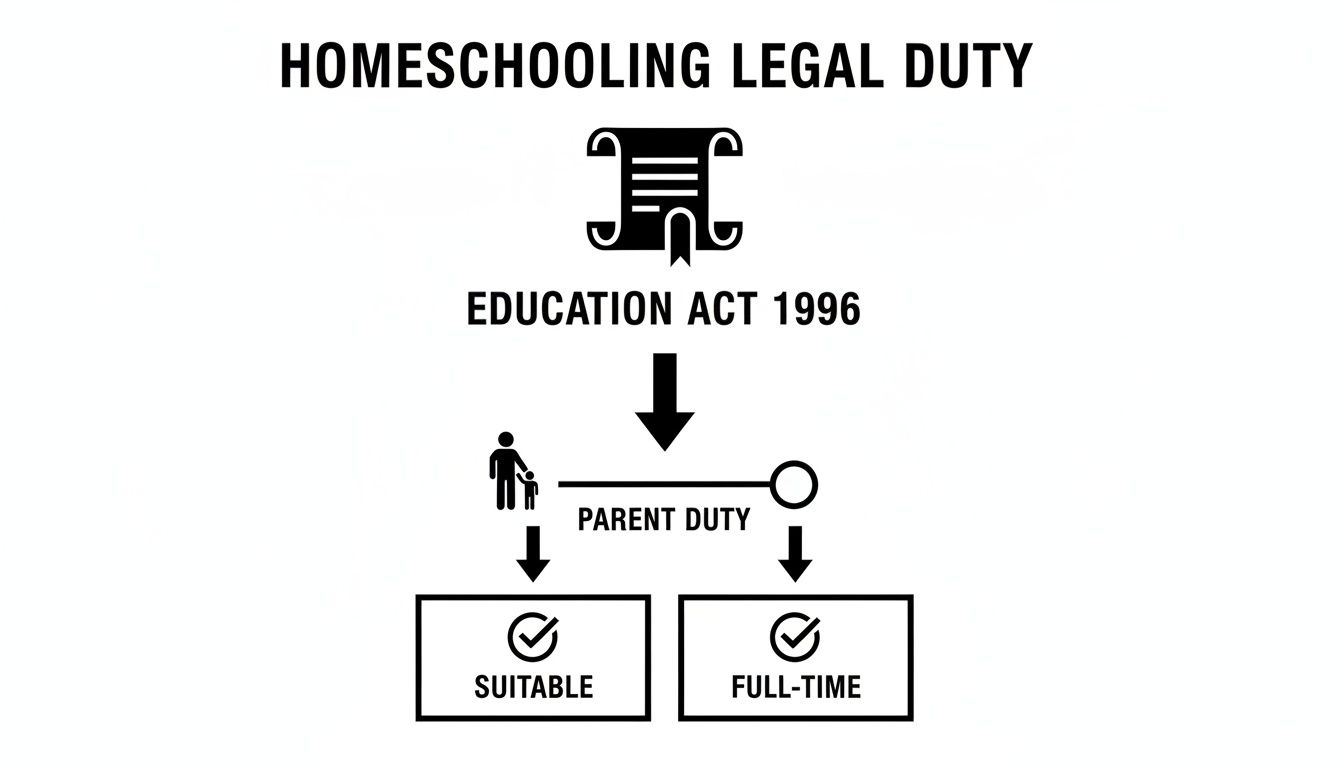
As you can see, the Education Act 1996 simply gives you, the parent, the responsibility to provide a suitable and full-time education. What that looks like is up to you.
The Wonder of the Primary Years (Key Stages 1 and 2)
Key Stage 1 (Years 1-2, ages 5-7) and Key Stage 2 (Years 3-6, ages 7-11) are all about laying the groundwork. This is a magical time of discovery, where the goal isn't just about memorising facts but about cultivating a genuine, deep-seated love for learning.
Instead of a checklist of subjects, think of it as building a toolkit of essential life skills, all through connection and play.
- Literacy: This isn't about endless phonics worksheets. It’s about the feeling of being snuggled on the sofa with a captivating story, the pride in writing a thank-you letter to a grandparent, or the shared laughter of creating a comic strip about the family dog.
- Numeracy: Forget rote sums. This is about the warmth of baking together and measuring ingredients (hello, fractions!), the empowerment of managing pocket money (real-world budgeting!), or the wonder of counting the ladybirds on a leaf in the garden.
- Science: This is the age of "why?". Science happens when you plant seeds and watch them grow together, mix vinegar and bicarb to make a fizzy volcano, and feel the mud squish under your boots on a walk to observe the changing seasons.
The real magic of homeschooling in these early years is tying learning directly to the world around you. A history lesson on the Normans isn't just a chapter in a textbook; it’s packing a picnic and exploring the ruins of a local castle, imagining the lives lived within those stone walls. That’s how abstract concepts become unforgettable, shared experiences.
Broadening Horizons in Early Secondary (Key Stage 3)
As your child moves into Key Stage 3 (Years 7-9, ages 11-14), their world starts to expand. They begin connecting ideas, thinking more critically, and figuring out who they are. The curriculum reflects this by introducing a broader range of subjects, from modern foreign languages to more detailed history and geography.
This is the perfect time to let your child's passions take the lead. If they’re obsessed with video game design, you can explore coding (computing), character development (English), and world-building (geography) through a project they genuinely care about. Imagine the confidence they'll build when their passion is treated as the valuable learning experience it is. The flexibility of the UK curriculum for homeschooling allows this deep, project-based learning to truly flourish.
Focusing on Qualifications (Key Stages 4 and 5)
Key Stage 4 (Years 10-11, ages 14-16) is when formal qualifications like GCSEs appear on the horizon. This can feel like a huge step, but it doesn’t mean your child's education has to become a rigid, exam-focused slog. You have the power to choose which subjects they take, allowing them to drop topics that cause them stress and focus on areas where they can truly shine and feel successful.
After that, Key Stage 5 (Years 12-13, ages 16-18) is the A-Level stage—a time for deep specialisation. Here, a student might focus on just three or four subjects they are passionate about, paving their way towards university or a future career.
Throughout this entire journey, from the playful discoveries of primary school to the focused expertise of A-Levels, the most important compass you have is your child. Their curiosity, their well-being, and their unique way of seeing the world should always be at the heart of the path you create together.
Making the Curriculum Work for Your Child
This is where the real magic of home education happens. The national curriculum gives you a fantastic framework, but your ability to bend and shape it to fit your child is your greatest superpower. For children who don’t quite fit the traditional school mould—whether due to Special Educational Needs (SEN), anxiety, or simply a different way of processing the world—this flexibility changes everything.
You finally get to stop trying to squeeze your child into a system that wasn’t built for them. Instead, you can build an education that fits them perfectly, like a bespoke suit. It’s about creating an environment where they feel seen, understood, and truly set up to succeed, not just get by. It's about seeing the relief on their face when they realise learning can be different.
And you're not alone in seeking this. Recent figures show that struggles with mental health and a lack of proper support are major reasons families are turning to home education. In the 2024/25 school year, a staggering 16% of the 175,900 home-educated children in England needed SEND support, with many parents pointing to school funding gaps as a key reason. This trend, part of a 60% rise in homeschooling since 2018/19, shows just how many families are actively looking for a better way when the mainstream system falls short. You can read more on how unmet needs are driving the rise in home education.
Moving Beyond the Textbook
Adapting the curriculum isn’t about throwing out core subjects; it’s about reimagining how they’re taught. It’s about putting your child’s needs first and wrapping the learning around them.
Think about a child who learns by doing—a kinesthetic learner. For them, a science textbook explaining plant biology might as well be written in another language. It's abstract, it's flat, and it just doesn't connect. It can make them feel like they're failing, when in reality, the teaching method is failing them.
A Practical Example: Hands-On Science
Instead of just reading a chapter on photosynthesis, you could bring it to life:
- Plant a small vegetable garden: Let them get their hands in the soil, watch seeds sprout, and measure the growth. Suddenly, biology becomes a real, tangible project they own. They can feel the success as the first shoots appear.
- Run simple experiments: Pop a celery stalk in some food colouring to see how plants “drink” water. It’s a simple trick, but it makes a scientific concept unforgettable and magical.
- Go on nature walks: Collect different leaves, identify trees, and connect what you’re learning to the world just outside your front door. This isn't a lesson; it's an adventure.
This approach doesn’t just teach the science. It builds confidence and validates their way of learning, sending the message: "The way you learn is brilliant."
Creating a Low-Demand, High-Support Environment
For children navigating anxiety, demand avoidance, or conditions like ADHD, the typical classroom can feel like a pressure cooker. The constant noise, social expectations, and sensory overload are completely overwhelming. Homeschooling allows you to design a sanctuary.
Your home can become a low-anxiety space where learning happens more naturally. This means you can match the day’s pace to your child's energy, take breaks whenever they’re needed, and weave therapeutic activities into your routine without anyone batting an eye. Imagine the gift of giving your child a space where they can finally relax and just be.
This might mean starting the day with something calming, like listening to an audiobook or doing some gentle stretches, instead of diving straight into formal lessons. It could mean breaking a maths lesson into three 15-minute bursts with a fun activity in between. To get a clearer picture of this approach, you can learn more about what SEN support looks like in practice.
Project-Based Learning for Deep Engagement
Some children, especially those with ADHD, learn best when they can deep-dive into a topic that grabs their imagination. This is where project-based learning becomes an incredible tool in your uk curriculum for homeschooling kit.
A Practical Example: Project-Based History
Let’s say your child is suddenly obsessed with ancient Egypt. Instead of just working through a textbook, you could build an entire multi-subject project around their passion:
- History & Art: Research and build a detailed model of a pyramid. Create their own cartouche with hieroglyphics.
- English: Write a short story from the perspective of a child living in ancient Egypt, or design a tourist brochure for the Valley of the Kings.
- Maths & Geography: Calculate the dimensions of the Great Pyramid. Map the Nile River and learn about why its annual flood was so important for farming.
This method transforms learning from a passive chore into an active, exciting quest. It honours your child’s interests and uses their natural curiosity as the engine for education, proving that real learning is built on connection, not just compliance. You're in the perfect position to build that for them, one step at a time.
Managing Exams and Assessments Without the School Gates
For many homeschooling families, the thought of GCSEs and A-Levels can feel like a looming storm cloud. After years of creating a nurturing, flexible learning environment, the idea of formal exams can bring a wave of anxiety. How do you translate your child’s rich, real-world learning into the formal qualifications they need for their future, without sacrificing their well-being?
The good news is that you don’t need school gates to access these qualifications. It’s a completely manageable process, and this section is your roadmap to navigate it with confidence. Let’s replace that feeling of uncertainty with a clear, practical plan that keeps your child’s emotional health at the very centre.
Becoming a Private Candidate
The key to this whole process is getting familiar with the term ‘private candidate’. This is simply the official name for a student who isn't enrolled in a traditional school but wants to sit for formal exams like GCSEs or A-Levels. As a parent, you'll step into an administrative role, guiding your child through the necessary steps.
It's an empowering position, but it does require some forward planning. You'll be responsible for choosing the exam boards, finding a registered exam centre that accepts private candidates, and handling all the registration paperwork and payments yourself.
Think of it like booking a special event. You need to find the right venue, check their availability well in advance, understand all the costs, and make sure you’ve confirmed everything long before the big day arrives. It’s about being organised to reduce stress for your child, not about being an exams expert.
This path gives you complete control, which is a huge advantage. You can select exam boards and specifications that align best with the UK curriculum for homeschooling approach you’ve taken, ensuring the final assessment is a fair reflection of your child’s hard work. You can explore how this works in detail with our guide to taking GCSEs as a home-educated student.
Finding Your Exam Centre and Choosing a Board
Finding a place for your child to physically sit their exams is often the biggest hurdle. Not all schools or colleges accept private candidates, so it’s vital to start your search early—ideally a full year before the exams are due to take place. This removes any last-minute panic.
Here’s a practical action plan to get you started:
- Step 1: Research Exam Boards: Major UK boards like AQA, Pearson Edexcel, and OCR have different syllabuses. Look at their websites with your child to find a specification that fits their learning style and interests.
- Step 2: Locate Potential Centres: The exam boards often provide lists of centres that accept private candidates. Your local authority may also be able to help.
- Step 3: Contact Centres Directly: Be prepared to make lots of calls and send emails. Ask about their fees, registration deadlines, and any specific requirements they have for private candidates, especially regarding access arrangements for SEN.
- Step 4: Book and Confirm: Once you find a centre, book your child’s place as soon as possible. Spaces are limited and fill up very quickly.
Platforms offering exam mode features can be a great help in getting your child ready for the real thing. They simulate test conditions to build confidence and familiarity with the format, which helps reduce exam-day anxiety and ensures they can perform at their best.
A Supported Path Through an Online School
While the independent route offers ultimate freedom, it can feel like a heavy administrative load, especially when you’re also trying to support your child academically and emotionally. This is where an accredited online school can make a world of difference, lifting that weight from your shoulders.
An established online school acts as your partner in this process, handling the logistics that can feel so overwhelming. Instead of you searching for a centre, they typically have their own approved exam centres or partnerships, taking the entire burden off your shoulders. This support allows you to focus purely on what matters most—being there for your child.
The table below gives a clearer picture of what each pathway involves.
Comparing Exam Pathways for Homeschooled Students
| Task | Independent Homeschooler | Student at an Accredited Online School |
|---|---|---|
| Finding an Exam Centre | Parent is responsible for researching, contacting, and booking a centre. Can be a stressful process. | The school provides access to its own accredited exam centres, handling all arrangements and removing the burden. |
| Choosing Exam Boards | Parent must research and select the appropriate board and syllabus. | The school’s curriculum is already aligned with specific exam boards, simplifying the choice. |
| Registration and Deadlines | Parent must manage all paperwork and ensure deadlines are met. | The school’s administrative team manages the entire registration process for the student. |
| Coursework Submission | Finding a centre to mark coursework can be extremely difficult. | Coursework is managed, marked, and submitted by the school’s own qualified teachers. |
Ultimately, choosing between these paths comes down to what feels right for your family. Whether you take the independent route or opt for a supported online programme, know that getting those qualifications is entirely achievable.
Creating a Homeschooling Plan That Feels Good
Right then, let's move from the theory to the practical. This is where you get to take all those ingredients—the curriculum guidelines, your child’s unique personality, and your family’s values—and cook up a homeschooling plan that actually works and feels good for everyone.
Forget trying to replicate a rigid, bell-driven school timetable. The whole point of homeschooling is to create a living, breathing rhythm that fits your family, one that has space for good days and bad days.
The goal here isn't to create a stressful, minute-by-minute schedule. It's to build a supportive structure that balances core learning with plenty of time for child-led rabbit holes, muddy outdoor adventures, and hanging out with friends. It’s about creating a flow that respects your child’s natural energy and curiosity, ensuring learning remains a joyful discovery, not a daily battle.
As you start shaping your approach, it can be really helpful to look at different educational frameworks. Exploring various philosophies of early childhood education can give you a solid foundation, helping you decide what truly matters to you and your child.
Designing a Fluid Weekly Rhythm
Instead of a strict schedule, think in terms of a weekly rhythm. This gives you just enough structure without sacrificing the freedom that makes homeschooling so powerful. Most importantly, it puts your child's emotional and physical needs right at the centre of the day.
Here’s a practical example of what that could look like:
- Morning Focus: Dedicate mornings to core skills like maths and English, when minds are often at their freshest. This could be 90 minutes of focused work, perhaps at the kitchen table with a cup of tea, broken up by snack breaks and a bit of movement.
- Afternoon Exploration: Afternoons are perfect for project work, science experiments, art, or history. This is the time for those deep dives into topics your child is genuinely excited about, whether that's coding a game or writing a play.
- Outdoor Time: Make nature a non-negotiable part of every single day. A walk in the woods isn't a "break" from learning; it is learning. It’s biology, PE, and a chance to reset emotionally, all rolled into one.
- Quiet Time: Build in a period for quiet reading, listening to an audiobook, or just some independent play. This gives everyone a chance to recharge their batteries and have some personal space.
Remember, this rhythm is a guide, not a rulebook. If your child is completely absorbed in building a magnificent Lego castle, you have the freedom to let that brilliant engineering project run its course. That’s the magic of it.
Meaningful Record-Keeping, Not Bureaucracy
Now, let's talk about tracking progress. This doesn’t have to mean creating piles of stressful paperwork. It’s about celebrating your child's journey in a way that feels authentic and meaningful to you both. You’re not creating evidence for an inspector; you’re capturing memories and milestones that show your child how far they've come.
The most powerful record-keeping tools are often the simplest. A beautiful learning journal filled with photos, drawings, and handwritten notes tells a far richer story of your child's growth than any formal report card ever could.
Here are a few simple ideas to get you started:
- A Simple Learning Journal: Grab a scrapbook. Stick in photos of projects, ticket stubs from museum visits, and jot down a few notes about what you did each week. It's a treasure chest of your time together.
- A Digital Portfolio: Use a simple app or even a private blog to upload photos and videos of your child’s work. This creates a wonderful digital memory book you can look back on for years to see their confidence grow.
- A "Done" List: Instead of a rigid "to-do" list that can feel overwhelming, keep a running list of all the amazing things you’ve accomplished together. It’s a fantastic confidence booster for both of you when you're having a tough day.
Ultimately, you have the power to design a homeschooling experience that is successful, joyful, and deeply supportive. Trust your intuition, follow your child’s lead, and build a plan that feels right for your family.
Common Questions About Homeschooling with the UK Curriculum
If you’re just starting to explore homeschooling, it’s completely normal to have a few questions and worries swirling around. Let's tackle some of the most common ones that parents ask us, so you can feel clear and confident on the path ahead.
What About Socialisation?
This is, without a doubt, the number one concern for parents considering home education. But here’s the thing: socialisation is about so much more than just being in a classroom with 30 other children of the exact same age. Real-world social skills come from interacting meaningfully with a wide variety of people, young and old.
Think of it less as classroom socialisation and more as community-based learning. Your child isn't limited to a single peer group. Instead, they can build genuine, chosen connections through:
- Local homeschooling groups and co-ops where they can find their tribe.
- Joining sports teams, music lessons, or drama clubs based on their passions.
- Volunteering for a cause they believe in, building empathy and purpose.
- Simply having more quality time with family, neighbours, and friends.
This approach often leads to deeper friendships and teaches children how to relate to a diverse mix of people—a skill that will serve them for life.
Is Homeschooling Expensive?
The cost of homeschooling is entirely up to you. It can be incredibly budget-friendly, or you can choose to invest in more structured programmes. The beauty of it is that you are in complete control of your budget.
You absolutely do not need to buy a pricey, all-in-one curriculum box to give your child a brilliant education. Your local library is a goldmine of free books and materials, and the internet is packed with high-quality, free educational resources.
The biggest investment you'll make is your own time and energy. For families who want more structure without the cost of private tutors, accredited online schools offer a fantastic middle ground, providing expert teaching and a full curriculum for a manageable fee.
Do I Have to Follow the National Curriculum to the Letter?
No, you don’t. This is a source of so much unnecessary worry. While the National Curriculum is an excellent framework and a useful guide, you have the freedom to tailor it to your child. Your legal duty is simply to provide a 'suitable' education—one that fits your child’s age, ability, and individual needs.
This flexibility is one of the greatest strengths of home education. It allows you to build a learning experience around your child’s passions, making their education far more personal, engaging, and ultimately, more effective. You can give your child an education that truly lets them be themselves.
At Queens Online School, we offer the trusted structure of the British curriculum but with the flexibility your child needs to truly flourish. We take care of the lesson planning, expert teaching, and exam arrangements, leaving you free to focus on what matters most: supporting your child’s love of learning. Discover our online school at https://queensonlineschool.com.