

Asynchronous learning is a wonderfully flexible way to learn, free from the constraints of a fixed timetable or location. It gives children access to materials like pre-recorded lessons, projects, and resources on demand, letting them learn at their own pace, whenever and wherever they feel most focused and ready.
Understanding Asynchronous Learning Through Your Child's Eyes
Imagine a child in a busy classroom. The teacher is explaining a new maths concept, but the pace is just a bit too fast. While others are already putting their hands up, your child is still stuck on the first step, a quiet panic setting in. They feel left behind, and the joy of learning starts to fade, replaced by the fear of being noticed for not understanding.
Now, picture that same child at home, watching a recorded lesson on their tablet. They can pause the video, rewind to hear an explanation again, and work through a problem without any pressure at all. Curiosity takes over. This is the heart of asynchronous learning—it’s an education that waits for your child.
Learning at Their Own Pace
Think about learning to ride a bike. Some children need stabilisers for weeks, building confidence with every wobbly attempt. Others are ready to pedal off on their own after a single afternoon. You wouldn't dream of taking the stabilisers away before your child felt secure, would you?
Asynchronous learning provides those educational 'stabilisers'. It gives your child the freedom to spend as much time as they need on a tricky topic or to fly through subjects they master with ease. It respects their individual journey, replacing classroom anxiety with a powerful sense of control and independence.
"Instead of forcing a child to keep up with a fixed schedule, asynchronous learning builds a schedule around the child. It honours their natural rhythm, energy levels, and moments of peak curiosity."
This approach isn't about learning in isolation; it's about learning with intention. The recent surge in online education has really brought its importance to the forefront. The COVID-19 pandemic saw a huge shift, with online learning use in Britain jumping from just 4% pre-2020 to 21% in recent years. This shows just how many families are now embracing this kind of flexibility. You can explore more about these online learning trends and statistics to see the full picture.
How It Works in Practice
So, what does this actually look like day-to-day for a child? Asynchronous learning is built on a library of accessible, high-quality materials that empower your child to take ownership of their education. Here’s a quick look at the core components.
Asynchronous Learning at a Glance
This table breaks down the key features of asynchronous learning, helping you see exactly how it supports your child's educational journey.
| Feature | What It Means for Your Child | Practical Example |
|---|---|---|
| Pre-Recorded Video Lessons | They can watch, pause, and re-watch lessons from their teachers whenever they need a refresher, ensuring they never miss a key concept. | Your child is struggling with long division. They can re-watch the teacher's 10-minute explanation five times, pausing at each step, until it finally clicks. |
| Project-Based Assignments | Instead of just worksheets, they can engage in creative projects that allow them to explore topics deeply and apply what they’ve learned. | Instead of a simple test on Ancient Rome, your child gets to build a model of the Colosseum or create a video diary as a Roman citizen. |
| Digital Resource Libraries | Access to articles, interactive tools, and educational games supports their curiosity and encourages them to research independently. | A lesson on volcanoes sparks an interest. Your child can immediately access a virtual tour of Mount Vesuvius and interactive geological maps. |
| Flexible Deadlines | Assignments often have submission windows rather than strict, single-day due dates, teaching time management and reducing stress. | An English essay is due by Friday. Your child, an early bird, can finish it on Tuesday, freeing up their mind for other subjects. |
Ultimately, this model fosters true understanding, not just memorisation. It helps your child build confidence, resilience, and a genuine love for learning because it’s happening on their terms.
How Asynchronous Learning Nurtures Your Child’s Potential
For many children, the traditional school environment feels like a race they were never prepared to run. The constant pressure to keep up, the fear of asking a “silly” question, the noise—it can all be overwhelming. Asynchronous learning changes the entire dynamic. It’s not about winning or losing; it’s about the personal journey of discovery, where every child can find their footing and move forward with genuine confidence.
This self-paced journey is where true potential is unlocked. Instead of focusing on just keeping up with the rest of the class, your child can concentrate on deeply understanding the material. This shift builds not just academic knowledge, but also vital life skills that will serve them long after they’ve left school.
Building Confidence and Essential Life Skills
Imagine a child who is hesitant to ask questions in a bustling classroom of thirty students. They worry about slowing the class down or being judged for not getting it the first time. In an asynchronous setting, that fear simply dissolves. They can pause a recorded lesson, rewind the teacher’s explanation, and reflect on a concept without any external pressure.
This simple act of control is incredibly empowering. It teaches them to identify what they don’t know and take the initiative to find the answer. For example, a teenager learning to code can spend an entire day debugging a single line of code, an experience that teaches them more about persistence and problem-solving than a dozen flawless worksheets ever could. Over time, this builds remarkable self-discipline and effective time management—skills that are fundamental to future success.
A self-paced, virtual learning strategy eliminates the need for formalised training in the classroom, saving time and money while allowing learners to engage when and where they need it most. This flexibility is key to nurturing independent, confident students.
For the advanced learner, the benefits are just as profound. Instead of feeling bored or held back by the class average, they have the freedom to soar. If they grasp a mathematical concept quickly, they can move on to more challenging problems or dive deeper into a subject they are passionate about. This keeps their intellectual curiosity alive and burning bright.
Creating a Safe Haven for Every Learner
Perhaps the most heartfelt benefit of asynchronous learning is the calm, supportive environment it creates for children with Special Educational Needs (SEN) or Social, Emotional, and Mental Health (SEMH) needs. The sensory overload of a typical school—crowded hallways, ringing bells, and constant social demands—can be exhausting.
An asynchronous approach offers a quiet refuge where learning can finally take centre stage.
- Reduced Sensory Input: A child with autism, for instance, can learn from home in a controlled environment, free from the unpredictable noises and bright lights that can cause anxiety and make concentration impossible.
- Emotional Regulation: If a child feels overwhelmed or frustrated by a difficult topic, they have the space to take a break, go for a walk, and return when they feel calm and ready, without feeling singled out.
- Focused Learning: A student with dyslexia can use text-to-speech software and take extra time to read through materials, ensuring they fully comprehend the information without the pressure of a ticking clock.
This calm setting allows them to focus their energy on learning, not just coping. It’s a space where they can be themselves, free from judgment, at a pace that honours both their emotional and intellectual needs. For more on creating this type of supportive educational environment, explore our insights into flexible learning schools.
A Proven Model for Deep Learning
The power of this flexible approach is increasingly recognised across the entire British education system. In the 2022-23 academic year, UK higher education saw 184,600 undergraduate students and 89,470 postgraduate-taught students engaged in online distance learning. Remarkably, 25% of all UK-based postgraduate students were studying this way, showing just how dominant it has become in advanced education.
For parents considering Queens Online School, this highlights how well-established virtual platforms are for delivering the British curriculum from Key Stage 2 right through to A-Levels. You can discover more insights into UK online education trends on neilmosley.com.
Ultimately, asynchronous learning puts your child's needs at the very centre of their education. It respects their unique timetable for growth, fosters genuine independence, and creates a safe space for them to truly flourish.
Finding the Right Balance: Why Your Child Needs Both Flexible and Live Learning
When parents first explore online schooling, a common worry pops up. Will my child feel isolated? Will they be stuck staring at a screen all day, missing out on the friendships, debates, and lively discussions that make school, well, school? It’s a completely fair question, and it comes from a place of love and concern for your child's happiness.
But the best online education isn’t about choosing between lonely self-study and rigid live lessons. It’s about creating a powerful, supportive blend of both.
Think of it this way: asynchronous learning is like giving your child the key to an incredible, ever-expanding library. Inside, they can discover expert-led video lessons, dig into fascinating reading materials, and tackle engaging projects whenever they feel most focused and curious. It’s their space to spend an entire afternoon absorbed in ancient history or modern science, completely free from the ringing of a school bell. This is where they learn to think deeply and master topics at their own pace.
Then there’s synchronous learning—the live, scheduled classes. This is the vibrant workshop down the hall. Here, your child brings the knowledge they’ve gathered from the library to share with classmates and a passionate teacher. They solve problems together, ask questions the moment they arise, and see issues from different perspectives. It’s energetic, exciting, and filled with the social buzz that sparks real friendships.
Why Your Child Needs Both Models
A truly effective education doesn’t make a child choose between the quiet library and the bustling workshop. It knows they need both to truly flourish.
An exclusively asynchronous model can, at times, feel a bit isolating. On the flip side, a purely synchronous one can recreate the very classroom pressures—like feeling rushed or being too shy to speak up—that many families are looking to leave behind.
The magic really happens when these two approaches are woven together into what’s known as a blended learning model. The freedom of self-paced study is perfectly balanced by the vital social connection of live, teacher-led classes. To see exactly how this fusion works, you can explore our detailed guide on what is blended learning.
This decision tree can help you visualise which style might suit your child's immediate needs, whether they require more control over their pace, a chance to explore topics more deeply, or simply a calmer space to study.
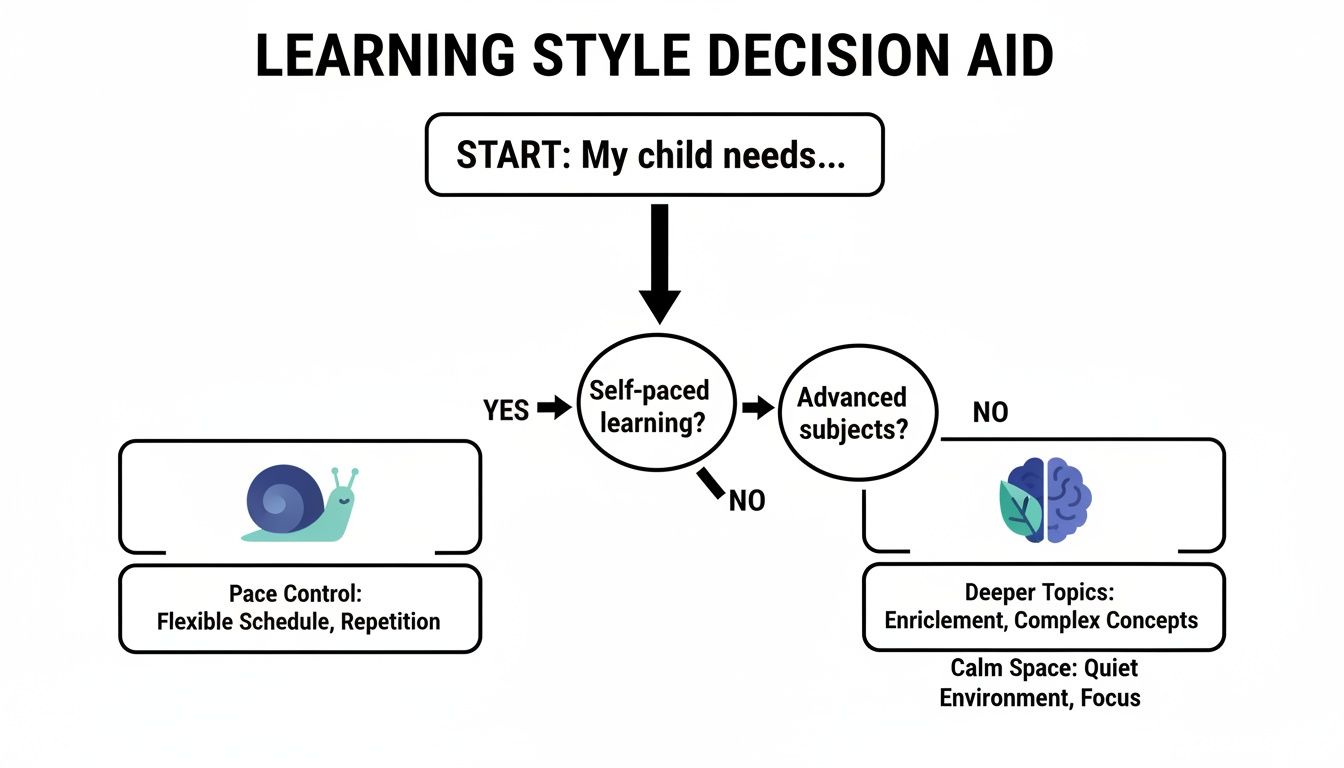
As the flowchart shows, different needs point to different learning strengths, reinforcing why a model that offers both flexibility and structure is so often the ideal choice.
Comparing Learning Models: What Works for Your Child?
To make it even clearer how this balanced approach can benefit your child, let’s put the different models side-by-side. Seeing the unique strengths of each method really highlights why a blend gives your child the best of all worlds.
| Aspect | Asynchronous Learning (The Library) | Synchronous Learning (The Workshop) | The Queens Online School Blend |
|---|---|---|---|
| Pacing | Child-led. The student moves at their own speed, revisiting topics as needed without pressure. | Teacher-led. The entire class moves through the material together at a set pace. | A balanced rhythm. Students master concepts at their own pace with asynchronous materials and then apply them in collaborative live lessons. |
| Social Interaction | Indirect. Students interact through forums, collaborative documents, or project feedback. | Direct and real-time. Spontaneous discussions, group work, and immediate feedback from teachers and peers. | Purposeful connection. Small group live classes ensure every child is seen and heard, fostering a strong sense of community and friendship. |
| Flexibility | Total freedom. Learning can happen at any time of day, fitting around family life and a child’s natural energy levels. | Structured schedule. Classes happen at fixed times, which provides routine and predictability. | Structured flexibility. A predictable timetable of live lessons provides a core structure, while asynchronous tasks offer the freedom to complete work when it suits the family. |
| Teacher Support | On-demand. Support is available via messages, email, or scheduled one-to-one sessions. | Immediate. Teachers provide instant clarification and support during the live lesson. | Continuous support. Children benefit from immediate help in live classes and can access detailed feedback and support on their asynchronous work. |
By bringing the library and the workshop together under one roof, we create an educational experience that feels both empowering and connected. Your child gains the independence to explore their passions deeply while building the social skills and relationships they need to feel part of a caring, vibrant community.
Navigating Potential Challenges with Confidence
As a parent, your child’s well-being is everything. When you look into a new way of learning, it’s only natural for questions and worries to pop up. Will they spend too much time staring at a screen? Can they stay motivated without a teacher physically in the room? And maybe the biggest question of all: will they still make friends and feel like they belong?
These are completely valid concerns, and it’s important to face them head-on. Switching to a more flexible learning model isn’t about pretending these hurdles don’t exist. It’s about seeing them as chances to build resilience, independence, and even stronger family bonds—with the right support system in place. You aren’t alone on this journey.
Fostering Connection and Community
One of the most common worries is that asynchronous learning will lead to social isolation. While your child won’t be sitting in a traditional classroom, a well-designed online school works hard to build a strong and vibrant community. It’s all about creating purposeful moments for connection that go far beyond just academics.
At Queens Online School, this is a top priority. We tackle the risk of isolation by weaving collaborative elements directly into our blended model:
- Small Group Live Lessons: Our interactive classes are kept small for a very good reason. It means every child gets a chance to speak, be heard, and work closely with their peers on projects. This is where a genuine sense of camaraderie starts to grow.
- Virtual Clubs and Events: From a chess club where a shy child finds their voice, to creative writing workshops where a budding author shares their story, our students connect with friends from all over the world who share their passions. These social hubs are where lasting friendships are formed.
- Dedicated Pastoral Care: Every child has a support network of teachers and staff who check in on their emotional well-being. We make sure they feel seen, valued, and connected to the wider school community.
This structure proves that asynchronous learning doesn’t have to mean learning alone. You can find out more about building a supportive community by exploring our guide on learning in virtual environments.
Cultivating Motivation and Balance
Another big concern is keeping motivation high while managing screen time. How do you make sure your child stays on track without the rigid bell schedule of a traditional school? The key is to create a rhythm and routine that works for your family, turning these potential challenges into strengths.
Instead of viewing motivation as something to be enforced, we see it as something to be nurtured. When a child feels in control of their learning and genuinely curious about a subject, motivation follows naturally.
Practical strategies can make a world of difference. A simple visual schedule on the wall can help a younger child understand their day, while a digital planner can empower a teen studying for their A-Levels. For example, a family might decide that from 3 pm onwards is "screen-free time," dedicated to playing outdoors, reading a book, or helping with dinner. This ensures that learning is balanced with essential downtime and real-world connection.
The demand for more flexible educational paths is growing. As of 2023, 11.6% of 16-24-year-olds in England were not in education, employment, or training (NEET), which highlights the urgent need for different models that can re-engage young people. Asynchronous learning, with its self-directed nature, has a proven track record in higher education. With 98% of universities now offering online courses, it’s clear that this style of learning prepares students for future success.
By having these honest conversations and putting simple, effective strategies in place, you can confidently navigate the world of flexible learning. You’ll be giving your child the tools they need to thrive, both academically and emotionally.
Practical Tips For Your Family To Succeed
Moving to a more flexible learning model is something you and your child will navigate together. It’s a brilliant chance to build a new, supportive relationship around their education and turn any challenges into opportunities to connect. Success here isn’t just about grades; it’s about nurturing their curiosity, resilience, and communication as a family.
Think of yourself less as a supervisor and more as a ‘learning coach’. Your role is to cheer on the process, not just the final result. This subtle shift in mindset can make a huge emotional difference, changing how your child sees their own progress and what they believe they can achieve.
Becoming A Supportive Learning Coach
The language you use matters more than you might think. Instead of just checking if tasks are done, try starting conversations that show you’re genuinely interested in what they’re discovering. This builds their confidence and reinforces the idea that learning is an exciting adventure, not just a list of things to get through.
For families starting out with asynchronous learning, strong parent involvement in education is key. This isn’t about hovering over their homework; it’s about creating a positive and encouraging atmosphere at home.
Instead of asking, "Is your homework done?" try, "What was the most surprising thing you learned today?" or "Show me a problem that really made you think."
These kinds of questions open the door for a real chat. They signal to your child that you value their effort, their curiosity, and their unique way of thinking. It’s about celebrating those ‘aha!’ moments and being there to help them figure out the tricky bits, reminding them that you’re their biggest supporter.
Age-Specific Tips For Students
Giving your child the right organisational tools helps them take charge of their own learning journey. Of course, what works for a primary schooler is very different from what a teenager studying for their A-Levels needs. The goal is to find a structure that feels supportive, not restrictive.
For Younger Children (Key Stage 2)
- Create a Visual Timetable: A colourful weekly planner with pictures or icons for different subjects and breaks can work wonders. A child might have a picture of a book for English, a calculator for maths, and a football for their afternoon break. It helps them see their day at a glance and gives them a sense of control.
- Set Up a 'Learning Nook': Designate a quiet, cosy corner just for their schoolwork. Letting them personalise it with their favourite pens and a comfy cushion makes it a space they actually want to be in.
- Use a Timer for Focus: A simple sand timer or a visual clock for short bursts of focused work (say, 20 minutes) followed by a planned break for a snack or play can be incredibly effective.
For Older Students (GCSE and A-Level)
- Introduce Digital Tools: Apps like Trello or Google Calendar are fantastic for managing deadlines and breaking big projects down into smaller, less daunting tasks. A student could create a board for their History coursework with columns for "To Research," "Drafting," and "Final Review."
- Encourage 'Chunking': Teach them to split study sessions into manageable chunks. For example, 45 minutes of deep focus on one topic, followed by a 15-minute break to stretch or listen to some music.
- Schedule Weekly Check-Ins: Set aside a relaxed time each week to look over their schedule together. This isn't about checking up on them; it's about offering support and helping them solve any problems they’ve run into.
By providing these simple tools and keeping the conversation going, you can turn asynchronous learning into a positive, collaborative experience for the whole family. You’re not just helping them succeed with their studies—you’re equipping them with skills for life.
Why Personalised Learning Is the Future
The whole conversation around education is changing. It’s no longer a simple choice between a traditional school building and learning online. Instead, it’s about finding a model that truly honours your child’s unique spirit, emotional needs, and intellectual curiosity. The future of learning lies in creating an experience that fits the child, not forcing the child to fit a rigid system.
This is where a thoughtful blend of learning styles becomes so powerful. Asynchronous learning provides the essential flexibility and depth that modern children need. It gives them the space to explore topics without pressure, to master concepts at their own speed, and to build the independence required to become confident, self-directed learners. This is the foundation of deep, meaningful education.
An Education for Life
However, learning isn’t just an academic pursuit; it’s a social one. This is why structured, live interaction is just as vital. These sessions build the vibrant community, teamwork, and social skills that children crave and need. When combined, these two approaches create an education that balances academic excellence with emotional well-being.
For any form of learning to be effective, it’s vital to help children develop strong critical thinking skills. A personalised approach gives them the time and support to question, analyse, and form their own conclusions rather than simply memorising facts for an exam.
By choosing a supportive, balanced approach, you are not just selecting a school—you are empowering your child with an education designed for their future success and happiness.
Ultimately, the goal is to nurture a love of learning that lasts a lifetime. It’s about equipping your child not just with qualifications, but with the resilience, curiosity, and self-awareness to thrive in a world that is always changing. This is the promise of truly personalised education, and it’s a future we should all be excited to build for our children.
Your Questions Answered: Putting Your Mind at Ease
Right, so you're exploring online learning and the term 'asynchronous' keeps popping up. It can feel like a lot of jargon, but it's a concept that really matters for your child's day-to-day experience. Let's tackle some of the most common questions parents ask us.
How on Earth Do I Keep My Child Motivated?
This is a big one, and it touches on a deep parental fear: will my child fall behind without a teacher standing over them? Motivation in a flexible learning environment isn't about constant nagging or checklists. It comes from a mix of genuine interest and a gentle, predictable structure.
Think about it: when a child gets to dive into a topic like the Tudor dynasty right when they feel most awake and curious, their natural desire to learn kicks in. That kind of internal drive is incredibly powerful.
But it’s not a free-for-all. A balanced approach, like the one we use, brings in regular live lessons with specialist teachers. These create encouraging deadlines and a sense of being part of a team. Your role shifts from enforcer to ‘learning coach’—celebrating the small wins and helping shape a simple daily rhythm. It’s a partnership between the school, your child, and you.
Is Asynchronous Learning a Good Fit for Children with SEN?
For many children with SEN or SEMH needs, such as ADHD or autism, a well-designed asynchronous model can be a massive relief. It removes the overwhelming noise and social pressures of a busy classroom, creating a calm, low-sensory space where they can actually focus.
The ability to pause a video, rewind a tricky explanation, and re-watch a lesson is a game-changer. It means they can learn at their own processing speed without that awful feeling of being rushed or left behind.
For a child who struggles with sensory overload, having control over their learning environment isn't just a nice-to-have; it's a necessity. It gives them the emotional and mental space they need to actually absorb information and thrive.
At Queens Online School, we pair this independence with the focused support of small, live classes where teachers genuinely understand their specific needs. This blend gives children the freedom to learn deeply and calmly on their own, while still getting the structured social connection they need to feel part of a community.
Will My Child Be Lonely and Miss Out on Making Friends?
This is often the first and most heartfelt question we hear from parents. We get it. Friendship is the magic that makes childhood bright. We believe that meaningful social development is about the quality of interactions, not just the number of children in a room. Friendship and community aren't left to chance here; they are intentionally woven into the fabric of our school.
Our live, interactive classes are the heart of our community. It’s where students work together on projects, debate ideas, and build real relationships with peers from all over the world in a safe, moderated space. And it doesn't stop there. We run a whole host of online clubs and social events where students connect over shared passions. We’re all about fostering a global community where genuine friendships can blossom, backed by our zero-tolerance anti-bullying policy.
At Queens Online School, we believe in an education that nurtures your child's confidence, respects their individual needs, and prepares them for a bright future. Discover how our balanced approach to online learning can empower your child by exploring our programmes at https://queensonlineschool.com.