


Getting your child into university is less about a single, dramatic leap and more about a series of thoughtful, well-planned steps. It's a journey that starts with nurturing their interests and builds towards an application that tells their unique story. The trick is to help them build a solid academic foundation, craft a personal statement that feels authentic, and choose courses that genuinely excite them. It’s a marathon, not a sprint, and it begins with understanding your child and what makes them tick, long before the final application is sent.
Your Child’s University Journey Starts Here
Thinking about how to get your child into university can feel like a huge task—a mix of excitement for their future and a good dose of anxiety about whether you're doing it 'right'. It’s a massive milestone for them, a first big step into their own future, and as a parent, your goal is to be their supportive guide without piling on the pressure. This guide is your roadmap, designed to turn a complicated process into a clear, manageable path, always keeping your child's wellbeing at the heart of every decision.
The journey really kicks off in the final years of secondary school, where every choice and grade starts to form the bigger picture. It’s not just about hitting academic targets; it’s about nurturing their curiosity, celebrating their passions, and helping them figure out what truly motivates them.
Mapping Out the Two-Year Timeline
The main application window stretches from the beginning of Year 12 right through to the emotional rollercoaster of receiving offers in Year 13. Getting your head around this timeline helps demystify the whole thing and lets you plan ahead, avoiding that last-minute panic that can steal the joy from this exciting time.
Imagine a student like 'Leo', who lives and breathes graphic design. His journey isn’t just a checklist. In Year 12, he might spend weekends visiting university open days, feeling the creative buzz of different art departments, and carefully curating a portfolio that showcases not just his skill, but his unique artistic voice. By the autumn of Year 13, his focus shifts to pouring that passion into his personal statement, ready to submit his application well before the January deadline. This foresight gives him the breathing room he needs to concentrate on his A-Levels, feeling calm and in control.
The university application process is a brilliant opportunity for your child to reflect on their achievements, explore their interests, and take real ownership of their future. Your role is to be their supportive co-pilot, not the one in the driver's seat.
This visual timeline breaks down the core stages of the journey.
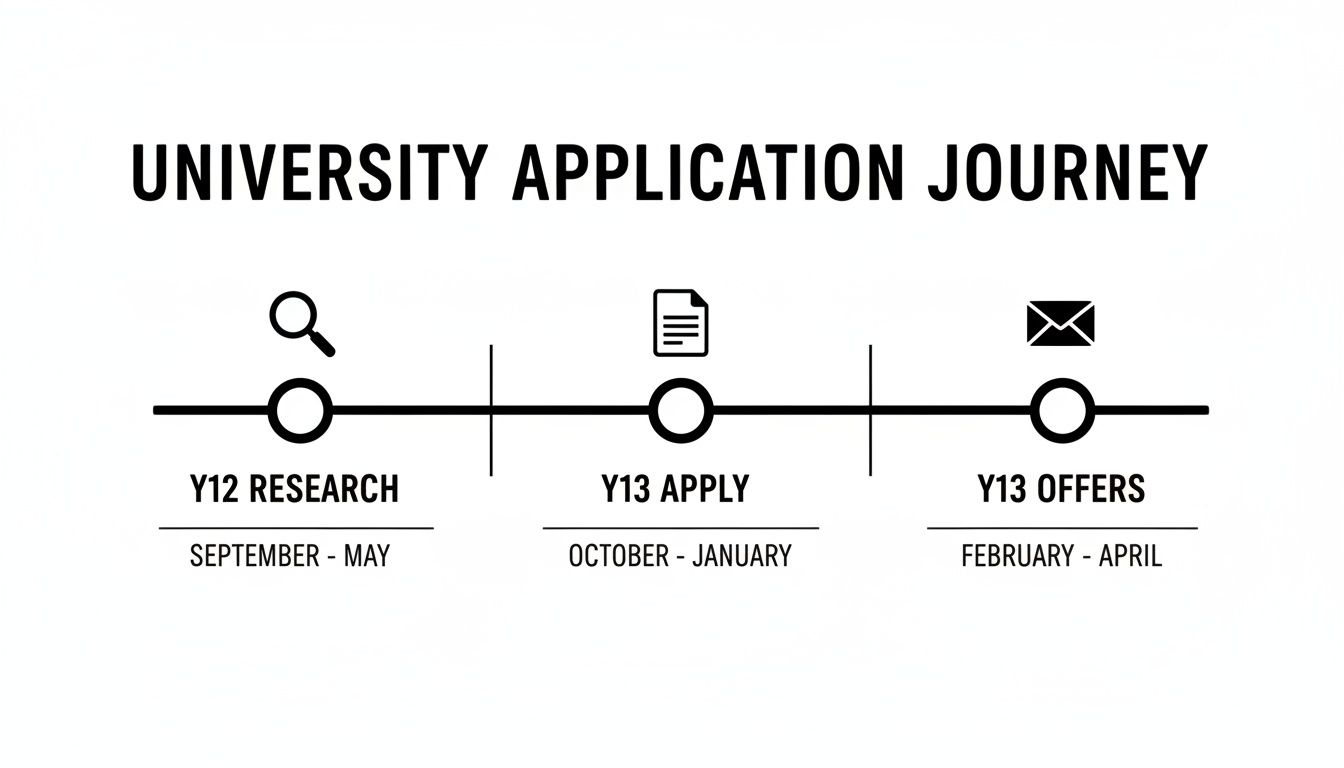
As you can see, it's a steady progression. There are distinct phases for research, application, and decision-making, all spread across two crucial years.
To make this even clearer, here’s a simplified breakdown of the key stages for both students and parents to keep in mind.
University Application Timeline: A Two-Year Overview
| Stage | Key Actions and Milestones | Emotional Focus for Parents and Students |
|---|---|---|
| Year 12 (Autumn – Spring) | Research & Exploration: Start exploring subjects, universities, and career paths. Attend university open days (virtual or in-person). Focus on achieving strong predicted grades. | Curiosity & Discovery: This is a low-pressure time for exploration. Your child's job is to dream. Your job is to listen. Encourage open chats about their passions without focusing on final decisions. |
| Year 12 (Summer) | Shortlisting & Prep: Begin creating a shortlist of 5 university choices. Start drafting the personal statement. Register for any required admissions tests (like UCAT or LNAT). | Focus & Reflection: The reality starts to set in, which can feel exciting and scary. Support them in reflecting on their strengths and what makes them proud. The personal statement is their story to tell. |
| Year 13 (Autumn) | Application & Submission: Finalise personal statement and get feedback from teachers. Complete and submit the UCAS application. The early deadline for Oxbridge, Medicine, etc., is 15th October. | Action & Nerves: This is the busiest period. Nerves are normal. Be their calm anchor. Your role is to be a proofreader and cheerleader, reminding them how far they've come. |
| Year 13 (Winter – Spring) | Interviews & Offers: Prepare for and attend interviews if required. Universities will start sending out offers. Respond to offers by the May deadline. | Patience & Decision-Making: The waiting game is tough on everyone. When offers arrive, help your child think through their choices logically, but also trust their gut feeling about where they'll be happy. |
| Year 13 (Summer) | Results & Confirmation: A-Level results day in August. Hopefully, their place is confirmed! If not, navigate the Clearing process. | Celebration & Support: Celebrate their hard work, no matter the outcome! If results aren't what they hoped for, your reassurance and practical support through Clearing will mean the world. |
Keeping this timeline handy can help everyone stay on track and reduce the feeling of being overwhelmed. It’s all about tackling one stage at a time.
A Focus on Personalised Learning
Every child’s path is different because every child is different. Some thrive in the bustling structure of a traditional school, while others find their voice in a more flexible environment. Online schooling, for instance, can offer a personalised pace that allows a student to dive deeper into subjects they love or get extra support where it’s needed without feeling left behind or held back. This kind of focused attention can be invaluable for building the academic confidence needed for a strong university application.
Whatever the educational setting, the goal is the same: to create a foundation where your child can flourish both academically and personally. The focus should always be on their individual needs and aspirations, empowering them to present their best, most authentic self to their chosen universities.
Building a Strong Academic Foundation
Strong academic results are the bedrock of any successful university application. They're often the first thing an admissions tutor looks at, creating a powerful first impression of your child’s ability and dedication. But this isn't just about passing exams; it's about helping your child make smart, strategic choices that align with their dreams and keep the right doors open for their future.
The journey starts with GCSEs, but it's really at A-Level (or equivalent qualifications like the IB) where the path to a specific degree truly takes shape. These choices can feel huge, loaded with the weight of future possibilities, so it's vital to approach them with care and plenty of conversation.

Making Strategic A-Level Choices
Choosing A-Levels isn't about picking the 'hardest' subjects to impress someone. It’s about selecting the right subjects for your child’s passions and ambitions. Many university courses list prerequisite subjects—the non-negotiables. Missing even one of these can feel like a door slamming shut before they've even had a chance to knock.
Let’s take 'Sophie'. She's a bright student who has dreamed of designing sustainable buildings since she was little, and now wants to study Engineering. For her, the A-Level choices are crystal clear and directly linked to that dream:
- Mathematics: This is the language of engineering. It's essential.
- Physics: This provides the fundamental principles she'll build her entire degree upon.
- A Further Subject: Further Maths is a huge advantage as it signals advanced analytical skills. Alternatively, a subject like Chemistry or Design Technology would also be a strong third choice that connects to her passion.
Without Maths and Physics, Sophie’s application would be rejected almost instantly, no matter how brilliant her other grades are. This is why digging into course requirements early on is so crucial. It helps your child build their academic profile with purpose, ensuring their hard work leads them where they want to go. For a deeper dive, you can explore our guide on how A-Levels work.
The Power of Predicted Grades
Predicted grades are the university’s first real glimpse into your child's academic potential at A-Level. Teachers calculate these based on performance in mock exams, coursework, and overall progress. They are, quite simply, one of the most critical parts of the UCAS application, and they can cause a lot of stress.
A strong set of predictions is what gets an application past the first hurdle. For the most competitive courses, it's everything. For instance, getting into top UK universities like Oxford demands elite grades, and statistics reveal stark disparities – Oxford received 14,694 UK undergraduate applications, issuing 2,996 offers and admitting 2,612, for a success rate of 63.7% among offer-holders. This shows that achieving strong predicted grades is paramount, as they determine whether your child's application is even seriously considered.
Predicted grades aren't just guesses; they are a testament to two years of consistent effort, resilience through tough topics, and a reflection of a student's potential to succeed at degree level. They are the key that unlocks the door to an offer.
This is where the right learning environment becomes so important. A school that offers focused, specialist teaching can be instrumental in helping students meet these high academic benchmarks. For a child who feels lost in a large class, the personalised attention of a smaller group can be the difference that turns a predicted B into an A, completely transforming their application and their self-belief.
Creating a Supportive Learning Environment
Every child learns differently, and finding the right environment can make a world of difference to their confidence and their grades. For some students, particularly those with Special Educational Needs (SEN), the traditional classroom can be a source of overwhelming anxiety. The noise, pace, and social pressures can make it incredibly difficult for them to show what they're truly capable of.
An alternative like online schooling can provide the quiet, focused space they need to flourish. In a calmer, more controlled setting, a student can concentrate entirely on their learning without distraction. For example, a student with ADHD who struggles with classroom focus can pause a recorded lesson to process information at their own pace. With tailored support from teachers who understand their specific needs, they can build the confidence and the grades to create an application that stands out for all the right reasons. To effectively showcase your child's unique academic journey and extracurriculars, exploring various student resume templates can provide a structured approach to highlight their strengths.
This isn’t about finding an easier path; it’s about finding a smarter one that puts your child’s well-being and learning needs first. By removing unnecessary barriers, you empower them to build an academic foundation that truly reflects their capabilities, giving them the best possible chance of getting into the university of their choice.
Crafting a Personal Statement That Tells a Story
The personal statement is your child's one real chance to speak directly to admissions tutors. It’s where they step out from behind their grades and show the real, passionate person who is so much more than a list of academic achievements. This is the moment for their personality, their curiosity, and the story of what makes them, them, to truly shine through.
So many students feel this immense pressure to sound overly academic or to list every single achievement, turning their statement into a dry, impersonal CV. But the most memorable statements—the ones that make an admissions tutor sit up and take notice—are those that tell a story. They connect the dots between a student's experiences, their academic interests, and their future ambitions in a way that feels genuine and compelling.

From Interest to Narrative
The real key is to move beyond simply stating an interest and instead show the story of how it came alive. An admissions tutor for a history degree has read countless statements from applicants who "love history." What they haven't read is your child's unique story of how that love came to be.
Let's imagine a student, 'Amara', who wants to study Archaeology. She could write, "I have always been interested in ancient civilisations." It’s fine, but it’s forgettable.
Or, she could tell her story:
"My fascination with archaeology began not in a classroom, but in the dusty corridors of the local museum I’ve visited with my grandad since I was small. It was there, peering at a collection of Roman pottery fragments, that I first wondered about the lives of the people who used them. This curiosity led me to volunteer on a local community dig last summer, where the thrill of unearthing a simple shard of pottery, untouched for centuries, solidified my desire to dedicate my studies to uncovering these lost stories."
The second version is far more powerful. It’s filled with emotion and personal connection. It demonstrates a genuine, long-term interest, shows initiative (volunteering), and links a cherished memory directly to her academic goals. It turns a simple hobby into a compelling narrative of intellectual curiosity.
Weaving in Super-Curricular Activities
Super-curricular activities are how your child proves their passion extends beyond the A-Level syllabus. These aren't just extra-curricular clubs; they are activities directly related to their chosen subject that show they are a self-motivated, inquisitive learner.
Encourage your child to think about how they already engage with their subject outside of school. This isn’t about padding a list; it’s about reflecting on what genuinely excites them.
For a prospective computer science student, this could be:
- Reading: Instead of saying "I read about AI," they could mention, "Reading Kai-Fu Lee's 'AI Superpowers' challenged my perspective on the ethics of machine learning and sparked my interest in human-computer interaction."
- Podcasts: Mentioning a podcast series that explored a niche area of their subject.
- Online Courses: Completing a short online course (a MOOC) on Python to show they are proactive in building their skills.
- Personal Projects: "I spent my summer holiday teaching myself to build a simple weather app. The frustration of debugging the code was matched only by the thrill I felt when it finally worked."
The trick is not to list these activities, but to explain what they got out of them. What did they learn? What new questions did it raise? How did it deepen their understanding or passion for the subject?
For a more detailed breakdown, our guide on how to write a compelling personal statement offers a structured approach to help your child articulate their journey effectively.
Highlighting Unique Learning Experiences
A student's educational journey is itself a powerful part of their story. This is especially true for those in non-traditional settings, like online school, because these experiences cultivate skills that universities value immensely.
An online A-Level student, for instance, has had to develop a high degree of self-discipline, time management, and independent research skills just to get through their courses. These are not just buzzwords; they are the very attributes needed to succeed in the independent environment of university.
Here’s how they could frame it:
"Studying my A-Levels online has taught me more than just the content of my subjects; it has taught me how to be an independent learner. Having to manage my own schedule and deadlines has fostered a level of self-discipline and motivation that I believe has prepared me exceptionally well for the rigours of university-level research and study."
This kind of reflection shows an admissions tutor a mature, self-aware applicant who understands the demands of higher education. It reframes what some might see as a different educational path into a clear strength.
The personal statement is the perfect place to showcase how your child’s unique background has shaped them into a resilient and capable student, ready for the next step. It is their story, and helping them tell it authentically is one of the most powerful ways you can support them.
Choosing the Right University and Course
With thousands of courses at hundreds of institutions, the choice can feel paralysing. It’s tempting to jump straight to the league tables, but finding the right fit for your child goes so much deeper than rankings. This decision is an emotional and practical one, all about finding a place where they will not just study, but genuinely thrive and feel happy for three or more years.
The key is to shift the question from "which is the best university?" to "which university is the best fit for my child?" This changes everything. It puts their unique personality, their learning style, and their happiness right at the heart of the decision-making process—exactly where it should be.
Looking Beyond the Course Title
A 'Business Studies' degree can mean wildly different things at different universities. One might be heavily theoretical, assessed by final exams. Another could be built around practical, real-world projects and a placement year. This is why you must encourage your child to become a detective and dig into the details of the course modules.
Let’s take 'Isabelle', a student predicted AAB who loves biology. She’s looking at two courses:
- University A: A traditional Biology BSc with a strong focus on lab-based research, assessed mostly by exams.
- University B: A Human Biosciences BSc that includes modules on public health and science communication, assessed through a mix of coursework, presentations, and exams.
If Isabelle is a hands-on learner who dreads exams but comes alive when presenting her ideas, University B might be a far better place for her to succeed and feel confident, even if University A is slightly higher in the league tables. It's all about matching the course structure to her strengths and what makes her feel capable.
Understanding the Campus and Culture
The university experience extends far beyond the lecture hall. The campus environment, the city it’s in, and the overall culture play a massive role in a student’s well-being and happiness. Does your child feel more comfortable in a bustling, diverse city, or would they feel safer and more at home in a quieter, self-contained campus?
Here are some crucial factors to discuss and research together:
- Campus vs City: Do they want everything in one place (campus) or to be integrated into a larger city? How will they feel commuting or living away from home for the first time?
- Accommodation: Look at the quality, cost, and availability of first-year halls. Is it guaranteed? Knowing they have a safe place to live is a huge weight off their mind.
- Student Support: What mental health, academic, and disability support services are on offer? This is a non-negotiable checkpoint. Ask how accessible these services are.
- Societies and Culture: Do the available clubs and societies match your child’s interests? This is key to them finding their "people" and building a supportive friendship group.
This choice is as much about finding a home as it is about finding a course. A happy, supported student is far more likely to be a successful one.
Making a well-researched, realistic choice has a huge emotional payoff. Just imagine the thrill of results day when those choices pay off. A record-breaking 255,130 UK 18-year-olds were accepted into university or college through UCAS. Astonishingly, 82% of those who received decisions on results day secured their first-choice university. This just goes to show how aligning choices with a student's grades and aspirations dramatically increases their chance of success. You can find out more from these university acceptance statistics on UCAS.com.
Comparing University Choices Beyond the Rankings
To help put this into practice, use a simple framework to compare universities on the factors that truly matter for your child's day-to-day life. Instead of just looking at academic prestige, consider the practical and personal elements that will shape their experience.
| Factor to Consider | University A | University B | University C |
|---|---|---|---|
| Teaching Style | Heavily lecture-based, exam-focused. Great for independent learners. | Mix of seminars, workshops, and practicals. Strong on group work. | Project-based learning with a final-year dissertation. Industry links. |
| Accommodation | Guaranteed in 1st year but expensive. Competitive for 2nd/3rd years. | Cheaper halls, but older facilities. Lots of private rentals nearby. | Modern, self-catered campus accommodation available for all years. |
| Student Support | Large, well-funded wellbeing service but can have long waiting lists. | Smaller, dedicated team with drop-in sessions. Strong peer mentor scheme. | Specialist SEN support is well-regarded. Proactive mental health checks. |
| Location & Vibe | Bustling city centre campus. Great for nightlife, but could feel overwhelming. | Self-contained campus on the edge of a smaller town. Quieter, community feel. | City university but with a defined campus area. Best of both worlds? |
| Societies/Clubs | Over 300 societies, very competitive sports teams. | Strong focus on arts, music, and drama clubs. Less focus on sport. | Niche societies (e.g., robotics, debating) are very active. |
| Employability | Strong links with corporate finance and law firms. Annual careers fair. | Good connections with local businesses and public sector for placements. | Excellent support for start-ups and entrepreneurs. Has an incubator hub. |
This kind of comparison helps you and your child see the full picture, moving beyond the simple numbers in a league table to find a university where they will genuinely feel they belong.
A Passport to Global Opportunities
For international families considering how to get into university, the British A-Level system is a powerful asset. These qualifications aren't just for the UK; they are recognised and respected by top universities worldwide.
This global recognition provides incredible flexibility and peace of mind. A student who completes their A-Levels through an online school can apply with confidence to universities in the UK, Europe, North America, or Australia. Their qualifications act as an academic passport, opening doors to a world of higher education and giving your family the freedom to consider a truly international future for your child.
Navigating Interviews, Entrance Exams, and References
For many of the UK’s most sought-after university courses, the UCAS form is just the first checkpoint. What comes next—entrance exams, interviews, and references—can feel like a series of high-stakes hurdles that cause sleepless nights. But with the right preparation, they become powerful opportunities for your child to show admissions tutors who they are beyond their grades and let their personality shine.
These components are designed to test the very skills an A-Level certificate can’t fully capture: thinking critically under pressure, reasoning on your feet, and showing a genuine, burning passion for a subject. They give admissions tutors a much more rounded view of an applicant, making this stage a make-or-break part of getting into a top university.
Demystifying University Entrance Exams
For courses like Medicine (BMAT/UCAT), Law (LNAT), or many programmes at Oxford and Cambridge, an entrance exam is non-negotiable. These tests aren't about recalling memorised facts; they’re designed to assess aptitude and raw skill. That’s why last-minute cramming rarely works and only adds to the stress. Success comes from consistent, early preparation.
Let's take a student, 'Daniel', who is applying for Law. The LNAT feels like a huge, scary obstacle. A smart and calm approach would be:
- Months in advance, he’d start by looking at sample questions to understand the format, reducing the fear of the unknown.
- To build the right skills, he'd spend time reading newspaper opinion pieces and debating them with his family, training his brain to analyse arguments—a core skill for the LNAT's multiple-choice section.
- In the final weeks, he would complete full mock tests under strict timed conditions to build stamina and master his pacing, so on the day, it feels familiar.
This methodical approach transforms a daunting exam into a manageable task, giving a student the confidence to let their true ability shine through.
Conquering the University Interview
The thought of an interview can be terrifying for any teenager. It’s easy to imagine it as an intense interrogation, but it's really just a conversation—one designed to explore your child’s enthusiasm and thought process. The goal isn't to catch them out; it's to see how they think and to get a feel for their personality.
Confidence is a byproduct of preparation. A brilliant way to prepare is to simply encourage your child to talk about why they love their subject. If they can speak with genuine passion about a book they’ve read, a concept that fascinates them, or a recent discovery in their field, they're already halfway there.
Consider this common mock interview question for a Medicine applicant: "A patient with a terminal illness refuses a treatment that could prolong their life by six months. How would you approach this situation?"
A nervous answer sticks to textbook ethics. A strong, empathetic one shows they've thought about the human side.
"My first priority would be to make sure the patient feels heard. I'd sit with them and gently try to understand why they are refusing—are they worried about side effects, the financial burden on their family, or the quality of life during those extra months? It's crucial to respect their autonomy, but it's just as important to ensure they aren't making this decision out of fear or misinformation. Ultimately, my role would be to support their decision, whatever it may be, and ensure they feel cared for and respected throughout the process."
This response shows a mature balance of clinical understanding and, more importantly, human empathy—a quality that can't be graded in an exam.
The Decisive Role of the Teacher's Reference
The teacher's reference is one of the most influential—and often overlooked—parts of a UCAS application. It's a confidential endorsement from a professional who has seen your child's academic journey up close. A generic, lukewarm reference can be the kiss of death, while a glowing, personal one can be the deciding factor that tips the scales in their favour.
This is where close student-teacher relationships, often fostered in smaller or more personalised learning environments like online schools, become a huge advantage. When a teacher genuinely knows a student—their struggles, their breakthroughs, their intellectual curiosity—they can write a reference that makes the application come alive.
For example, a teacher could write: "While many students struggled with the concept of quantum mechanics, 'Chloe' was relentless. She stayed after class with questions and spent her lunchtimes watching university lectures online until it clicked. Her determination is remarkable." This personal anecdote validates everything your child has said about themselves, adding a layer of authenticity that admissions tutors value immensely.
Answering Your Big University Application Questions
The path to university is rarely a straight line. It’s completely normal for both students and parents to have a whirlwind of “what if?” questions that keep you up at night. Knowing how to handle the unexpected twists and turns is just as important as planning for the expected milestones.
Let's tackle some of the most common worries with clear, practical answers to help you feel more confident as you move forward.
What Happens If My Child Doesn’t Get Their Predicted Grades?
That moment when the results aren’t what you all hoped for can feel devastating. For your child, and for you. The most important thing to do in that first hour is to give them a hug, let them process it, and remind them that this is just a detour, not a dead end. Their worth is not defined by these grades.
It is absolutely not the end of the road. Your first port of call should be UCAS Clearing, the system universities use to fill any remaining places. Plenty of excellent universities will have spots available, and your child can phone them directly. It’s a fast-paced process, but it can lead to amazing new opportunities they hadn't even considered.
This moment can also be an unexpected chance to pause and reflect:
- Is this still the right course for them?
- Could a different university actually be a better fit for their personality?
- Would taking a gap year to retake an exam or gain some work experience be a powerful alternative that helps them mature and refocus?
Remember, resilience in the face of a setback is a life skill that universities value deeply. There are always other routes to success.
How Can My Child Stand Out with SEN or SEMH Needs?
Universities today are actively committed to supporting students with diverse needs, so being open about this is a strength, not a weakness. On the UCAS form, there’s a dedicated section to declare a disability or learning difference. It’s vital to reassure your child that this information goes directly to the university's student support services, not the admissions department, so it will not negatively impact their application.
The personal statement is a brilliant place to frame their experience in a positive light. Instead of seeing it as a hurdle, they can highlight the resilience, unique problem-solving skills, and sheer determination they’ve developed.
"Managing my dyslexia alongside my A-Levels has taught me to be an incredibly organised and strategic learner. It has strengthened my ability to approach complex problems from multiple angles, a skill I am excited to bring to my university studies."
A supportive school that truly understands their needs can write a reference that champions not just their academic potential, but also their character and their ability to thrive in a university environment. For many students, researching the available assistive technology for students with disabilities can also be a game-changer when planning for a successful transition.
How Do We Handle University Finances and Student Loans?
Let’s be honest: the financial side of university is a common source of family stress. For UK students, the first step is applying for Tuition Fee and Maintenance Loans through the relevant Student Finance body for your country (England, Scotland, Wales, or Northern Ireland).
These loans cover tuition costs and help with living expenses. A key point of reassurance for your child is that repayments don't begin until they are earning over a specific salary threshold. The amount they can borrow for maintenance often depends on household income, so it’s worth researching their entitlement early on to manage expectations.
It’s also a great idea to encourage your child to start building a simple budget. Spend some time together looking for scholarships, grants, and bursaries. Many universities offer these for all sorts of reasons—from academic merit to personal circumstances—and the best part is, they do not need to be paid back. Winning one can be a huge confidence boost.
What’s Different for International Students?
For international students, the UCAS process is very similar, but there are a few extra hurdles. They will almost certainly need to prove their English language proficiency, usually by taking a recognised test like the IELTS (International English Language Testing System).
Financially, they will be liable for international tuition fees and must demonstrate they have the funds to cover these costs as part of their student visa application. You can find out more about the specifics in our detailed guide on how to apply to UK universities.
One of the biggest advantages an international applicant can have is a set of qualifications that are instantly understood and respected by UK admissions tutors. Completing a British curriculum through an online school, for example, means a student's A-Level qualifications are immediately recognised, making the whole application process that much smoother and less stressful.
At Queens Online School, we understand that the journey to university is unique for every family. Our personalised approach, specialist teachers, and supportive environment are designed to help your child not just achieve their academic potential, but to build the confidence and resilience they need to thrive. Discover how we can support your child's path to their dream university at https://queensonlineschool.com.