
Choosing between different home schooling curriculums can feel like a huge task, but the most important first step has nothing to do with books or websites. It begins with understanding your child—their unique spark, their quiet struggles, and the way they see the world. Before you even glance at a formal plan, the real work is to centre your entire approach on the amazing person you are teaching.
Start With Your Child, Not the Curriculum
The journey into home education is, at its heart, an act of love. It’s a commitment to creating an environment where your child can flourish, not just academically, but emotionally and personally. This shift in perspective is profound. It moves the conversation from "What should they learn?" to "How do they learn best?"
This approach is becoming more common as families seek educational paths that truly honour their child's individual needs. In fact, the move towards home education represents a significant change in the UK. During the 2024/25 academic year, 175,900 children in England were electively home educated—a notable 15% increase from the previous year, with many families choosing this path to provide specialist provision.
Creating a Learner Profile
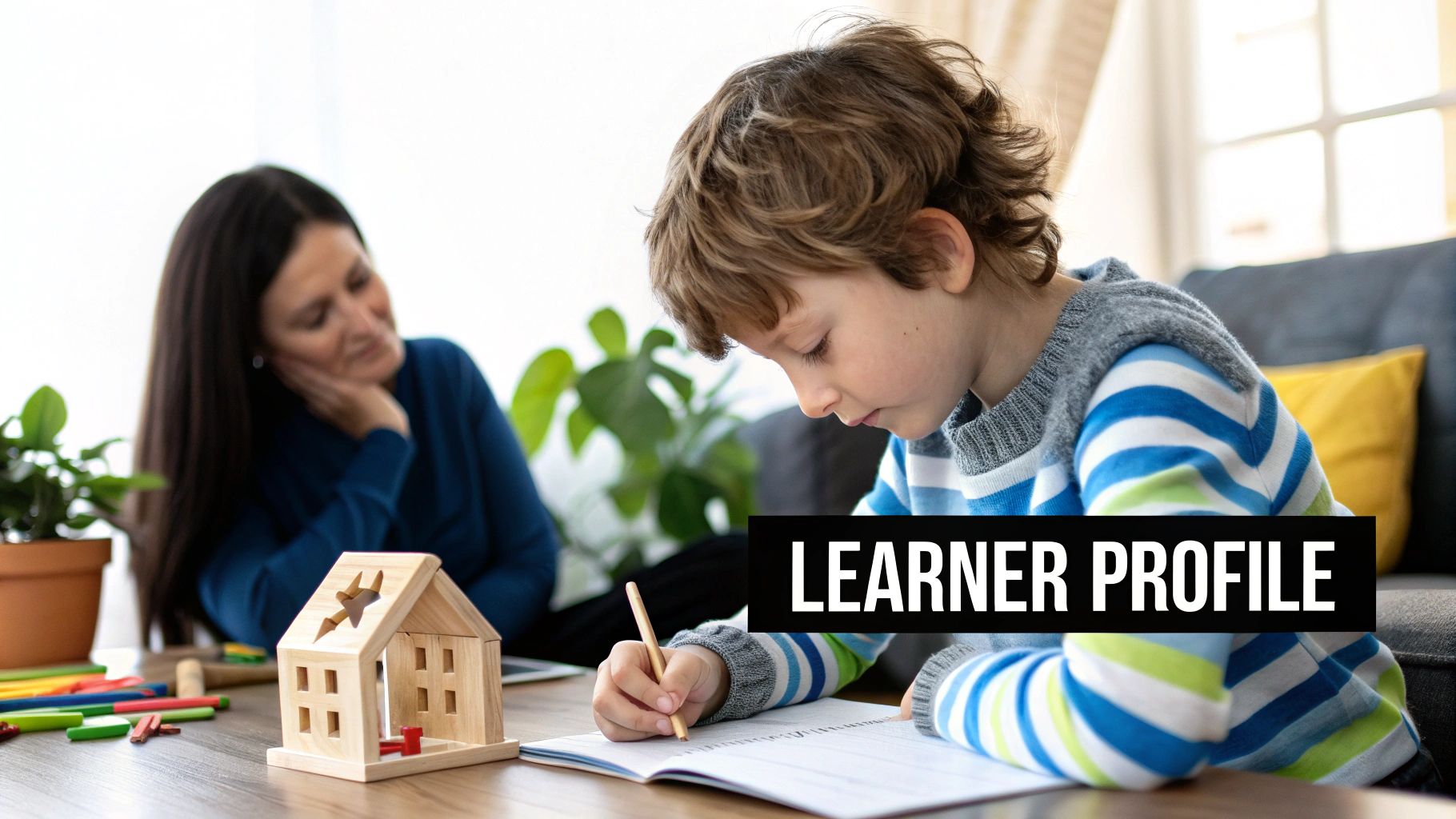
Before you even think about subjects, take some time to create a 'learner profile'. This isn't a test or a formal assessment; it's a gentle, loving observation of who your child is right now. Think of it as mapping their inner world so you can build an education around their natural curiosity.
Ask yourself these kinds of questions:
- What sparks their joy? Is it building elaborate LEGO creations, losing themselves in a fantasy novel, or taking things apart to see how they work? That feeling of pure, unforced delight is your greatest teaching tool.
- How do they engage with the world? Are they a hands-on learner who needs to move and touch, or a visual one who absorbs information through charts and videos?
- What are their biggest challenges? Do they struggle with staying focused, feel anxious in structured settings, or just need a bit more time to process new ideas? Knowing this helps you build a safe space for them to grow.
- When are they most energised? Do they do their best thinking first thing in the morning, or do they come alive in the afternoon?
Practical Examples of Child-Centred Learning
Putting this knowledge into practice is what makes home education so powerful. It’s about tailoring the experience to the child, moment by moment.
For example, imagine your child is obsessed with dinosaurs. Instead of forcing them through a standard maths worksheet, they could learn measurement by comparing the sizes of different species or practice reading with thrilling stories about paleontologists. A budding artist could explore history by recreating ancient pottery. This is where the magic happens. You’re not just teaching facts; you’re nurturing a lifelong love of learning by connecting it to what they already adore.
By focusing on your child's unique learning style and passions first, you build a foundation of trust and engagement. This positive start makes choosing from the many home schooling curriculums feel less like a chore and more like an exciting next step.
This child-first approach lays the groundwork for a successful and joyful educational journey. If you're considering this path, understanding the benefits of home education can offer further encouragement and insight into how this model supports a child’s holistic development.
Unpacking Homeschooling Philosophies
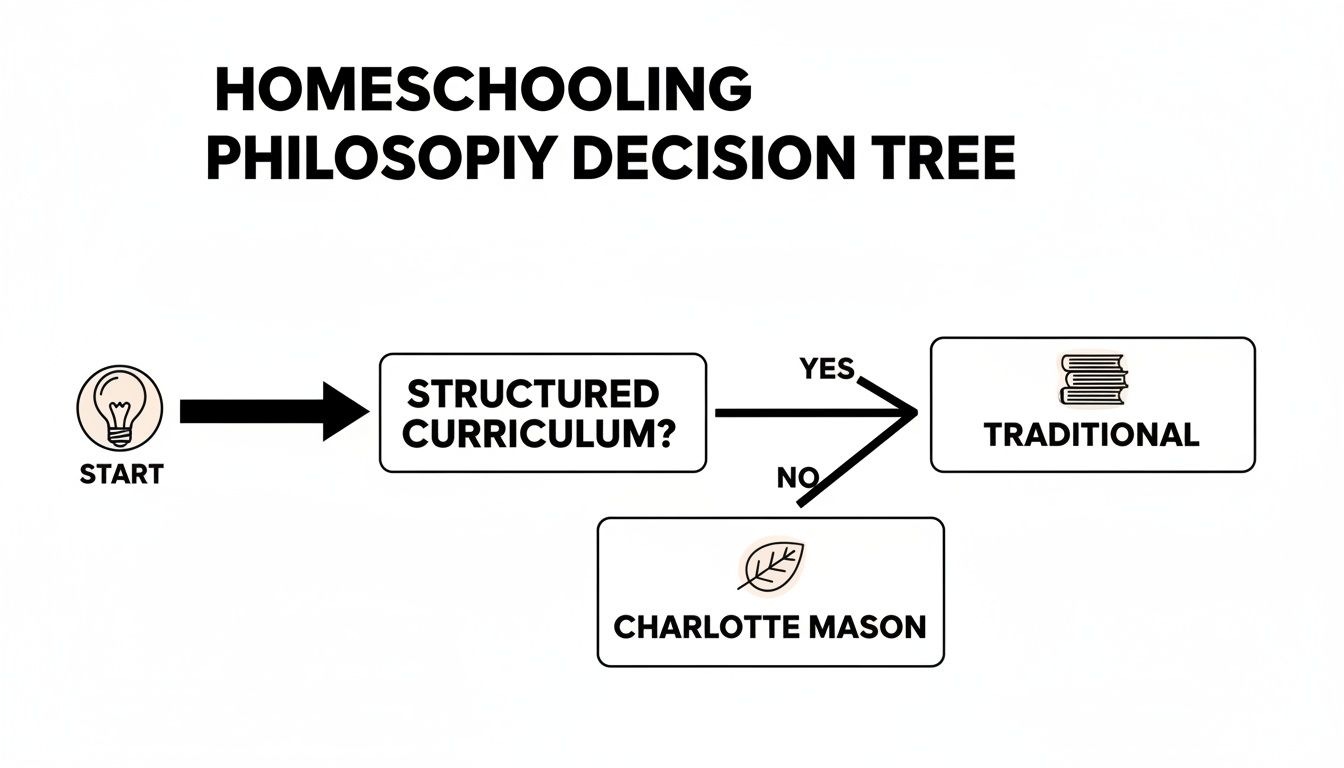
Right then, let's unpack the different philosophies behind homeschooling. Think of a curriculum not just as a set of books, but as a roadmap for your child's education. Some are like motorways—structured, clear, and heading straight for a destination. Others are more like scenic country lanes, inviting you to wander and explore.
The goal isn't to find the "best" philosophy, because there isn't one. It's about finding the one that resonates with your child and fits with your family's way of life. When you understand the core idea behind an approach, you can see past the marketing and choose a path that feels authentic and, most importantly, sustainable for the long haul.
The Traditional British Curriculum Path
For many families, the endgame is a set of recognised qualifications. The traditional British curriculum, built around Key Stages, GCSEs, and A-Levels, offers exactly that—a familiar, reliable framework. It’s a well-marked trail where each stage builds logically on the last.
This approach is all about mastering a defined body of knowledge. It’s a fantastic fit for a child who thrives on clear expectations, enjoys a structured daily routine, and feels secure knowing exactly what comes next. It offers peace of mind because it aligns directly with university entrance requirements and future career paths.
- Practical Example: A family on this path might use specific Pearson Edexcel textbooks for Year 9 maths to cover the GCSE syllabus. Their child finds comfort in the clear, step-by-step progression, knowing that each completed chapter is a step closer to their goal. Science lessons would involve structured experiments designed to tick off specific learning objectives, leaving no gaps before formal exams.
The Child-Led Wonder of Montessori
At the other end of the spectrum is the Montessori philosophy, which is built on the simple belief that children are born learners, driven by their own curiosity. Here, the parent isn't a lecturer but a guide, preparing an environment rich with opportunities for discovery. It’s less about a rigid schedule and more about protecting that innate spark of wonder.
This method truly respects a child's individual pace and interests. It's perfect for the hands-on, self-motivated learner who constantly asks "why?" and wants to figure things out for themselves. The focus is on fostering independence, concentration, and a genuine love of learning through tangible, self-correcting materials. Building this kind of independence is crucial for developing strong learning habits, something we explore in our guide to self-directed learning.
“The greatest sign of success for a teacher… is to be able to say, 'The children are now working as if I did not exist.'” – Maria Montessori
This quote really gets to the heart of it all—empowering the child until they are the confident captain of their own learning journey.
The Literature-Rich World of Charlotte Mason
The Charlotte Mason approach is a gentler, more soulful way of educating. It's founded on the idea that children are whole people who deserve a rich and generous education. The motto says it all: "Education is an atmosphere, a discipline, a life." Instead of dry textbooks, this method uses high-quality literature—what she called "living books"—to make subjects come alive.
A day in a Charlotte Mason homeschool is filled with short, varied lessons to keep the mind fresh and engaged. You’ll find nature study, art and music appreciation, and narration, which is the simple act of a child telling back what they’ve learned in their own words.
- Practical Example: Imagine a child who finds history dry. A Charlotte Mason morning might start with a chapter from a captivating historical novel about Roman Britain. Suddenly, the Romans aren't just facts on a page; they're characters in a story. Afterwards, the child might spend 20 minutes journaling and sketching wildflowers they found on a walk, followed by listening to a piece by a classical composer that stirs their emotions.
This philosophy is wonderful for the imaginative, story-loving child who connects with the world through narrative and beauty. It nurtures not just a sharp mind, but a deep appreciation for the world and a strong moral character.
The Creative Power of Unit Studies
The Unit Studies approach is all about making connections. Instead of teaching subjects in separate little boxes—maths over here, history over there—it weaves them all together around a central topic. This project-based method makes learning feel relevant and exciting because every activity is part of a bigger, more engaging story.
This approach is a lifesaver for families with multiple children of different ages, as everyone can learn together at their own level. It's also a perfect fit for the creative, project-driven child who lights up when they can see how different ideas link together.
- Practical Example: A family could spend a few weeks diving into a topic their child is passionate about, like space exploration. They'd read astronaut biographies (History/English), build a model rocket (Art & Engineering), calculate its trajectory (Maths), and learn about the solar system (Science). Every subject is woven into their space adventure, making learning a cohesive and unforgettable experience.
Comparing Homeschooling Philosophies at a Glance
With so many distinct approaches, it can be helpful to see them side-by-side. Use this quick reference to compare the core ideas, structure, and ideal learner for each major homeschooling philosophy.
| Curriculum Type | Core Philosophy | Structure Level | Best Suited For Children Who… |
|---|---|---|---|
| British Curriculum | Knowledge is sequential and mastery-based, leading to formal qualifications. | High | Thrive on routine, clear goals, and feel secure with structure. |
| Montessori | Children are natural learners who thrive with hands-on, self-directed exploration. | Low to Medium | Are independent, curious, hands-on, and like to work at their own pace. |
| Charlotte Mason | Education is a rich, gentle journey using "living books," nature, and the arts. | Medium | Are imaginative, love stories, and connect emotionally with ideas. |
| Unit Studies | Learning is most effective when subjects are integrated around a central topic. | Flexible | Are project-oriented, creative, and love seeing the "big picture." |
Ultimately, this table is just a starting point. The best approach for your family might even be a blend of a few different philosophies, tailored to your child’s unique personality and your family’s goals.
How to Choose and Customize Your Curriculum
With a whole world of different home schooling curriculums at your fingertips, making a choice can feel like a monumental task. But this isn't about finding a flawless, one-size-fits-all solution off the shelf. It’s about gathering the right tools to build an education that truly fits your child’s unique personality and your family’s day-to-day reality.
Think of yourself as a bespoke tailor. You wouldn’t dream of making a suit without taking precise measurements first, and the same logic applies to your child's education. The real key is finding a solid framework that you can adjust, tweak, and personalise until it fits them perfectly.
As you navigate your options, remember to stay connected to your child. Ask them what feels exciting and what seems boring. Their honest feedback is the most valuable compass you have in this process.
Aligning With Your Family’s Reality
Before you fall in love with a particular curriculum, it’s vital to get practical. A beautiful, literature-rich programme might look ideal on paper, but if it demands hours of prep time that you simply don’t have, it will only lead to stress and frustration for everyone involved.
Here are the core factors to weigh up:
- Your Budget: Homeschooling costs can vary wildly. Be honest about what you can comfortably afford before you start browsing.
- Your Time Commitment: How many hours a day can you realistically set aside for direct teaching? Some curriculums are designed to be "open-and-go," while others require significant parental planning and involvement.
- Your Teaching Style: Do you feel more comfortable following a detailed teacher’s manual, or do you prefer the freedom to follow your child’s rabbit trails of interest? Your own confidence and well-being are huge factors in making homeschooling sustainable long-term.
The Power of Eclectic Homeschooling
Many families discover their perfect fit isn't one single curriculum, but a blend of several. This is the heart of eclectic homeschooling—mixing and matching resources to create a completely customised educational plan. It’s an approach that puts you and your child firmly in the driver's seat.
The beauty of eclectic homeschooling is its flexibility. It empowers you to choose the very best resources for each subject, honouring your child's needs and your family's educational philosophy without being confined to a single box.
- Practical Example: Imagine you have a child who is a math whiz but struggles with writing. You might use a rigorous, online maths programme for its clear, step-by-step lessons to challenge them appropriately. For language arts, however, you could use a more creative, game-based approach, focusing on storytelling and poetry to build their confidence without the pressure of formal essays.
Making a Confident and Informed Choice
Once you’ve got a shortlist of potential home schooling curriculums, it's time to do some proper research. Don’t just rely on the glossy marketing materials on a publisher’s website.
- Request Samples: Most companies will happily provide sample lessons. Print them out and give them a go with your child. Watch their face. Does it spark their interest, or do their eyes immediately glaze over? Their reaction will tell you everything.
- Seek Honest Reviews: Look for reviews from families who have used the curriculum for a full year. YouTube and homeschooling blogs are brilliant for finding in-depth, unbiased opinions from people who've been in your shoes.
- Consider Your Long-Term Goals: If your child has their sights set on university, you need to ensure your chosen path aligns with GCSE and A-Level requirements. Planning backwards from their dreams can bring much-needed clarity to your decisions today.
Evidence shows that this careful planning really pays off. Homeschooled students using structured curricula often achieve impressive results, typically scoring 15% to 25% higher on standardised academic tests than their public school peers. This advantage holds true across different parental education levels and family incomes.
For practical advice on structuring your year, exploring dedicated resources on homeschool curriculum planning can be incredibly helpful.
By focusing on your child, your family's capacity, and your long-term goals, you can shift from feeling overwhelmed to feeling empowered, ready to build an education that truly works.
Navigating UK Qualifications and Assessments
One of the biggest questions we hear from homeschooling families is, "What about official qualifications?" The thought of navigating GCSEs and A-Levels without the familiar structure of a school can feel overwhelming, but it’s a path that is well-trodden and completely manageable.
It all comes down to replacing that worry with a clear, confident plan. With a little foresight, you can put your child on a direct route to their future goals, whether that’s university, an apprenticeship, or diving straight into a career.
Mapping Your Curriculum to Key Stages
The journey towards qualifications starts long before anyone picks up an exam paper. It begins with thoughtfully mapping your chosen home schooling curriculums to the UK's educational framework, known as Key Stages.
Think of Key Stages as developmental signposts rather than rigid boxes. They provide a helpful guide for what children typically learn at certain ages, making sure a solid foundation is built year after year. This doesn't mean you have to recreate a school classroom on your kitchen table. It’s simply about being conscious of covering the core concepts appropriate for your child's age group so that no learning gaps appear.
- Key Stage 2 (Ages 7-11): This is all about building those foundational skills. For a child who loves stories, this might mean exploring history through living books and writing their own fictional accounts. For a more hands-on learner, it could involve science experiments in the garden. Both are valid ways to hit the milestones.
- Key Stage 3 (Ages 11-14): Here, learning becomes more complex. The focus shifts to deepening knowledge in core subjects, which naturally prepares your child for the rigour of GCSE-level work down the line.
- Key Stage 4 (Ages 14-16): This stage is dedicated to GCSEs. Your curriculum choice will become much more targeted, focusing squarely on the specific syllabus of your chosen exam board to give your child the best chance of success.
By keeping these stages in mind, you create a seamless educational pathway. You get to keep all the freedom and flexibility of homeschooling while ensuring your child is perfectly prepared for the next academic step.
The Practical Steps to Formal Exams
When it's time for those formal qualifications, your child will register as a private candidate. This is a standard procedure, and thousands of home-educated students successfully sit their exams this way every single year. The process breaks down into a few clear, actionable steps.
First, you’ll need to choose an exam board, such as Pearson Edexcel or AQA. It’s vital that your curriculum aligns with their specific syllabus for each subject. Next, you need to find an approved exam centre that accepts private candidates. This could be a local school, a college, or a dedicated test centre. Our advice? Start this search early, as places can be limited and fill up quickly.
The key to a stress-free exam experience is proactive planning. By researching exam centres and aligning your curriculum with an exam board syllabus well in advance, you transform a potentially overwhelming process into a series of simple, manageable tasks.
Beyond Tests: Charting Progress with Portfolios
While exams are important milestones, they only show one part of your child’s growth. One of the huge advantages of homeschooling is the opportunity to capture a much richer, more holistic picture of their learning journey. Creating a detailed portfolio is a fantastic way to do this.
A portfolio is more than just a scrapbook; it’s a compelling record of their passions and achievements. It can include things like:
- Examples of their best work: An essay they felt truly proud of, a detailed science project report, or a collection of poems.
- Photographs and videos: Documenting hands-on projects, a presentation they gave, or even a dramatic performance they put on.
- Reading lists: A simple log of all the wonderful books they've explored throughout the year.
- Project-based evaluations: A record of a unit study, showing all the cross-curricular skills they developed along the way.
This approach not only provides a wonderful keepsake but also builds a powerful record of their abilities and passions. It shifts the focus from simply passing tests to celebrating the entire learning process. This, in turn, builds your child’s confidence and showcases the true depth of their knowledge—something that proves invaluable for future opportunities, including university applications.
Using Online Schools for Support and Community
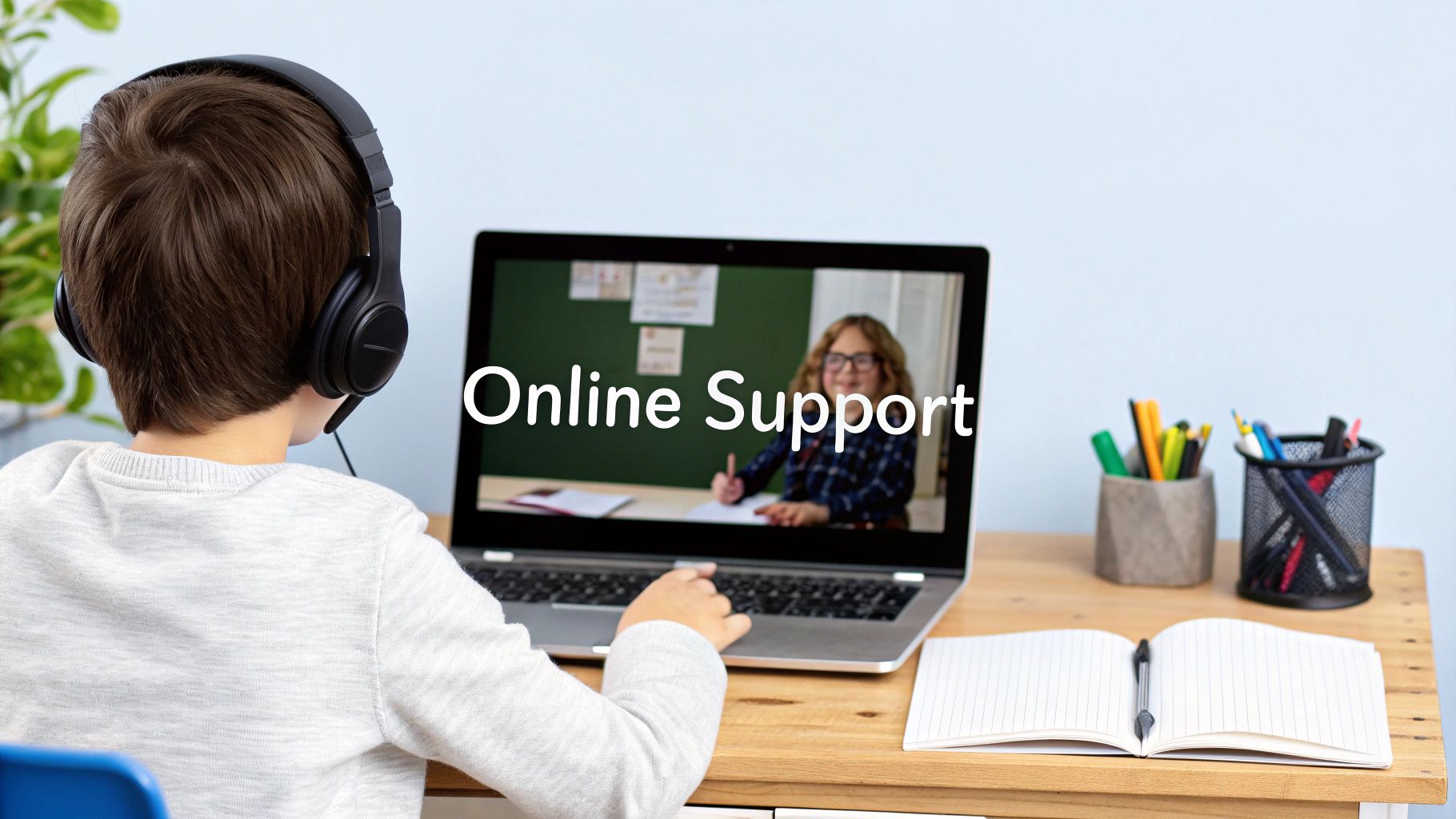
Choosing to homeschool doesn’t mean you have to go it alone. That feeling that you suddenly need to be an expert in every single subject can be pretty daunting, but modern home education offers a powerful partnership through online schools.
This creates a brilliant hybrid model that blends the freedom of homeschooling with the focused expertise you’d find in a traditional school. You get to keep the flexibility and personalised pace your child thrives on while bringing in specialist support exactly where—and when—it’s needed most.
A Hybrid Model for Modern Families
Think of an online school as a specialist tutor you can call on for any subject. Perhaps your teenager is fascinated by science, but A-Level Physics feels completely out of your depth. An online provider can step in with an expert teacher, live interactive classes, and a structured curriculum, making sure your child gets the specialist instruction they need to hit their goals.
This model is wonderfully adaptable to whatever your child needs.
- Practical Example (Supplementing): You could continue teaching humanities using your favourite Charlotte Mason approach, focusing on rich discussions and nature walks. Meanwhile, you could enrol your child in an online school for maths and science, giving them access to expert teachers who can prepare them thoroughly for GCSEs.
- Practical Example (Core Curriculum): An online school could provide the entire core curriculum, handling the planning and assessment. This frees you up to focus on enriching their learning with field trips, volunteering, passion projects, and practical life skills that build character and confidence.
This blend offers a reassuring balance, taking away the pressure to be an expert in everything. It allows you to focus on being your child’s guide and mentor, confident that their academic progress is fully supported.
Targeted Support for Every Learner
This supportive framework is particularly powerful for children with Special Educational Needs (SEN). In a traditional school, large class sizes can make it incredibly difficult for a child to get the individual attention they need to really flourish. Online schools often have small class sizes, where teachers can build a genuine connection with each student.
By partnering with an online school, you give your child more than just academic instruction; you give them access to a supportive ecosystem designed to help them build confidence and succeed on their own terms.
This environment allows for targeted support tailored to your child's specific learning profile. A teacher who understands their challenges can adapt a lesson in real-time, providing the encouragement and tools they need to engage and progress. For families looking for a safer, more nurturing alternative, this level of personalised care is a huge draw.
In fact, data from England shows that school suspensions reached a record 955,000 in 2023–24—a 21% increase from the previous year. This context helps explain why a growing number of families are exploring comprehensive online British curricula that prioritise a child's well-being and offer specialist SEN provision.
Fostering Community and Friendships
One of the most common worries about homeschooling is socialisation. The brilliant thing about a quality online school is that your child joins a vibrant, global community of learners from day one. It completely breaks down the isolation that can sometimes creep into home education.
These platforms are built to foster connection in safe, moderated spaces. Children can join virtual clubs based on their interests—from coding and debating to art and creative writing. They attend online assemblies and social events, building genuine friendships with peers from different cultures and backgrounds.
For a child who felt overwhelmed or unseen in a busy school playground, this offers a different way to connect. They can find their tribe based on shared passions, building social confidence in an environment where they feel understood and valued. You can see how an online home education in the UK can provide both the academic structure and the rich social life your child deserves.
Answering Your Questions About Homeschooling Curriculums
Stepping into the world of home schooling curriculums often brings a mix of excitement and a whole lot of questions. If you're feeling a bit uncertain, that's completely normal. This final section is all about tackling those common queries with clear, practical advice to help you move forward with confidence.
How Much Do Home Schooling Curriculums Cost?
The great news is that homeschooling can be tailored to fit almost any family budget. The financial side is incredibly flexible, with costs ranging from almost nothing to a more significant investment, depending on the path you choose. It’s not about how much you spend, but how wisely you use your resources to meet your child’s needs.
You can absolutely build a rich and effective curriculum using entirely free resources. Websites like BBC Bitesize, Khan Academy, and your local library offer a treasure trove of high-quality materials without costing a penny. For those who prefer a more structured, "off-the-shelf" approach, a complete "boxed" curriculum for a full academic year can range from £300 to over £1,000.
At the higher end, a full-time online school represents a larger investment, but that fee covers live teaching from subject-specialist instructors, all the materials you'll need, and a supportive administrative framework. The best strategy? Set a clear budget first. You might use free tools for subjects where your child is flying and invest in paid options for areas where they need a bit more guided support. The "best" curriculum isn't the most expensive; it's the one that works for your child.
How Can I Support My Child with SEN at Home?
This is one of the most powerful reasons many families choose to home educate. Homeschooling gives you a unique chance to create a truly bespoke learning environment that honours your child's specific needs, free from the pressures and sensory overload that can make a traditional classroom so challenging.
Your child is always the starting point. If they have an Education, Health and Care Plan (EHCP), this document can be an excellent guide for shaping your educational approach. The key is to pick a curriculum that is flexible and can be easily adapted.
- A practical example: For a child with dyslexia who finds reading exhausting, you could use audiobooks for literature and history, allowing them to absorb complex ideas without strain. Maths could be taught with hands-on manipulatives instead of worksheets.
- An online school can offer access to specialist teachers trained in SEN support and the huge benefit of small, focused classes where your child feels seen and heard.
You have the power to control the pace, bring in multi-sensory teaching methods, and build a calm, low-stress environment where they feel safe enough to take risks and truly thrive. Your goal is to create a sanctuary for learning that validates their experience and helps them build unstoppable confidence.
Can My Homeschooled Child Get into University?
Yes, absolutely. Universities across the UK and around the world are very familiar with and welcoming to homeschooled applicants. The path to higher education is clear and well-trodden for home-educated students. The most important thing is to follow a curriculum that leads to recognised qualifications, such as GCSEs and A-Levels.
To sit these exams, your child will need to be registered as a "private candidate" at an approved exam centre. It’s vital to keep meticulous records of their academic work, extracurricular activities, and any passion projects they dive into. This portfolio builds a compelling story of their dedication and abilities.
An organised portfolio and a clear academic record are your child's passport to higher education. Homeschooled students often write standout personal statements for their UCAS applications, highlighting their independence, self-motivation, and deep passion for their subjects—qualities that universities really value.
Partnering with an online school can make this process even smoother, as they can provide official transcripts and predicted grades, taking a lot of the administrative headache out of the application journey.
How Do I Know if My Child Is on Track?
Without the usual school reports landing on your doormat, it’s natural to wonder how you're supposed to measure progress. The good news is that homeschooling allows you to build a much deeper, more holistic picture of your child’s development than a simple grade on a test ever could. You get to see their learning unfold day by day.
Here are a few meaningful ways to track their progress:
- Regular Check-ins: Have gentle, informal chats about what they’re enjoying and what they’re finding tricky. Creating a safe space for them to be honest is crucial.
- Narration: Ask your child to simply tell you about what they’ve learned in their own words. This is a powerful Charlotte Mason technique that reveals true understanding, not just memorisation.
- Portfolio Reviews: Sit down together every few months and look through their work. Celebrate their achievements and chat about what they'd like to focus on next. This shared reflection builds their sense of ownership over their education.
While homeschooling regulations can vary, the core principle of providing a suitable education is universal. For those looking at the fundamentals, it can be helpful to see how things work elsewhere; this resource offers some basic information about American homeschooling, which provides a useful comparative perspective.
At Queen's Online School, we understand that choosing the right educational path is one of the biggest decisions your family will make. We offer a complete online British curriculum with live, interactive classes led by expert teachers, giving you the structure and support to help your child achieve their full potential. Discover how we can partner with your family on this incredible journey. https://queensonlineschool.com