


Choosing the right A-Level path is a huge decision, and as a parent, you feel the weight of that choice deeply. When you consider a maths A level online, you’re exploring a flexible, focused, and rigorous route designed to put your child’s unique needs front and centre. This isn’t just about swapping a classroom for a screen; it’s about finding an environment where they can finally stop struggling and start to genuinely thrive.
Is an Online Maths A Level Right for Your Child?
Watching your child navigate their education can feel like a constant search for the right key to unlock their potential. For some, the traditional classroom is that key. For many others, however, the noise, the pace, and the social pressures can become overwhelming barriers to real learning. An online A-Level in Maths offers a different, and often more effective, approach that can feel like a breath of fresh air.
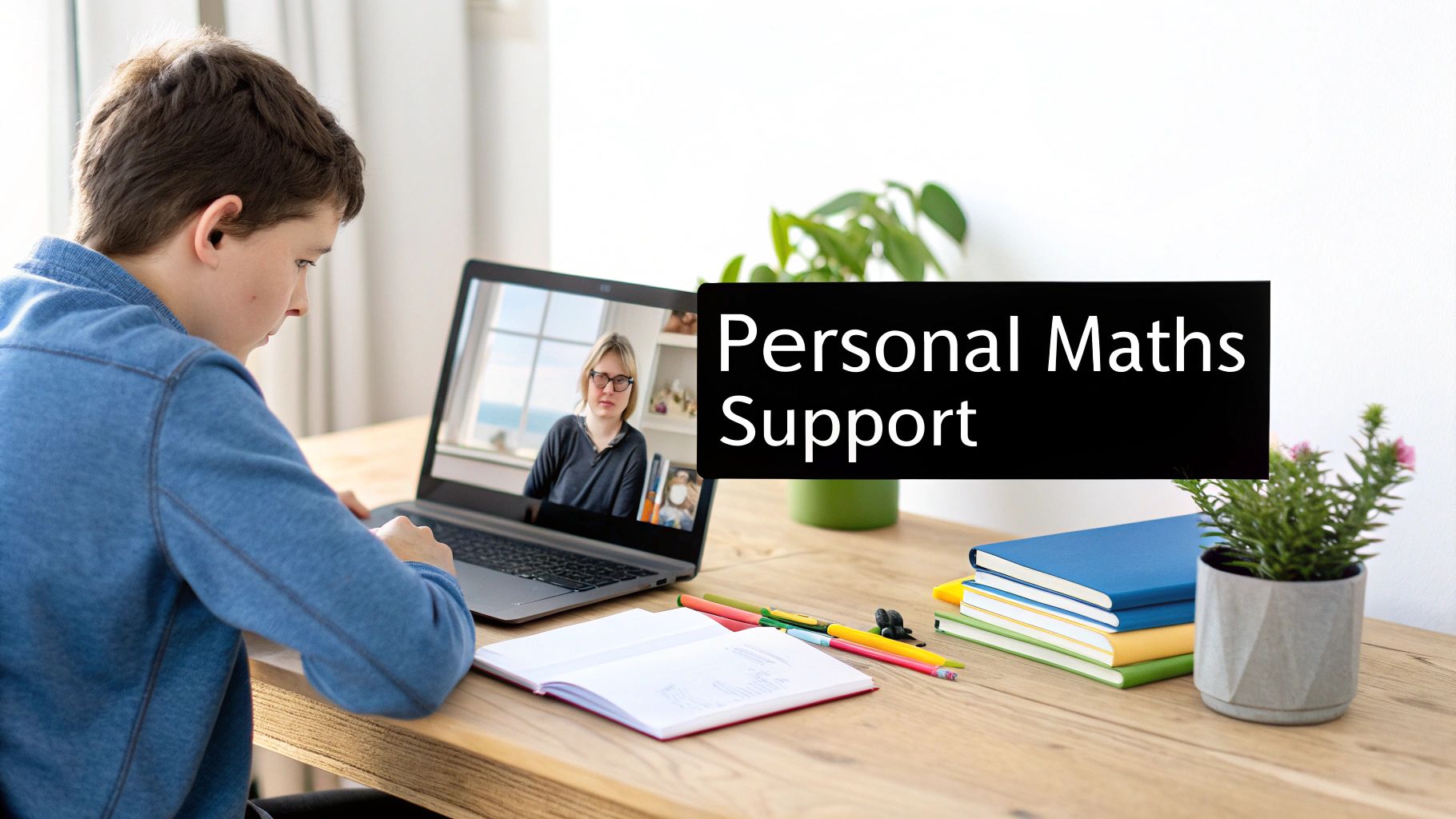
Think about the difference between a crowded lecture hall and a personalised workshop. In a large class of thirty, your child might hesitate to ask a question, worried about slowing everyone else down or being judged for not "getting it." Online, in a small, live interactive class, they are a name, not a number. The teacher gets to know their strengths and the areas where they need that little bit of extra support, fostering a connection that can transform their relationship with the subject.
A Tailored Environment for Every Learner
This personalised setting is a game-changer for so many different types of students. Imagine a talented young footballer, like 'Leo', trying to balance an intense training schedule with his studies. The flexibility of an online A-Level means he can pursue his dream of playing professionally without having to compromise on his academic goals, attending classes from his laptop wherever his training takes him.
For other students, the benefits are even more profound:
- The Quiet Achiever: For the child who is easily distracted or feels anxious in a busy school, the calm focus of learning from home can be a huge relief. It allows them to engage deeply with complex topics without the usual interruptions.
- Students with SEN/SEMH Needs: A structured online environment provides a predictable and supportive space. For a student with dyscalculia, for example, a teacher can use digital tools to break down a problem visually in real-time, building their confidence one step at a time.
- The Ambitious Student: For those aiming for top universities, having access to specialist A-Level Maths teachers—regardless of their postcode—ensures they receive the highest quality of instruction to help them achieve their dreams.
It’s all about creating a space where your child feels seen, heard, and empowered. When a student feels safe to make mistakes and ask questions, they build the academic resilience needed to tackle challenging concepts in calculus or mechanics. That confidence is the bedrock of genuine learning.
Before deciding, it’s worth getting a clearer picture by understanding distance learning education and its core principles. It can also be helpful to explore the dynamics of https://queensonlineschool.com/learning-in-virtual-environments/ to see how these digital classrooms foster success.
Ultimately, the goal is to find a path where your child doesn’t just learn maths, but learns to love the challenge it presents.
What to Expect from the A-Level Maths Curriculum
One of the first questions parents ask when looking into maths a level online is whether the curriculum is as rigorous and respected as the one taught in a traditional school. It’s a completely fair question, and the answer is a reassuring one. Any accredited online A-Level follows the exact same specification from exam boards like Pearson Edexcel. This means your child studies the same content and sits the very same exams as their peers in physical schools.
The curriculum is so much more than abstract numbers; it’s a powerful toolkit for understanding the world. It’s built around three core pillars, each designed to develop a different kind of analytical strength, ensuring your child gains the deep, well-rounded mathematical fluency that top universities and employers are looking for.
The Core of A-Level Maths: Pure Mathematics
Pure Mathematics is the backbone of the A-Level course, making up a full two-thirds of the content. This is where your child will build the foundational skills that underpin every other area of maths. Think of it as learning the language of mathematics itself—the logic, the patterns, and the elegant structures that connect different ideas.
But this isn't about memorising formulas. It’s about seeing how these concepts come to life. The curriculum covers core algebra, fundamental calculus principles, and trigonometry. So when your child studies calculus, they aren't just learning abstract theory; they're discovering the mathematics that helps an animator create realistic movement in a Pixar film, or allows engineers to calculate the precise curve of a suspension bridge.
The goal is to move beyond "how" and discover the "why." A student who understands why a particular method works can apply that knowledge to solve unfamiliar problems—a skill that is absolutely essential for success at university and beyond.
This deep conceptual understanding is what separates a good mathematician from a great one. It fosters problem-solving skills and a logical mindset that is valuable in countless fields, from science and tech to finance and law.
Applying Maths to the Real World: Statistics and Mechanics
The remaining third of the course is split between two fascinating applied modules: Statistics and Mechanics. This is where the abstract principles of Pure Maths are put to work to solve tangible, real-world problems, allowing your child to see the direct relevance of their studies.
- Statistics: If your child is curious about the world, they’ll love statistics. It’s the science of collecting, analysing, and interpreting data. For example, they might analyse real-world data to determine if a new climate change policy is actually working, or use probability to understand the risks involved in financial markets. It equips them with the critical thinking skills needed to question headlines and understand the data shaping our society.
- Mechanics: This is the mathematics of the physical world—of motion, force, and energy. For a student fascinated by engineering, physics, or even sports science, Mechanics provides the tools to model and predict how objects move and interact. It answers practical questions like, "What is the optimal angle to throw a javelin to achieve the maximum distance?" or "How do forces interact on a bridge to keep it standing?"
These applied modules make the subject feel relevant and exciting. They show that maths isn't just a classroom subject; it's a living, breathing discipline that helps us make sense of everything around us.
This rigorous curriculum is a key reason why A-Level Mathematics has become the most popular subject in the UK, with entries now exceeding 112,000. This represents over 12.7% of all A-Level entries—a testament to its value in unlocking doors to top universities where strong quantitative skills are essential. You can explore more about these trends and what they mean for students aiming for higher education by reading the full analysis of A-Level mathematics entries.
How to Choose the Right Online Maths Provider
Choosing an online maths provider can feel like a huge responsibility. You're not just picking a service; you're trusting a vital part of your child's future to people you've probably never met. The questions that keep you up at night—'Will my child actually be seen and heard?' 'What happens if they get stuck?'—are exactly the right ones to be asking.
The key is finding a provider that answers them with genuine care and solid support systems. This is about finding a place where your child won't just learn maths, but will actually start to feel confident and thrive. It means looking past the glossy brochures and focusing on what creates a personal, secure, and academically strong learning experience.
Look for Official Accreditation First
Before you look at anything else, check for official accreditation. This is non-negotiable. Look for providers approved by recognised exam boards like Pearson Edexcel or AQA. Accreditation is your guarantee that the school meets strict quality standards and that the A-Level your child earns will be recognised and respected by universities everywhere.
An online school that is also an approved examination centre is a massive plus. It simplifies the whole exam process, taking away the stress of having to find an external centre. This means your child can sit their exams in a familiar, supportive environment, which can make all the difference on the day.
The Power of Live, Interactive Learning
The way lessons are delivered is probably the biggest factor in your child’s day-to-day experience. Self-paced, pre-recorded courses might sound flexible, but they can also be incredibly isolating. They put all the pressure to stay motivated squarely on the student’s shoulders. For A-Level Maths, where every concept builds on the last, this can quickly lead to frustration and gaps in understanding.
In contrast, live interactive classes create a real, supportive virtual classroom. When your child can raise a virtual hand and ask a question the moment it pops into their head, it stops a small confusion from turning into a major roadblock. It’s that real-time connection with an expert teacher that builds confidence and deepens understanding.
"I had so many students wanting to show their work and defend their work that we couldn’t get through them all in a day…My students were now learning from each other and teaching math to one another. It was a huge moment in our classroom."
This is the kind of engagement that transforms passively watching a video into actively learning. It turns a screen into a community.
A good provider will bring all the core components of the A-Level Maths curriculum to life through this kind of engaging teaching, guiding students through the different pathways available.
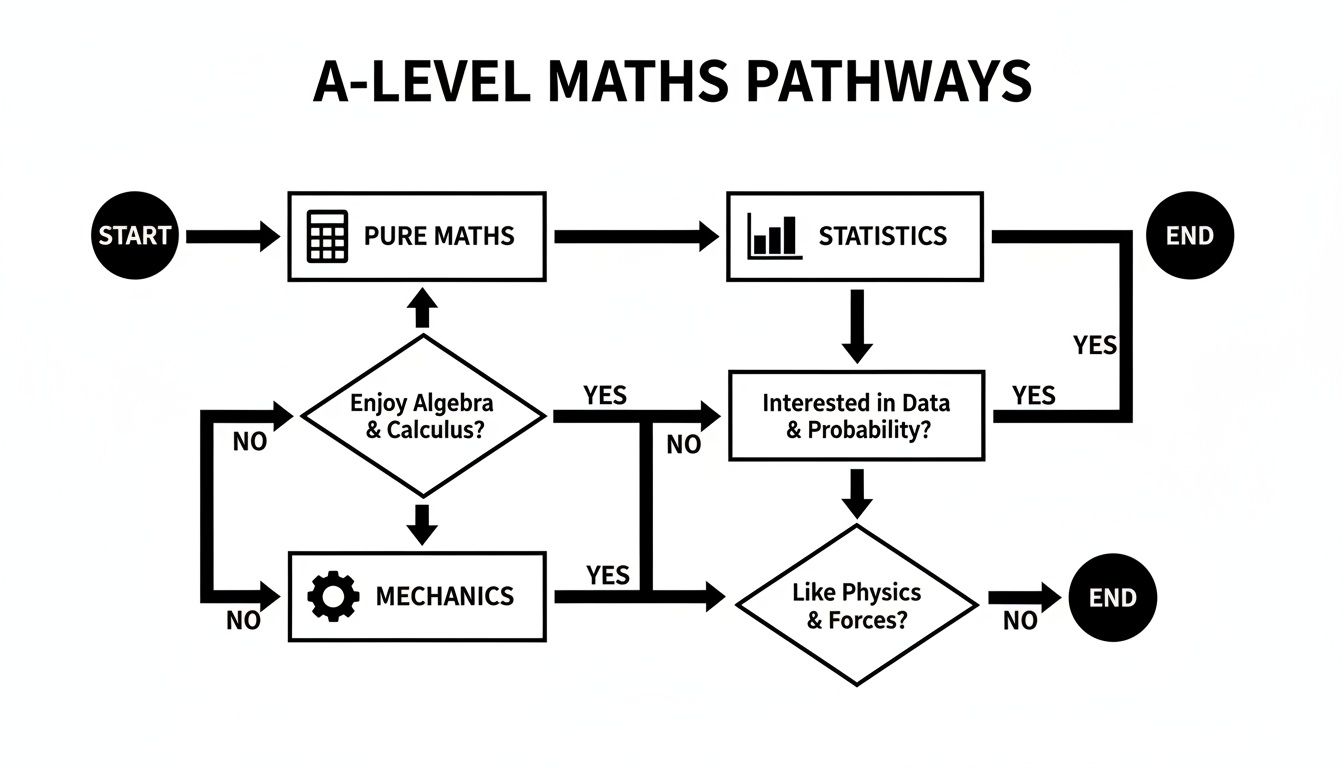
This visual pathway shows how Pure Maths forms the bedrock of the course, with Statistics and Mechanics offering specialised routes that connect maths to real-world applications.
To help you weigh the options, here’s a breakdown of the common delivery models you’ll encounter.
Comparing Online A Level Maths Learning Models
| Feature | Live Interactive School (e.g., Queen's Online School) | Self-Paced Recorded Courses | Private Tutoring Only |
|---|---|---|---|
| Teaching Style | Live, timetabled lessons with a qualified teacher and a small group of peers. | Pre-recorded video lessons that students watch on their own schedule. | One-to-one sessions focused on specific topics or homework help. |
| Social Interaction | High. Students learn with and from peers in a collaborative classroom setting. | Low. Learning is a solo activity with no peer interaction. | Medium. Interaction is only between the tutor and the student. |
| Immediate Support | High. Students can ask questions in real-time and get instant feedback. | None. Questions must be sent via email or forums, with delayed responses. | High. The student gets the tutor's undivided attention during sessions. |
| Structure | High. A consistent school timetable provides routine and accountability. | Low. Requires a high degree of self-discipline and motivation from the student. | Medium. Sessions are scheduled but lack the structure of a full curriculum. |
| Cost | Mid-range. Offers a comprehensive school experience for a termly or annual fee. | Low. Typically the cheapest option as it involves minimal human input. | High. The most expensive option, usually billed by the hour. |
| Best For | Students who thrive on structure, peer interaction, and immediate teacher support. | Highly independent and self-motivated learners who need maximum flexibility. | Students needing targeted support to supplement another form of learning. |
Choosing the right model really comes down to understanding your child's personality and learning style. While a self-paced course might work for a very disciplined student, most young people benefit from the structure, community, and expert guidance a live online school provides.
Prioritising SEN and SEMH Support
For a child with SEN (Special Educational Needs) or SEMH (Social, Emotional, and Mental Health) needs, the right online school can be truly life-changing. It offers a calm, predictable space, free from the sensory overload and social pressures of a busy mainstream school. But this is only true if the provider has proper, dedicated expertise.
When you're talking to potential schools, ask very specific questions:
- Do you have a dedicated SEN Coordinator (SENCo)? A SENCo is crucial for ensuring your child’s individual needs are understood and consistently met.
- Are your teachers trained in inclusive practices? Specialist training means teachers know how to adapt their methods for different learning styles, whether that's for dyslexia, dyscalculia, or managing anxiety.
- What specific support is available? Look for practical things like one-to-one support sessions, genuinely small class sizes, and the option to ask questions privately via chat. These features can empower a child who is nervous about speaking up.
To help you compare different providers, our guide on the best online learning platforms offers more insight into what makes a digital education provider truly effective for all types of learners.
Making this choice is an emotional investment as much as a financial one. By focusing on accreditation, live teaching, and dedicated support for every child, you can find an online school that feels less like a service and more like a partner in your child's success.
The Real Benefits of Studying Maths A Level Online
The decision to study A-Level Maths online often starts with a practical need for flexibility, but the true benefits run much deeper. They touch on your child's confidence, their well-being, and the essential skills they'll carry into their future.
It’s about seeing the relief on your child's face when they finally grasp a concept that used to make them feel lost. It's about watching them develop a belief in their own ability to tackle any challenge.

Think of a student we'll call 'Maya'. She felt anxious and overlooked in a busy school of a thousand pupils. The constant noise made it hard to concentrate, and the thought of asking a question in front of thirty other students was terrifying.
Online, in a small class, everything changed. The calm focus of learning from home allowed Maya to properly engage with complex topics. And the ability to ask her teacher questions directly via private chat gave her a voice she never felt she had before. She started to solve problems she once thought were impossible, and that feeling of achievement was transformational.
This story is incredibly common. When you remove the social pressures and logistical chaos of a traditional school environment, many students don't just cope—they blossom. Their academic self-esteem is rebuilt, lesson by lesson, in a space where they feel seen and supported.
Cultivating Confidence and Future-Ready Skills
One of the most powerful outcomes of online learning is the development of independent study skills that universities absolutely prize. Students learn how to manage their time, take ownership of their learning, and use digital tools like a pro. These aren't just study habits; they're life skills that set them up for the self-directed learning expected in higher education and modern careers.
This structured independence is backed by consistent, high-quality teaching. The achievement rates in A-Level Mathematics tell a compelling story of steady excellence. In recent results, 42.6% of male entrants and 40.2% of female entrants scored top A*-A grades—remarkably consistent with previous years. For parents, this reliability is a huge part of the appeal; it shows that a structured online model delivers dependable results. You can explore the full A-level results and trends to see this consistency for yourself.
An online maths A level empowers your child by giving them access to specialist teachers, a supportive community, and the space to find their academic footing. It’s about building a foundation of confidence that extends far beyond the final exam.
Global Connections and World-Class Education
Online learning also opens up a world of new opportunities, connecting your child with people and expertise they might never encounter in their local school.
- Access to Specialist Teachers: Your postcode no longer limits your child's access to the best educators. An online school can connect them with passionate, subject-specialist maths teachers from anywhere in the country.
- A Diverse Global Community: Students learn alongside peers from different countries and cultures. This doesn't just broaden their perspectives; it prepares them for a globalised world.
- Education Without Borders: For international families, this model provides access to a world-class British education and a prestigious A-Level qualification without the upheaval of relocation.
This combination of personal growth, academic rigour, and global connection is what makes studying A-Level Maths online such a compelling choice. It’s a pathway that prioritises your child's well-being while preparing them for a very bright future.
Navigating Exams Costs and University Applications
Thinking about the practical steps of exams and university applications can feel a bit daunting. This is the point where all the hard work connects to your child's future, and getting it right can give you both real peace of mind.
Let's start with the financial side, as it's often the first question on parents' minds. When studying for a maths A-Level online, the costs split into two key areas: the course tuition fees and the separate fees for sitting the final exams.
These exam fees are paid directly to an approved examination centre and can vary quite a bit, typically ranging from £150 to £250 per A-Level subject.
Finding an Exam Centre and Managing Costs
Most online students sit their exams as a private candidate. In practice, this means you have to find a local school or college that accepts external students, which can involve a lot of phone calls and administrative stress.
This is exactly why choosing an online school that is also a Pearson Edexcel Approved Examination Centre is such a huge advantage.
It just simplifies everything. Your child can sit their exams in a familiar, supportive environment, run by the same people they’ve come to know and trust. It takes a massive layer of logistical worry off your plate, freeing your child up to focus completely on their performance.
The goal is to make the exam experience as seamless as possible. A calm, familiar setting can have a real impact on a student's confidence and results on exam day, turning a potential source of anxiety into a straightforward final step.
Showcasing Strengths to Top Universities
A common question we hear is: "How do top universities view online A-Levels?" The answer is simple—they are valued equally. The qualification itself is identical to one earned at a traditional school. What admissions tutors at leading universities really care about is the final grade, not how it was taught.
In fact, the experience of online learning can be a powerful asset on your child's UCAS personal statement. It demonstrates qualities that universities are desperate to see in their undergraduate students.
- Self-Discipline and Time Management: Your child can talk honestly about how they structured their own study schedule, using a real-life example: "I created a weekly timetable, blocking out time for live lessons, independent study on calculus, and practice papers, which helped me stay on track for my mock exams."
- Digital Fluency: They have become experts in using digital learning tools for collaboration and research—skills that are absolutely essential for success at university.
- Resilience and Initiative: Choosing an online path isn't the default option; it shows a proactive and mature approach to their own education.
These aren't just empty buzzwords; they are concrete examples of the skills your child has been developing every single day. For more detailed advice, our guide on how to apply to UK universities offers practical tips on crafting a compelling application. An online A-Level gives them a unique story of independence and focus that can truly make a personal statement stand out from the crowd.
Your Questions About Online A-Level Maths Answered
Deciding on an online A-Level in Maths for your child is a big step, and it’s completely natural to have a few questions swirling around. You're making a major investment in their future, and you need to feel confident you're making the right call.
We hear from parents all the time, and the same thoughtful concerns often come up. Let's tackle them head-on.
Will My Child Feel Isolated Studying A-Level Maths Online?
This is probably the number one worry we hear, and it’s a valid one. The image of a teenager learning alone in their room isn't what any parent wants. But the reality of a great online school is a world away from that picture.
The best online schools are built around creating a lively and supportive community. Through live lessons in small groups, students see, hear, and talk directly with their teachers and classmates in real time. They’re not just passively watching a screen; they’re actively participating.
Think of a practical example: a teacher sets up a breakout room for three students to tackle a difficult mechanics problem together. One student shares their screen, another suggests a formula, and the third points out a potential error. This is active, collaborative learning that builds both skills and friendships. Far from being isolating, this model often creates a powerful sense of belonging.
A supportive learning community is built on interaction and shared experience. When students feel part of a team, tackling challenging problems together, they build not just knowledge but also friendships and confidence.
How Do Top Universities View Online A-Level Maths Qualifications?
This is a simple one: top universities, including the prestigious Russell Group, see A-Levels from accredited online schools as exactly the same as those from a traditional school. The qualification is identical, the curriculum is the same, and the exam board is the same. What admissions tutors really care about is the final grade.
In fact, many universities now view the online learning experience as a bonus. It tells them a student is self-disciplined, organised, and comfortable with the kind of digital tools they'll be using at university. It demonstrates a maturity and a commitment to their own learning that can make an application truly stand out.
What Happens If My Child Struggles With a Topic?
This is where a live, interactive teaching model really shows its strength. In a small class, a specialist teacher will notice immediately if a student is finding something difficult. They can then offer personalised support right there and then, in the lesson. There's no need to wait weeks for a parent-teacher evening to find out there’s a problem.
For instance, if your child is struggling with trigonometric identities, the teacher can instantly pull up a virtual whiteboard, draw the unit circle, and walk them through the logic step-by-step, ensuring they grasp it before the lesson moves on. A good online school will also have a strong safety net:
- One-to-one support sessions for extra help when a concept just isn't clicking.
- Regular progress checks and detailed feedback to spot any issues early on.
- Recorded lessons that students can re-watch whenever they need a refresher.
Help is always on hand. A moment of confusion is just that—a moment—not a long-term barrier to success.
Is an Online A-Level a Good Fit for a Child with SEN or Anxiety?
For many students with SEN, or for those who find the traditional school environment overwhelming, online learning can be genuinely transformative. It removes the social pressures and sensory overload of a busy, noisy school building. It creates a calm, predictable, and safe space where they can focus purely on learning.
Imagine a student who experiences anxiety. The simple ability to ask a question privately using the chat function, without 30 pairs of eyes turning to look at them, can be incredibly empowering. This feature gives them a voice and helps them build their confidence, step by step, in a way that feels safe and manageable. Leading online schools have dedicated SEN coordinators and teachers trained in these inclusive practices.
At Queens Online School, we don’t just have answers to these questions—we’ve built our entire school around them. We believe every child deserves an education that sees them, supports them, and inspires them. Our live, interactive classes and dedicated specialist teachers create a community where your child won't just learn, they'll flourish. Discover how we can support your child’s A-Level journey today.