


Choosing the right educational path for your child can feel like navigating a complex map with countless routes. You worry, you research, and you hope you're making a choice that will open up a world of possibilities for them, not close doors. The weight of that decision is real.
This is where the Pearson Edexcel International GCSE comes in. Think of it less like a simple school certificate and more like an academic passport, giving your child the freedom to explore their future anywhere in the world.
Your Child's Passport to Global Opportunity
A standard UK GCSE is like a domestic ID – perfectly valid and respected within the UK. The International GCSE, however, is the passport. It holds the same value at home but is also instantly recognised and welcomed across the globe, from universities in the US to institutions in Australia and Europe.
This global recognition isn't an accident; it's designed with your child's future in an interconnected world at its very heart.
A Curriculum Built for a Global Citizen
The curriculum isn't just a UK course taught abroad; it's built from the ground up with a child like yours in mind—one who may live anywhere in the world. This means the content is more culturally inclusive and relevant to young people from diverse backgrounds.
Imagine your child studying a history topic not just from one country's viewpoint, but framed with international perspectives. This doesn't just teach them facts; it helps them develop a broader, more empathetic worldview, preparing them to be a true global citizen. For a deeper dive into the nuances, you can explore the differences between GCSE and IIGCSE in our detailed guide.
Why This Matters for Your Child
Ultimately, this choice comes down to one simple truth: you want the very best for your child. The anxiety around making the right decision is completely understandable. The real value of the Pearson Edexcel International GCSE is the confidence and peace of mind it provides you as a parent.
Choosing this pathway means you are equipping your child not just with knowledge, but with a qualification that speaks a universal language of academic excellence, recognised by the world's leading universities.
This isn't just about passing exams. It’s about giving your child the tools and credentials they need to turn their dreams into reality, whether that means attending a top UK university or pursuing their passion at an institution on the other side of the world. It provides them with:
- Global University Access: Qualifications that are welcomed by admissions officers from Cambridge to Cornell.
- Relevant Learning: A curriculum that makes sense to an international student, promoting a wider, more inclusive perspective.
- Future-Proof Skills: An education that prepares them for a world where their talent and knowledge matter more than borders.
Choosing Subjects That Ignite Your Child's Passion
Picking GCSE subjects feels like a huge moment for any family. It’s that point where the future starts to feel real, mixing excitement with a bit of "Are we making the right choice?" pressure. It’s completely normal to feel the weight of this decision, wanting to guide your child towards a future where they will be happy and fulfilled.
The great thing about the Pearson Edexcel International GCSE framework is its design. It’s built to turn that pressure into a journey of discovery for your child. The focus is on real understanding and critical thinking, which helps them connect with subjects in a much deeper, more personal way.
When a child is genuinely interested in what they’re learning, it stops being a chore and becomes a passion. That’s the real goal here: to help them find the subjects that spark their curiosity and make them feel capable and inspired.
This qualification is more than just a certificate; it's a key that unlocks doors to top-tier universities and global opportunities.
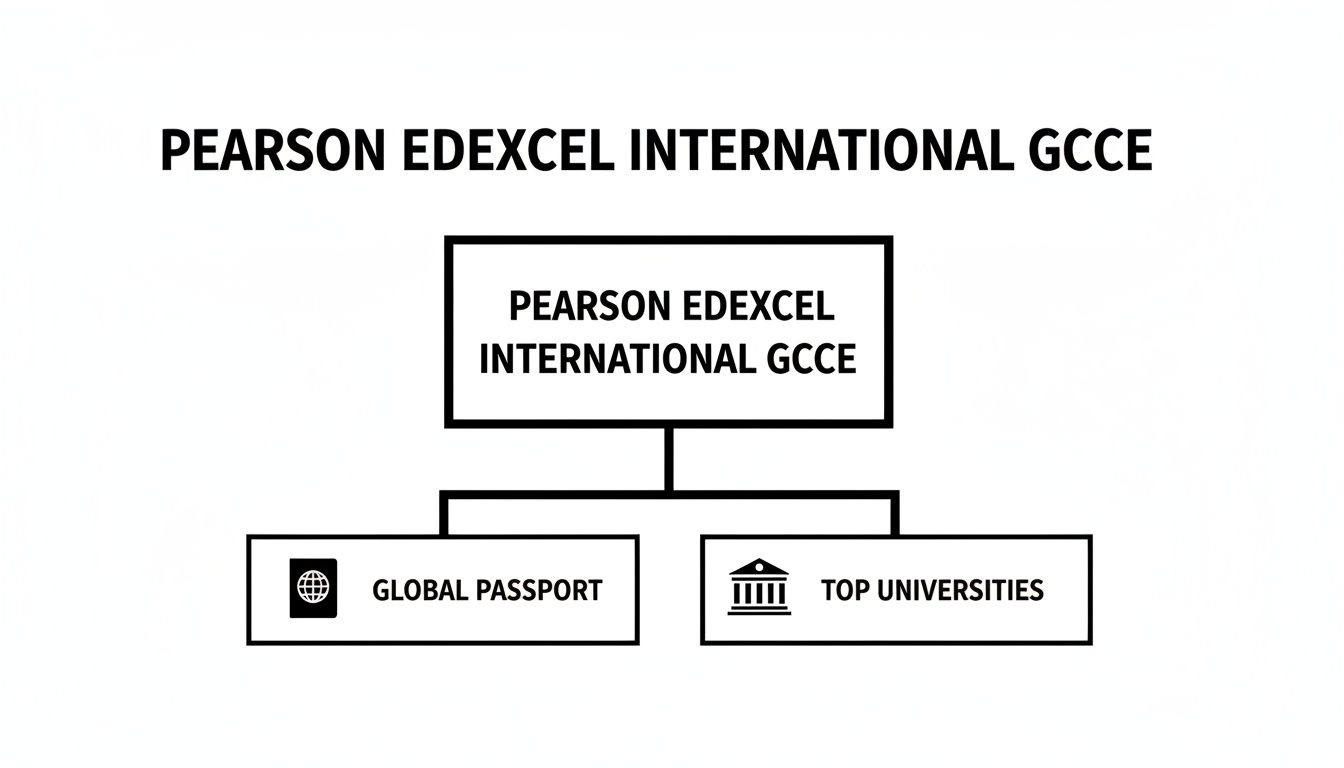
As the diagram shows, International GCSEs are the foundational step toward helping your child achieve their biggest academic and personal goals on a worldwide stage.
From Core Skills to Creative Pursuits
The range of subjects on offer is incredibly broad, designed to cater to all sorts of interests and talents. You’ve got the core disciplines, of course—Mathematics, English, and the Sciences (Biology, Chemistry, and Physics). These are the bedrock of any solid education, building the essential analytical and communication skills that are priceless no matter what career path your child follows.
But the options don’t stop there. Does your child have an entrepreneurial streak? A subject like Business can be transformative. For example, instead of just defining 'profit', they might be tasked with creating a business plan for a sustainable café, getting hands-on experience with marketing, finance, and operations. This turns theory into a tangible project they can feel proud of.
Are they fascinated by different cultures and global issues? Global Citizenship provides a fantastic lens for exploring complex societal challenges, helping them understand the world and their place in it. A student taking International GCSE Biology won't just learn about cells from a textbook; they’ll analyse real-world case studies on disease prevention, sharpening their evaluation skills and connecting their learning to a purpose.
The goal is to empower your child to build a curriculum that reflects who they are and who they want to become. It’s about creating a set of qualifications that tells a story of their unique talents and aspirations.
Navigating all these choices can feel a bit overwhelming, which is why we've put together a clear, step-by-step framework to help. For more detailed guidance, check out our expert advice on how to choose GCSE subjects. It's designed to support your family's discussions and help you move forward with confidence.
Building Pathways to Future Success
One of the best ways to motivate a teenager is to help them see the link between their schoolwork today and their dreams for tomorrow. While nobody expects a 14-year-old to have their entire career mapped out, understanding how certain subjects open specific doors can make the decision-making process much clearer and less stressful for them.
To help you and your child visualise these pathways, we’ve put together some popular subject combinations and the university degrees they often lead to.
Popular International GCSE Subject Pathways and University Aspirations
This table offers a starting point, showing how different subject combinations can pave the way for specific university courses and careers.
| Subject Combination | Potential University Degrees | Key Skills Developed |
|---|---|---|
| Maths, Further Maths, Physics, Chemistry | Engineering, Computer Science, Physics, Astrophysics | Logical reasoning, problem-solving, advanced numeracy |
| Biology, Chemistry, Maths, English Literature | Medicine, Dentistry, Veterinary Science, Pharmacy | Scientific inquiry, data analysis, empathy, communication |
| History, English Literature, French, Art | Law, Journalism, History of Art, International Relations | Critical analysis, persuasive writing, cultural understanding |
| Business, Economics, Maths, Geography | Finance, Business Management, Marketing, Urban Planning | Strategic thinking, commercial awareness, data interpretation |
Think of this table as a conversation starter, not a rigid set of rules. The most important thing is to have an open, heartfelt dialogue with your child, exploring what genuinely sparks their interest. The best subject choices will always be a combination that feels both challenging and deeply rewarding for them.
Understanding Grades and Global University Recognition
For most families, the mere mention of exam results can bring on a wave of anxiety. It's a completely normal feeling. You want to see your child’s hard work rewarded, but the codes and systems used for grading often feel confusing, if not a little intimidating. It’s your child’s future, and you deserve to feel clear about what it all means.
Our goal here is to cut through that confusion and give you some peace of mind. Let’s demystify the assessment process for the Pearson Edexcel International GCSE, so you feel informed and confident about what the results truly mean for your child's journey.
Decoding the 9 to 1 Grading System
Pearson Edexcel International GCSEs use a 9 to 1 grading scale, with 9 being the highest possible grade. If you’re more familiar with the older A* to G system, it’s helpful to see how the two compare.
Think of it this way: the new system was designed to give more recognition to students who achieve the very highest marks. It offers more nuance, which can be a real advantage when your child is applying to competitive universities.
Here’s a simple way to translate the grades:
- Grade 9: This is reserved for the absolute top-performing students, sitting above the old A*.
- Grade 8: Roughly equivalent to the lower end of an A*.
- Grade 7: This lines up with the old A grade.
- Grade 5: Considered a 'strong pass' and is equivalent to the top of a C or the bottom of a B grade.
- Grade 4: This is a 'standard pass' and aligns with a C grade.
For most A-Level courses and universities, a grade 4 or 5 is the minimum requirement in essential subjects like Maths and English. A grade 7 or above is often what top-tier institutions look for as a sign of high academic ability. Seeing your child achieve these grades is a wonderful affirmation of their effort.
Recognised by the World's Best Universities
The most important question for any parent is, "Will these qualifications actually open doors for my child?" The answer is a resounding yes. Pearson Edexcel International GCSEs are respected and accepted by universities all over the globe.
Their reputation is built on rigour and high academic standards. Just look at the recent performance data for UK-based students. In the Autumn 2023 exam series for English Language B, 49.7% of UK candidates achieved grades 9-7, and an incredible 86.5% secured grades 9-5. You can explore these impressive UK student achievements in more detail.
This level of performance ensures that universities—from the UK’s prestigious Russell Group to the US Ivy League—see these qualifications as a reliable indicator of a student’s potential.
“Oxford does not differentiate between the mode of assessment for practical skills in IALs… Both are accepted as valid qualifications. Oxford does not have a preference for one exam board over another, as International A Levels offered by Pearson Edexcel, Cambridge International (CAIE), or Oxford AQA are all considered equally when assessing applicants’ academic qualifications.”
— Undergraduate Admissions and Outreach, University of Oxford
This statement from Oxford itself highlights the trust that elite institutions place in these qualifications. Your child's hard work will be recognised on a global stage. From the University of Cambridge in the UK to Cornell University in the US and the University of Melbourne in Australia, these GCSEs are a recognised mark of excellence, giving your child the best possible launchpad for their future.
Sorting out the practical side of exams can often feel like a full-time job in itself. Just when you think you should be focused on supporting your child’s revision, you’re suddenly faced with timetables, deadlines, and the search for an exam centre. It can be a real headache, but with a clear plan, it’s just a series of manageable steps.
Your first port of call is getting to grips with the exam series. The main Pearson Edexcel International GCSE exams are held in May/June, which is when the vast majority of students sit their papers. But it’s good to know there are other windows, especially if your child needs a plan B or a resit.
This built-in flexibility is a huge relief for many families. It gives your child a second chance to show what they can do without the pressure of waiting an entire year, allowing them to learn from the experience and try again with fresh confidence.
Understanding the Key Exam Series
The exam schedule has been refined over the years to better support students. A key change is the introduction of a major November series, which has replaced the old January window. Pearson Edexcel has confirmed that 24 subjects are now offered in this autumn slot, with timings aligned to GMT to make things simpler for UK-based centres. It provides a structured, predictable opportunity for exams outside of the main summer rush. You can discover more about the November series straight from the source.
This autumn window is perfect for a few scenarios:
- Resits: It offers a timely opportunity for your child to improve a grade, turning a disappointment into a learning moment.
- Modular Learning: It lets your child sit an exam as soon as they feel ready, building their confidence one subject at a time.
- Spreading the Load: Taking a few exams here can ease the immense pressure of sitting them all in one go in the summer.
Getting these dates in your diary well in advance is crucial. Once you have them, you can work backwards and map out a revision plan that feels steady and controlled, not frantic, for both you and your child.
Finding an Approved Exam Centre
If your child is studying with a provider that isn't an approved exam centre, you'll need to find one yourself and register as a 'private candidate'. This usually means ringing around local schools and colleges to see if they accept external students for exams.
Honestly, this process can be a nightmare. We’ve heard from countless parents who have spent weeks on the phone, only to be told that centres are full or simply don’t take private candidates. It adds a huge amount of stress right when you and your child need it least.
The simplest, most stress-free path is to enrol with an online school that is also a Pearson Approved Examination Centre. When your school and exam centre are one and the same, the entire administrative burden disappears.
At Queen’s Online School, we are a fully approved Pearson exam centre. For our students, this means there’s no frantic search for a place to sit their exams. We handle all the registrations, deadlines, and logistics for them.
Think of the relief in knowing all those practical details are sorted. Instead of chasing down exam officers and filling out paperwork, you can put that time and energy where it truly counts: encouraging your child and being there for them as they prepare for the big day. It allows your family to focus on the learning, knowing the final step is already secure.
Personalised Learning and SEN Support Systems
Every child learns differently. As a parent, one of your biggest worries might be whether your child will get the individual attention they need to truly thrive. This concern can feel even more pressing if your child has Special Educational Needs (SEN) or needs support with their Social, Emotional, and Mental Health (SEMH).
The structure of the Pearson Edexcel International GCSE is designed to be flexible, but it’s within a supportive learning environment that this flexibility truly comes to life. The goal is never to make a child fit the mould of an exam; it's about shaping the support system to fit the unique needs of your child.

This philosophy ensures that every student, regardless of their learning style or challenges, has an equal opportunity to show what they know. It’s all about building a bridge between your child’s potential and their performance, and giving you the peace of mind that they are being properly cared for.
Tailoring Support for Every Learner
A one-size-fits-all approach to education simply doesn't work. Recognising this, Pearson Edexcel offers a robust framework for what are known as 'access arrangements'. These are pre-agreed adjustments made to exams that remove barriers for students with specific needs, all without changing the academic demands of the qualification itself.
These arrangements aren't about giving an unfair advantage; they’re about levelling the playing field so your child can show what they truly know. For a child who struggles with processing speed, a standard timed exam can be an overwhelming source of anxiety. It doesn't test their knowledge of the subject, only their ability to work under immense time pressure.
Some practical examples of these accommodations include:
- Extra Time: A student with dyslexia might be granted 25% extra time to read and process the exam questions. This allows them to demonstrate their deep understanding of Shakespeare without being held back by their reading speed.
- Supervised Rest Breaks: For a child with anxiety or ADHD, the ability to take short, supervised breaks can make a world of difference. It lets them step away, refocus, and manage their stress during a long exam, preventing them from becoming overwhelmed.
- Use of a Word Processor: A student with dysgraphia, who finds handwriting physically painful or difficult, can type their answers. This ensures their brilliant ideas are what's being judged, not their penmanship.
These adjustments are carefully considered and require evidence of need, ensuring the integrity of the Pearson Edexcel International GCSE is always maintained.
A Story of Flourishing with Support
Imagine a student we’ll call Alex. He’s a bright and creative thinker who loves history but has dyslexia. In a traditional classroom, timed essays were his biggest fear. The jumble of words on the page and the pressure of the clock meant his written work never reflected the deep historical knowledge he held inside. His confidence was plummeting, and his parents felt heartbroken watching him struggle.
When Alex joined an online school to prepare for his International GCSEs, his support system was rebuilt from the ground up. His teachers used dyslexia-friendly fonts and provided notes in advance. Most importantly, the school worked with his family to apply for access arrangements.
In his exams, Alex was granted the use of a word processor and extra time. For the first time, he could focus on what he knew, not how he wrote it down. The relief was transformative. He went on to achieve a grade 8 in History, opening the door to his A-Level aspirations.
This is the power of a personalised approach. It moves beyond just accommodating a need; it actively empowers a child to realise their true potential. For parents, there is no greater feeling than seeing your child succeed on their own terms, with their confidence restored. You can learn more about how our online courses are structured to support SEN students.
Accessible Qualifications for All
This commitment to accessibility is woven into the very fabric of the qualifications. When exploring support systems, it's also helpful to look at specific challenges, such as understanding dyslexia in second language learning, which is particularly relevant for students taking modern language IGCSEs.
The structure of Pearson Edexcel International GCSEs is designed to recognise a wide range of attainment. For instance, data from the Autumn 2023 exams for Science (Double Award) showed that 80.6% of UK candidates achieved at least a grade 3. This highlights a robust qualification that supports diverse learners and shows that with the right support, success is achievable for every child.
Why an Online School Is the Modern Choice for GCSEs
Choosing the right educational path for your child is about more than just the curriculum. It’s about finding an environment where they feel safe, supported, and truly seen. For many parents, online schooling might feel like a leap into the unknown. What does a typical day actually look like, and how can it create a space where a child doesn’t just learn, but thrives?
Let’s step into the shoes of a student preparing for their Pearson Edexcel International GCSEs online. Their morning doesn’t begin with a frantic school run. Instead, they log into their virtual classroom calmly, ready to learn. They aren’t one of thirty faces in a crowded room; they’re part of a small, focused group of around ten students from different corners of the world.
The lesson is live and fully interactive. Their teacher, a subject specialist, knows every student by name, their strengths, and where they might need a little extra help. For example, if a student is struggling with a concept in Physics, the teacher can instantly share an interactive simulation to make it clearer for them. Students who are shy can use a private chat function to ask questions without the anxiety of speaking up in front of everyone.

A Community Built on Safety and Respect
This carefully moderated environment is built on a foundation of safety. There’s a zero-tolerance anti-bullying policy that isn’t just a poster on a wall—it’s actively enforced. Every interaction is respectful, creating a positive atmosphere where your child can build real confidence and focus purely on their learning and friendships, giving you peace of mind.
Between lessons, they might join a virtual club for coding, debating, or creative writing, connecting with peers who share their passions. This sense of community is powerful, proving that deep, meaningful friendships don’t need school corridors to flourish.
To deliver this kind of personalised learning and robust SEN support, an online school's technology is crucial. The very best learning management systems are used to create a digital campus that is both seamless and supportive for every student.
Flexibility That Empowers Your Child
Even after the structured day ends, the learning continues—but on their terms. Because every lesson is recorded, your child can revisit a tricky concept in Chemistry or re-watch a complex Maths problem being solved. This is how they build the autonomy and independent study skills that are absolutely essential for A-Levels and university.
This flexibility also carves out precious time for life beyond the screen. It allows a talented musician to get in their afternoon practice, an aspiring athlete to attend training sessions, or simply gives a child more time to rest and recharge, preventing the burnout that so many young people experience.
This isn't just a substitute for traditional school; it's a modern, intentional choice for a superior learning experience. It puts your child's well-being and academic growth at the very centre of everything, empowering them to succeed not just in exams, but as confident, resilient individuals.
For families considering the Pearson Edexcel International GCSE journey, choosing an online school offers real, tangible benefits:
- Personalised Attention: Small class sizes mean your child will never get lost in the crowd.
- A Safe Haven: A secure, bully-free environment where your child feels respected and heard.
- Global Connections: The chance to learn alongside a diverse, international community of peers.
- A Balanced Life: The flexibility for your child to pursue passions, manage their time, and avoid burnout.
Your Questions About International GCSEs Answered
Stepping into the world of different qualifications can feel a little confusing, and it’s perfectly normal to want clear, honest answers. We’ve put together some of the most common queries we hear from parents to help you feel confident that you’re making the right choice for your child’s future.
Our aim here is to cut through the jargon and give you the reassurance and clarity you need for the journey ahead.
Are International GCSEs a Proper Equivalent to UK GCSEs?
Yes, absolutely. This is often the biggest worry for parents, but let me put your mind at ease. Leading universities across the world, including the UK’s prestigious Russell Group, recognise Pearson Edexcel International GCSEs as a direct equivalent to UK GCSEs. They carry the exact same academic weight and value.
To make sure of this, the qualifications are fully regulated by Ofqual, the UK's official qualifications authority. This process ensures they meet identical, rigorous standards. Your child will be on an equal and fair footing when applying for A-Levels and competitive university places, with no disadvantage whatsoever.
How Can an Online School Actually Support Students with SEN?
This is an area where a dedicated online school can make a profound difference to a child's life. At Queen’s Online School, we don’t just offer support; we build it into the very fabric of your child’s education. We create Individual Education Plans (IEPs) that are designed around your child’s specific needs from day one. Our small class sizes also mean that every child gets genuine, personal attention from their teachers.
For example, a teacher will know if a student needs instructions broken down into smaller steps or benefits from visual aids. Our digital platform makes it straightforward to integrate assistive technology, and we handle all communications directly with Pearson Edexcel for you. We’ll arrange any official exam accommodations, like extra time or a scribe, empowering your child to show what they can really do, free from unnecessary stress.
What Happens if My Child Needs to Resit an Exam?
The path through education isn’t always a straight line, and sometimes a child has a bad day or struggles with a subject. The International GCSE exam schedule is built with this reality in mind, offering a flexibility that can be a huge relief for families.
With a main exam series in May/June and another in November for many core subjects, students have clear and timely opportunities to improve their grades if they need to.
This structure does away with the long, anxious wait for another full year to pass. It allows a student to refocus, rebuild confidence with targeted support, and show what they are truly capable of without losing precious momentum.
At Queen's Online School, we don’t just leave them to it. We provide dedicated revision courses and one-to-one support to help students get ready for resits, focusing on mastering those tricky topics and, just as importantly, rebuilding their self-belief. It turns a setback into a comeback story.
At Queen’s Online School, we believe in providing a supportive, empowering, and world-class education for every child. Discover how we can help your child flourish on their Pearson Edexcel International GCSE journey by exploring our programmes at https://queensonlineschool.com.