

Choosing a curriculum for home schooling is about so much more than just picking out textbooks. It’s an emotional and deeply personal decision about crafting an educational path that lets your child truly flourish—one that honours their unique spirit, ignites their natural curiosity, and builds a rock-solid foundation for their dreams.
Finding the Heart of Your Homeschooling Journey

Stepping into the world of home education can feel like standing at the shore of a vast ocean. The sheer number of curriculum options stretching out before you can be overwhelming, sparking a mix of excitement and anxiety. Where on earth do you even begin?
The secret is to start not with a catalogue of resources, but with your child. A curriculum isn't just a list of subjects to tick off. It's the philosophy that guides your days, the rhythm of your learning week, and the very soul of your child’s educational adventure. It's the difference between forcing a child who learns by doing to sit still with worksheets, and instead giving them a science kit that makes their eyes light up with wonder.
Shifting Your Perspective
Instead of asking, "Which curriculum is the best?", try asking a far more powerful question: "What does my child truly need to thrive?" This simple shift reframes the entire process. It transforms what could be a stressful decision into an incredible opportunity to connect with your child on a much deeper level and truly see them for who they are.
Think about these starting points to get a real sense of their needs:
- Personality: Is your child an energetic explorer who feels stifled sitting still, or are they a quiet thinker who gets lost in a single topic for hours? The former might need a curriculum built around field trips and projects, while the latter would adore a deep dive into a historical period.
- Learning Style: Do they learn best by listening, seeing, or doing? For example, a visual learner will grasp fractions with colourful charts, while a kinesthetic learner needs to physically cut a pizza or a cake to truly understand the concept.
- Passions: What makes them completely lose track of time? Weaving their love for Japanese anime, video game design, or horses into your chosen curriculum will ignite a genuine passion for learning that lasts a lifetime.
By putting your child at the very centre of this decision, you move past generic solutions and start building an education that feels like it was made just for them. Exploring the many benefits of home education can also bring clarity, showing how this personalised approach supports a child's overall well-being and academic growth.
A curriculum for home schooling should feel less like a rigid script and more like a compass. It gives you direction while allowing you the freedom to explore the beautiful and unexpected detours your child's curiosity will inevitably create.
You Are Not Alone on This Path
If you're considering this journey, it’s reassuring to know you are part of a rapidly growing community. The number of families choosing elective home education (EHE) in England grew from an estimated 92,000 to 111,700 children between autumn 2023 and autumn 2024.
That’s an increase of roughly 21% in a single year, proving that curriculum-based home schooling is now a significant and respected educational path for thousands of families. This is a journey of empowerment, and it all starts with finding the heart of your homeschool.
Exploring Different Home Schooling Models
Now that you have a clearer, more loving picture of your child's needs, it's time to explore the 'how'. Choosing a model for your home schooling journey is a bit like trying on different coats; each has a unique style, fit, and feel. Some are formal and structured, while others are flexible, designed to move and breathe with the person wearing them.
Your goal is to find the one that fits your child and your family culture just right. By understanding the core philosophy behind each model, you can get an intuitive sense of which one resonates with your values and, most importantly, with your child’s personality. Let's walk through some of the most common approaches.
Comparing Popular Home Schooling Curriculum Models
To help you get a quick sense of the landscape, this table breaks down the core ideas behind the most common home schooling philosophies. Think of it as a quick-glance guide to help you start matching a model to your child's learning style and your family's goals.
| Curriculum Model | Core Philosophy | Best For a Child Who… | Parental Involvement |
|---|---|---|---|
| Traditional (School-at-Home) | Replicates a conventional school environment with a set timetable, textbooks, and graded assessments. | Thrives on structure, routine, and clear expectations. Needs the security of a predictable day. | High – Parent acts as the teacher, delivering pre-planned lessons and marking work. |
| Classical | Follows a three-part process (the 'Trivium') that aligns with a child's cognitive development: grammar, logic, and rhetoric. | Enjoys deep, systematic learning, history, and making connections between subjects. | High – Requires the parent to guide the child through rigorous, content-rich material. |
| Charlotte Mason | Based on the idea that children are whole persons who learn best from 'living books', nature, and the arts. | Is creative, loves stories, and blossoms with short, varied lessons and plenty of outdoor time. | Medium to High – Parent curates resources and facilitates a rich, gentle learning atmosphere. |
| Montessori | Emphasises hands-on, child-led learning in a prepared environment with specific materials. | Is independent, curious, and learns best through tactile, self-directed exploration. | Medium – Parent prepares the environment and observes, guiding rather than directly instructing. |
| Unschooling | Learning is driven entirely by the child's natural interests and curiosities, without a formal curriculum. | Is highly self-motivated, inquisitive, and feels constrained by structured or forced learning. | Varies – Parent acts as a facilitator, providing resources and opportunities as interests arise. |
Ultimately, many families find they don't stick rigidly to one model. Instead, they create a bespoke blend that works for them, borrowing elements from different philosophies as their child grows and their needs change. A child might thrive with a structured approach for Maths, but need a more child-led, unschooling style for their creative pursuits.
Structured and Teacher-Led Approaches
These models often mirror the structure of a traditional school, providing a clear path, predefined subjects, and measurable progress. They are an excellent choice for a child who feels safe and secure with routine, or for families who want a straightforward framework to follow.
-
Traditional (School-at-Home): This is exactly what it sounds like—replicating the school day at home. A child's morning might involve dedicated 45-minute blocks for Maths, English, and Science, creating a rhythm that feels familiar and secure, especially if they are transitioning from mainstream education.
-
Classical Education: This historic model is built on the 'Trivium', which aligns learning stages with a child's natural development. For a younger child in the 'Grammar Stage,' this could mean joyfully memorising poems or chanting multiplication tables, while an older child in the 'Rhetoric Stage' might be passionately debating the causes of the First World War.
Child-Led and Interest-Driven Philosophies
In complete contrast, these models place the child's natural curiosity at the very centre of their education. Here, the parent acts more as a facilitator or guide, providing rich resources and opportunities rather than delivering instruction from a set script. This approach honours the child as the driver of their own learning journey.
-
Charlotte Mason: This gentle, literature-rich approach is founded on the idea that children are whole people who deserve a broad and inspiring education. A typical day isn't about rushing through worksheets. Instead, a child might spend twenty minutes engrossed in a beautifully written book about ancient Egypt, then narrate the story back to you, followed by an afternoon in the garden sketching the plants they find.
-
Montessori: This model emphasises hands-on, self-directed activity. A child isn't told what to do, but is invited into a prepared environment. They might choose to spend their morning working with colourful beads to understand thousands, hundreds, tens and units, all at their own pace, feeling a deep sense of accomplishment and independence.
-
Unschooling: This is the ultimate child-led approach. Learning is entirely driven by a child's interests. For example, a child's fascination with a video game could become a deep dive into coding (to understand how it's made), mythology (to explore the story), and even business (to learn about the gaming industry). It is the ultimate expression of trust in a child's innate desire to learn. Many families find that cultivating a child's ability for self-directed learning is a powerful skill, regardless of the specific model they follow.
The most powerful home schooling plan is not one that is rigidly enforced, but one that breathes with your family. It should be a living document that adapts to your child's growth, challenges, and blossoming passions.
Seeing these rhythms side-by-side helps to show that there is no single 'right' way. The best home schooling model is simply the one that brings joy, peace, and a genuine love of learning into your home and into your child's heart.
Navigating the British Curriculum for Official Qualifications
For many parents, one of the biggest worries about home education boils down to qualifications. You want to give your child a bespoke, supportive learning environment, but you also think, "Will they be able to get into university? Will they have the same opportunities as their friends?" These are completely valid, heartfelt concerns, and they sit right at the centre of choosing a curriculum.
The great news is that a curriculum home schooling pathway that follows the British system provides a clear, internationally recognised route to success. This approach takes the anxiety and guesswork out of the equation, replacing it with a structured and proven educational journey that honours both your child's needs and their future goals.
Using the National Curriculum as Your Compass
While home educators in the UK aren't legally required to follow the National Curriculum, it’s incredibly helpful to think of it as a reliable compass. It’s a framework designed by educational experts to make sure a child’s knowledge and skills develop logically and comprehensively as they grow.
Aligning your home school with this structure gives you an immediate sense of direction. It helps you ensure there are no learning gaps and that your child is building the solid foundation needed for the exam years. The curriculum is conveniently broken down into Key Stages, with each one building on the last.
- Key Stage 2 (Ages 7-11): This is where a child develops a love for stories, a curiosity for numbers, and a sense of wonder about the world through science.
- Key Stage 3 (Ages 11-14): Here, their world expands. They might discover a passion for a particular period in history, fall in love with a new language, or realise they have a talent for art.
- Key Stage 4 (Ages 14-16): This is the critical GCSE period. For a child, this is when they get to focus deeply on the subjects that truly excite them, preparing them for the future they envision.
Following this kind of structured approach gives you, as a parent, immense peace of mind. You know your child is on a path that leads directly to the qualifications they’ll need for their future, whether that’s university, an apprenticeship, or heading straight into the world of work.
The Direct Path to GCSEs and A-Levels
For most families, the end goal is achieving excellent GCSE and A-Level results. This is precisely where a structured curriculum shines. It isn't just about learning different subjects; it's about learning them in a way that directly prepares a child for the specific demands of the exams.
A huge number of UK home-educating families choose GCSE and A-Level syllabuses because they are the gateway to sixth-form colleges, apprenticeships, and universities. This focus on getting recognised qualifications is clear when you see just how many secondary-age pupils are represented in the government's elective home education data.
This visual below shows the fundamental choice you have: a structured, curriculum-based model versus a more interest-led, child-driven approach.
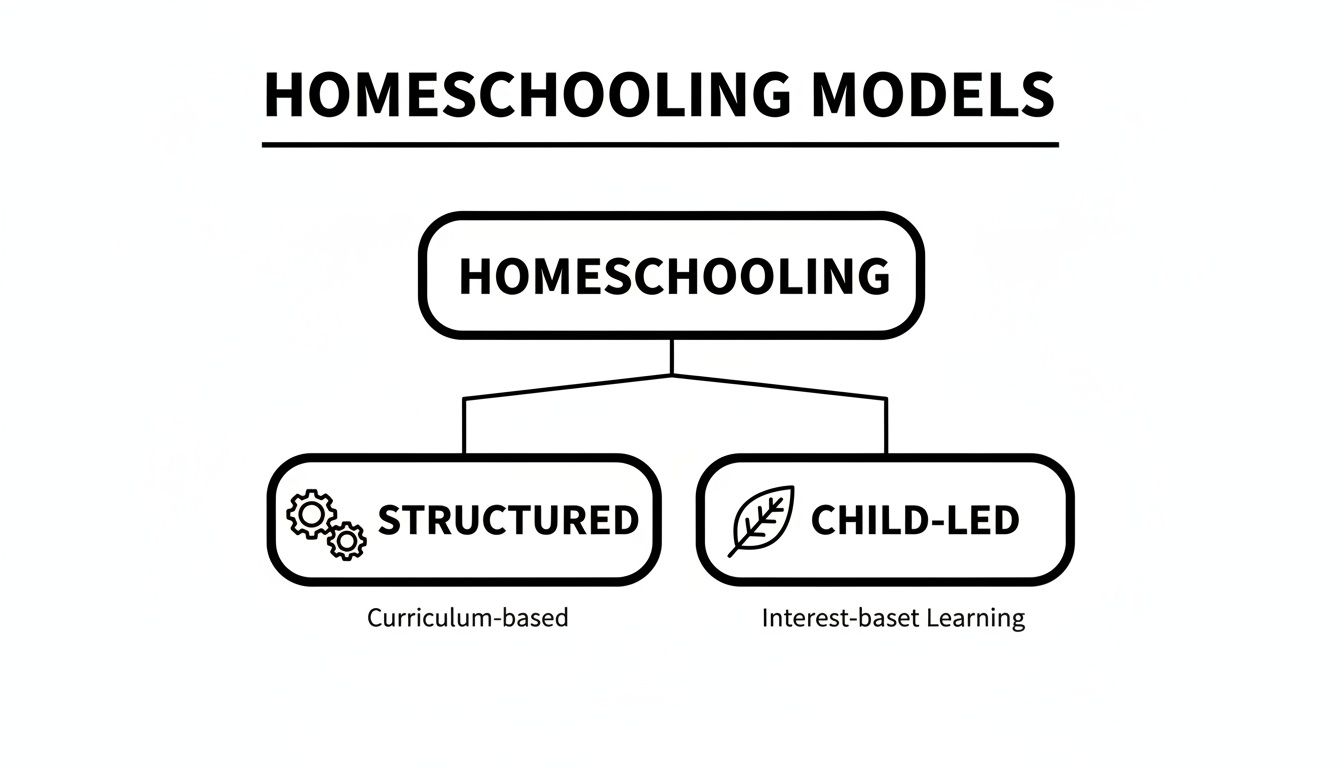
When the goal is official qualifications like GCSEs, the structured path provides the framework and support needed to meet exam board requirements without the stress.
Following a curriculum built for this purpose means every topic on the syllabus is covered in the right depth. Providers that follow this model, like online schools, offer subject-specialist teachers who know exactly what examiners are looking for. They provide the expert guidance needed for complex subjects and can even manage the entire process of exam entry, lifting a huge administrative weight off parents' shoulders. You can explore our guide on achieving home education GCSEs to see how this supported journey works in practice.
Choosing a curriculum aligned with the British system isn't about restricting your child's freedom. It's about providing them with a key—a key that unlocks doors to higher education and future opportunities, giving you the confidence that their hard work will be officially recognised.
How to Choose the Right Homeschool Curriculum

Choosing a curriculum can feel like the biggest, most daunting decision on your home education journey. That pressure can be paralysing. But it doesn't have to be. By breaking it down into a few manageable, human steps, you can shift from feeling overwhelmed to feeling confident and empowered.
The goal isn't to find some mythical "perfect" curriculum. It's about finding the right fit for your unique child and your family, right now. Think of it less as a final exam and more as a process of discovery you and your child get to do together.
Step 1: Connect With Your Child’s Needs
Before you even think about opening a curriculum catalogue, the most important work happens in your own home. The heart of any successful curriculum home schooling plan is knowing the learner inside and out. So, take some time to just watch and listen.
-
Observe their natural rhythms: When are they most alert and focused? For example, if your child is a 'night owl' who comes alive in the afternoon, forcing a heavy Maths lesson at 9 AM will only lead to frustration for both of you. A flexible curriculum lets you schedule their toughest subjects when they're at their best.
-
Listen to what they say about learning: Ask them what they love and what they loathe about schoolwork. Their answers are gold. A child who says, “I hate writing stories, but I love telling them,” might do brilliantly with a curriculum that values oral storytelling or lets them create a podcast instead of a written essay.
This first step is about gathering loving intelligence. It’s about seeing the individual in front of you and inviting them to be a partner in their own education.
Step 2: Define Your Family’s Educational Vision
Once you have a clearer picture of your child, it’s time to zoom out and look at your family’s big-picture goals. What’s the ultimate purpose of this journey for you? Is it to nurture creativity, achieve the academic grades needed for university, or build practical, real-world skills?
Your educational vision is your mission statement. Jotting it down, even just as a few bullet points, creates a powerful filter for every decision that follows. If your vision includes "building confidence in a child who struggles with anxiety," then a high-pressure, test-heavy curriculum is immediately off the table.
Step 3: Research With Purpose
Now that you're armed with insights about your child and your family's vision, you can start looking at specific options. If you're just starting out or have little ones, a guide on Choosing Your Homeschool Curriculum for Kindergarten can be a fantastic resource.
As you explore, ask sharp questions that dig deeper than just the list of subjects covered:
- How much parent prep time is needed each day?
- Does it allow for children to work at different speeds?
- What does a typical day or week actually feel like for a child?
- Can you see any sample lessons to know if the teaching style will resonate with your child?
This focused approach stops you from drowning in a sea of choices. You’re no longer just browsing; you're actively hunting for a tool that matches your well-defined needs.
Step 4: Trial and Adapt, Especially for SEN
No curriculum choice is a life sentence. The most liberating thing any home-educating parent can realise is that a curriculum is a tool, not your boss. Give yourself permission to try something out and tweak it as you go.
Remember, the curriculum works for you; you do not work for the curriculum. If a part of it is causing tears and frustration, it is not a failure on your child's part or yours. It's simply a sign that a different approach is needed.
This flexibility is absolutely vital for children with Special Educational Needs (SEN). A standard, off-the-shelf curriculum might move too fast or present information in a way that just doesn't click. Home education gives you the incredible opportunity to tailor everything. For example:
- For a child with dyslexia, this means choosing a curriculum that uses audiobooks and multi-sensory phonics rather than just black-and-white text.
- For a child with ADHD, it means finding a programme with short, engaging lessons and lots of movement breaks, instead of long lectures.
For a child who has struggled in a mainstream school, this adaptive, responsive way of learning can be life-changing. It replaces the constant feeling of failure with a growing sense of competence, rebuilding the confidence that is so fundamental to learning.
Bringing Your Curriculum to Life with an Online School
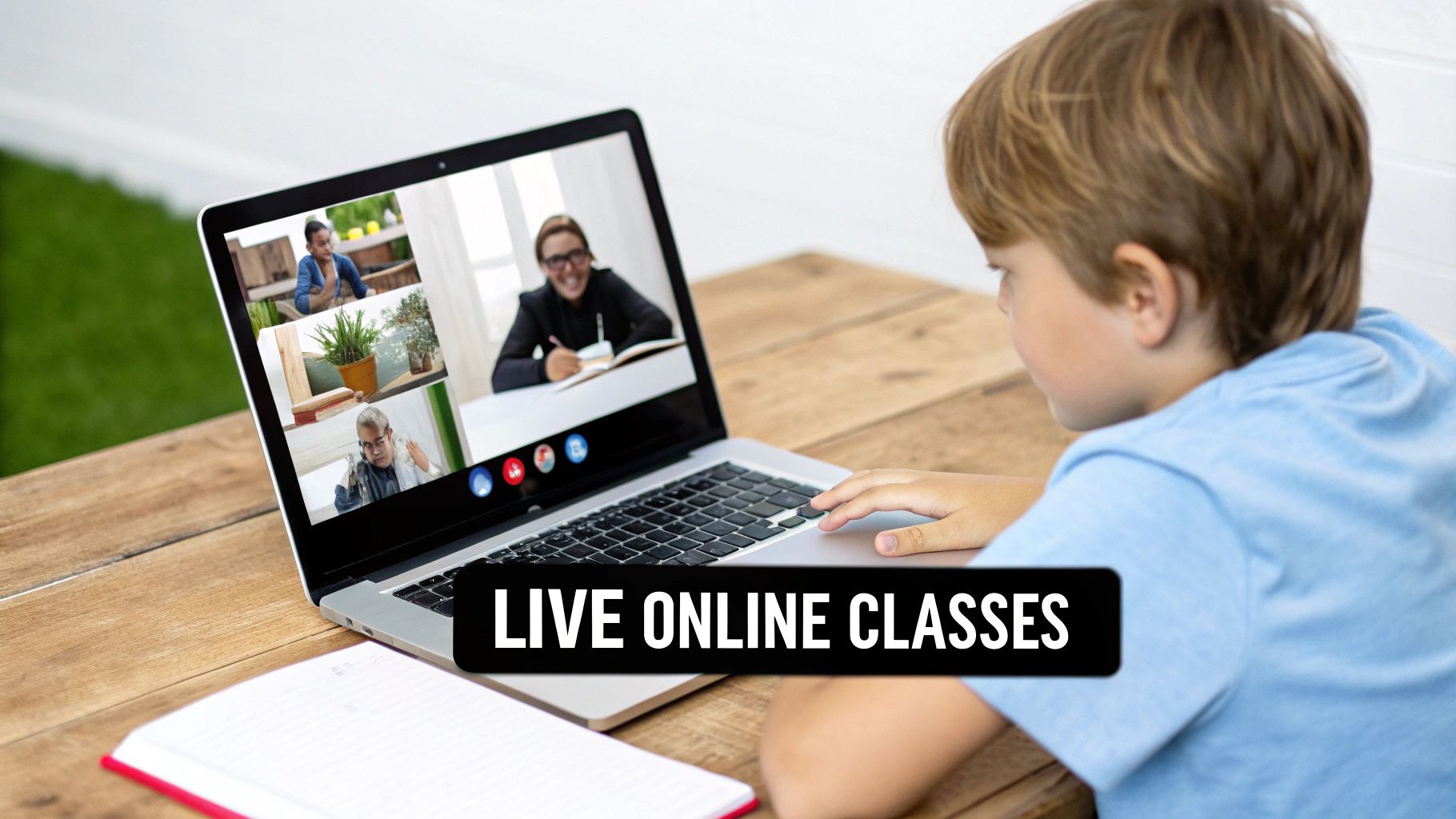
Choosing your curriculum home schooling path is a huge, empowering decision. But once you’ve settled on a model, a new reality begins to set in. The day-to-day responsibility of not just choosing, but delivering that education can feel immense.
It’s one thing to be passionate about history, but quite another to have to explain the complexities of covalent bonds for a GCSE Chemistry exam. It's a weight many parents feel acutely, leaving them worried they can't do justice to every subject or keep their child consistently engaged.
This is precisely where partnering with an online school can transform your home education journey. It’s not about handing over control; it's about gaining a powerful ally for your child.
Expert Teachers Who Ignite Passion
An online school brings the curriculum to life with true subject specialists. These are qualified, experienced teachers who can make even the most challenging topics feel exciting. Think of the difference it makes for your child to learn.
For example, imagine your child is struggling with a complex concept in Physics. Instead of you both getting frustrated over a textbook, they can join a live lesson with a teacher who can explain it using real-world examples, interactive simulations, and answer their specific questions in the moment. That 'aha!' moment of understanding is priceless.
An online school doesn't replace you as the primary guide in your child's education. Instead, it provides a team of specialists who build the intricate parts of the academic structure, allowing you to focus on nurturing your child's overall growth and well-being.
Structure, Support, and Peace of Mind
One of the toughest parts of home education is creating a sustainable daily rhythm. An online school provides an instant, balanced structure with a clear timetable of live, interactive lessons. This simple framework lifts the daily pressure of planning every single learning block from your shoulders.
This ready-made structure offers a triple benefit:
- For your child: It creates a predictable routine, which is incredibly calming and helps them to manage their time and focus their energy without feeling adrift.
- For you: It removes the huge administrative burden of scheduling, lesson planning, and sourcing materials. You get to be the supportive parent, not a stressed-out administrator.
- For academic progress: It ensures every part of the curriculum is covered methodically, giving your child the best possible foundation for exam success without any gaps.
This blend of professional instruction and parental support creates a powerful educational environment. And for those interested in modern learning, exploring the impact of AI in education can offer fascinating insights into how technology is shaping these supportive environments.
A Global Community of Friends
One of the most heartfelt concerns for parents considering home education is socialisation. Will my child feel isolated? How will they make friends? A quality online school is designed to solve this exact problem by creating a thriving social ecosystem where children can truly belong.
In live classes, students aren't just passively watching a screen. They’re collaborating on projects in virtual breakout rooms, getting into lively debates, and building real relationships with peers who share their interests, whether that's a love for fantasy novels or a passion for coding.
Beyond the classroom, your child can join virtual clubs for everything from chess to creative writing. They can take part in online assemblies and social events. This provides a safe, moderated, and wonderfully diverse social circle, giving your child the joy of connection and the confidence that comes from finding their tribe.
Your Questions About Homeschooling Answered
Starting a homeschooling journey always brings a wave of questions. These aren't just about timetables and textbooks; they’re the big, heartfelt questions about your child's future, your own ability to guide them, and how it all works in practice. Let's tackle some of the most common worries with clear, straightforward answers to give you confidence and peace of mind.
Do I Have to Be a Qualified Teacher to Homeschool My Child?
Absolutely not. This is probably the biggest myth in home education. UK law requires you to provide a "suitable, full-time education," but it doesn't say you need a teaching certificate. Your greatest assets are your deep understanding of your child, your dedication, and your ability to create a warm, supportive learning space where they feel safe to make mistakes and grow.
Think of your role as a learning facilitator. You’re there to spark curiosity, find great resources, and cheer them on. For example, if your child is fascinated by space, you don't need to be an astrophysicist. You can learn alongside them, visiting science museums, watching documentaries, and finding books together. When you reach the complex subjects at GCSE or A-Level, an online school can provide the specialist teachers, freeing you to continue being their biggest champion.
How Will My Child Get Official GCSE or A-Level Qualifications?
This is a vital question for any family planning for university or specific careers. When you homeschool, your child sits their exams as a private candidate at an official exam centre. On your own, this involves a lot of admin that can feel pretty overwhelming.
If you go the DIY route, you'll need to:
- Find a local exam centre that accepts private candidates (not all do!).
- Make sure the curriculum you've used aligns perfectly with the exam board syllabus that the centre uses.
- Manage all the registration forms, deadlines, and fees yourself.
This is one of the biggest reasons families choose an accredited online school. A good one handles all of that for you. They make sure your child learns the correct curriculum, completes all the required practicals or coursework, and gets entered for their exams correctly. It removes a massive layer of stress and allows your child to focus purely on their learning.
What About Socialisation and Making Friends?
Ah, the "socialisation" question! It comes from a good place, but it’s based on the outdated idea that a classroom of 30 same-aged kids is the only way to learn social skills. In reality, home-educated children often have wonderfully rich and diverse social lives.
For example, your child's week might include:
- A gymnastics class where they work as a team with other children.
- Volunteering at a local animal shelter, learning responsibility and communicating with adults.
- Collaborating on a coding project with a friend they met in their online school class who lives in another country.
Modern online schools have completely changed the game here. Students interact every day in live classes and work together in virtual breakout rooms. They can join clubs for everything from creative writing to coding and take part in school-wide online events. It’s a brilliant way to build a global group of friends in a safe, moderated environment.
Social connection is a fundamental human need. The beauty of a curriculum home schooling approach, especially when supported by an online community, is that it allows children to build genuine friendships based on shared interests, not just proximity in a classroom.
How Much Does Curriculum Home Schooling Cost?
The cost of home education can vary wildly, so it’s important to find a path that fits your family’s budget. There’s no single price tag; it all depends on the approach you take.
Here’s a rough idea of what to expect:
- The DIY Approach: This can be the cheapest option, using free online resources and library books. The trade-off, however, is the huge amount of your own time you’ll invest in planning, preparing materials, and teaching every single subject.
- Boxed Curricula: Buying a pre-packaged, all-in-one curriculum can set you back several hundred to over a thousand pounds a year for each child. It gives you structure and materials, but you’re still the one delivering all the lessons.
- Online Schooling: Enrolling in a full online school is a bigger investment, but the fees typically cover everything: live lessons from qualified teachers, all digital resources, a structured timetable, pastoral care, and often the exam registration logistics. When you compare it to the cost of hiring multiple private tutors, it often proves to be a more cost-effective and complete solution.
At Queen's Online School, we provide a complete, supportive, and academically rigorous British curriculum education from the comfort of your home. We handle the expert teaching, curriculum planning, and exam logistics so you can focus on what matters most—nurturing your child's love for learning.
Discover how our live, interactive classes and vibrant global community can transform your family's educational journey. Explore our programmes to learn more.