

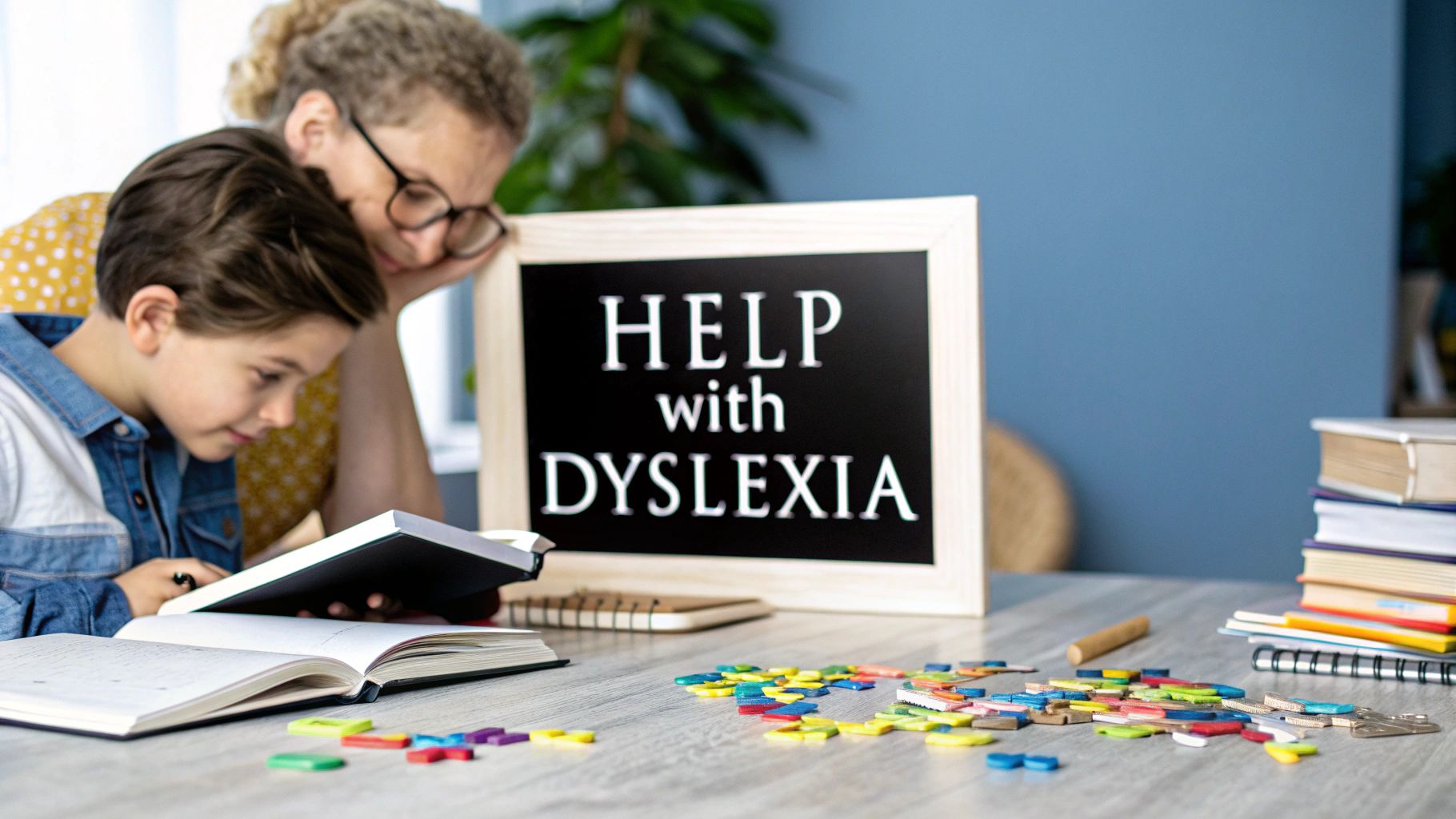
Helping your child with dyslexia isn't about "fixing" a problem. It’s about the heart-sinking feeling you get when they say "I'm stupid," and turning that into a moment of connection. It’s about creating a warm, supportive home where it’s safe to make mistakes, trying out playful, multi-sensory ways to learn, and working as a team with their school. It's about building their confidence, piece by piece, and celebrating the unique and wonderful way their brain works.
Your Child's Journey with Dyslexia: A Different Way of Thinking
That knot of worry you feel when you see your child struggling with reading is something countless parents know all too well. Watching them reverse letters, stumble over words they seemed to know yesterday, or just get completely frustrated with homework can make you feel helpless. It’s a tough spot to be in, but it’s also the first step onto a new and much more positive path—one where you become their greatest champion.
This guide is here to walk that path with you. We're not here to focus on the struggles, but on the practical steps and genuine hope that come next. The goal is to help you see that dyslexia is not a measure of your child's intelligence or their potential. It's simply a different way of processing information—a unique brain wiring that often comes with its own set of incredible strengths.
Understanding the Dyslexic Mind
Your child's mind isn't broken; it just works differently. Where others might see a jumble of letters, your child might be visualising incredible 3D designs. They might struggle to spell a simple word but then solve a complex puzzle that leaves everyone else stumped. In fact, around 1 in 10 people in the UK are thought to have dyslexia, so your child is part of a large, creative, and remarkably resilient community.
Your role in this journey is to become their best advocate, and that starts with understanding how to help them shine. This involves a few key shifts in how you see them and support them:
- Reframe the challenge: Stop thinking, "Why can't my child read?" and start asking, "How can I help my child learn to read in a way that makes sense to them?"
- Build on their strengths: What makes their eyes light up? Art, sport, problem-solving, telling amazing stories? Find those talents and celebrate them loudly and often.
- Focus on effort, not just results: Praise their hard work and perseverance. Acknowledge the courage it takes for them to even open the book, not just the final score on a spelling test.
- Create a safe space: Make home a haven of encouragement where it's okay to make mistakes and try again without fear of judgement or disappointment.
Think about it this way: imagine your child writes a wonderfully imaginative story, but the spelling is all over the place. Instead of reaching for the red pen, which can feel like a criticism of their effort, you could say, "Wow, the idea of a robot who eats clouds is amazing! I love how you described its metallic wings. Let's just work on a couple of these spellings together." This small change puts the focus on their creativity, validating their ideas and building their confidence as a storyteller first.
The most important thing to remember is that you are not alone. Millions of families are on this same journey, discovering the incredible potential that lies within a dyslexic mind.
By embracing this perspective, you're not just helping your child manage dyslexia; you are empowering them to see their unique way of thinking as a superpower. You're setting them up for a future where they understand their challenges but are ultimately defined by their strengths. This guide will give you the practical tools and compassionate strategies you need to feel confident as you support your brilliant, unique learner.
Recognising the Signs of Dyslexia at Different Ages
Knowing what to look for is the first and most powerful step you can take. It’s so easy to fall back on the old myth that dyslexia is just about reversing 'b's and 'd's, but the reality is much broader and more nuanced than that. Spotting the signs is all about observing patterns over time, putting your child at the centre of your focus, and trusting that gut feeling you have when something doesn’t seem quite right with how they are learning.
Dyslexia presents itself differently as a child grows. The clues you might see in a reception-aged child will be worlds away from those in a teenager studying for their GCSEs. By understanding what to look for at each stage, you can gather specific, real-world examples that will be incredibly helpful when you speak with your child’s teachers. This isn't about labelling; it's about understanding them better so you can get them the right kind of support.
Early Years Signs: Ages 4-6
In the preschool and early primary years, the signs are often related to the building blocks of language rather than reading itself. You might notice your bright, chatty child struggles with things that seem to come easily to their peers, and you see the flicker of confusion in their eyes.
It’s a time of rapid development for all children, so one or two of these signs alone may not be a concern. A consistent pattern, however, is worth paying close attention to.
- Difficulty with Rhyming: They might find it hard to join in with nursery rhymes or simple rhyming games like "cat, sat, mat." You might see them get quiet or look away when it’s their turn.
- Trouble with Letter Sounds: Connecting a letter to its sound (phonics) can be a real challenge. For example, you might have practised the 's' sound with them countless times, but they still can't seem to recall it consistently.
- Remembering Their Own Name: Forgetting the letters in their own name or taking an unusually long time to learn to write it can be an early indicator.
- Jumbled Phrases: You might hear them mix up sounds in words, saying things like "pasghetti" for spaghetti or "aminal" for animal. This is common, but persistent jumbling can be a sign.
Primary School Signs: Ages 7-11
As children move into Key Stage 2, the demands of formal reading and writing ramp up, and the signs of dyslexia often become more apparent. This is also where the emotional impact can start to show. It’s heartbreaking to watch your child, who once loved stories, start to say they "hate reading" to avoid the feeling of failure.
It’s crucial to praise their effort and creativity during this time. For instance, if they write a brilliant story but the spelling is all over the place, focus on their wonderful ideas first.
A key thing to look for is a noticeable gap between their verbal ability—how brilliantly they can tell you a story—and what they can get down on paper. Other signs include:
- Slow, Hesitant Reading: Reading aloud may be choppy and full of pauses. You might notice they lose their place on the page frequently or use a finger to track every single word.
- Confusing Similar-Looking Words: They might frequently mix up words like 'was' and 'saw' or 'on' and 'no', even after being corrected many times.
- Spelling Struggles: Spelling can be incredibly inconsistent. They might spell the same common word, like 'they', correctly once and then incorrectly just a sentence later.
- Sequencing Difficulties: Retelling a story in the right order, or remembering the months of the year, can be surprisingly difficult for them.
Putting the pieces together isn't always straightforward. It's helpful to remember that dyslexia manifests in various ways, and understanding the different types of dyslexia can provide more clarity on your child's specific challenges.
Secondary School Signs: Ages 12+
For older students, the signs can be more subtle but have a significant impact on their academic life and self-esteem. Many teenagers with undiagnosed dyslexia have developed clever coping strategies to hide their difficulties, but the increased workload of secondary school often brings things to the surface. The frustration of knowing the answer but not being able to write it down can be immense.
At this stage, challenges with organisation and memory become much more prominent. The sheer volume of information they need to manage for exams can feel completely overwhelming.
Consider these common signs:
- Difficulty Taking Notes: Copying from the board or a book can be slow and full of errors, making their notes almost impossible to revise from later.
- Poor Organisation: They might have a perpetually messy backpack, constantly forget homework, or really struggle to plan and structure an essay.
- Trouble Memorising Facts: Remembering dates for a history test or formulas for a science exam can feel like an insurmountable task, no matter how long they study.
- Exhaustion from Reading: They might complain that reading gives them a headache or makes them feel tired. This is often because the mental effort required for them to decode text is so intense.
To help you see the bigger picture, here’s a quick summary of how these challenges can evolve through the school years.
Common Signs of Dyslexia by School Stage
| Key Stage | Reading & Spelling Challenges | Organisational & Memory Signs |
|---|---|---|
| Early Years (Ages 4-6) | Difficulty with rhymes and letter sounds; jumbles words. | Trouble recalling sequences like the alphabet or days of the week. |
| Primary (Ages 7-11) | Slow, hesitant reading; confuses similar words; inconsistent spelling. | Struggles to follow multi-step instructions; difficulty telling time. |
| Secondary (Ages 12+) | Avoids reading aloud; slow writing speed; poor note-taking. | Disorganised work; forgets deadlines; struggles to memorise facts for tests. |
Seeing these signs laid out can help you connect the dots between what you observed when your child was five and what you’re seeing now at fifteen.
Understanding these patterns is the first step, but it’s also important to remember you're not on this journey alone. In the UK, it's estimated that around 1 in 10 people have dyslexia. This means in a typical secondary school with 1,000 pupils, around 100 students may be dyslexic, though many remain undiagnosed. This context helps frame your conversations with schools, allowing you to ask concrete questions about how they support this significant group of learners.
Creating a Dyslexia-Friendly Environment at Home
Your home should be your child’s sanctuary. It's the one place where the pressure can lift, and they can feel completely safe to be themselves. When homework feels like a battle and reading practice ends in tears, transforming your home into a dyslexia-friendly space can make all the difference.
This isn’t about becoming a private tutor overnight. It’s about becoming a partner in their learning, focusing on connection and confidence above everything else. The goal is to shift learning from a source of stress to an opportunity for exploration. It's about celebrating effort, not just perfection, and creating a space where your child feels understood, supported, and emotionally safe to try, fail, and try again.
Make Learning a Multi-Sensory Experience
Dyslexic brains thrive when they can learn with more than just their eyes. Using sight, sound, touch, and even movement helps forge stronger connections in the brain. When a child can physically interact with letters and words, the information is far more likely to stick.
Think beyond flashcards and worksheets. It’s time to get creative and make learning feel like play.
- Tactile Letters: Use shaving foam on a tray, a shallow dish of sand, or even finger paint to practise tracing letters and spelling words. The physical sensation helps cement the letter shapes in their memory.
- Magnetic Tiles and Blocks: Building words with magnetic letters on the fridge or using wooden letter blocks allows them to physically manipulate and arrange letters without the pressure of handwriting.
- Audio and Visual Together: When they are reading, encourage them to follow the words with their finger or a ruler. This simple act connects the physical movement with the sight of the word and the sound they are making.
For example, if your child is tripping over the word "because," you could have them build it with letter tiles, trace it in sand, and then say each letter aloud as they point to it. This layered approach engages multiple senses and reinforces learning in a really low-pressure way.
Fall in Love with Stories, Not Just Reading
One of the most heart-wrenching things for a parent is watching their creative, imaginative child decide they "hate" books, simply because the mechanics of reading are so difficult. The key here is to separate the love of stories from the act of decoding words on a page.
Audiobooks are a magical tool for this. They allow your child to access rich vocabulary, complex plots, and fascinating worlds without the struggle. This builds their comprehension skills and, most importantly, keeps their passion for stories alive.
By providing access to stories through audio, you are giving your child the vocabulary and narrative structures they need to become a better reader. You are filling their well of knowledge so that when they encounter words in print, they already have a context for them.
Let them listen in the car, before bed, or while drawing. You'll be amazed at the sophisticated words and ideas they start using. It shows them that stories are for them, even if reading the words on the page is hard right now.
Prioritise Effort and Celebrate Creativity
A child with dyslexia often has to work ten times harder than their peers just to keep up. It's exhausting, and their efforts can feel invisible when the end result is still full of mistakes. This is where your praise can completely change their mindset.
Shift your focus from the outcome to the process. Instead of pointing out the spelling errors in the story they’ve written, praise their incredible imagination. Say something like, "The way you described the dragon's scales was so vivid! I could picture it perfectly."
This simple change helps build their self-esteem as a creator and thinker, which is essential for developing the resilience they need to tackle their challenges. You're teaching them that their ideas have value, separate from the technical correctness of their writing. This is how you help your child—by nurturing their spirit as much as their skills.
How To Work With Your Child's School and Seek Assessment
Navigating the school system to get the right support for your child can feel like learning a new language. It’s easy to feel overwhelmed or intimidated, but you are your child's most important advocate. This is about working together with the school to unlock the support your child deserves, and you are more than capable of leading that conversation.
Remember that feeling of worry when you first noticed their struggles? Channel that into positive action. Your insights and observations from home are invaluable pieces of the puzzle. You're not just a parent; you are the expert on your child.
Preparing For a Meeting With the School
Before you meet with the school's Special Educational Needs Coordinator (SENCO), gathering your thoughts and evidence is key. This isn't about building a case against the school, but about presenting a clear, collaborative picture of your child’s needs.
A well-prepared folder can give you a huge confidence boost. Include specific, concrete examples.
- Your Observations: Write down a list of the signs you’ve seen at home. For instance, "Takes over an hour to do homework that should take 20 minutes," or "Can tell me a brilliant, complex story but can't write a single sentence."
- Work Samples: Bring examples of their written work. A piece of homework that is full of spelling mistakes, reversed letters, or shows a huge effort for little output can speak volumes.
- Previous School Reports: Highlight any comments from past teachers about slow reading, spelling difficulties, or disorganisation.
This preparation helps you move the conversation from "I think my child is struggling" to "Here is how my child is struggling." It makes the challenges tangible and helps the SENCO understand exactly what you are seeing.
Understanding the School Support System
In the UK, schools often use a process called the ‘assess, plan, do, review’ cycle. This is a continuous loop of support that should be happening for any child with identified needs. Understanding this helps you ask the right questions.
- Assess: The school identifies your child’s specific difficulties.
- Plan: The teacher and SENCO decide what interventions or support will be put in place. This could be small group phonics sessions or using a coloured overlay for reading.
- Do: The plan is put into action.
- Review: After a set period, everyone looks at the progress and decides if the support is working or needs to be changed.
You have a right to be involved in this cycle. Ask questions like, "What is the plan for this term?" and "When can we meet to review their progress?" This shows you are an engaged partner in your child's education. For a deeper dive into the school-based systems, our guide explains more about what is SEN support and how it works.
The simple infographic below outlines some supportive steps you can continue at home, reinforcing the partnership between home and school.
The key takeaway here is that supportive actions at home don't need to be complex. Simple, consistent strategies focusing on listening, play, and praise create a powerful foundation for learning.
Seeking support is a journey of persistence. You may need to have several conversations, and that’s okay. The goal is to build a team around your child where everyone—you, the teacher, the SENCO—is working towards the same goal of helping them thrive.
Seeking a Formal Diagnostic Assessment
Sometimes, school-based support isn't enough, or you might need a formal diagnosis to truly understand the picture and unlock further support. This formal assessment is usually done by an educational psychologist or a specialist teacher with an assessment qualification.
A diagnosis can feel like a huge, emotional step. But for many families, it's a moment of immense relief. It validates everything you’ve been seeing and gives your child a name for their struggles, showing them they are not "lazy" or "stupid"—their brain just works differently.
A formal assessment typically involves a series of one-to-one tests looking at things like:
- Underlying verbal and non-verbal ability
- Phonological processing (how they process sounds in words)
- Working memory
- Reading speed and accuracy
- Spelling ability
The final report provides a detailed profile of your child's strengths and weaknesses, along with recommendations for support. This document is incredibly powerful. It's the key to accessing support like 25% extra time in GCSEs and A-Levels, the use of a laptop in exams, or access to specialist teaching. When considering specialised support, exploring options like special needs tutoring can provide individualised strategies and assistance for your child.
However, it's important to know that support for dyslexic learners can be uneven across the country. Official UK guidance acknowledges that provision is often "fragmented," with different local authorities offering varied assessment routes and school-based support.
Research highlights that estimates for people with dyslexia in Britain range from 10% to 15% of the population, yet the help offered can depend heavily on your postcode. This is why parental advocacy is so critical. Where schools adopt a systematic approach with early screening and specialist interventions, outcomes for dyslexic learners improve significantly. This knowledge empowers you to push for what is proven to work, ensuring your child gets the help they need, no matter where you live.
Practical Tools and Technology That Empower Learners
Watching your child’s brilliant ideas get trapped behind a wall of spelling and writing difficulties is incredibly frustrating for both of you. This is where technology steps in, not as a shortcut, but as a bridge. It gives dyslexic learners the tools they need to show what they truly know, reducing frustration and building precious independence.
This isn’t about just listing apps. It’s about understanding how these tools can transform your child's learning journey, helping them work smarter, not just harder. Each recommendation is a practical solution you can explore today to help your child feel empowered rather than defeated by their schoolwork.
From Text to Speech and Back Again
Two of the most powerful types of assistive technology directly tackle the core challenges of reading and writing. They don't do the work for the child; instead, they remove the mechanical barriers, allowing their cognitive energy to be spent on ideas and understanding.
Imagine your child has just finished writing a story. Using text-to-speech software, they can have their own words read back to them. Hearing an error, like a missed word or a clunky sentence, is often far easier than spotting it on the page. This simple process turns editing from a demoralising chore into an achievable task.
Speech-to-text tools, like the voice typing feature in Google Docs, are equally powerful. Your child can simply speak their thoughts, and the words appear on the screen. This is a game-changer for those who find the physical act of writing slow and arduous, helping them get their creative ideas down before they fade.
Organising Thoughts in a Visual World
Dyslexic learners are often big-picture thinkers. They can see the final destination but struggle with the linear, step-by-step process of getting there. This is especially true for planning essays or projects, where a blank page can feel incredibly intimidating.
Mind-mapping software is designed for this exact challenge. Tools like MindMeister allow a child to start with a central idea and then branch out with thoughts, facts, and connections in a non-linear way.
- They can use colours, images, and keywords to organise information visually.
- It helps them see the relationships between different parts of a project.
- Once the map is complete, many tools can convert it into a linear outline, providing a ready-made structure for their writing.
Assistive technology is at its best when it complements, not replaces, direct instruction. It provides the scaffolding a child needs to access the curriculum and demonstrate their learning, building their confidence to tackle tasks independently.
In addition to dedicated software, many devices have built-in accessibility features that can make a huge difference. Changing the background colour to a soft yellow or cream, increasing line spacing, and using dyslexia-friendly fonts like OpenDyslexic can significantly reduce visual stress and make text easier to process. These simple adjustments put the child in control of their reading environment.
For those looking to integrate these tools within a structured educational framework, many providers offer specialised support. Learning more about how online courses for SEN can incorporate assistive technology is a great next step for families exploring different educational paths.
Building Reading Fluency and Understanding
Beyond tools for writing and organisation, other technologies focus on improving reading skills directly. These tools are designed to support, not replace, the hard work of learning to read. You can also enhance your child's skills by exploring effective techniques for better reading comprehension.
The following table breaks down how different technologies can address specific learning challenges, offering practical dyslexia help for everyday tasks.
Assistive Technology Solutions for Common Dyslexic Challenges
This table highlights some of the most common challenges faced by children with dyslexia and matches them with specific technologies that can make a real difference. Think of it as a starting point for finding the right support for your child's unique needs.
| Challenge Area | Type of Technology | Examples of Tools | How It Helps Your Child |
|---|---|---|---|
| Reading Fluency | Text-to-Speech (TTS) | NaturalReader, Speechify | Reads digital text aloud, allowing them to hear how words are pronounced while following along. |
| Writing & Spelling | Speech-to-Text | Google Docs Voice Typing | Captures their spoken ideas, bypassing spelling and handwriting barriers to get thoughts on paper. |
| Editing Work | Proofreading Software | Grammarly, Immersive Reader | Highlights spelling, grammar, and sentence structure errors they might not see when reading. |
| Planning & Organisation | Mind-Mapping Software | MindMeister, Coggle | Helps them visually organise thoughts and project plans before starting to write. |
Finding the right combination of tools can take a bit of trial and error, but the payoff—a more confident and independent learner—is well worth the effort.
Nurturing Strengths and Building a Positive Future
After the assessments, the school meetings, and the tech trials, it's easy to get lost in the details. But we need to circle back to what matters most: your child. This journey isn't just about managing the difficulties of dyslexia; it's about celebrating the incredible strengths that so often come with it. It’s about building a future where your child doesn't just cope but truly thrives because of, not in spite of, their unique mind.
Think about it. Many people with dyslexia are brilliant at creative problem-solving, seeing the big picture, and thinking outside the box. This is no accident. The very brain wiring that can make decoding text a slog often fuels a natural talent for visual, spatial, and conceptual thinking.
From Challenge to Superpower
I often describe the dyslexic mind as being wired for 3D thinking in a 2D world. While others are focused on the individual bricks (the words on the page), your child might be visualising the entire building in their head. This ability is a massive asset in fields that demand innovation, creativity, and seeing connections that others miss.
The world is filled with proof. Entrepreneurs like Richard Branson, visionary directors like Steven Spielberg, and countless architects and engineers share this common thread. Their stories aren't tales of overcoming a deficit; they're about harnessing a different way of thinking to achieve extraordinary things. Sharing these examples can be incredibly powerful for a child who feels defined by their struggles. It shows them what's possible.
Identifying and Nurturing Their Unique Talents
Your role now is to be a talent scout for your child. Help them discover where they shine. This is how you rebuild the self-esteem that reading difficulties can so easily chip away at. It’s about finding their "thing."
- The Budding Engineer: Is your child obsessed with LEGO, constantly taking things apart to see how they work? Lean into it. Get them more building kits, visit science museums, or find a local coding club.
- The Natural Performer: Do they have a flair for the dramatic, telling incredible stories, or acting out scenes? Find a drama club or just let them put on shows at home. Let them be the star.
- The Visual Artist: Are they always doodling, with a great eye for colour and design? Provide them with art supplies and praise their creativity and vision, not just their technical skill.
Let's say your child builds an intricate, complex spaceship from LEGO but struggles to write a single paragraph about it. Focus your energy on the creation. Ask them to give you a tour of the ship, describing all its amazing features. You could even offer to be their scribe, writing down their words. The idea is what matters, not the spelling.
By focusing on their strengths, you're not ignoring the challenges. You're giving them the confidence and resilience they need to face them. You're teaching them that their worth isn't measured by a spelling test, but by their creativity, empathy, and unique way of seeing the world.
The ultimate goal is to help them understand their own learning profile. When they can confidently say, "I find reading long books hard, but I'm amazing at solving visual puzzles," they start to own their narrative. They are no longer a child who struggles, but a creative thinker with a specific challenge. This shift in identity is everything.
You’re not just preparing them for the next school year; you're preparing them for a future where their different way of thinking is their greatest asset.
At Queens Online School, we create an environment where every child’s unique strengths are celebrated. Our specialist teachers understand different learning styles and provide the personalised support your child needs to build confidence and achieve their full potential. Learn more about our approach to inclusive education.