

A mock GCSE exam is simply a practice run taken under formal exam conditions, long before your child sits the real thing. It can feel like a huge, scary milestone, but if we shift our perspective, we can see it for what it truly is: a dress rehearsal. Think of it less as a final judgment and more as a loving spotlight, illuminating the path forward and showing exactly where your child can shine brightest.
Why Your Mock GCSE Exam Is a Powerful Tool for Growth
The very mention of a "mock exam" can send a ripple of anxiety through a household. For your child, it feels like a high-pressure preview of what’s to come, and it's heartbreaking to watch them worry. For you, as a parent, it’s easy to get caught up in fears about their preparation and what the results might mean for their future.
These feelings are completely normal, and they come from a place of love and care. But what if we reframe it? Instead of a terrifying hurdle, let's see the mock GCSE exam for what it truly is: a supportive and empowering learning opportunity. It’s a chance for your child to prepare, practise, and grow without the immense pressure of a final grade hanging in the balance.
This practice run is one of the most valuable experiences in the entire GCSE journey. It's often the first time your child will face the full formality of an exam hall: the absolute silence, the watchful invigilators, the strict timing. It’s a lot to take in. Facing this now, in a lower-stakes environment, demystifies the whole process and can dramatically reduce exam-day nerves when it really counts, helping your child walk in feeling capable and calm.
The Ultimate Dress Rehearsal
Imagine an actor preparing for a leading role. They wouldn’t just memorise their lines and hope for the best on opening night. They’d have full dress rehearsals to get comfortable with the stage, the lights, and the feel of the performance. A mock exam serves exactly the same purpose for your child.
It’s a safe space for them to test everything:
- Revision Strategies: Did that mind map for History actually help the facts stick, or did it just feel like colouring in? Were flashcards the right call for Biology, or did they feel more like a chore? Mocks are the perfect place for your child to discover which revision methods genuinely work for them.
- Time Management: Getting through a three-hour Maths paper is a skill in itself. Mocks teach your child how to pace themselves, how to decide when to move on from a tricky question, and how to handle the rising pressure of the clock. This is a skill that builds resilience.
- Exam Technique: This is where they learn the practical art of answering questions effectively. For example, they might learn that for a 6-mark History question, they need to make two developed points with evidence, whereas a quick 2-mark question just needs a short, sharp answer. This insight is invaluable.
A Benchmark for Future Success
Beyond just being great practice, mock exams are an incredibly accurate predictor of final performance. This isn't just a feeling; it's backed by solid data.
An analysis by FFT Education Datalab covering thousands of schools in England revealed a striking correlation between mock results and actual GCSE grades. For many subjects, the correlation hit 0.95 for a grade 7/A, indicating an almost perfect alignment. This shows that a well-run mock exam is a reliable snapshot of where your child currently stands, giving you both a clear and realistic picture.
"The mock exam is not a verdict. It is a diagnostic tool. It’s the educational equivalent of an X-ray, showing you exactly where the fractures are so you can heal them before the main event."
The table below breaks down exactly why this "dress rehearsal" is so crucial for your child's confidence and final grades.
Why Your Mock Exam Matters at a Glance
| Purpose of the Mock Exam | How It Helps Your Child | Emotional Benefit |
|---|---|---|
| Identifies Knowledge Gaps | Pinpoints specific topics or modules that need more revision. | Replaces vague, overwhelming anxiety with a clear, focused revision plan. |
| Tests Revision Strategies | Shows which study methods (e.g., flashcards, mind maps) are effective for them. | Builds their confidence in their ability to prepare effectively. |
| Builds Exam Stamina | Gives them practice sitting still and concentrating for 2-3 hours. | Reduces the mental and physical fatigue they might feel in the real exam. |
| Refines Time Management | Teaches them how to pace themselves and allocate time per question. | Lessens the rising panic of running out of time on the day. |
| Demystifies the Process | Familiarises them with the formal exam hall environment and rules. | Significantly lowers exam-day anxiety and fear of the unknown. |
| Provides a Realistic Grade | Offers an honest, accurate snapshot of their current performance. | Sets realistic expectations and motivates targeted, achievable improvement. |
Ultimately, the results provide invaluable feedback for everyone involved. For your child, it highlights exactly what to focus on. For teachers—whether in a traditional school or an online centre like Queen's Online School—this data is gold. It allows them to create tailored support plans for your child, organise intervention groups, and zero in on where they need the most help.
It turns that cloud of uncertainty into a clear, actionable roadmap, empowering your child to walk into their real GCSEs feeling prepared, confident, and ready to show what they can do.
What to Expect During the Mock Exam Period
The mock exam period can feel like it descends in a sudden whirlwind of timetables, strict rules, and a heavy sense of pressure. For many children, the uncertainty of it all is more stressful than the actual exams. So, let’s pull back the curtain and walk through exactly what happens, turning that unknown into a clear, predictable journey that you can navigate together.
This roadmap will demystify everything from the moment the timetable lands in your inbox to making sense of the results, helping your child feel prepared and in control.

The Pre-Exam Countdown
The mock season doesn't just spring to life on the day of the first paper. It truly kicks off weeks earlier with the release of the mock exam timetable. This one document is your family's first real look at the schedule, and it can bring on a mix of motivation and a sudden jolt of anxiety.
When it arrives, the best thing you can do is sit down with your child and break it down together over a cup of tea. Look for any exam clashes, spot the days with multiple papers, and identify those crucial gaps perfect for revision. This is the moment a daunting list of dates transforms into an actionable, manageable plan.
Here’s a practical example:
Imagine your child sees they have a morning Maths paper followed by an afternoon History paper on the same day. That can feel instantly overwhelming. By spotting this on the timetable early, you can plan together for a calm lunch break with their favourite sandwich and a quick, focused review for History, rather than letting it become a frantic last-minute cram session. This tiny bit of planning can make a world of difference to their mindset and performance.
Navigating Formal Exam Conditions
For many students, the biggest shock to the system is the shift to formal exam conditions. This isn't just about being quiet; it’s a specific set of rules designed to perfectly mirror the real GCSEs. Understanding these rules beforehand helps remove the element of surprise and dials down that day-of anxiety.
Whether they're in a traditional school hall or a focused online environment, these conditions almost always include:
- Complete Silence: No talking or any form of communication with other students from the moment they step into the exam space.
- Strict Timings: Invigilators give clear instructions on when to start and stop. The clock is non-negotiable.
- No Personal Belongings: Bags, phones, and smartwatches are all stored away. Only pre-approved equipment is allowed on the desk.
- Invigilator Presence: Staff will be walking around to make sure rules are followed and to help with any issues, like needing more paper.
The point of these strict rules isn’t to intimidate your child. It’s to create a completely fair and calm environment where every single student has the same opportunity to show what they know, free from distractions.
The Online Mock Exam Experience
For students at online schools like Queen’s Online School, the experience is just as formal, but it unfolds in the comfort of a familiar setting. This can be a huge relief for a child who finds large halls overwhelming, but it’s important to understand how exam integrity is maintained.
Online invigilation is managed very carefully to ensure fairness. Students log into a secure platform where they are monitored by a friendly invigilator via webcam and microphone. Often, their screen is shared to ensure no unauthorised websites or resources are being used. It effectively creates a controlled, one-on-one exam setting that prevents cheating while keeping your child in their own safe space.
Here’s what an online exam looks like in practice:
Your child logs into their exam portal. An invigilator greets them warmly, confirms their identity, and asks them to pan their camera around the room to show their workspace is clear. Once the exam begins, the invigilator remains present on screen, silently monitoring, just as they would in a physical hall. For paper-based exams taken online, your child completes the paper on camera, then uses a special app to scan and securely upload their work within a strict time limit.
This process ensures that an online mock GCSE exam has the same rigour as one taken in person, providing a true reflection of your child's abilities. By understanding these steps, the entire mock period becomes less of a mystery and more of a manageable, structured process for them to navigate.
How to Secure Support for Every Type of Learner
Every child learns differently, and let's be honest, a formal exam hall can feel like it was built for just one type of student. It's heartbreaking to watch your child grapple with anxiety, sensory overload, or learning differences in the run-up to their mocks. But here’s the good news: they are entitled to support, and your voice as their parent is the most powerful tool for making sure they get it.
This isn’t about giving anyone an unfair advantage. It’s about levelling the playing field so your child can show what they truly know. This support, officially called access arrangements, makes sure the exam is testing their grasp of chemistry or history—not their ability to cope with the exam environment itself.
Understanding Common Access Arrangements
Think of access arrangements as adjustments for students with specific needs, disabilities, or even temporary injuries. They're the exam equivalent of giving glasses to a student who is short-sighted; they simply remove a barrier to allow for a fair assessment. Your child's school or exam centre is responsible for applying for these on their behalf, but it all starts with evidence of an established need, and that’s where you come in.
Common arrangements you’ll see include:
- Extra Time: Usually 25% more time, this is a game-changer for a child with slower processing speeds or reading difficulties like dyslexia. It gives them the breathing room to properly read questions and structure their answers, without the rising panic of constantly watching the clock.
- A Scribe: This is where an adult writes down the student's dictated answers. It's a lifeline for a child with dysgraphia, whose thoughts move faster than their hand can write, or a student with a physical injury that makes writing painful.
- A Separate Room: For a child with high anxiety, ADHD, or sensory sensitivities, the main exam hall—with its rustling papers and background coughs—can be a minefield of distractions. A quiet, separate room with just a few other students can completely change their ability to focus and feel calm.
- Rest Breaks: These are supervised breaks that allow a child to step away, reset, and manage their energy or anxiety before getting back to the paper.
For learners who find that deep pressure helps them focus during revision or the exam itself, you might consider exploring resources on tools like a weighted lap pad as part of their wider support strategy.
How to Advocate for Your Child
Getting the right support in place starts with clear, open communication. Be proactive. Schedule a meeting with the school’s Special Educational Needs Coordinator (SENCo) long before the mocks are due to start. To build a strong case, pull together any relevant documents you have, like reports from an educational psychologist, GP or therapist.
When you go into the meeting, be ready with specific, heartfelt observations. Instead of just saying, "My son is anxious," try something like: "I've noticed that when he's doing timed homework, his handwriting becomes illegible and he often misses key parts of the question. I’m worried that in a real exam, this will stop him from showing the examiner what he knows. Could we explore if extra time or a word processor would be appropriate for him?" If you want to get a better handle on the frameworks schools use, you can explore our guide on what SEN support entails.
Advocating for your child isn’t about being confrontational; it’s about collaboration. You are the expert on your child. You know their struggles and strengths better than anyone. The school has the expertise in navigating the exam system. Working together, you can build a plan that allows your child to shine.
Remember, the support provided during a mock GCSE exam is also essential practice for the real thing. It lets your child get used to the arrangements, making sure they feel comfortable and confident when it really counts. This practice run is vital for closing attainment gaps. Data from Ofqual and the EPI shows that while 70.4% of 16-year-olds in England achieve a grade 4 or above, this figure hides big regional differences. For learners facing extra hurdles, a well-supported mock exam provides the targeted preparation they need to bridge that gap. You can discover more about these GCSE result trends from the EPI's analysis.
Building a Practical Mock Exam Preparation Plan
The countdown to mock GCSE exams can feel like a pressure cooker for the whole family. It’s so easy to fall into the trap of last-minute, high-stress cramming, but the best preparation is always a marathon, not a sprint. Let's walk through a game plan for building calm, consistent habits that will see your child through, one manageable step at a time.
A huge part of this is understanding what goes into comprehensive test preparation. When you help your child break revision down into smaller, bite-sized chunks spread over several weeks, you replace that rising sense of panic with a feeling of control and steady progress. It’s a much kinder and more effective approach for everyone’s well-being.
Eight Weeks Out: The Foundation Phase
With two months to go, the name of the game is organisation, not intense revision. This is your window to gently gather all the tools and lay a solid foundation. Getting this done now prevents that last-minute chaos where notes are missing and your child feels completely overwhelmed before they even begin.
It’s all about creating a calm, functional workspace together. Sit down with your child and sort through their folders, organise their class notes, and help them pinpoint any topics that have gone astray. This simple act of getting organised can be incredibly empowering for a teenager who’s feeling lost in a sea of material.
Now is also the perfect time to map out a revision timetable. This isn't about creating a rigid, hour-by-hour schedule designed to add more stress. Think of it as a flexible guide that blocks out time for specific subjects while fiercely protecting crucial downtime for hobbies, friends, and rest.
- Map out subjects: Pencil in revision slots for each subject across the week.
- Keep it realistic: Aim for focused 30-40 minute sessions. Forget those gruelling three-hour slogs; they’re rarely productive and can lead to burnout.
- Prioritise well-being: Schedule in non-negotiable breaks, family time, and physical activity. These are just as important as the revision itself for your child's mental health.
Four Weeks Out: The Practice Phase
As you hit the one-month mark, the focus gently shifts from organising to active practice. This is when your child should start digging into past papers. It's one thing to know the content, but it's another skill entirely to apply it under the pressure of a ticking clock.
Starting past papers now gives them enough time to figure out not just what they don't know, but how they're losing marks. Are they misreading the questions? Running out of time? Not writing enough detail in those longer answers? This kind of insight is pure gold.
Here's a practical example: Your child does a practice Biology paper and gets a question on osmosis wrong. Instead of just marking it as 'wrong', you can sit with them and ask, "What do you think happened here? Did you forget the definition, or was the question just worded in a confusing way?" This turns a mistake into a valuable learning moment.
The goal here isn't to get perfect scores straight away. It's to build familiarity and confidence. Each past paper they complete is like a dress rehearsal, making the real mock exam feel less like a terrifying unknown and more like a familiar routine.
This is also a great moment to tweak revision techniques. If mind maps aren't clicking for a particular subject, now is the time to switch to flashcards or another method. For a huge range of different approaches, you can find some excellent GCSE revision tips to help your child find what works for them.
Sample Mock Exam Revision Timetable
| Time Slot | Monday | Tuesday | Wednesday | Thursday | Friday |
|---|---|---|---|---|---|
| 4:00 – 4:45 PM | Maths (Algebra) | English (Poetry) | Science (Biology) | History (Topic A) | Geography (Topic B) |
| 4:45 – 5:30 PM | BREAK | BREAK | BREAK | BREAK | BREAK |
| 5:30 – 6:15 PM | Science (Chemistry) | History (Topic B) | French (Vocab) | English (Macbeth) | Maths (Geometry) |
| 6:15 PM onwards | FREE TIME | FREE TIME | FREE TIME | FREE TIME | WEEKEND! |
This is just a template, of course. The best timetable is one that’s realistic for your child and your family life. Adapt it, change it, and make it your own.
The Final Week: The Mindset Phase
The last week before the mocks is absolutely not about cramming. Frantically trying to learn new topics at this stage will only dial up your child's anxiety and lead to burnout. Instead, this week is all about consolidating knowledge and, most importantly, focusing on their well-being and a positive mindset.
Encourage your child to review their notes lightly, maybe going over key definitions or formulas. The real work now is preparing their mind and body. That means prioritising sleep, eating nutritious meals they enjoy, and staying hydrated. A tired, hungry brain simply can't perform at its best.
This timeline shows how planning for support is a long-term process, starting well before the exams themselves.
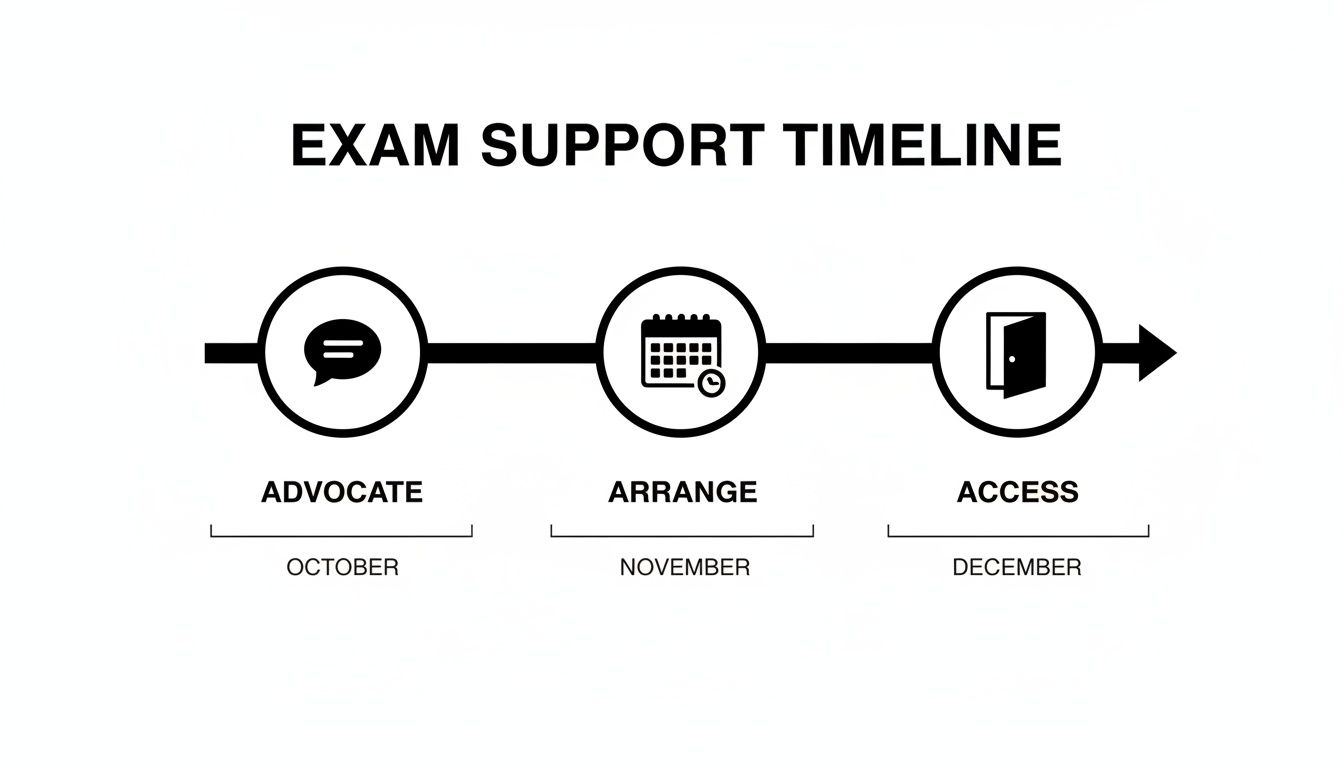
As the image illustrates, getting the right arrangements in place often starts months in advance, which highlights why early and open communication with the school or exam centre is so vital.
Your most important role during this final week is to be a source of calm and reassurance. Remind them that they’ve put in the work, that this is just a practice run, and that you are proud of their effort, whatever the outcome. A supportive, low-pressure home is the best possible preparation you can give them now.
Turning Mock Results Into Real GCSE Success
The mock results have landed. For you and your child, that moment brings a wave of emotion—relief, pride, or maybe a pang of disappointment. Whatever the feeling, the first step is to just breathe and put the grade itself to one side for a moment. Right now, your most important job is to celebrate their effort.
They walked into that exam hall, sat down at that desk, and they saw it through. That takes real courage, and it deserves to be recognised, no matter what the piece of paper says. Acknowledge their hard work first. "I'm so proud of you for getting through that" creates a safe space to talk about the results without fear or judgement, reinforcing the vital message that a mock GCSE exam is a practice run, not a final verdict on who they are.
From a Grade to a Game Plan
Once the initial emotions have settled, it’s time to turn that single letter or number into a powerful roadmap for your child. The real value of a mock isn’t in the overall grade; it’s buried in the details of the marked paper. Sitting down together to go through it is how you turn a vague sense of disappointment into a targeted, actionable plan that they can feel good about.
This is all about pinpointing specific weak spots with surgical precision. It’s the difference between your child thinking, "I'm just bad at Maths," and them realising, "I consistently lose marks on algebra questions with quadratic equations." The first statement is a dead end that crushes their spirit. The second is a starting line for them to build from.
Here’s what that looks like in practice:
Imagine your child got a Grade 5 in their English Literature mock and they're feeling down about it. You both look through the paper and spot a pattern:
- They scored really well on the multiple-choice questions about the plot—they clearly know the story.
- But they lost most of their marks on the long, analytical essay questions.
- The teacher's comments keep mentioning things like "needs more textual evidence" or "add more specific quotes."
Suddenly, the problem isn't that they don't understand the book. The real issue is exam technique—they’re finding it tough to use direct quotes from the text to back up their arguments. And just like that, you have a clear, manageable goal to work on together, turning their disappointment into a sense of purpose.
Creating a Targeted Action Plan
Once you’ve identified these specific areas for improvement, you can build a simple but effective plan together. Doing this collaboratively is key, as it empowers your child and gives them a sense of control over their own progress.
Your action plan could be as straightforward as this:
- Identify the Top 3 Weaknesses: Don't try to fix everything at once—that’s overwhelming. Just pick the three areas where a little bit of focused effort will make the biggest difference.
- Find the Right Resources: This might mean going back over specific chapters in a textbook, finding some targeted online tutorials, or asking their teacher for extra practice sheets on that exact topic.
- Practise and Review: Dedicate short, focused revision sessions to these skills. For the English example above, this could mean practising how to write a single, perfectly supported paragraph before trying to tackle a full essay again.
The mock result is the 'what'. A detailed look at the paper reveals the 'why'. And your new action plan becomes the 'how'. This structured approach turns a moment of potential anxiety into an engine for genuine progress.
This process of review and planning is crucial, especially when you consider the shifting landscape of GCSEs. Trends in grades and entries show just how important mocks are for predicting performance and tailoring revision. For instance, while headline Grade 4+ rates in England dipped slightly in Maths (58.2%) and English (59.7%), the picture for 16-year-olds alone showed Maths holding steady at 71.9%. Understanding these wider patterns helps schools and families focus their efforts where they’ll count the most. You can explore a deeper dive into the main trends shaping GCSE results.
By framing the mock results in this way, you teach your child an invaluable lesson: setbacks aren’t failures. They are opportunities to learn, adapt, and come back much, much stronger.
How to Arrange Private Mock Exams Outside of School
For families on a different educational path, like home education, or for students who simply need that extra, formal practice to feel confident, arranging a private mock GCSE exam can feel like a daunting task. But the great news is that it’s entirely possible. Your child doesn't need to be enrolled in a traditional school to get the benefit of a formal, invigilated exam experience.
So, how does it work? The whole process is built around accredited examination centres. These are simply schools or dedicated centres approved by exam boards (like Pearson Edexcel or AQA) to host private candidates for the real exams. Many of these places, including online schools like Queen’s Online School, also offer the chance to sit mock exams under the exact same strict conditions, giving your child that vital practice.
Finding and Booking a Centre
Your first job is to track down a suitable exam centre. While the Joint Council for Qualifications (JCQ) keeps an official list, a quick online search for "private candidate GCSE centre near me" is often the fastest way to get started. Don't forget to check out online schools too, as they can offer a lot of flexibility and support for individual learners.
When you reach out to a centre, be really clear about what your child needs. Let them know you’re looking to book a mock GCSE exam for a private candidate. They’ll walk you through their specific process, but you'll need a few key bits of information ready.
Here’s a practical example of how it might go:
- Initial Enquiry: You get in touch with a centre like Queen's Online School, explaining that your child is home-educated and you feel they would really benefit from sitting a mock Maths paper in a formal setting.
- Provide Details: The centre will probably ask for your child’s details, the specific exam board and subject code (e.g., Pearson Edexcel Mathematics A, 1MA1), and any access arrangements they might need.
- Booking and Payment: You'll then get information on costs and available dates. Fees for private mocks can vary but typically cover the exam paper, the invigilator's time, and the marking by a subject specialist.
Booking a private mock exam gives your child an invaluable opportunity to experience formal exam conditions in a neutral environment. This can be a huge confidence booster, removing the fear of the unknown before they sit their final GCSEs.
What to Expect as a Private Candidate
The experience for a private candidate is designed to be identical to that of any student in a mainstream school. This is crucial. The centre provides the official paper, enforces formal exam conditions, and has the script marked by a qualified examiner.
This ensures the feedback your child receives is a true and accurate reflection of their performance against the official marking criteria—no guesswork involved. For families already exploring different educational routes, you can learn more about how home education for GCSEs works in practice to see how this fits into a wider learning plan for your child.
Ultimately, arranging a private mock exam puts you back in control. It empowers you to give your child the same high-quality preparation available to any student, making sure they walk into the real thing feeling ready, confident, and seen.
Your Top Mock GCSE Questions Answered
When it comes to GCSEs, the mock exams often stir up the most questions and a fair bit of anxiety for both parents and children. That's completely understandable. Let's cut through the confusion and give you some clear, straightforward answers to the questions we hear most often.
Can You Actually Fail a Mock GCSE Exam?
The short answer is no, not really. Your child can't technically "fail" a mock in the same way they would a final GCSE, because there are no official pass or fail grades attached to them. It’s so important to help them see mocks as a diagnostic tool, not a final judgement on their abilities.
Of course, a low score can feel disheartening for them. But its real purpose is to shine a bright light on the topics that need more work. It’s a crucial learning opportunity that gives them a clear roadmap for what to focus on between now and the real thing, which is a gift, not a failure.
How Much Do Mocks Really Affect Predicted Grades?
They matter—a lot. Mocks are one of the most significant pieces of evidence teachers use to determine predicted grades for sixth form or college applications. Your child's performance in these exams, alongside their classwork and other assessments, gives teachers solid proof of their academic potential.
A strong mock result can give a teacher the confidence to award a more ambitious prediction, helping your child's application stand out. A lower-than-expected score might lead to a more cautious grade. This is why it’s so important to encourage your child to give the mock GCSE exam their best shot; it helps their teachers advocate for them effectively when it counts.
Remember, the mock exam is a snapshot in time. It shows what a student can do on one particular day, which is powerful information for teachers creating predictions.
What Happens If My Child Is Ill on Exam Day?
Life happens, and schools have plans for it. If your child is genuinely too unwell to sit an exam, the first step is to contact the school immediately. Your child’s health always comes first. Most schools have clear procedures for this and may be able to reschedule the test or, in some cases, use alternative evidence to assess your child’s progress.
For private candidates sitting exams at a centre, it’s just as important to get in touch as soon as you know there’s an issue. Check their specific policy on illness. In any situation, open and honest communication is always the best way to find a fair solution for your child.
At Queen's Online School, we understand that every child's journey is unique. Our small, supportive classes and expert teachers are here to guide your family through the entire GCSE process with confidence and care. Discover how our personalised approach to online learning can help your child thrive.