

A Levels are all about your child choosing three or four subjects they feel passionate about and studying them in incredible depth over two years. Think of it as the crucial bridge between the broad, compulsory curriculum of GCSEs and the specialised focus they’ll need to thrive at university.
It's a journey that builds towards a set of final exams, and the grades they achieve are what universities look at most closely. It's a big moment, and these qualifications really do matter for their future.
A Parent's Guide To How A Levels Work
That jump from GCSEs to A Levels can feel like a big one, both for you and your child. Suddenly, they’re going from juggling ten or more subjects to just a handful. For parents, this shift often brings a wave of questions: Have they picked the right subjects? Are they ready for this level of focus? It’s a time filled with excitement, but let's be honest, there's a bit of apprehension mixed in there too.
But this change isn't just about more difficult schoolwork. It’s about watching your child take their first real steps towards a future shaped by what they genuinely find interesting. This is the moment they get to stop being a generalist and start becoming an expert in the subjects they love, and your support is their anchor.
The Shift From Broad To Deep Learning
I like to think of GCSEs as a tasting menu—a chance for your child to sample small bites of many different subjects to see what sparks their curiosity. A Levels, on the other hand, are like choosing their favourite dish from that menu and learning to cook it to perfection, exploring every single ingredient and technique until they master it.
Instead of spreading their attention thin, your child will now dive deep into just three or four areas. This allows them to move far beyond simply memorising facts. They’ll start to develop the critical thinking, analytical, and problem-solving skills that are essential not just for university, but for life.
Imagine your child, who always loved their GCSE History lessons, now spending two years poring over primary source documents from the Tudor period. They're not just learning dates; they're crafting their own arguments and even challenging long-held interpretations. It's almost like an "academic apprenticeship," where they learn to think like a historian, a scientist, or a literary critic, finding their own voice in the process.
To help you and your child get a clear picture of this transition, here’s a quick comparison of the key differences between the two qualifications.
A Levels Vs GCSEs Key Differences At A Glance
This table offers a clear, side-by-side comparison to help you and your child quickly understand the step up from GCSEs to A Levels.
| Aspect | GCSEs | A Levels |
|---|---|---|
| Number of Subjects | Typically 8-12 subjects. | Typically 3-4 subjects. |
| Depth of Study | Broad overview of many topics. | In-depth and specialised study. |
| Learning Style | More teacher-guided instruction. | Requires more independent study and self-motivation. |
| Assessment | A mix of coursework and final exams. | Primarily assessed through final exams at the end of two years. |
| Purpose | Provides a foundational education across a wide range of subjects. | Prepares students for university-level study and specific career paths. |
| Skills Developed | Time management, foundational knowledge, basic analytical skills. | Critical thinking, in-depth analysis, independent research, essay writing. |
As you can see, the shift is significant. It’s a deliberate move away from breadth towards a much deeper, more focused approach to learning that requires a new level of personal responsibility.
Why This Specialisation Matters
This intense focus is precisely what top universities are looking for. They want to see applicants who not only have a solid base of knowledge but also a genuine passion and a proven ability to study independently. The A Level structure has been fine-tuned over decades to cultivate exactly these qualities in your child.
The core purpose of A Levels is to prepare students for the rigours of higher education. By mastering a few subjects, they build the intellectual stamina and independent study habits needed to thrive in a degree-level environment.
Ultimately, this period is about nurturing your child’s interests and building their academic confidence. It’s a chance for them to connect with subjects on a profound level, transforming learning from a school requirement into a genuine pursuit of knowledge. They are beginning to shape their academic identity, and your role is to help them find both joy and purpose in their studies, reminding them that it's okay to feel challenged along the way.
Navigating The Two-Year A-Level Journey
The A-Level course is a two-year marathon, not a sprint. For your child, this journey will be one of the most significant periods of their academic life. It won’t just shape their university applications; it will fundamentally change their way of thinking and their belief in themselves.
Understanding the structure and the emotional rhythm of these two years can help you provide the support they need to thrive, turning potential anxiety into confident, steady progress.
It all kicks off with a burst of excitement. Your child has finally left the broad scope of GCSEs behind and can now pour all their energy into subjects they genuinely love. This new-found freedom is incredibly motivating, but it comes with a steep learning curve. The demand for independent study and critical analysis starts from day one, which can sometimes feel a little daunting.
This helpful timeline shows the key milestones in a student's path, from finishing GCSEs, through the A-Level years, all the way to arriving at university.
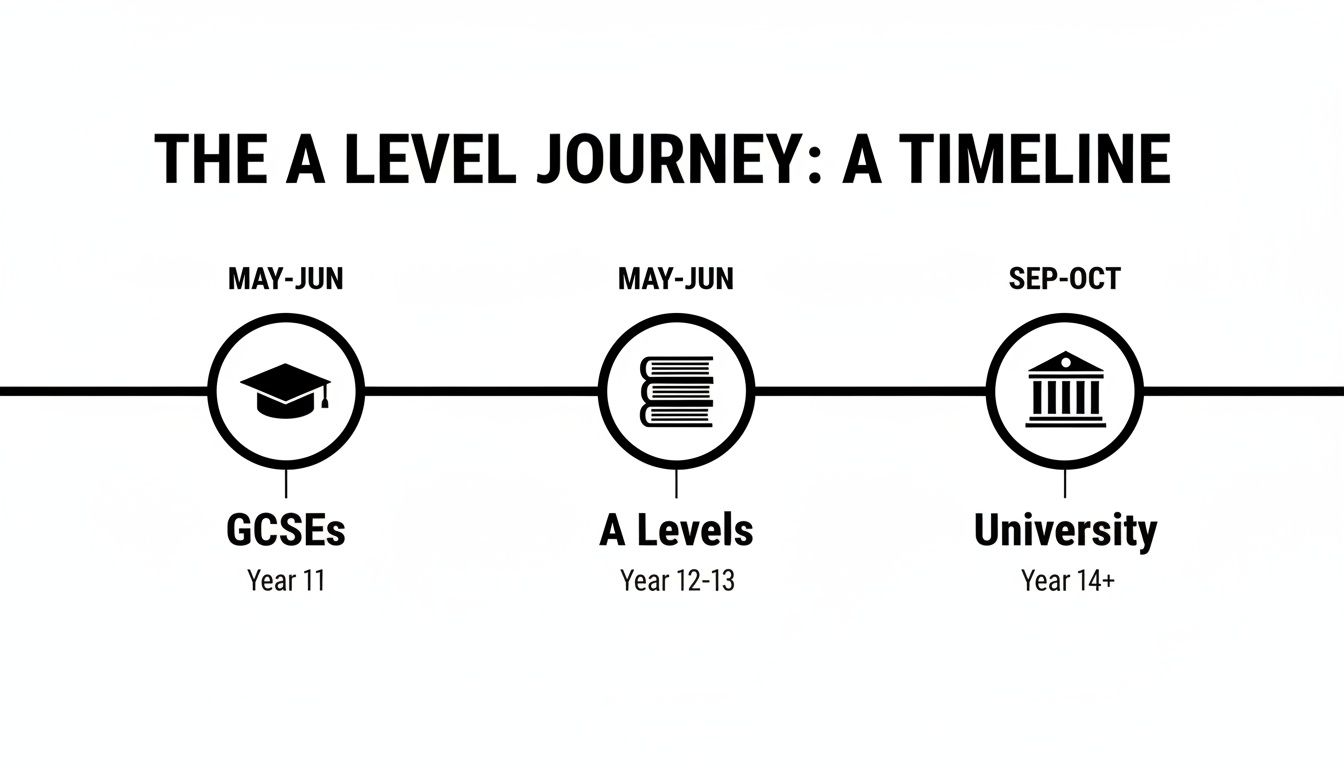
As you can see, A-Levels are the essential two-year bridge connecting the foundational knowledge of secondary school with the specialised world of higher education.
The First Year: Building The Foundation
The first year, often called AS-Level, is all about laying the groundwork. Think of it like a builder constructing the deep, strong foundations for a house. Without this solid base, the more complex structure of the second year simply can’t be supported. Your child needs to feel secure in their knowledge before they can build upon it.
For example, a student taking A-Level Biology will spend this first year mastering core concepts like cell structure, biological molecules, and genetics. They aren’t just memorising facts; they’re learning a new, more scientific language and the fundamental principles that govern all life. This mastery gives them the confidence they need for the tougher challenges ahead.
This is the year where good study habits—consistent revision, feeling brave enough to ask questions, and doing their own research—are absolutely crucial. By the end of this year, your child needs a firm grasp of the core curriculum, as the university application process begins in earnest, with predicted grades often based on their performance.
The Second Year: The Deep Dive
The second year is where the magic really happens. With the foundations secure, students start to build upwards, connecting concepts, forming their own arguments, and engaging with their subjects on a much deeper level. The training wheels come off, and they are encouraged to think like genuine academics, trusting their own instincts and ideas.
This is where the curriculum is designed to foster true critical thinking.
- Analysis: A History student doesn't just learn what happened; they explore why, weighing up different historians' interpretations to form their own opinion.
- Synthesis: In English Literature, your child might compare how a modern poet and a Shakespearean sonnet explore the theme of love, creating a unique argument that is entirely their own.
- Evaluation: A Chemistry student won’t just learn a method; they’ll be asked to evaluate its efficiency and suggest improvements, trusting their analytical skills.
The goal of the second year is to shift a student from being a passive receiver of information to an active participant in their own learning. It’s about cultivating the intellectual curiosity and resilience they will need to succeed at university and beyond.
Managing The Emotional Arc
This journey isn't just academic; it's emotional. The initial excitement can sometimes give way to a mid-course slump, especially around the middle of Year 12. The workload feels relentless, and the final exams seem impossibly distant. This is a completely normal part of the process, and it’s a time when they need your reassurance most.
Your support is their lifeline here. Encouraging them to stay organised, gently reminding them of their long-term goals, and celebrating small victories (like finishing a tough essay) can make a huge difference. Simply acknowledging their stress and saying, "I can see how hard you're working, and I'm proud of you," helps build the resilience they need for the final push.
As they enter the final months, this pressure often transforms into focused determination, culminating in the final exam period.
Choosing The Right A Level Subjects For Your Child
Watching your child face their A Level subject choices can feel like a huge moment. It's often painted as a monumental decision that will shape their entire future, and the pressure to "get it right" can be overwhelming for everyone involved. But it doesn't have to be a source of stress.
Instead, think of this as a brilliant opportunity for a conversation about who they are and who they want to become. The goal isn't just to tick boxes for a university application; it's about helping them build a study programme that makes them feel excited and motivated to learn every single day.

Starting With Your Child's Passions
The single most important factor for success at A Level is genuine interest. These two years demand a level of independent study and resilience that is incredibly hard to sustain without a real passion for the material. Start the conversation by asking what they truly enjoy, not just what they think they should be studying.
What subjects make their eyes light up? What topics do they read about in their own time? A student who loves their subjects is far more likely to push through the tough moments and put in the hard graft needed to achieve top grades.
A motivated student who feels a personal connection to their subjects will always outperform one who has chosen subjects based on external pressure or perceived prestige. Your role is to help them listen to their own inner voice.
Aligning Subjects With Future Goals
While passion is the engine, they also need a destination in mind. If your child has a specific career or university course they’re dreaming of, their A Level choices need to act as a clear stepping stone. This is where you can offer practical guidance, helping them research the prerequisite subjects for different degrees.
For instance, a student dreaming of becoming a doctor will almost certainly need A Level Chemistry and Biology. Your role here is to help them connect their choices now with their future aspirations, making the decision feel purposeful rather than abstract.
Here are a few practical examples to get the conversation started:
- For the aspiring engineer: Imagine your child building bridges or designing new technology. A combination of Mathematics, Physics, and Further Mathematics creates the essential toolkit they'll need for top engineering courses.
- For the future lawyer: If your child is fascinated by justice and human stories, a mix of History, English Literature, and Politics builds exceptional skills in critical analysis, powerful argumentation, and understanding complex texts.
- For the potential psychologist: For a child curious about the human mind, Psychology, Biology, and Mathematics provide a brilliant blend of scientific understanding, human behaviour analysis, and the statistical skills needed for research.
Thinking about powerful A Level subject combinations can help make these choices feel more concrete and strategic.
Balancing Passion And Practicality
So what happens when your child's favourite subject doesn't align with the "facilitating subjects" preferred by some top universities? These are subjects like Maths, English Literature, the Sciences, and History, which are seen as excellent preparation for a wide range of degrees. This is where a balanced approach is key.
Encourage your child to consider a mix. Perhaps they can choose two facilitating subjects that keep lots of doors open, alongside one subject they are pursuing purely for the love of it, like Art or Music. This kind of combination creates a powerful university application that showcases both their academic rigour and their unique personality.
This balance ensures they are not only a strong candidate on paper but also a happy and engaged student. After all, their well-being during these demanding two years is just as important as the final grades. The UK's A Level system offers a huge variety of options, so there is always a way to build a profile that feels authentic to them.
Ultimately, choosing A Level subjects is a deeply personal journey. By putting your child's interests, needs, and happiness at the centre of the conversation, you can help them navigate this decision with confidence and build a pathway that feels both authentic and exciting.
Understanding A-Level Grades And UCAS Points
When results day finally rolls around, the letters on the page can feel like a secret code. For your child, seeing their grades is a moment packed with emotion—pride, relief, and sometimes, a little confusion. Your role is to be their calm harbour, helping them decode what it all means for their next big step.
A-Level grades range from A* (the highest) down to E (a pass). Anything below an E is classed as a U (Unclassified). While these letters represent two years of incredible effort, they’re also a crucial part of another language: the language of university admissions.
This is where UCAS Tariff points come into play. They are the numerical value assigned to qualifications like A-Levels, and they are the key to unlocking university offers.
Turning Grades Into A University Currency
Think of UCAS points as a special kind of currency. Each A-Level grade your child earns is worth a certain number of points, and they use these accumulated points to ‘buy’ their place on a chosen degree course. When a university makes an offer of ‘120 points’, they’re essentially setting the price for entry.
This system is incredibly empowering for your child because it often provides more flexibility than you’d think. It shows them that there isn't just one single path to securing their spot. Their unique combination of grades can work in different ways to meet the university's requirements, valuing their overall effort.
Understanding this conversion helps turn the anxiety of "Did I get the exact grades?" into a more confident and strategic approach to planning for results day.
How The Points System Works In Practice
Let's look at a real-world example. Imagine your child’s dream university course has made them an offer of AAB. On the surface, that feels very specific and rigid, and the pressure to hit those exact grades can be intense. But what does it mean in terms of points?
Let's break it down using the official conversion rates:
- An A grade is worth 48 UCAS points.
- A B grade is worth 40 UCAS points.
So, an offer of AAB is equivalent to 136 UCAS points (48 + 48 + 40). Suddenly, this opens up other possibilities. For instance, if your child achieved an A* in their strongest subject but got two Bs (A*BB), that would give them 136 points (56 + 40 + 40). They've successfully met the offer!
This flexibility can be a huge relief for a worried student, showing them that one slightly lower-than-predicted grade doesn't have to close the door on their ambitions. For a complete breakdown, you can check out our detailed guide explaining what UCAS points are and how they are calculated.
A focus on total UCAS points helps your child see their results as a portfolio of achievements. It values their hard work across all subjects and shows that their overall effort is what truly counts.
Here’s a quick-reference table to help you see how A-Level grades translate directly into UCAS points.
A Level Grade To UCAS Tariff Points Conversion
| A Level Grade | UCAS Tariff Points |
|---|---|
| A* | 56 |
| A | 48 |
| B | 40 |
| C | 32 |
| D | 24 |
| E | 16 |
This table is a great tool for quickly calculating different grade combinations to see if they meet a specific university offer.
The competition for places at top universities remains high, which can add to your child's stress. Data from the Education Policy Institute shows that the proportion of A-Level entries awarded top grades (A or A*) rose from 25.2% to 28.2% in recent years. This makes entry to the most popular courses even more competitive, making every single UCAS point count.
Ultimately, understanding A-Level grades and UCAS points is about translating your child's hard work into a clear plan for the future. It demystifies the university admissions process and empowers them with the knowledge to navigate it with confidence and less anxiety.
How Online Learning Can Support A-Level Success
The traditional school environment, with its bustling corridors and rigid timetables, works well for many students. But let's be honest, it doesn't work for everyone. For some children, the pressure, pace, or social dynamics can become a barrier to their true potential. This is where understanding how A-Levels work in an online setting can be a genuine game-changer, revealing a path to success built around your child's individual needs.
Think of a student who is bright and insightful but struggles with the social anxiety of a packed classroom. In a physical school, they might hesitate to raise their hand, and their valuable contributions get lost in the noise. For them, the A-Level journey becomes a daily battle against nerves rather than an exciting exploration of subjects they love.
This is exactly where online learning creates a new, more supportive reality. It offers a calm, focused environment where your child can engage with their studies on their own terms, free from the social pressures that might be holding them back.

Personalised Learning Puts Your Child First
At its heart, effective online education is all about personalisation. Unlike a one-size-fits-all classroom, a dedicated online school can adapt the learning experience to suit each child's unique pace and style. During the demanding A-Level years, this child-centric approach makes all the difference to their confidence and well-being.
Consider another student, one with health challenges who often misses days at school. In a traditional setting, they’re left to play catch-up on their own, often feeling isolated and falling behind. An online school completely transforms this experience into one of empowerment.
Key benefits of this flexible structure include:
- Recorded Lessons: Every single lesson is recorded. This means your child can revisit complex topics as many times as they need to without feeling embarrassed to ask. It empowers them to take control of their own learning, turning moments of confusion into opportunities for mastery.
- Small, Interactive Classes: With smaller class sizes, subject-specialist teachers can provide detailed, one-to-one feedback. That quiet, brilliant student finally finds their voice, building the confidence to ask questions and share ideas in a safe, encouraging space.
- Flexible Timetables: Learning can be scheduled around appointments, family commitments, or simply a child's natural energy levels. This promotes well-being and helps prevent the all-too-common burnout seen in sixth form.
By placing the student's needs at the centre of the educational experience, online learning dismantles the barriers that can prevent them from thriving. It creates an environment where their potential is not just recognised but actively nurtured.
Building Confidence And Essential Skills
The structure of online A-Levels doesn't just cater to academic needs; it actively builds the skills required for university and beyond. The format encourages a high degree of self-discipline, time management, and personal responsibility—qualities that are invaluable for their future independence.
Students quickly learn to manage their own study schedule, communicate professionally with teachers via digital platforms, and conduct independent research using online resources. These aren't just study skills; they're life skills that prepare them to succeed with confidence in the modern world.
As A-Level students lean more on digital tools, a solid grasp of ethical academic practice becomes crucial. This includes understanding academic integrity in the age of AI to ensure their hard work is always their own.
The Power Of A Supportive Community
One of the biggest myths about online schooling is that it's isolating. In a high-quality online school, the reality is the complete opposite. A vibrant and inclusive global community is fostered, where students connect with peers from diverse backgrounds in live lessons, clubs, and virtual social events. This broadens their perspectives and helps them build lasting friendships.
For a child who has felt like an outsider in a traditional school, finding this sense of belonging can be transformative. It reinforces that they are part of a community that values them for who they are, boosting their self-esteem and their motivation to succeed.
Ultimately, choosing the right learning environment is one of the most important decisions you can make for your child's A-Level journey. For many, exploring a dedicated online A-Level programme can unlock their full potential, providing the support, flexibility, and confidence they need to not just pass their exams, but to truly flourish.
Your A Level Questions Answered
The A-Level journey is a big one, full of ups and downs, so it’s only natural for questions to pop up along the way. As a parent, you’re not just a spectator; you’re the chief supporter, and you want to be ready with calm, practical advice when your child needs it most.
We’ve pulled together answers to some of the most common concerns we hear from families. Our focus, as always, is on putting your child’s emotional well-being first and helping you navigate this chapter with confidence.
What Happens If My Child Gets Disappointing Grades?
Results day can be one of the most emotionally charged moments in a teenager’s life. When those grades aren't what they’d hoped for, the disappointment can feel immense, and your first instinct will be to shield them from that feeling. The single most important thing to remember—and to remind them—is that this is not a dead end. It’s just a detour.
Once the initial shock wears off, the first step is to take a breath. Then, have a calm conversation with their school or teachers to get the full picture and understand the options for a formal appeal. Beyond that, there are several positive ways forward.
- Resitting Exams: This is an incredibly common and effective path. With renewed focus and a different approach, many students see a huge jump in their grades the second time around. It's a fantastic opportunity to turn a setback into a story of resilience.
- UCAS Clearing: Every year, thousands of students find brilliant university courses through Clearing. It’s a dynamic and exciting process, not a "second best" option. Your child might even discover a course or university they’d never considered before that turns out to be the perfect fit.
- Exploring New Paths: Sometimes, a disappointing grade is simply a sign that a particular subject wasn't quite right. This can be a brilliant chance to look at other exciting routes, like a foundation year, a different degree altogether, or a high-quality apprenticeship that offers a direct path into a career.
A grade is just a snapshot of performance on one particular day; it is not a final verdict on your child’s potential or their future happiness. The goal is to help them see this moment not as a failure, but as a chance to pause, reassess, and choose the path that’s truly right for them.
How Do Predicted Grades Work And Why Are They So Important?
Predicted grades can sometimes feel like a mysterious and high-pressure part of the process, but they’re actually quite straightforward. They are simply the grades your child’s teachers professionally estimate they will achieve in their final A-Level exams.
These predictions are absolutely vital because universities use them as the main piece of evidence when deciding whether to offer your child a place.
Teachers don't just pluck these grades out of thin air. They base their predictions on solid evidence gathered all the way through your child's studies. This includes their performance in mock exams, the quality of their coursework, their engagement in class, and their overall progress since the beginning of Year 12.
This is exactly why consistent effort makes such a difference for your child. Every piece of work they complete and every discussion they contribute to builds a picture of their ability. This gives their teacher the proof they need to make an ambitious—but still credible—prediction that truly reflects what your child is capable of.
For example, a student who works steadily all year, hands in their homework on time, and revises properly for mocks gives their teacher a mountain of positive evidence. That steady commitment demonstrates the maturity and work ethic that helps universities feel confident in offering them a place.
Are A Levels Recognised By Universities Outside The UK?
Yes, absolutely—and this is fantastic news for any family with an international outlook. A-Levels are often called the ‘gold standard’ of pre-university qualifications for a good reason: they are recognised and highly respected by top universities all over the world.
Whether your child is dreaming of studying in the USA, Canada, Australia, or anywhere in Europe, their A-Levels will be understood and valued by admissions teams. This global recognition makes them a superb choice for any student hoping for an education that opens doors internationally.
- For US Universities: Imagine your child thriving at a top American university. A-Levels are seen as excellent preparation for that level of academic demand, and strong grades can sometimes even be converted into college credits, giving them a valuable head start.
- For European Universities: Many universities across Europe welcome applications from students with A-Levels, often treating them as equivalent to their own national school-leaving qualifications, making the application process smoother.
This is where an online A-Level provider can be a huge advantage for a child living outside the UK. It allows international students to gain these prestigious British qualifications without having to move countries. The exam certificates are awarded by the very same UK-based exam boards (like Pearson Edexcel or Cambridge International), ensuring they carry the exact same weight as those earned in a physical UK school. It’s a seamless and respected pathway to higher education, wherever in the world your child dreams of going.
Navigating the A-Level years is a significant journey, and finding the right educational environment is key to your child's success and happiness. At Queen's Online School, we combine subject-specialist teaching with a supportive, child-centric approach to help every student achieve their full potential. Discover how our online A-Levels can build your child’s confidence and open doors to their future.