


Seeing a disappointing grade can feel like a punch to the gut for both you and your child. But improving your child's GCSE grades starts with an honest, kind review of where they are now. Before you dive into planning, it's vital to understand the real challenges they're facing—not just the ones on paper. This is about building a strategy together, based on trust and collaboration, not pressure.
Your Starting Point: A Compassionate Performance Review
The path to better GCSE grades doesn’t begin with a colour-coded timetable or a mountain of past papers. It starts with a quiet conversation, away from the pressure and expectations. It starts with connection.
To build a plan that actually works, you need a clear, kind, and honest picture of the current situation—both academically and emotionally. Think of it less as a judgement and more as a diagnosis to find the root cause of their struggles.
Seeing a disappointing mock grade can stir up a lot of worry, but that grade is just a symptom. The real mission is to uncover the story behind it, together. Is your child feeling completely lost in algebra? Do they know the material but the panic that rises in their chest during an exam makes their mind go blank? Or are they just feeling so burnt out that the thought of opening another textbook feels impossible? Answering these questions together is the most crucial first step.
Starting The Conversation
Kicking off this chat can feel incredibly delicate. The secret is to approach it as a team, not an interrogation. Your child is probably already feeling the weight of these exams, so creating a safe, supportive space where they feel heard, not judged, is everything.
Imagine this: instead of leading with, "Why was your science grade so low?", which can feel like an accusation, try a softer, more open approach. Maybe over a cup of tea, you could say:
- "I saw your mock results, and my first thought was about you. How are you feeling about them?"
- "Which subjects are feeling the heaviest right now? Is there anything that feels particularly stressful when you sit down to study?"
- "Let's look at this together. Where do you feel you're flying, and where do you think we could make the biggest difference with a bit of extra focus? I'm here to help."
This collaborative tone immediately shows you're on their side. You're not just a parent demanding results; you're a partner in their success, ready to listen, understand, and help find a way forward.
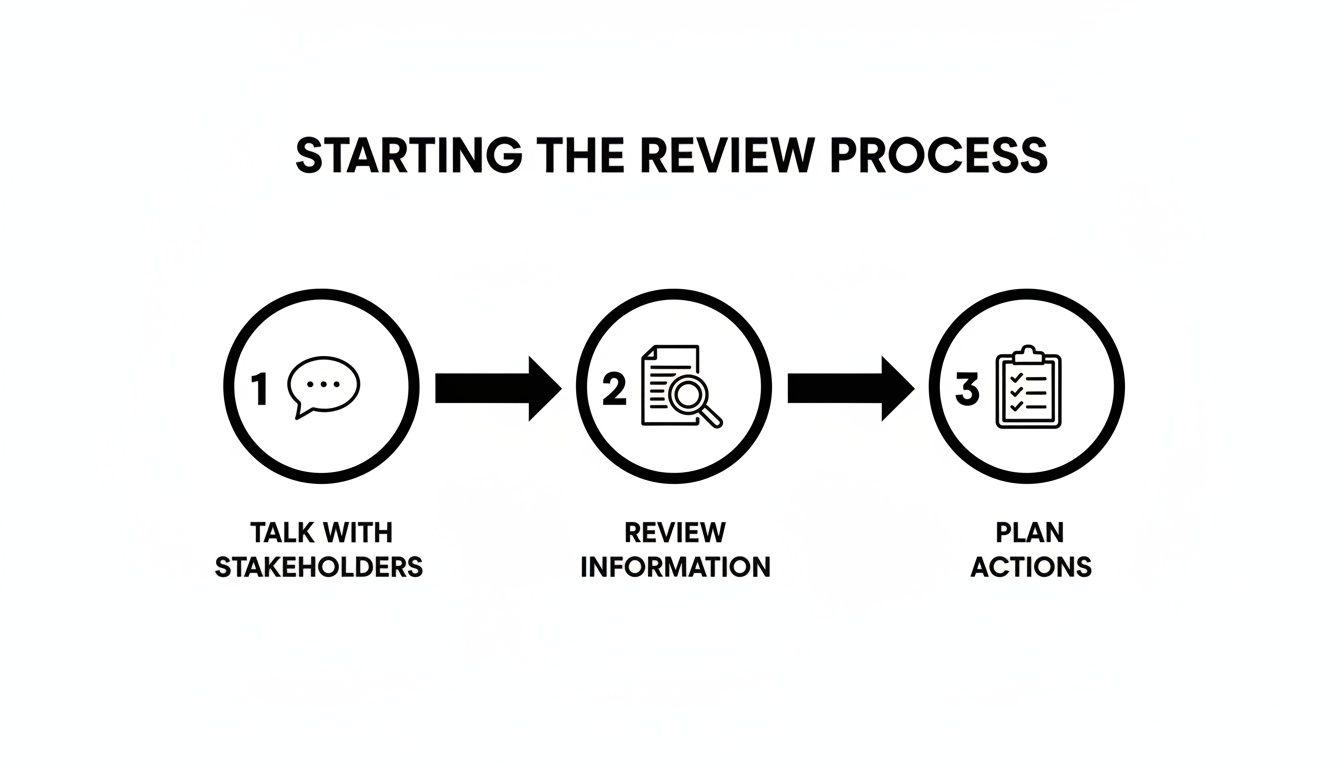
This process—talking, reviewing, and then planning—is the foundation of any good revision strategy. By putting their feelings first, you get the honest insights needed to build a plan that tackles the real issues, not just the grades on the surface.
Looking Beyond The Obvious
Once the conversation is flowing, you can dig a bit deeper. Sometimes, the problem isn't a lack of knowledge but a specific issue with exam technique that steals marks away.
For example, a student might lose marks simply because they misread 'command words' like 'explain' versus 'evaluate', writing a brilliant description when the examiner was looking for a critical judgement. Or perhaps the ticking clock creates so much anxiety they can't manage their time effectively in the exam hall. Chatting about their experience with recent mock GCSE exams can bring these hidden patterns to light.
This is where a quick diagnostic can be really helpful. Working through a checklist together can turn a vague, overwhelming feeling of "I need to do better" into a concrete set of actions.
Quick Diagnostic Checklist For Parents And Students
Use this table as a gentle starting point for your conversation. It helps frame the discussion around specific, actionable areas, taking the emotional heat out of the final grades.
| Area Of Focus | Key Questions To Ask Together | Actionable First Step |
|---|---|---|
| Subject Knowledge | "Which specific topics feel the shakiest? Be honest, which bits make your heart sink a little?" | Let's pinpoint just 1-2 topics in one subject to review first. We're not trying to fix everything at once. |
| Revision Habits | "How are you currently revising? Does it feel like it's actually helping, or just ticking a box?" | Let's experiment with one new revision technique for a week. Maybe making silly flashcards or a colourful mind map. |
| Exam Technique | "How did you feel for time in the last mock? Was it a mad rush at the end?" | Let's go through one past paper together, but we'll ignore the answers. We'll just focus on what the questions are really asking. |
| Wellbeing & Mindset | "How are your energy levels, honestly? Are you feeling overwhelmed or anxious about exams?" | Let's schedule a non-revision activity you love, just for fun. A proper break is just as important as study time. |
Going through these points helps you both see the bigger picture. It shifts the focus from blame to problem-solving, which is far more productive and so much better for your child's morale.
"The goal isn't to pinpoint every single mistake from the past. It's to find the one or two key areas where a small change can unlock the biggest improvement. This builds momentum and, most importantly, the belief that they can do this."
Building A Revision Plan That Actually Works

We've all seen it: the beautiful, colour-coded timetable, pinned to the wall with the best of intentions. By the end of the first week, it’s usually ignored—a source of guilt rather than guidance. The truth is, a rigid schedule forced upon a teenager rarely survives contact with reality.
An effective revision plan isn’t a punishing boot camp. It's a flexible, living document that your child helps create and feels a sense of ownership over. It must respect their energy levels, their social life, and their unique learning style. Getting them involved isn't just a nice idea; it's the secret to building sustainable habits that prevent burnout and keep them feeling in control.
Moving Beyond The 9-to-5 Model
The biggest mistake is treating revision like a school day. A teenager's brain doesn't just switch on at 9 am and off at 3 pm. Some are night owls who do their best thinking after dinner; others have a burst of energy first thing on a Saturday morning. Forcing them into a schedule that fights their natural rhythm is a recipe for frustration.
Start by mapping out their week together, but begin with the non-negotiables—the things that make them feel human.
- Protect Their Downtime: First, block out football practice, time with friends, and that series they're binge-watching. Guarding their free time is absolutely vital for their mental health and shows you respect them as a person, not just a student.
- Track Their Energy: Ask them, "When do you feel most awake and focused? And when do you just feel drained and want to stare at a wall?" This simple question is a game-changer.
- Plan for Peaks and Troughs: Let's say they're sharpest between 10 am and noon on a Saturday. That's the perfect time to slot in the most challenging subject, like that tricky part of physics. Easier tasks, like making flashcards for History, can be saved for a lower-energy time, like early evening.
This approach does more than just get the revision done. It teaches them invaluable skills in self-awareness and time management, framing revision not as a punishment but as a manageable task that fits around their life.
The Power Of Short, Focused Bursts
Staring at a two-hour block labelled "Maths Revision" is enough to make anyone want to procrastinate. The sheer scale of it feels overwhelming. A much kinder and more effective way is to break study sessions into smaller, more digestible chunks.
This is where techniques like the Pomodoro Method come in. It’s incredibly simple but surprisingly powerful:
- Pick one small task: For example, "Complete 5 algebra problems from a past paper," not "Revise Maths."
- Set a timer for 25 minutes: Work on that single task with zero distractions.
- Take a 5-minute break: This is mandatory! They must get up, stretch, grab a drink—anything but revision.
- Repeat: After four of these "Pomodoros," they've earned a longer break of 15-30 minutes.
These short bursts feel less daunting, which makes starting the task a million times easier. They also train the brain to focus intensely for short periods, which is a massive help for improving concentration. To build a revision plan that truly delivers, incorporating effective study strategies for exams is non-negotiable.
Creating A Realistic And Flexible Schedule
Once you know their energy patterns and have a method for focused work, you can sketch out a weekly plan. This isn't a minute-by-minute schedule set in stone, but a flexible guide that leaves room for life to happen.
Here’s what a flexible weekly goal might look like for a child who is a morning person on weekends but tired after school:
- Monday: 2 x Pomodoros on English Literature (Poetry).
- Tuesday: 1 x Pomodoro on History flashcards + 30 mins watching a French film.
- Wednesday: Football practice (Total rest from revision).
- Thursday: 2 x Pomodoros on Biology (Cell structure).
- Friday: Meet friends (Total rest from revision).
- Saturday: 3 x Pomodoros on Maths (morning peak) + 2 x Pomodoros on Geography (afternoon).
- Sunday: Catch-up slot (if needed) or full rest day.
This model builds in plenty of rest, is tailored to your child's energy, and focuses on achievable goals rather than rigid time slots. For a deeper dive into creating this kind of balanced approach, these expert revision tips for GCSE offer even more practical ideas.
The best revision plan is one that actually gets used. By designing it with your child, you're not just creating a schedule; you're building their confidence, empowering them to take control of their own learning, and showing them you're on their team.
How To Turn Past Papers Into Your Secret Weapon
Knowing the syllabus inside out is one thing, but performing under the intense pressure of an exam is a completely different ball game. This is where past papers become your child's most powerful ally—but only if they’re used smartly. Just churning through paper after paper is a fast track to burnout, not better grades.
The real magic happens when you treat past papers like a training ground for the main event, not just a test. It’s a deliberate, three-part strategy: practice under timed conditions, mark like an examiner, and analyse every single mistake with kindness. This simple loop transforms passive revision into active, targeted training that builds both skill and confidence.
Replicate The Exam Environment
The exam hall has its own unique pressures: the dead silence, the ticking clock, the feeling that your entire future is on the line. It can be incredibly unsettling, and many bright students who know their subject cold can crumble under these conditions. The best way to build their resilience is to gently mimic that environment right at home.
This isn’t just about setting a timer. It’s about creating a focused, distraction-free bubble.
- No Phones: The phone needs to be in another room, completely switched off. This removes the constant temptation and anxiety of notifications.
- Strict Timing: Use the exact time allocated for the real paper. If it’s a 90-minute exam, they work for 90 minutes on the dot. When the timer goes off, pens down. No "just one more minute."
- Quiet Conditions: Recreate the silence of the exam hall as best you can. No TV in the background, no little siblings interrupting.
It might feel a bit intense at first, but this practice is priceless. It helps your child get a feel for pacing, manage the surge of adrenaline, and learn how to allocate their precious minutes across different questions. This is a fundamental part of knowing how to improve GCSE grades that goes way beyond pure subject knowledge.
Learn To Think Like An Examiner
Once the timer stops, the real work begins. Don't just glance over the paper and check for right or wrong answers. This is the moment to get inside the examiner's head by using the official mark scheme. Sitting down with your child and walking through it together can be a genuine eye-opener.
You’ll quickly see where marks are really won and lost. For instance, in a Biology question, your child might write "the enzyme stopped working because it got too hot," which is correct in essence. But the mark scheme explicitly rewards the scientific term "denatured." Seeing this on paper makes it click. It's not about being clever; it's about giving the examiner the exact keywords they're looking for.
This process demystifies grading and turns it into a game they can actually learn to win. It shows them that for every mark awarded, there’s a clear and specific requirement to be met.
By consistently using the mark scheme, your child starts to see the exam not as a test of what they know, but as a system for demonstrating their knowledge in the precise way the exam board demands.
This change in mindset is often what separates a Grade 6 from a Grade 7. The evidence for this approach is clear; schools that mandate this kind of focused practice see dramatic improvements in outcomes. For example, in England's 2023 results, the proportion of top grades (7-9) reached 22.4%, a notable rise from pre-pandemic levels, with experts often attributing this to smarter revision techniques. You can discover more about how these trends reflect student performance on Schools Week.
Master The Mistake Journal
The final, and arguably most powerful, step is to create a 'mistake journal'. This isn't about shaming them for errors; it's about treating every mistake as a clue that can lead them to a better grade. It transforms a moment of frustration into a powerful learning opportunity.
The journal can be a simple notebook. After marking a paper, your child should log every question they got wrong or dropped marks on. For each entry, they need to note three things:
- The Question: What was the topic or command word? (e.g., A question about coastal erosion).
- The Mistake: Why did I lose marks? (e.g., "I misread 'compare' and only described one thing," or "I completely forgot the formula for calculating resistance."). The key here is honest reflection, not self-criticism.
- The Fix: What will I do differently next time? (e.g., "I will highlight the command word before I start writing," or "I'll make a flashcard for that formula and stick it on my mirror.").
After just a few papers, patterns will start to emerge. They might notice they consistently struggle with questions worth more than four marks, or always misinterpret graphs in Geography. This journal transforms a vague feeling of "I'm bad at this" into a concrete, actionable plan. It's the ultimate tool for personalised revision, ensuring every practice paper makes them smarter and more prepared than the last.
Putting Wellbeing At The Heart Of Revision
Let's be honest. An exhausted, anxious, and overwhelmed student simply cannot learn or perform at their best, no matter how perfectly crafted their revision timetable is.
We often treat wellbeing as an afterthought—a luxury to squeeze in if there’s time. This is a fundamental mistake. Wellbeing isn't a distraction from revision; it's the very engine that powers effective learning. It is the absolute key to sustainably improving GCSE grades.
Prioritising your child's mental and physical health isn’t about taking time away from their studies. It’s about making the time they do spend sharper, more focused, and emotionally sustainable.
Imagine their brain is a high-performance car. It needs the right fuel, regular maintenance, and time off the track to function. Pushing them to revise late into the night on a diet of energy drinks and stress will only lead to a breakdown. Putting them first is the smartest revision strategy you have.
Building A Foundation Of Calm And Connection
Your home should feel like a sanctuary from exam pressure, not an extension of the classroom. Creating an environment where it's safe to talk about stress, fear, and feeling overwhelmed is one of the most powerful things you can do for your child.
Start by normalising these feelings. You could say something like, "This is a really stressful time, and it's completely normal to feel worried. I just want to check in – how are you actually feeling today?" This simple question opens the door for a real conversation, showing them they're not alone in their struggle. The ability to cope with academic pressures is built on understanding and managing stress effectively.
This emotional support builds a psychological safety net. When a student feels truly heard and understood, rather than just managed, they become far more resilient and better equipped to handle whatever challenges come their way.
The Non-Negotiable Pillars Of Wellbeing
While emotional support is vital, a few practical cornerstones of physical health have a direct and undeniable impact on memory, concentration, and academic performance. These aren't just 'nice-to-haves'; they are essential for your child's brain to work properly.
- Consistent Sleep: Teenagers need around 8-10 hours of sleep per night. It’s during sleep that the brain files away what it has learned. A lack of sleep directly tanks this process, called memory consolidation.
- Nourishing Food: A brain running on sugary snacks and caffeine is like a car running on fumes. It leads to energy crashes and an inability to focus. For example, a breakfast of protein and complex carbs (like eggs on toast) provides slow-release energy, preventing that mid-morning slump, unlike a sugary cereal.
- Simple Movement: Just 20-30 minutes of moderate exercise, like a brisk walk with the dog or kicking a ball around, can boost blood flow to the brain, reduce stress hormones, and improve mood. It's a natural reset button that clears the mind.
Frame these not as chores but as powerful revision tools. Explaining that a good night's sleep isn't lazy—it's actively helping them remember their history notes—can completely change their perspective.
Taming The Digital Distractions
In the thick of exam season, the constant pull of social media notifications can be a major source of anxiety and a huge drain on focus. The pressure to stay connected while also needing to study is a uniquely modern battle for our kids.
Setting boundaries together is a practical way to manage this. It’s not about a total ban, which can feel punishing and lead to conflict, but about creating protected time for deep focus.
Practical Example: The 'Phone Jail'
Agree on specific 'phone-free' revision blocks. For instance, from 6 pm to 8 pm, all family phones—yours included!—go into a box or a drawer in another room. This becomes the "phone jail."
This simple act removes the temptation for everyone and models good habits. It allows for deep, uninterrupted focus, making study time far more productive. Knowing they can check their phone during their next scheduled break makes the rule much easier to stick to.
Finding The Right External Support
Sometimes, even with the best plan and the most supportive family, a particular hurdle feels too high to clear alone. Recognising when your child needs targeted, outside help isn’t a sign of failure—it’s a mark of insightful parenting.
It could be a single subject that’s become a source of tears and frustration, or the entire school environment feeling overwhelming. Whatever the case, finding the right external support can be the key that finally unlocks their potential. This is about adding a specialist to your team, finding a fresh voice to explain a concept differently, or finding a new environment to help your child fall back in love with learning.
When To Consider A Subject-Specific Tutor
Has your child hit a complete wall with a particular subject? Perhaps it’s the abstract concepts in Physics or the complex grammar in Spanish. Despite their best efforts and your encouragement, their grades are stuck and the frustration is mounting. This is the classic signal that a subject-specific tutor could make all the difference.
A great tutor does more than just re-teach the syllabus. They create a safe, one-to-one space for a child to admit, "I just don't get it," without the fear of looking silly in front of their peers.
- Here's a classic scenario: Your child is struggling with trigonometry in Maths. In a class of 30, the teacher has to move on, but your child is still stuck on the first step, feeling lost and left behind. A tutor can spend an entire session on that single concept, using different analogies and methods until it finally clicks. That "aha!" moment can be the turning point that rebuilds their confidence in the whole subject.
This kind of targeted intervention is proven to be incredibly effective. For core subjects like English and Maths, focused support for resits has been shown to significantly improve GCSE outcomes. Recent data highlighted a 14% increase in post-16 candidates taking these exams, with resit programmes helping to narrow the attainment gap for many pupils.
Exploring Alternative Learning Environments
But what if the issue isn't just one subject, but the entire experience of school? For many students, the noise, social pressures, and rigid pace of a traditional classroom can be deeply overwhelming, causing anxiety that becomes a barrier to learning. This is especially true for children with special educational needs (SEN) or social, emotional, and mental health (SEMH) challenges.
In these situations, the answer isn't more pressure—it's a different environment altogether. This is where online schooling can be a genuine lifeline.
For a child who feels lost, anxious, or invisible in a crowded classroom, an online school provides a calm, focused, and personalised space to learn and thrive. It removes the social anxiety and allows their academic abilities to finally shine through.
Platforms like Queen’s Online School are designed specifically with this in mind. They offer the full, structured British curriculum but deliver it in a way that puts the child's individual needs front and centre. It’s about fitting the school to the child, not forcing the child to fit the school.
How Online Schooling Rebuilds Confidence
Think about the tangible difference this kind of environment makes. Instead of a large, intimidating classroom, your child joins a small, live, and interactive online class. If they are too shy to speak up, they can ask the teacher questions privately via text, getting immediate, discreet support without being singled out. This small feature can be revolutionary for an anxious child.
The flexible schedule also means they can tackle difficult subjects when they feel most focused, with the ability to re-watch recorded lessons if a concept doesn't stick the first time. This level of control and personalisation is incredibly empowering. By offering a range of GCSE online courses in the UK, these schools provide pathways that truly fit the child.
Ultimately, whether you choose a tutor or explore an online school, the goal is the same: to listen to your child's needs and find the right support to help them not just improve their GCSE grades, but also rediscover their confidence as a capable and resilient learner.
A Parent's Guide: Your GCSE Questions Answered
As a parent, you naturally want to give your child the best possible support, but it's easy to feel overwhelmed by a sea of conflicting advice. Knowing how to help your child improve their GCSE grades often starts with getting clear, compassionate answers to your most pressing concerns. Here are some of the most common questions we hear from parents, answered with practical, experience-led advice.
How Many Hours a Day Should My Child Revise for Their GCSEs?
There’s no magic number, because quality will always trump quantity. A tired, resentful hour of revision is worthless compared to 25 minutes of focused, positive work. A good rule of thumb for a Year 11 student is around 1.5 to 2.5 hours of effective revision on a school night, and maybe 3-4 hours spread across a weekend day.
But this must be personalised to your child. The real goal is to find a consistent rhythm that works for them and doesn't lead to burnout. Remember, a rested brain is a learning brain.
A brilliant method to try is the Pomodoro Technique: 25 minutes of intense focus, followed by a 5-minute break. This simple trick makes revision feel less daunting and keeps concentration high. Most importantly, any schedule you create together must protect that non-negotiable time for friends, hobbies, and proper rest.
What Can I Do If My Child Has No Motivation to Revise?
A lack of motivation is rarely laziness. It’s almost always a symptom of feeling completely overwhelmed or paralysed by the fear of failure. Your first role isn't to be a director, but a supportive detective—to gently understand the emotion behind the inaction.
Start by breaking revision down into tiny, non-threatening steps. Instead of the huge instruction, "You need to revise Chemistry," try something small like, "Could we just spend 10 minutes finding your Chemistry notes and putting them in a pile?" The next step might be, "Let's just read one page together." These small wins build momentum and start to chip away at that huge, scary feeling of being swamped.
Also, try connecting their effort to their future goals, not yours. Remind them how these grades are a stepping stone to that art course, apprenticeship, or future they've talked about. And finally, validate their feelings. A simple, "I get it, this is really tough, and it's okay to feel this way," is far more powerful than, "You just need to get on with it."
Is It Too Late to Improve GCSE Grades a Few Months Before the Exams?
Absolutely not. A few focused months can make a monumental difference, but the key is to be strategic and kind to your child. This isn't the time for re-learning every topic from scratch. It’s time for "smart revision."
The fastest way to gain marks now is by mastering exam technique. This means focusing intensely on completing past papers under timed conditions and meticulously going through the mark schemes afterwards. This process alone can often push a student up an entire grade boundary.
Help your child identify their weakest topics—specifically, the ones that carry the most marks—and tackle those first. It's a classic case of working smarter, not just longer. Consistent, targeted effort on these high-impact areas will deliver the best results when time is short.
Should We Pay for a Private Tutor or a Revision Course?
This is a common dilemma, and the answer really depends on your child's specific needs and what is causing them to struggle. External support can be incredibly effective, but it isn't a one-size-fits-all solution.
A private tutor can be a game-changer for a student who is struggling with one particular subject, offering tailored, one-to-one attention that a classroom teacher simply can't provide. Similarly, a good revision course can offer a fantastic confidence boost and a dose of focused practice right before the exams kick off.
Before you invest any money, always speak to your child's teachers first. They know your child's learning style and struggles. Schools often run excellent and free after-school revision sessions or clinics that might be exactly what your child needs.
If you do decide to seek external help, treat it like a partnership. Find a tutor who not only knows the exam board inside out but who also connects with your child on a personal level. That positive, trusting relationship is often just as important as the subject knowledge they share.
At Queen's Online School, we understand that every child's journey to academic success is unique. Our small, interactive classes and personalised support from subject-specialist teachers create an environment where students can rebuild their confidence and achieve their full potential. Discover how our flexible approach to the British curriculum can help your child improve their GCSE grades by visiting us at https://queensonlineschool.com.