


So, you’re thinking about your home education curriculum. The very thought can feel huge, a mix of heart-swelling excitement and a deep sense of responsibility. You’re not just picking out textbooks; you’re crafting the world your child will learn in, the one where their curiosity can truly catch fire. It's a journey from feeling a little uncertain to feeling truly empowered, and you have everything you need to make it a beautiful success.
Your Home Education Journey Starts Here
This feeling of responsibility is one you share with a rapidly growing community. In autumn 2024, local authorities across the UK reported a staggering 111,700 children were being electively home-educated. That’s a 21.4% jump from the previous year, a clear signal that more and more parents are searching for a more personalised, heart-led path for their children. You can dig into the numbers yourself in the official Department for Education statistics.
What Is a Home Education Curriculum, Really?
First, let's clear something up. Forget the rigid school timetables and the pressure of standardised tests you might be picturing. When you bring education home, the curriculum becomes a living, breathing guide—not a rulebook. It’s less about ticking boxes and much more about connecting the dots in a way that truly makes your child’s eyes light up.
A truly effective home education curriculum is one that bends and adapts to your child's spirit. It serves their curiosity, not the other way around, making learning feel like an adventure rather than a chore.
At its heart, a curriculum for home education is simply your plan for what your child will learn and how they'll learn it. This isn't about recreating school at the kitchen table. It’s about building a framework around what matters most:
- Your Child’s Passions: What makes them lose track of time? Whether it's dinosaurs, coding, or ancient myths, their interests are the engine for their entire education. Imagine using their love for Minecraft to teach geometry and storytelling. That's the magic.
- Their Learning Style: Is your child a hands-on doer who learns by building and touching, a visual observer who needs to see it to believe it, or someone who learns best by listening and discussing? Your approach should play to their natural strengths, making them feel seen and understood.
- Your Family’s Goals: Are you aiming for university entrance down the line? Or is your deepest wish to foster a specific skill, or simply nurture a lifelong, joyful love of learning?
Ultimately, the goal is to create an educational experience that feels authentic, supportive, and full of joy. By understanding the core benefits of home education, you can start designing a plan that doesn't just meet academic benchmarks but also builds your child’s confidence, well-being, and sense of self.
Exploring Different Home Education Philosophies
Choosing a curriculum for home education isn't like picking a textbook off a shelf. It's more like deciding on the very heart of your learning environment. It’s about finding a philosophy that clicks with your family’s values and, most importantly, aligns with the unique way your child sees the world. This isn’t about enforcing rigid rules; it’s about discovering a rhythm that feels natural, supportive, and even joyful.
The desire for this kind of personalised learning is growing fast. A revealing survey from August 2025 showed that 32% of British parents are now seriously considering or already leaning towards homeschooling. This shift is deeply rooted in curriculum concerns, with a staggering 75% of parents believing that mainstream schools just aren't preparing children for real life. The full research on education statistics paints a clear picture of why so many families are looking for a better way.
This journey is about weaving together your child's needs, your educational philosophy, and a practical framework into a cohesive plan.
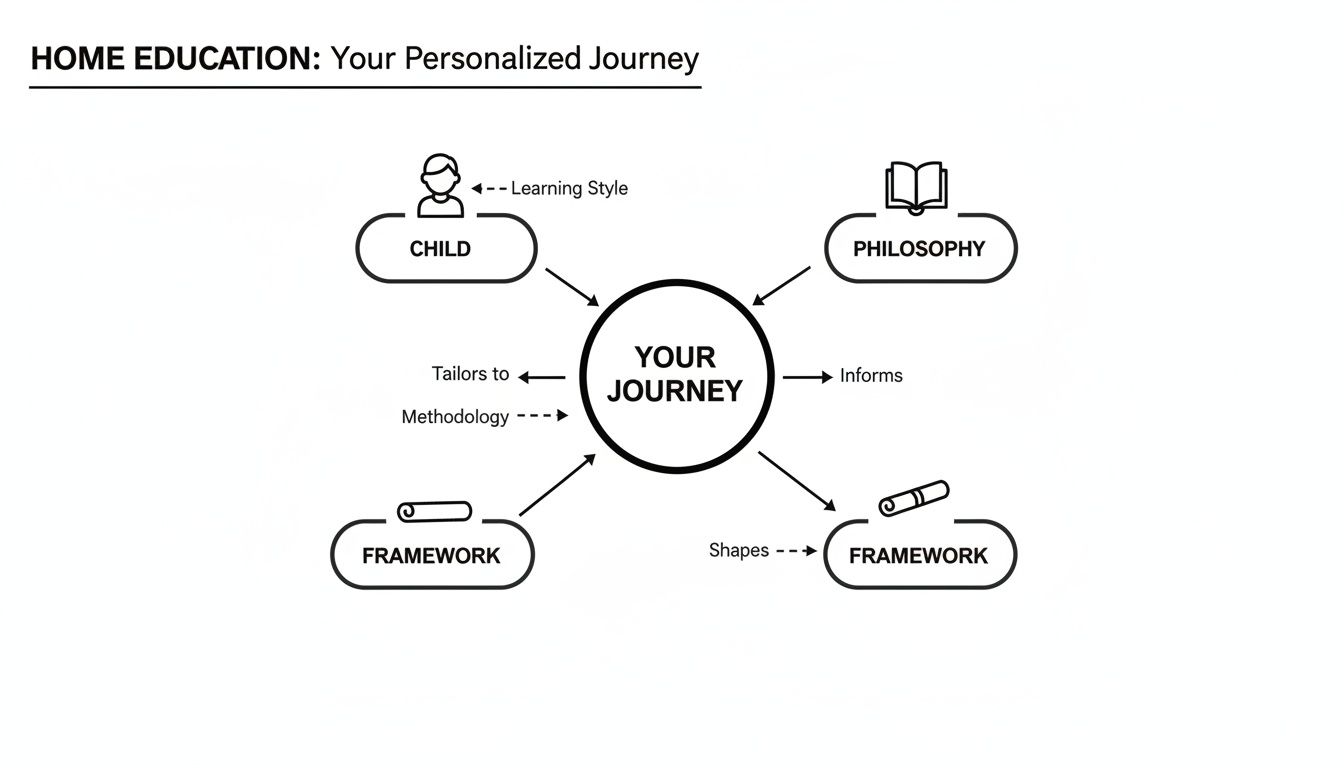
As the diagram shows, the most successful home education puts the child firmly at the centre, with everything else—philosophy, structure, resources—working to serve them.
To help you find the right fit, we’ve broken down some of the most popular home education philosophies. This table offers a quick comparison to see how they stack up.
Comparing Home Education Curriculum Approaches
| Approach | Core Philosophy | Structure Level | Best Suited For |
|---|---|---|---|
| National Curriculum | Follows the UK's standardised educational framework to ensure alignment with school peers. | High | Families wanting a clear, pre-defined path or a child who feels secure with familiar structures. |
| Classical | Builds knowledge through a three-stage process (Trivium) focusing on logic, reason, and rhetoric. | High | Learners who thrive on rigour, logic, and a deep dive into historical and literary classics. |
| Charlotte Mason | "Education is an atmosphere, a discipline, a life." Uses ‘living books’ and nature to foster a love of learning. | Medium | Children who are curious, love stories, and learn best through gentle, real-world, and holistic experiences. |
| Unschooling | Child-led learning where interests and passions dictate the educational journey without a formal curriculum. | Low | Self-motivated, curious children in families who trust the natural learning process and value autonomy. |
| Unit Studies | Explores a central topic (e.g., 'Space') through multiple subjects, creating an interconnected learning web. | Flexible | Children who enjoy project-based learning and seeing the connections between different subjects. |
Each of these approaches offers a completely different flavour of home education. Let's dig a little deeper into what they feel like in practice, for your child.
The Structured Path: The UK National Curriculum
For many families just starting out, following the UK National Curriculum offers a sense of security and a clear roadmap. Think of it as a well-marked hiking trail—the path is clear, the milestones are visible, and you know it leads to a recognised destination like GCSEs and A-Levels.
This approach is particularly comforting if your child is anxious about change or might transition back into the school system at some point. It ensures they cover the same core subjects as their peers, which can make them feel connected and any future integration much smoother.
A practical example: A Year 4 child on this path would be tackling fractions in maths, exploring the Romans in history, and learning about states of matter in science, just like their friends in the local primary school. This simplifies planning and makes finding resources straightforward, freeing up your mental energy to focus on your child's engagement.
The Classical Model: Building a Foundation of Logic
Classical education is like constructing a beautiful, enduring building. It’s all about creating a strong intellectual foundation through three distinct stages, known as the Trivium, which are designed to match a child's cognitive development.
- Grammar Stage (Ages 6-10): Young children are like sponges, so the focus is on absorbing facts. For a child at this stage, it feels like a game—learning happens through memorisation using catchy songs, fun chants, and vivid stories.
- Logic Stage (Ages 10-14): As they start to think more analytically, the emphasis shifts to reason, argument, and understanding cause and effect. They begin to ask "why?" and this approach gives them the tools to find satisfying answers.
- Rhetoric Stage (Ages 14-18): Finally, teenagers learn to express their ideas eloquently and persuasively, empowering them to feel confident and articulate in their beliefs.
This method is known for its academic rigour, championing critical thinking and a deep engagement with the great works of Western literature and history.
The Charlotte Mason Method: A Living Education
Imagine an education filled with muddy-kneed nature walks, afternoons spent looking at beautiful art, and books you just can't put down. That’s the essence of the Charlotte Mason approach. It’s a philosophy built on the belief that children are whole people who deserve a rich, wide-ranging education, not just a diet of dry facts.
"Education is an atmosphere, a discipline, a life." — Charlotte Mason
This philosophy famously avoids dry, ‘dumbed-down’ textbooks. Instead, it uses ‘living books’—beautifully written narratives by authors who are truly passionate about their subject. Learning happens organically through narration (telling back what they've learned in their own words), nature journaling, and hands-on experiences.
A practical example: Instead of reading a textbook chapter on pond life, a child in a Charlotte Mason homeschool might spend the morning at a local pond, sketching what they see, feeling the squelch of the mud. Afterwards, they’d read an engaging, illustrated story about frogs and then narrate back everything they learned, their own voice bringing the knowledge to life.
Unschooling and Unit Studies: Following Your Child's Heart
Finally, we have two of the most child-centred approaches: unschooling and unit studies. Unschooling is the ultimate in interest-led learning. There is no set curriculum at all; learning simply unfolds from a child's natural curiosity, questions, and passions, validated and supported by the parent.
Unit studies offer a wonderful blend of structure and freedom. You pick a central theme that makes your child's eyes sparkle—like 'Ancient Egypt' or 'The Rainforest'—and then explore it across multiple subjects, weaving them all together.
A practical example: A unit study on space, inspired by your child watching a rocket launch, could involve:
- Science: Feeling the awe of learning about planets, stars, and gravity.
- Maths: Calculating the mind-boggling distance between planets or the speed of light.
- History: Getting swept up in the drama of the space race between the USA and the Soviet Union.
- Art: Painting shimmering constellations or building a model rocket they can hold in their hands.
This method turns learning into a cohesive, exciting exploration, showing children how everything they learn is beautifully interconnected in the real world.
How to Choose the Right Curriculum for Your Child
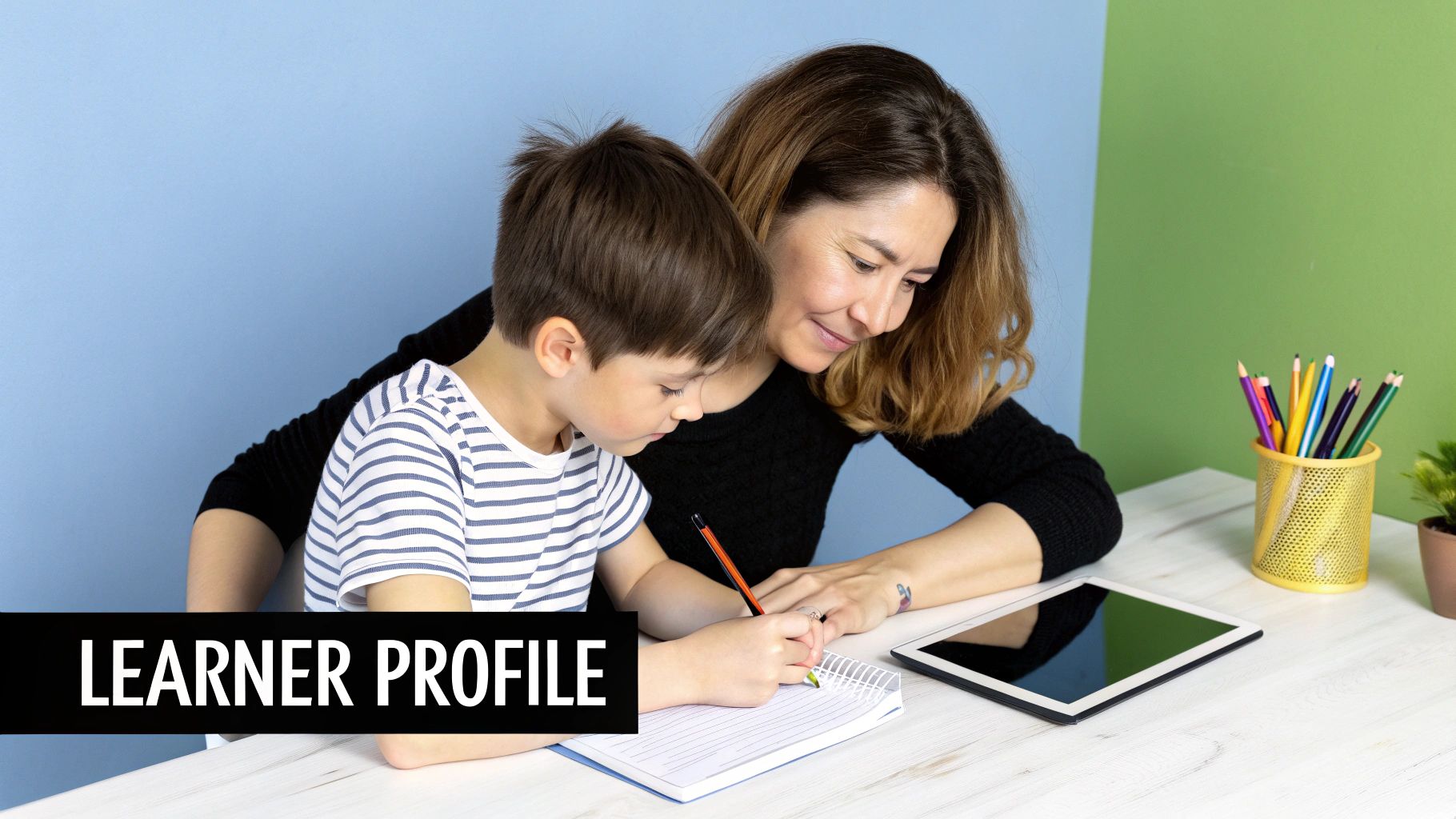
Choosing a home education curriculum isn't about ticking boxes or browsing catalogues. It's about looking closely at the unique, wonderful child right in front of you. This decision is really an act of love—an opportunity to build an education that doesn't just teach them, but truly sees them for who they are.
Before you even think about specific resources, the first and most important step is to create a 'learner profile'. Think of it as a mosaic of their personality, their strengths, and the things that make them light up with curiosity. This profile will be your compass, guiding you toward a curriculum that feels less like a set of rules and more like a warm, natural fit.
Start with Your Child’s Unique Learning Style
Every child learns differently. Trying to force a hands-on, active learner into a worksheet-heavy curriculum is like asking a fish to climb a tree. It's frustrating for everyone and completely misses their natural talents. By understanding how they best absorb the world, you can find a path that feels effortless and genuinely engaging for them.
So, what does this look like for your child?
- For the Kinesthetic Learner: Does your child need to move to think? They’ll learn fractions best by actually slicing a pizza in the kitchen or understand historical battles by acting them out with toy soldiers. Look for curriculums that feel like an adventure, packed with experiments, building projects, and physical activity.
- For the Visual Learner: This child soaks up information through their eyes. They will adore detailed diagrams, colourful timelines, and well-made educational videos. A curriculum that uses beautiful illustrations, mind maps, and engaging visual content will capture their imagination and make them feel understood.
- For the Auditory Learner: Does your child remember every word of a story you read them? They thrive on discussion, listening to audiobooks, and using rhymes or songs to memorise facts. A curriculum built around rich storytelling and heartfelt conversation is where they will truly flourish.
The goal isn't to rigidly label your child. Most children are a blend of styles, but knowing their dominant preference helps you choose a curriculum that plays to their strengths. This builds their confidence and fosters a real love for learning.
Uncover Their Passions and Curiosities
What does your child talk about endlessly? What do they choose to read or watch in their free time? These passions aren't distractions; they are the most powerful fuel for their education. A huge advantage of home education is the ability to weave these interests right into the heart of their learning.
For instance, a child obsessed with video game design could have their entire curriculum built around it. Suddenly, maths becomes the exhilarating challenge of coding logic and geometry. English is about writing compelling character backstories that bring their world to life, and science explores the physics engines that make the game work. When learning is relevant to what they love, motivation is never a problem.
Consider Your Role as the Parent Educator
Now, it’s time for a moment of gentle honesty with yourself. Your energy, teaching style, and the practical realities of your daily life are just as critical to this equation. An ambitious curriculum that requires hours of hands-on prep every day simply isn’t sustainable if you’re also working from home or juggling other commitments. That's okay.
Ask yourself these questions, with kindness:
- How much time can I realistically dedicate? Be truthful about your capacity. Some curriculums are 'open-and-go' with minimal prep, while others demand significant planning. Choosing one that fits your life prevents burnout.
- What is my teaching style? Are you a structured planner who loves a clear schedule, or do you prefer to be more flexible and spontaneous? Choose a curriculum that aligns with your natural rhythm, not one that fights against it, so that teaching feels joyful for you, too.
- What is our budget? Home education resources range from completely free online materials to comprehensive, all-in-one boxed sets. Knowing your budget will narrow down the options significantly.
This desire for a more flexible and supportive educational environment is a growing trend across the UK. The number of home-educated children is rising, partly because families are looking for approaches that better support their children's wellbeing. In the North East, for example, Sunderland saw its number of EHE pupils soar by 200% between 2019 and 2025, often driven by a need to address mental health.
This shift is pushing curriculum developers to create resources that balance academic progress with emotional wellbeing. You can learn more about the trends shaping UK homeschooling and how families are adapting.
By balancing your child’s needs with your own capacity, you create a home learning environment that is not just effective, but also sustainable and joyful for the whole family.
Bringing Your Curriculum to Life With Practical Planning
You’ve explored the philosophies and found a style that resonates with your child’s heart. Now for the exciting bit: turning those big ideas into the beautiful, messy reality of daily life. This is where your curriculum for home education truly comes alive, transforming abstract concepts into the sound of laughter during a science experiment or the quiet focus of a child completely lost in a history book.
The aim isn’t to clone a rigid school timetable. Far from it. The goal is to create a gentle rhythm that provides structure without killing the spontaneity that makes home learning so magical. Think of it as a dance between planning and discovery—covering the essentials while leaving plenty of room for your child’s curiosity to joyfully take the lead.
As you start mapping out your weeks, the real challenge is translating your plans into genuinely engaging activities. It's one thing to pencil in 'maths', but another thing entirely to plan something that sparks a genuine "Aha!" moment. This is the heart of designing effective learning experiences that actually stick.
Creating A Flexible Weekly Rhythm
A weekly plan should be your anchor, not your cage. It gives your child the predictability they need to feel secure, but it has to be flexible enough to embrace life’s unexpected gifts—a sunny day begging for a nature walk or a sudden fascination with ancient Egypt that deserves a deep, immersive dive.
And remember, a child's attention span and energy levels change dramatically with age. Your schedule needs to respect that, honouring their developmental stage with kindness and patience.
For instance, younger children thrive on short bursts of focused activity broken up with plenty of play and movement. An older teen preparing for exams, on the other hand, will naturally need longer, more structured blocks for independent study.
A Look At A Key Stage 1 Schedule
For a child aged 5-7, learning should feel like play. A schedule for this age isn’t about strict timings but about creating a natural flow of engaging activities. The focus is on hands-on exploration and building those foundational skills in a joyful, low-pressure way.
Here’s a glimpse of what a day might feel like for your child:
- Morning (9:30 AM – 11:30 AM): Kick things off with 20 minutes of a playful phonics game using magnetic letters on a whiteboard. Follow that with a story snuggled on the sofa, and then head into the garden to count ladybirds and leaves—a gentle, real-world introduction to numeracy.
- Late Morning: Time for a creative session with paint or playdough, allowing for totally free expression where there are no mistakes.
- Afternoon (1:00 PM – 2:30 PM): After lunch, it’s adventure time. A trip to the local park becomes a science lesson on insects and seasons, while a visit to the library nurtures a lifelong love of reading and the wonder of choosing their own books.
The key at this stage is connection. The learning happens in the conversations you have while baking, in the questions your child asks on a walk, and in the stories you read snuggled up together.
Structuring A Key Stage 4 (GCSE) Week
As your child moves towards their GCSEs, the schedule naturally becomes more formal to handle the demands of their subjects. But it is absolutely vital to protect their mental health by balancing focused academic work with downtime for their personal passions. This is how you prevent burnout and keep that precious love of learning alive.
A week for a 14-16 year old could be organised into dedicated study blocks:
- Core Subject Blocks (e.g., 90 minutes): Set aside focused time for subjects like Maths, English, and Science. This allows for in-depth work, from tackling tricky equations to drafting essays.
- Flexible Study Time: Build in periods for independent research, coursework, or revision. This is where they learn crucial self-management skills and feel a sense of ownership.
- Passion Projects: Ring-fence time for what they truly love, whether it's coding, learning an instrument, or writing a novel. This is non-negotiable for their wellbeing and reminds them that learning is more than just exams.
- Breaks and Physical Activity: Ensure the schedule includes proper breaks and time to move their body. A walk, a quick workout, or just time away from the desk makes all the difference to their focus and mood.
To give you a clearer picture, here is a sample timetable that balances core subjects with other important activities for a younger learner.
Sample Weekly Timetable for a Key Stage 2 Learner
| Time Slot | Monday | Tuesday | Wednesday | Thursday | Friday |
|---|---|---|---|---|---|
| 9:30 – 10:30 | Maths (Number bonds game) | English (Creative writing) | Maths (Fractions with baking) | English (Reading comprehension) | Project Work (History) |
| 10:30 – 11:00 | Break / Snack / Outdoor Play | Break / Snack / Outdoor Play | Break / Snack / Outdoor Play | Break / Snack / Outdoor Play | Break / Snack / Outdoor Play |
| 11:00 – 12:00 | Science (Plant life cycle) | History (The Romans) | Music Practice / Art | Geography (Mapping skills) | Science Experiment |
| 12:00 – 1:00 | Lunch | Lunch | Lunch | Lunch | Lunch |
| 1:00 – 2:00 | PE (Local park or sports) | Library Visit / Reading | Project Work (History) | PE (Swimming or dance) | Nature Walk & Sketching |
| 2:00 – 2:45 | Quiet Reading | French (Duolingo/App) | Free Choice (Board games) | French (Duolingo/App) | Tidy Up / Review the Week |
This is just a template, of course. The real magic happens when you adapt it to fit your child's interests, energy levels, and your family’s unique rhythm.
Essential Resources To Support Your Plan
You are never alone on this journey. A wealth of incredible resources exists to support every part of your curriculum for home education. Building a diverse toolkit can enrich your child's learning and offer you invaluable support when you need it.
Free Online Platforms:
- BBC Bitesize: An absolutely outstanding resource aligned with the UK curriculum, offering videos, quizzes, and guides for all key stages.
- Khan Academy: Perfect for maths and science, providing free, world-class instruction through easy-to-follow videos and practical exercises.
- Local Community: Don't forget your local museums, libraries, and home education co-ops. These are fantastic for socialisation and hands-on learning, reminding your child they are part of a wider community.
For families seeking a more structured path, particularly for the crucial exam years, having a well-defined plan is key. Exploring a complete homeschooling syllabus for the UK can provide a clear and comprehensive roadmap, ensuring all necessary topics are covered for qualifications like IGCSEs and A-Levels. This helps you blend your unique family approach with recognised academic standards.
Navigating UK Legal Requirements and Assessments
Let's start with the question that keeps so many home-educating parents up at night: "Am I doing enough to meet the legal requirements?"
First, take a deep breath. The law in the UK is built on trust and flexibility, and it puts your child's needs right at the centre of everything.
It’s a common myth that you are required to follow the National Curriculum. You’re not. Your legal duty is to provide a 'suitable' full-time education appropriate for your child's age, ability, aptitude, and any special educational needs they might have. That wording is intentionally broad, designed to empower you to do what's best for your child, not to catch you out.
This freedom is what allows you to build a home education curriculum that truly serves your child. What matters most is that you're providing a broad, balanced education that prepares them for life in their community and the wider world.
What Does ‘Suitable Education’ Mean in Practice?
The word ‘suitable’ can feel a bit vague, but it really just comes down to common sense and genuine effort. It doesn't mean you have to replicate a school day, hour by hour. It simply means creating an environment where your child is consistently learning and developing in a way that is right for them.
Your Local Authority (LA) has the right to make informal enquiries to check that a suitable education is being provided. This isn't something to fear; think of it as an opportunity to proudly share the wonderful learning journey you and your child are on. You can do this by showing them things like:
- Examples of Work: A folder of drawings, written stories, maths worksheets, or even just photos of a science experiment bubbling away on the kitchen counter.
- A Simple Plan: A brief, informal outline of the topics you're thinking of covering over the next term. It doesn’t need to be exhaustive.
- Resource Lists: A simple list of the books, websites, and places (like museums, parks, or local historical sites) you use for learning.
A ‘suitable’ education is less about ticking boxes and more about showing a clear, child-focused intention to help them learn. Your passion for your child’s progress and wellbeing is your greatest asset.
Rethinking Assessment Beyond Tests
In a home education setting, assessment isn’t about high-stakes exams. It’s about something far more powerful: observing your child's growth every single day. This is a much more personal and insightful way to track progress, focusing on true understanding and the little sparks of discovery rather than just memorising facts for a test.
Think of it as collecting precious snapshots of their learning journey. This continuous, gentle assessment can take many forms, all centred on your child's individual progress.
Practical Ways to Track Progress
- Portfolios: Keep a scrapbook or a digital folder with work they are proud of. For a budding artist, this could be a collection of their drawings showing how their technique and confidence have blossomed over the year.
- Project-Based Evidence: Document bigger projects from start to finish. If your child decides to build a model of a Roman villa, take photos of the process and jot down the brilliant questions they asked along the way.
- Conversations and Narration: This is one of the most powerful assessment tools you have. Simply asking your child to "tell me all about the Tudors" after a project reveals far more about their real understanding than any multiple-choice quiz ever could. It honours their voice.
Pathways to Formal Qualifications
As your child gets older, you'll naturally start thinking about formal qualifications like IGCSEs and A-Levels. This is an entirely achievable goal for home-educated learners, and it absolutely doesn't mean you have to abandon your personalised curriculum.
The key is to plan ahead. You can register your child as a private candidate at an approved exam centre. Many online schools and curriculum providers specialise in supporting home-educated students through these qualifications, offering expert tutoring and ensuring all the syllabus points are covered.
This allows you to continue with a flexible, personalised education that respects your child's needs, while still opening all the right doors to university and their future dreams.
Using Online Resources to Enhance Home Learning
Modern home education beautifully blends muddy hands from the garden with the endless possibilities of digital tools. Integrating online resources into your curriculum isn't about mindlessly increasing screen time; it's about strategically enriching your child's learning while giving yourself powerful support.
Think of technology as a flexible and potent ally on your journey. It’s about building a bespoke educational team around your child. You might feel passionately confident leading history and art, but the thought of teaching A-Level Chemistry can be daunting for many. This is exactly where online platforms can step in—not to replace you, but to supplement your strengths and ease your burden.
Assembling Your Child's Learning Team
Imagine your child needs specialist support for a subject like Mandarin or advanced physics. An online school can provide live, interactive lessons with a subject-specialist teacher, taking the pressure right off you. This ensures your child receives expert instruction and frees you up to focus your energy on the areas where you shine.
This blended approach honours your child's needs by giving them access to the best of both worlds: your dedicated, personal guidance and the specialised knowledge of an online educator. It’s a partnership that ensures no subject is off-limits.
- You could lead: Humanities, nature study, and creative arts, fostering a love for storytelling and exploration.
- An online school could cover: Complex STEM subjects, foreign languages, or exam preparation for IGCSEs and A-Levels.
This model lets you create a truly balanced and comprehensive learning experience, tailored precisely to your child's academic needs and future goals. Many families find that a curated list of quality homeschooling resources for the UK is a fantastic starting point for building this support network.
Using online resources is like being the conductor of an orchestra. You don't have to play every instrument yourself; you just need to bring them all together to create beautiful, harmonious learning for your child.
Expanding Your Child's World
Beyond formal instruction, digital tools can open up a world of connection and discovery, breaking down the four walls of your home classroom. They provide avenues for your child to connect with other learners, explore global resources, and engage with their learning in dynamic new ways.
To bring your curriculum to life with interactive experiences, consider platforms like the Lumi H5P Cloud. Tools like this allow you to create and share dynamic educational content, turning passive learning into active engagement.
For example, your child could design an interactive quiz on the Tudors to share with a friend or build a virtual tour of the solar system. This strategic use of technology ensures your home education is not just robust but also exciting and deeply connected to the world around them.
Still Have Questions About Home Education Curriculums?
Stepping into the world of home education is a huge, exciting decision. It's also completely normal to have a few questions swirling around as you get started. This is a personal journey, after all, and you want to get it right for your child.
Let's walk through some of the most common worries we hear from parents, answering them with practical, child-focused advice. The bottom line is this: there's no single 'perfect' curriculum because there's no single 'perfect' child. Your child is unique, and your approach will be too.
How Can I Be Sure They Won't Fall Behind?
This question always comes from a place of deep love and responsibility. The fear of your child having 'gaps' in their knowledge is completely understandable, but this is where home education actually gives you a powerful advantage: you get to move at your child's pace, not the pace of a classroom of 30.
If your child hits a wall with fractions, you can pause. You can spend a week baking together, building with LEGO, and measuring things around the house until it finally clicks for them, without any shame or pressure. On the flip side, if they develop a sudden obsession with Roman history, you can dive headfirst into it, going far deeper than any school timetable would ever allow. This mastery-based approach leads to a much more profound and lasting understanding.
Progress isn't a straight line; it's a rich, winding path. Home education lets you honour your child's unique timeline, building their confidence by making sure they feel successful at every step instead of being rushed along.
What About Socialisation?
Ah, the classic. This is probably the biggest myth about home education. Real socialisation isn't about sitting in a room with children who are all the exact same age. It’s about learning to interact confidently and meaningfully with people of all ages, from all walks of life, in real-world situations.
Think about the vibrant social world you can build for your child, one that goes far beyond the school gates:
- Local Groups: Look for home education co-ops, forest school groups, or local sports teams. They are full of families just like yours, ready to welcome you.
- Community Activities: Enrol them in things they genuinely love, like art classes, music lessons, or a drama club, where they can bond with others over a shared passion.
- Everyday Life: Don't underestimate the power of regular visits to the library, chatting with the shopkeeper, or asking a question at the museum. These are countless opportunities for authentic social interaction.
This kind of socialising often fosters more mature, adaptable, and genuine social skills, setting them up brilliantly for life.
Can I Really Change My Mind If a Curriculum Isn't Working?
Absolutely! In fact, this is one of the greatest strengths of home education. You are never locked into a single path. If the structured, book-heavy curriculum you chose is causing tears and frustration for your active, hands-on learner, you have the power to change it.
It’s not a failure; it’s a brilliant adjustment based on what you're observing about your child's needs. Listening to your child and being flexible enough to adapt is the very heart of successful home education. Trust your gut—if something doesn't feel right for your family, you have the freedom to pivot towards something that does.
Feeling ready to build a learning experience that truly fits your child? Queen’s Online School offers a flexible, supportive British curriculum with live lessons from subject-specialist teachers, creating a perfect partner for your home education journey. Explore our personalised approach at https://queensonlineschool.com.