

Once the GCSE exams are over, figuring out the next step can feel like a mix of excitement and nerves for both you and your child. So, what is sixth form in the UK, really? The simplest way to think of it is as a crucial two-year bridge, known as Years 12 and 13, that connects the dots between the broad curriculum of secondary school and the more specialised world of university or a career.
For the first time, your child gets to drop the subjects they found a chore and focus entirely on the ones that genuinely light them up. It’s a chance for them to start becoming the person they want to be.
Understanding The Sixth Form Journey
The term "sixth form" might sound a bit old-fashioned, but it represents a hugely important and deeply personal stage in your child's education. It’s the period for 16 to 18-year-olds where they finally move beyond the compulsory subjects of GCSEs and start to actively shape their own future.
Imagine the relief and excitement your child will feel swapping a packed timetable of ten different subjects for a focused schedule of just three or four that they genuinely love. That’s the real heart of the sixth form experience. The focus shifts from general knowledge to nurturing a real passion and expertise in a few chosen areas.
This transition isn't just academic; it’s a big step towards adulthood. It comes with more independence, a greater need for self-motivation, and the responsibility of making some pretty big decisions. It’s an emotional journey, too, mixing the thrill of new freedoms with the very real pressure of what comes next.
The core purpose of sixth form is to empower your child to specialise. It’s where they transition from being a student of many subjects to becoming an expert in a few, laying the groundwork for a future that truly excites them.
To give you a clearer picture, here’s a quick overview of what sixth form looks like.
Sixth Form At A Glance: Key Facts
This table breaks down the essentials, offering a quick summary for busy parents and students.
| Key Aspect | Typical Details |
|---|---|
| Age Group | 16-18 years old |
| School Years | Years 12 and 13 |
| Purpose | To specialise in a few subjects in preparation for university or a career. |
| Key Qualifications | A-Levels are the most common, but BTECs, T-Levels, and apprenticeships are also popular. |
| Independence Level | Much higher than GCSEs. Students are expected to manage their own time and study independently. |
| Next Steps | University, apprenticeships, or entering the workforce. |
Ultimately, sixth form is about preparing your child not just for exams, but for life after school.
A Diverse Educational Landscape
The path your child takes after their GCSEs can vary a lot, which is wonderful because it means there's an option to fit every kind of young person. While many people think this period is all about A-Levels, the reality is a rich mix of qualifications designed for different strengths and ambitions.
Nationally, A-Level participation sits between 43% and 47% of the cohort, but a huge number of students pursue other routes. Roughly 19% take on vocational qualifications like BTECs, about 15% study Level 2 qualifications (which often includes retaking key GCSEs), and around 6% jump straight into apprenticeships. This data, explored by the Institute for Fiscal Studies, shows there's no single "right" way forward.
Successfully navigating this period often comes down to strong organisational skills. To help your child manage their new responsibilities and independent study time, it might be worth exploring some planning apps to organise your life. The whole journey is about finding the right fit for your child’s unique personality, strengths, and dreams, ensuring they feel confident and capable.
Finding The Right Learning Environment
Those two years of Sixth Form are critical, and the right environment can be the difference between a student just surviving and truly thriving. Choosing where your child spends this time is a deeply personal decision, one that needs to be about their unique personality, learning style, and emotional needs.
It’s less about league tables and more about a feeling—where will your child feel safe, seen, and inspired? What works wonders for one student might not be the best fit for another. Does your child feel most comfortable with structure and familiar faces, or are they itching for more freedom and a campus-like feel? Answering that question honestly is the first step.
Understanding Your Options
The three main types of sixth form provision in the UK each offer a very different experience. It’s worth weighing up the pros and cons of each against what you know about your child’s character to make a choice you all feel confident in.
- School Sixth Form: This is often the most seamless transition. Attached to a secondary school, it offers continuity in a familiar setting with teachers your child already knows. That familiarity can be incredibly reassuring, especially for a student who finds change a bit daunting. Class sizes are usually smaller, creating a more structured and nurturing environment.
- Sixth Form College: These are standalone institutions that often feel more like a small university campus. They represent a fresh start and a step up in independence for students who are ready for a change. Because they’re bigger, they often have a wider range of subjects and a huge variety of extracurricular activities on offer, which can feel liberating for a curious teen.
- Independent or Specialist College: These are fee-paying institutions that might have a specific academic focus (like the arts or sciences), exceptionally small class sizes, or specialised resources. They can be a fantastic choice for students with very clear career goals or those who would benefit from a highly personalised educational approach.
Think about it this way: a quiet but brilliant student might blossom in the smaller, more supportive sixth form at their current school. On the other hand, a confident, independent learner might feel energised by the freedom and social buzz of a large sixth form college.
The best setting is one that not only pushes your child academically but also makes them feel seen, supported, and happy. It’s about finding a place where their personality can really shine.
This decision tree gives you a visual on the different paths available after finishing GCSEs, whether the goal is university, a specific career, or just figuring things out.
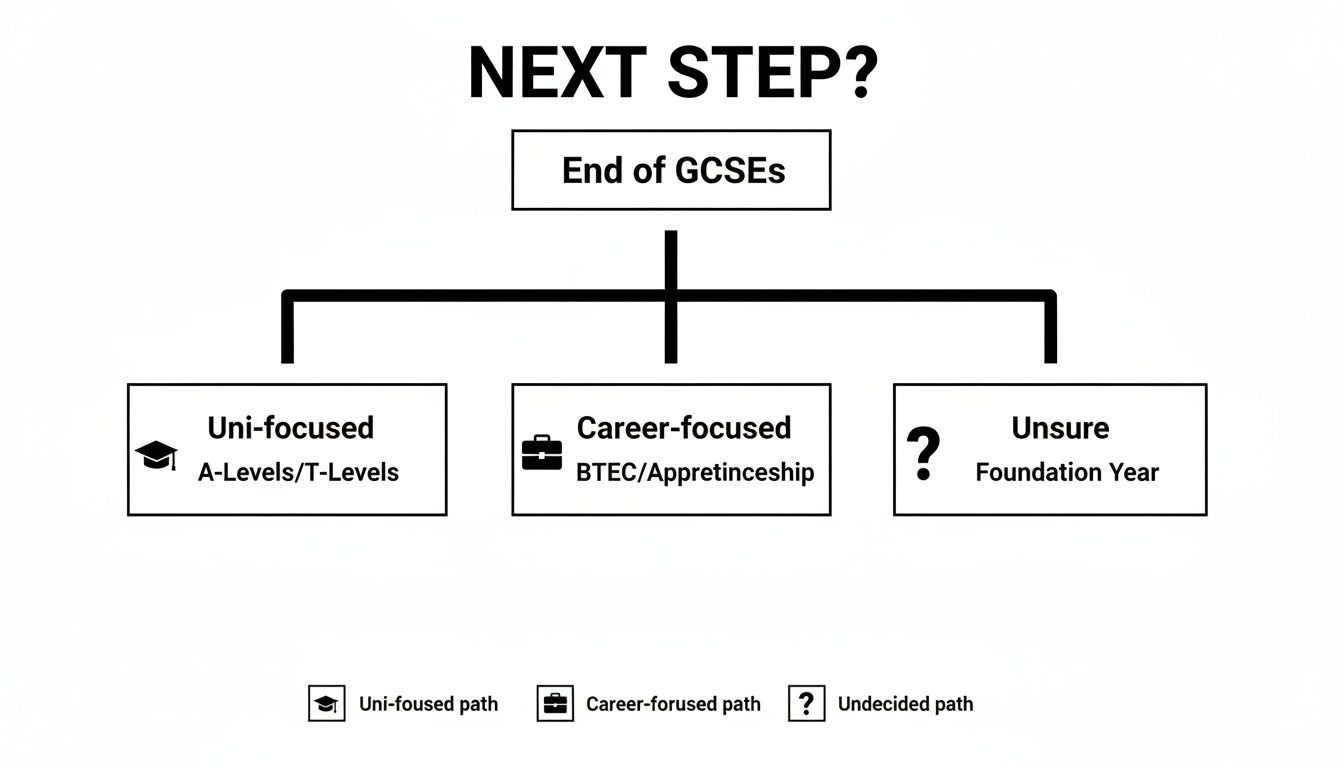
The key thing to remember is that there’s no single “correct” path. The journey is flexible and can, and should, be adapted to your child’s individual goals and how they learn best.
Choosing The Right Qualifications: A-Levels vs BTECs
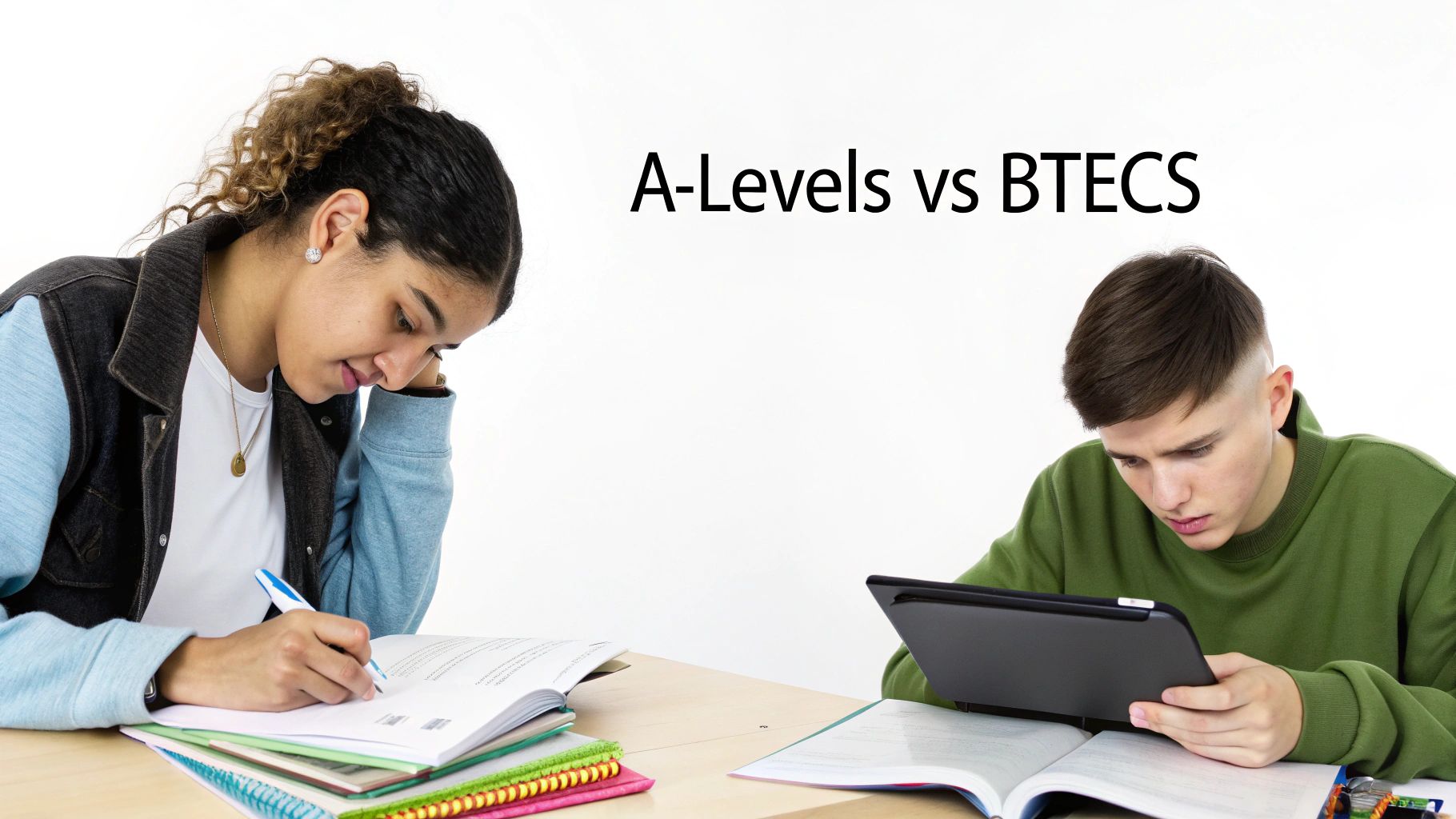
Once you’ve got a feel for the right environment, the next big conversation is about what your child will actually study. The world of post-16 qualifications can feel like a confusing alphabet soup, but for most, it boils down to two main paths: A-Levels and BTECs.
Choosing between them isn't about which one is "better"; it’s about finding the best fit for your child's learning style, passions, and future ambitions. This decision is one of the first truly significant ones they'll make about their future, so it’s natural for them to feel both the excitement and the weight of it.
Think of it like choosing a training method for an athlete. A-Levels are like becoming a specialist, diving deep into the theory and strategy of a sport. BTECs, on the other hand, are like a hands-on apprenticeship—you’re on the field, learning practical skills from day one.
The Academic Route with A-Levels
A-Levels are the traditional academic pathway in the UK and remain the most common route to university. Students typically choose three or four subjects to study in incredible depth over two years, with everything culminating in final exams.
This route is perfect for students who genuinely enjoy academic learning—the deep reading, the essay writing, the research, and solving theoretical problems. It’s designed to build a powerful foundation of knowledge in specific subjects, which is exactly why top universities value them so highly.
A quick example: Imagine a student who dreams of becoming a doctor. They would need the academic rigour of A-Level Chemistry and Biology, as these subjects provide the non-negotiable scientific knowledge for a medical degree. Their third A-Level might be Maths or Psychology, adding another layer of valuable analytical skill. Watching them immerse themselves in these challenging subjects can be a real joy.
A-Levels are an excellent choice for a child who has a clear passion for academic subjects and a strong idea of what they want to study at university. They build the critical thinking and independent study skills that are absolutely vital for higher education.
Understanding which subjects work well together is a key part of this decision. If you're exploring this path, getting advice on smart A-Level subject combinations can bring a lot of clarity and help align your child’s choices with their university goals.
The Vocational Path with BTECs
BTECs (Business and Technology Education Council awards) are vocational qualifications that take a much more practical, hands-on approach to learning. Instead of being all about final exams, they are assessed through a mix of coursework, practical projects, and some exams along the way.
This approach is ideal for students who learn best by doing. These courses are directly linked to specific career sectors and are often developed with input from employers, ensuring the skills learned are relevant and genuinely useful in the workplace.
Here’s how that looks in practice: Think of a creative, artistic student who wants to become a graphic designer. For them, a BTEC in Art and Design would be far more engaging than traditional exams. They’d spend their time building a portfolio, mastering design software, and working on real-world project briefs—preparing them directly for either a job or a specialised design degree. Seeing them proud of a finished project is a reward in itself.
The key is to match the qualification to your child's natural strengths and what gets them excited to learn. Whether they thrive on academic debate or practical creation, the right choice will empower them to build a future they are genuinely passionate about.
Navigating The Application Process Step By Step
The journey into sixth form can feel like a sudden rush of deadlines and big decisions, often stirring up more anxiety than excitement. But it really doesn’t have to be that way.
Breaking the application process down into smaller, manageable steps can turn it from a source of stress into a confident stride towards the future. This journey usually kicks off in the autumn of Year 11, which is the perfect time for exploration and discovery. This is when your child will start attending open days, getting a real feel for different environments and asking the questions that matter most to them.
Demystifying The Entry Requirements
One of the first hurdles you'll come across are the entry requirements, which can sometimes look like a secret code. You’ll often see phrases like "five GCSEs at grade 4 or above, including English and Maths."
This simply means your child needs to pass at least five separate GCSE subjects with a grade 4 (the equivalent of an old grade C) or higher. Crucially, two of these must be English Language and Mathematics, as they’re seen as the essential building blocks for further study.
The most important thing to remember is that these requirements are there to ensure a student can cope with the increased academic demand, not to create a barrier. If your child is worried about a specific grade, always talk to the school or college directly. They are there to help find a solution.
A Typical Application Timeline
While the exact dates can vary from place to place, the process generally follows a predictable pattern. Knowing these key moments can help you and your child feel in control and ready for what’s next.
- Autumn Term (Year 11): This is research time. Go to open evenings, browse prospectuses, and start putting together a shortlist of potential schools or colleges.
- October – January: Application windows open and close. Most applications are submitted online during this period. Some might also ask for a personal statement or a reference.
- February – April: This is when conditional offers are sent out. These offers depend on your child achieving specific grades in their GCSEs.
- August (GCSE Results Day): The big day arrives, and offers are confirmed based on the results.
The waiting can be the hardest part, stirring up a lot of emotions. On results day, the key is to stay calm. If the grades aren't what you hoped for, don't panic. Your child will be looking to you for reassurance. The first port of call should be the careers adviser at your child's current school.
For those already looking ahead to university, our guide on how to apply to UK universities offers a fantastic long-term view of this process. And when you're preparing those applications, getting inspiration from powerful personal statement examples can be incredibly helpful.
Why Pastoral Care And Well-Being Matter
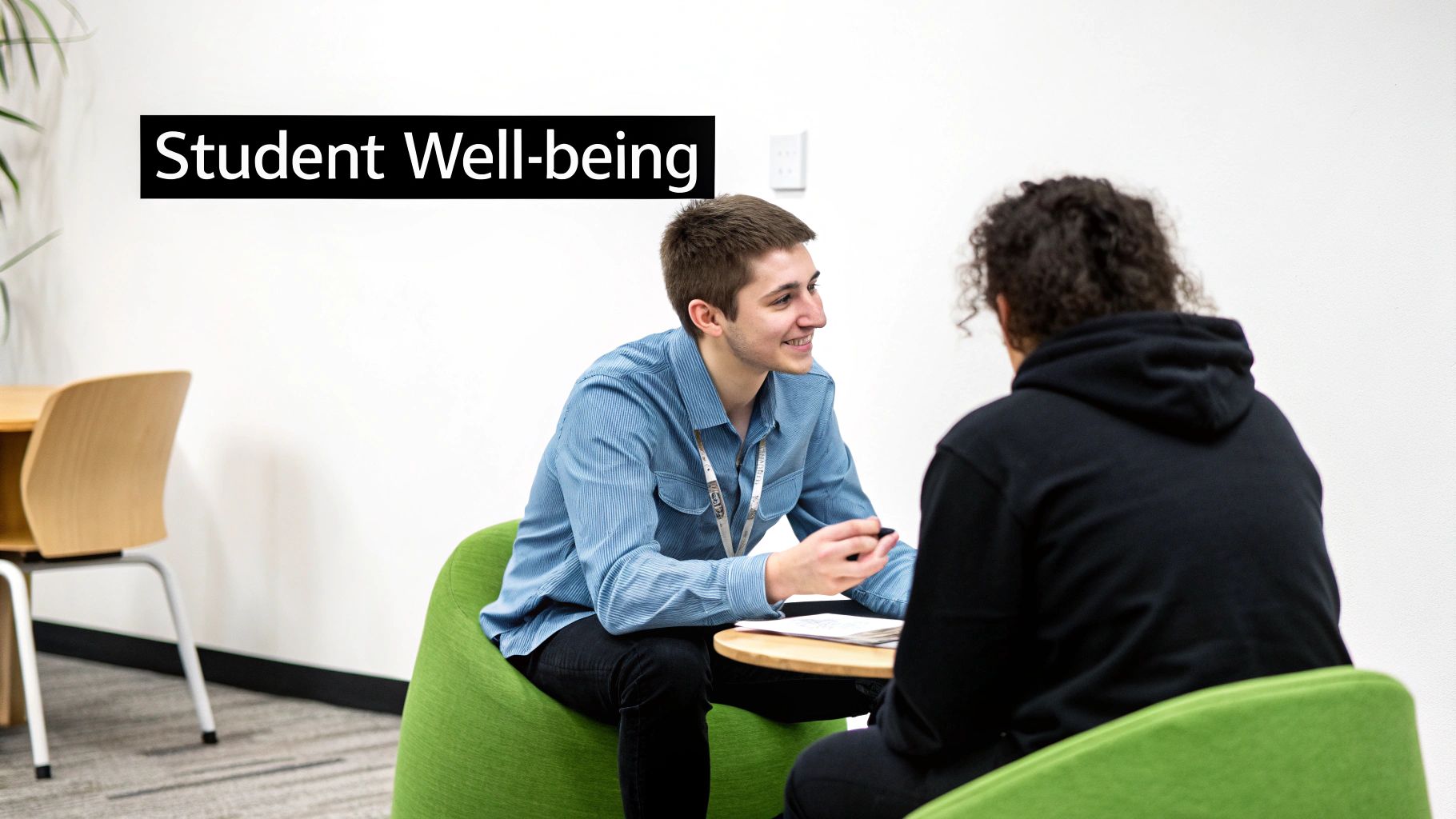
Academic results will always be a focus, but let’s be honest: your child’s happiness and emotional health are paramount. The leap into sixth form brings a wave of new independence, but it can also come with intense academic pressure and the weight of making life-changing decisions about the future.
This is where excellent pastoral care becomes non-negotiable. It’s the safety net that allows students to take academic risks, the support system that helps them bounce back from setbacks, and the guidance that builds their resilience for life beyond the classroom. A caring environment isn't a "nice-to-have"; it is the very foundation for genuine academic achievement.
What Excellent Support Looks Like
Strong pastoral care is far more than just a friendly face in the corridor. It’s a structured, proactive system designed to support every aspect of your child’s well-being, from their mental health to their university aspirations.
When you visit a potential sixth form, look for evidence of a dedicated support network. This often includes:
- Personal Tutors: A single point of contact who knows your child as an individual, helps them set personal and academic targets, and is the first person to notice if they are struggling.
- Mental Health Resources: Easy access to school counsellors, well-being hubs, or partnerships with external mental health services.
- University and Careers Guidance: Specialist advisors who provide expert, one-to-one support with UCAS applications, personal statements, and exploring career pathways.
Imagine a student, let's call her Sarah, who is feeling completely overwhelmed by her A-Level workload. A proactive personal tutor notices she’s quieter in class and arranges a chat. Together, they break down her revision into manageable chunks and build a new study timetable, transforming her anxiety into a sense of control. This is what great pastoral care does—it steps in before a wobble becomes a crisis.
Support For Every Student's Needs
A truly inclusive sixth form recognises that every child’s journey is different. It ensures tailored support is in place for those who need it most, particularly students with Special Educational Needs (SEN).
The number of students with identified needs is growing. Recent statistics show that 4.6% of the A-Level cohort receive SEN support, with a 6.3% year-on-year increase. This highlights how vital it is for institutions to have robust support systems. You can discover more insights about special educational needs trends on the official government statistics website.
On open days, don’t be afraid to ask direct questions to gauge a school’s commitment. Inquire about their SEN provision, the experience of their learning support staff, and how they create an environment where asking for help feels safe and normal. After all, your child's well-being is the single most important factor in their success.
Is An Online Sixth Form The Right Choice?
For many students, the traditional school environment, with its busy corridors and rigid timetables, just doesn't feel like the right place to learn. The pressure to fit a certain mould can sometimes stifle a young person's true potential. This is exactly where an online sixth form comes in, offering a powerful and flexible alternative that’s built around the student, not the institution.
This modern approach to A-Levels isn’t about learning in isolation; it’s about empowerment. It’s designed for students whose lives and ambitions don't neatly fit into a standard 9-to-3 school day.
Who Thrives in an Online Environment?
An online sixth form can be the perfect solution for a whole range of students, each with their own story and circumstances. It’s a space where their education adapts to their life, not the other way around.
Just think about who this could be for:
- The dedicated athlete: A young gymnast who needs to attend training camps can schedule their learning around their commitments without ever falling behind.
- The creative performer: A budding actor can head to auditions in the middle of the day, confident that their live lessons are recorded and ready to watch whenever they are.
- The student with anxiety: For a teenager who finds a crowded school building overwhelming, learning from the safety and comfort of home can be life-changing, allowing them to focus fully on their studies.
- The independent learner: A highly motivated student can power through topics at their own pace, diving deeper into subjects they love without being held back by a fixed classroom speed.
An online sixth form provides a nurturing space where a child’s well-being and individual circumstances come first. It proves that a high-quality education doesn't have to take place within the four walls of a traditional classroom.
A typical day in an online sixth form is structured yet flexible. It’s built around live, interactive classes with subject-specialist teachers, with plenty of opportunities for one-to-one support. Students also connect with a global community of peers through virtual clubs and common rooms, so they’re very much part of a vibrant school community. You can find out more about the structure and benefits of A-Levels online study here.
Ultimately, this path is about more than just academics. It deliberately builds independence, time management, and self-discipline—skills that top universities really value. It’s a modern, high-quality choice that leads to the same excellent qualifications, proving that the best educational journey is the one that truly centres on your child’s needs.
Your Sixth Form Questions Answered
Even with all this information, it's completely normal to have a few lingering questions. Choosing a sixth form is a big step for your child, and feeling confident in that decision is key. Let's tackle some of the most common worries we hear from parents and students during this important time.
These final thoughts are designed to put your child’s needs at the centre of the conversation, helping you navigate the emotional and practical sides of this transition with a bit more clarity.
What Happens If My Child Misses Their Grades?
This is easily one of the biggest worries, but it is rarely the end of the road. On GCSE results day, the first thing to do is stay calm and get in touch with the sixth form or college directly. You’ll often find that schools can be flexible, especially if your child has only narrowly missed a grade in one subject.
If their first choice isn't possible, don't panic. There are always other options:
- Alternative Courses: The school might offer a place on a similar course that has slightly different entry requirements. For example, if they missed the grade for A-Level Psychology, a BTEC in Health and Social Care could be a fantastic alternative.
- Other Providers: Quickly contact other local colleges. Many will still have places available and are used to handling last-minute applications.
- Resits: It's very common for students to resit GCSE Maths or English alongside their A-Levels or BTECs. This is a well-trodden and manageable path.
Can My Child Change Their Mind About Subjects?
Yes, they can—but usually only in the first few weeks of Year 12. Most schools and colleges have a short window where students can switch subjects if they realise they’ve made the wrong choice.
It is so much better for your child to raise concerns early and switch to a subject they will enjoy and succeed in, rather than struggle through a two-year course they dislike. Encourage open conversations about how they are finding their new timetable.
This initial period is all about finding the right fit. A supportive sixth form will understand this completely and work with your child to make sure their final choices line up with their strengths and future goals, always putting their well-being first.
Making the right choice for your child's sixth form education is a significant decision. At Queen's Online School, we offer a flexible, supportive, and high-quality online A-Level programme designed around your child's individual needs. Discover how we empower students to achieve their academic dreams by exploring our approach at https://queensonlineschool.com.