

When a child's world is governed by an overwhelming need to avoid demands, it can leave parents, caregivers, and educators feeling heartbroken, lost, and exhausted. This isn't defiance; it's a profound, anxiety-driven need for autonomy known as Pathological Demand Avoidance (PDA), a profile often associated with autism. Standard parenting or teaching techniques, which rely on direct requests and clear consequences, can often feel like pouring fuel on a fire, increasing a child's terror and strengthening the avoidance. The relentless pressure of navigating a world not built for their needs can lead to significant distress. For parents and educators navigating the complexities of PDA, understanding related challenges such as autism burnout can provide further insight into the child's experience and the cumulative impact of daily stress.
The key isn't to apply more pressure, but to shift our perspective entirely. We must see the world through their eyes—a world where a simple request can feel like a terrifying loss of control—and put their need for safety and autonomy at the very centre of our approach. This requires moving away from traditional, compliance-based methods and embracing a more flexible, collaborative, and low-arousal mindset. It’s about building a fortress of trust and connection first, so that learning and cooperation can follow.
This article moves beyond theory, offering a deep dive into practical, empathetic, and effective pathological demand avoidance strategies. We will explore how to:
- Reframe requests to reduce the feeling of threat.
- Foster genuine collaboration and share control.
- Use humour and play to soothe an anxious heart.
- Adapt the environment to support a child's need for autonomy.
We'll provide real-world examples and gentle scripts that you can start using today to create a more peaceful, connected, and supportive environment for the PDA child or teen in your life.
1. The Low Arousal Approach (Indirect Requests)
The Low Arousal Approach is one of the cornerstone pathological demand avoidance strategies for good reason: it directly addresses the heart of PDA, which is an anxiety-driven need to avoid demands. This approach isn't about being permissive; it's about being strategic and emotionally intelligent to reduce the anxiety that triggers avoidance. Instead of issuing direct commands, which can feel like a terrifying loss of control to a PDA child, you reframe requests to be less confrontational and more collaborative.
At its heart, this strategy recognises that a PDA brain perceives demands as genuine threats. A simple instruction like "put your coat on" can trigger a fight, flight, or freeze response, leaving a child feeling panicked and cornered. The Low Arousal Approach seeks to bypass this threat detection system by lowering the perceived level of demand. This involves changing not just your words, but also your tone, body language, and overall energy. It’s about creating an emotional atmosphere where your child feels safe, respected, and in control, making cooperation a natural outcome rather than a battle of wills.
How to Implement Indirect Requests
Shifting from direct commands to indirect communication requires practice, but it can transform daily interactions from a source of conflict into moments of connection. The goal is to present a task as an observation, a choice, or a problem to be solved together.
Examples in Action:
- Direct Demand: "Get your shoes on now, we're going to be late!"
- Indirect Alternative: "I’m putting my shoes on. I wonder if you’re going to choose the trainers or the boots today? It's so tricky to decide." (This invites curiosity and offers control, soothing the initial panic of the demand).
- Direct Demand: "You need to do your homework."
- Indirect Alternative: "Oh, that maths homework is on the table. It looks really challenging; I'm not even sure I could do question three." (This externalises the demand and positions you as an ally, not an enforcer).
- Direct Demand: "Come to the table for dinner."
- Indirect Alternative: "Dinner is ready when you are. I hope I made enough spaghetti for everyone!" (This communicates information without pressure, respecting their autonomy).
This approach works because it shifts the power dynamic. It whispers to the child's anxious nervous system, "I trust you and I am on your side," which is profoundly calming and reassuring.
Tips for Success
To make this strategy effective, consistency and authenticity are key. Your child will sense if you're just using a trick.
- Soften Your Tone and Body Language: Lower your voice, avoid intense eye contact, and keep your posture relaxed and open. This non-verbally communicates that you are not a threat, but a safe harbour.
- Use Declarative Language: Make statements rather than asking questions or giving commands. For example, instead of "Can you brush your teeth?", try "It’s nearly bedtime. Toothbrushes are in the bathroom."
- Offer Genuine, Limited Choices: Provide two or three acceptable options. "Would you like to wear the blue jumper or the green one?" This small gift of autonomy can feel huge to a child who feels powerless.
- Embrace Playfulness: Humour and play are brilliant ways to diffuse tension. "The sock monster seems to have stolen one of your socks! We must find it!" is much more engaging and less threatening than "Find your other sock."
- Model the Behaviour: Start doing the task yourself without comment. Begin tidying up the living room, and your child might join in once they see it's a low-pressure, collaborative activity.
This technique is fundamental because it meets the child's deep-seated need for autonomy while still guiding them towards necessary tasks. It is a proactive way to de-escalate potential conflicts before they even begin.
2. Collaborative Problem-Solving (CPS)
Collaborative Problem-Solving (CPS) is a powerful, evidence-based model that reframes challenging behaviour as a result of lagging skills, not a lack of will. Developed by Dr. Ross Greene, this approach is one of the most effective pathological demand avoidance strategies because it directly honours the PDAer’s core need for autonomy and control. Rather than imposing adult-led solutions, CPS empowers the child by making them an equal and respected partner in solving the problems that cause them stress and lead to avoidance.
At its core, this strategy operates on the compassionate philosophy that "kids do well if they can." It shifts the focus from managing behaviour to solving the problems that cause it. For a PDA child, this is revolutionary. It validates their struggle, reduces the confrontational dynamic of demands, and builds skills in areas like flexibility, frustration tolerance, and problem-solving. By working with your child, not on them, you create an environment of trust and partnership that lowers their anxiety and makes cooperation possible.
How to Implement Collaborative Problem-Solving
The CPS model involves three key steps, designed to be followed in sequence. The goal is to move from a place of conflict to one of collaboration by first understanding your child's perspective before finding a solution that works for everyone.
Examples in Action:
-
Scenario: A child refuses to do their homework, leading to nightly battles.
- Empathy: (In a calm moment) "I've noticed that getting started on homework after school has been really tough lately. It feels like a big battle for you. What's up?" (Listen with an open heart, without judgment).
- Define the Problem: "So, I’m hearing that you feel completely drained after school, and the thought of more work feels overwhelming, almost painful. And, from my side, I’m worried about the work piling up. We have a problem."
- Invitation: "I wonder if there's a way we could figure this out together, so you get the break your body and mind need and the homework gets done without a fight. Any ideas?"
-
Scenario: A teenager is consistently late for school, causing stress for everyone.
- Empathy: "It seems like mornings are really stressful for you. I’m wondering what’s making it so hard to get out the door on time. Tell me about it."
- Define the Problem: "It sounds like you feel rushed and anxious about the day ahead, which makes it hard to get motivated. And I am concerned about you missing lesson time."
- Invitation: "Let's brainstorm some ideas to make mornings feel a bit calmer for you while also making sure you can get to school on time. What do you think could help?"
This approach works because it transforms you from an adversary into an ally. It communicates, "Your feelings matter. My concerns matter. We will solve this problem as a team."
Tips for Success
Authenticity is crucial for CPS to be effective. It must be a genuine partnership, not a disguised way to get compliance.
- Always Start with Empathy: The first step is non-negotiable. Genuinely listen to understand your child's perspective, not just to plan your response. See the world through their eyes.
- Use 'And', Not 'But': When defining the problem, use language that validates both sets of concerns. "I understand you feel X, and I am concerned about Y" is collaborative. "I understand you feel X, but…" invalidates their feeling and creates division.
- Brainstorm Without Judgment: During the invitation step, accept all ideas initially, no matter how unrealistic they seem. This encourages creative thinking and shows you respect their input, building their sense of self-worth.
- Start with Low-Stakes Problems: Build trust and practice the process on smaller, less emotionally charged issues first before tackling bigger challenges.
- Be Consistent: For CPS to become the new normal, all caregivers should try to use the approach. This consistency helps build a predictable, low-threat environment where the child feels safe.
This technique is transformative because it builds crucial life skills and strengthens relationships, moving away from a cycle of demand and refusal towards one of mutual respect and cooperation.
3. Reducing Demand Opacity Through Transparency and Predictability
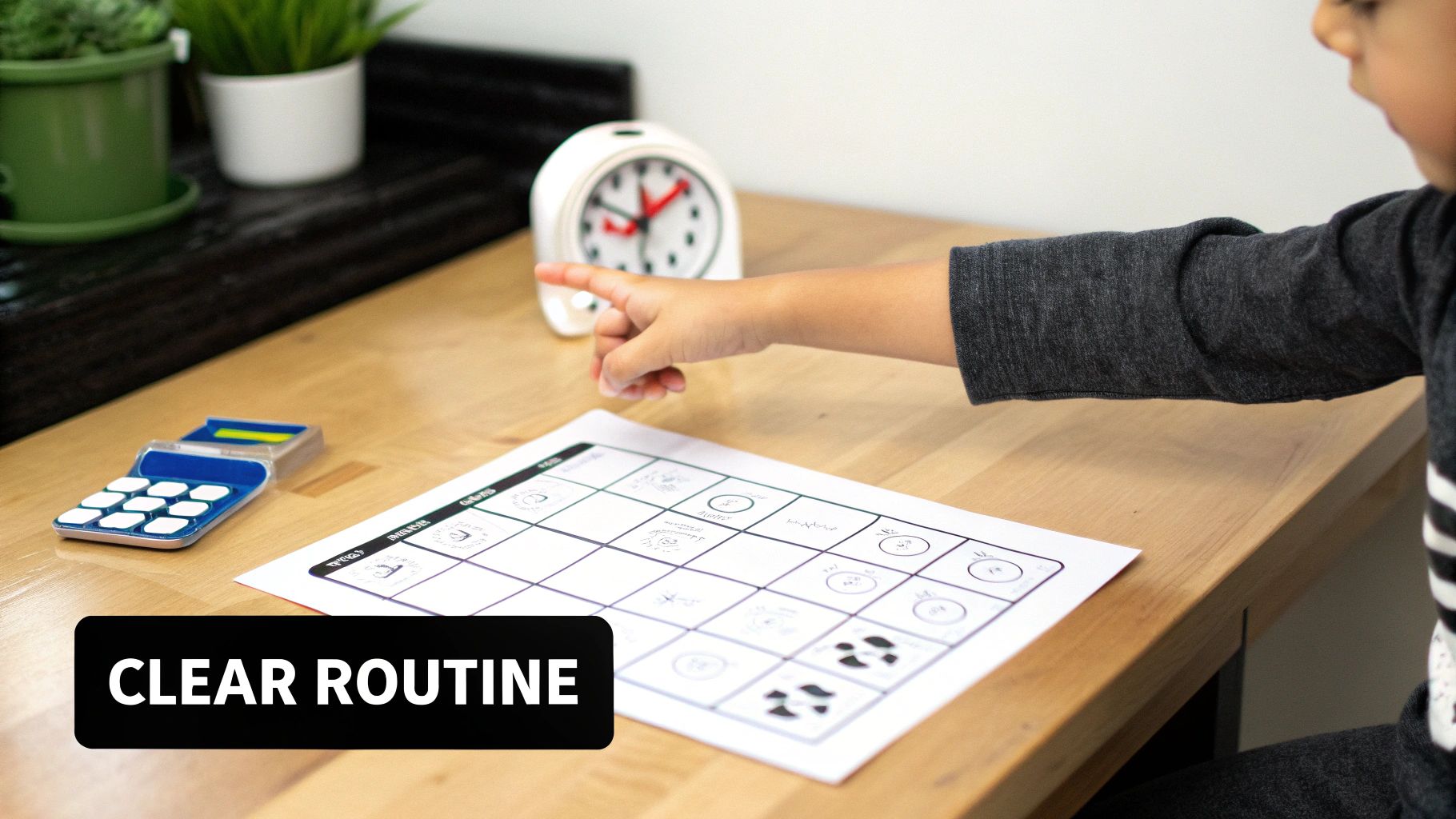
Uncertainty is a significant source of anxiety for many, but for a PDA individual, it can be paralysing. This strategy focuses on making the environment as transparent and predictable as possible to reduce the anxiety that fuels demand avoidance. When a child doesn't know what's coming next or what is secretly expected of them, their threat response is on high alert, constantly scanning for danger. By making the "hidden curriculum" of daily life visible, you lower this anxiety and create a sense of safety and control.
This approach is one of the most effective pathological demand avoidance strategies because it directly counters the fear of the unknown. Instead of facing a stream of unexpected transitions and unspoken expectations, the child is equipped with a map for their day. This transparency isn't about rigid scheduling; it’s about providing clear information so they can mentally and emotionally prepare for what lies ahead, significantly reducing the likelihood of a demand feeling like a sudden, overwhelming threat.
How to Implement Transparency and Predictability
The goal is to externalise information about routines, transitions, and expectations, moving it from your head into a shared, visible space. This makes you a co-navigator on their journey rather than a director shouting orders.
Examples in Action:
- Vague Plan: "We're going out later." (This can create immense anxiety about what 'later' means and where 'out' is).
- Transparent Alternative: A visual schedule on the wall shows pictures: 1. Lunch, 2. Put on coats/shoes, 3. Car journey, 4. Park. This is discussed gently in the morning, giving ample processing time.
- Surprise Transition: "Okay, five more minutes of tablet time, then it's off."
- Transparent Alternative: "At 2 pm, we'll need to transition from free play to getting ready for dinner. I've set a timer so we all know when it's coming." (The timer becomes the 'demander', not the parent, which feels much less personal and threatening).
- Multi-step Task: "Get ready for school." (This is a huge, vague demand with many hidden steps).
- Transparent Alternative: A laminated checklist with pictures or words (e.g., get dressed, eat breakfast, brush teeth, pack bag) with tick boxes allows the child to see the scope of the task and feel a sense of accomplishment and control as they progress.
This approach works because it externalises the demand. The schedule, the timer, or the checklist becomes the authority, which is far less threatening than a direct command from a person. It provides a feeling of control over their own world.
Tips for Success
To truly reduce anxiety, these tools must be used collaboratively and consistently, becoming a reliable and comforting part of the environment.
- Use Visual Supports: Visuals are processed more quickly and with less emotional weight than spoken words. Use timetables, now-and-next boards, or checklists.
- Provide Generous Advance Notice: A verbal heads-up of 10-15 minutes before a transition is crucial. For bigger events, like a family visit, discuss them the day before to allow for emotional preparation.
- Use Concrete Language: Avoid vague phrases like "in a little while." Instead, use specific times or clear events: "After this episode finishes, we will…"
- Create an Organised Environment: A tidy and predictable physical space reduces cognitive load. Having a designated place for school bags, shoes, and homework removes the 'hidden' demand of finding them, which can be the final straw on a stressful day.
- Involve Them in Planning: Where possible, update schedules together. "We need to go to the shop today. Shall we put it before or after our walk?" This gives them agency and a voice. This kind of collaborative planning is a key component of effective SEN support at home.
This strategy empowers the child by giving them the information they need to feel prepared and in control, transforming a potentially threatening world into a manageable and predictable one.
4. Playfulness and Humour as Anxiety Reducers
Using playfulness and humour is one of the most heartwarming and effective pathological demand avoidance strategies because it directly counters the anxiety that fuels demand avoidance. This approach reframes a potentially stressful demand into something lighthearted and connecting, disarming the brain's threat response. By turning a task into a game or making a silly joke, you reduce the perceived pressure and control, making cooperation feel more like a shared moment of fun and less like a threat to their autonomy.
This strategy is not about trivialising a child's struggle but about changing the emotional climate around it. For a nervous system wired to see demands as a loss of autonomy, a playful tone or a shared laugh can instantly shift the dynamic from confrontation to connection. It communicates that you are an ally, not an authority figure imposing their will. It creates a feeling of safety and joy, which are essential for a PDA child to lower their defences and engage with the world around them.

How to Implement Playfulness and Humour
Weaving play into daily routines requires creativity and an understanding of what makes your child's heart light up. The goal is to make the experience of completing a task more about the fun interaction and less about the demand itself.
Examples in Action:
- Direct Demand: "Get ready for school now."
- Playful Alternative: "Right, Agent Double-O-Seven, your mission, should you choose to accept it, is to put on your uniform. This message will self-destruct in five seconds… pfffssshh!"
- Direct Demand: "You have to take your medicine."
- Playful Alternative: (Using a silly voice) "I am the Medicine Monster, and I demand to be swallowed! Don't let me escape! My magical powers will be yours!"
- Direct Demand: "Tidy your room."
- Playful Alternative: "Oh no! It looks like a toy tornado has hit this room. We'd better form a rescue team and save all the poor, stranded toys from the floor-lava before it's too late!"
This approach works by replacing the feeling of being controlled with a feeling of shared fun. Laughter releases endorphins, which are natural stress reducers, helping to regulate an anxious nervous system and deepen your bond.
Tips for Success
To make this strategy feel authentic and not like a trick, it needs to come from a genuine place of connection and love.
- Know Their Humour: Pay attention to what your child genuinely finds funny. Is it silly voices, slapstick, or witty remarks? Tailor your approach to their unique style to make them feel truly seen.
- Be a Co-conspirator: Frame tasks as a "you and me against the world" scenario. "Let's quickly get these shoes on before the 'late-monster' catches us!" This builds a sense of team and shared purpose.
- Use Exaggeration: Over-the-top, dramatic reactions can be hilarious. "Oh, the tragedy! This one lonely sock has lost its partner forever! We must reunite them for the sake of all sock-kind!"
- Create Characters: Invent funny personas for different activities. The 'Toothbrush Tickle Master' or the 'Super-Speedy-Shoe-Sorter' can make mundane tasks exciting.
- Gauge the Mood: Be sensitive to their emotional state. If they are already highly anxious or overwhelmed, an overly energetic, playful approach might be jarring. Sometimes, a quiet, gentle bit of humour is more effective and comforting.
This technique is powerful because it prioritises the relationship and emotional well-being over simple compliance. It builds trust and demonstrates that you understand and are sensitive to their internal experience of anxiety.
5. Environmental Modifications and Control Scaffolding
Environmental modification is a proactive and deeply compassionate pathological demand avoidance strategy that focuses on changing the surroundings rather than the individual. It acknowledges that for a PDA person, the environment itself can be filled with overwhelming demands—both seen and unseen. This approach involves thoughtfully altering the physical and social landscape to reduce triggers and naturally increase a sense of autonomy, thereby lowering anxiety and the subsequent need for demand avoidance.
At its core, this strategy is about architecting a world that feels safer and more predictable for your child. It shifts the focus from managing behaviour to creating the conditions where cooperation can flourish. By removing unnecessary rules, providing genuine choices, and designing spaces that support independence, you scaffold control for the child. This isn't about eliminating all structure; it's about being intentional with the demands you place, ensuring they are essential and presented in a way that honours the profound need for autonomy.
How to Implement Environmental Modifications
This approach requires you to become a detective in your own home or classroom, identifying hidden demands and replacing them with opportunities for control. The goal is to reduce the environmental "noise" that contributes to anxiety.
Examples in Action:
- Home Situation: Instead of a rigid rule that breakfast is a specific cereal at a set time, which can trigger a morning battle.
- Modification: Create a "breakfast station" with two or three approved, easy-to-access options (e.g., a basket with cereal bars, a mini-fridge with yoghurts). The demand shifts from the confrontational "eat this now" to the empowering "here are the choices for when your body is ready."
- School Situation: A student refuses to start their maths worksheet in a noisy, overwhelming classroom.
- Modification: The environment is adapted to offer a choice of work locations. "You can work on this at your desk, in the quiet corner, or with noise-cancelling headphones." This gives crucial control over their sensory environment, making the academic task more accessible.
- Family Rule: A constant battle over wearing a "proper" coat.
- Modification: The rule is simplified to its essential purpose: safety and warmth. "We need to be warm enough to be safe outside." The choice of what achieves this (a hoodie, a fleece, layers) is handed back to the child, removing the arbitrary demand and honouring their bodily autonomy.
This approach works by reducing the number of battles you have to fight. By thoughtfully removing non-essential demands from the environment, you conserve your emotional energy—and theirs—for the truly non-negotiable ones.
Tips for Success
To make this strategy work, you must be willing to let go of conventional expectations about rules and structure and focus instead on what truly matters for your child's well-being.
- Remove a Non-Essential Rule: Start small. Pick one rule that causes daily friction but isn't critical for health or safety (e.g., making the bed every morning) and let it go. Observe the positive impact this has on your child's overall stress levels.
- Create a 'Control Menu': For situations that are often difficult, create a visual list of available choices. This might be a menu of acceptable snacks, a list of calming activities, or options for how to complete a chore. This gives them a sense of power in a world where they often feel powerless.
- Involve Them in Rule-Making: When a rule is necessary, co-create it. Discussing why it's needed and agreeing on the terms together gives a powerful sense of ownership and control.
- Design for Autonomy: Organise spaces to support independence. Put clothes in drawers they can easily reach, have snacks on a low shelf, and ensure school supplies are accessible. This reduces the need for them to ask for help, which can itself feel like a demand.
- Explain the 'Why': For the few non-negotiable rules, clearly and calmly communicate the reasoning behind them, focusing on safety and wellbeing. "We have to hold hands in the car park because my most important job is to keep you safe from the moving cars."
This technique is fundamental because it validates the child's experience of the world as demanding. It communicates trust and respect, building a foundation for collaboration rather than conflict.
6. Co-Regulation and Emotional Attunement Strategies
Co-regulation is one of the most powerful and loving pathological demand avoidance strategies because it addresses the neurological root of demand avoidance: a dysregulated, terrified nervous system. This strategy isn’t about fixing a behaviour; it's about lending your own regulated state to help your child find their calm. For a PDA individual, whose anxiety can escalate rapidly in the face of perceived demands, your stable and attuned presence acts as an external anchor, creating the psychological safety they desperately need to process and eventually meet expectations.
At its core, this approach recognises that PDA-related anxiety is not a choice. When a PDA brain perceives a threat, it triggers a survival response. Co-regulation involves a caregiver actively managing their own emotions to model calmness, thereby soothing the child’s nervous system through emotional connection. It’s about being the calm in their storm, showing them through your own peaceful physiology and presence that they are safe and that this overwhelming feeling will pass. This builds deep trust and strengthens your bond, making cooperation more likely over time.
How to Implement Co-Regulation and Attunement
Emotional attunement means truly seeing and hearing the emotion underneath the behaviour. It requires you to pause your own agenda and connect with your child’s emotional experience first, before attempting to solve any problem.
Examples in Action:
- Scenario: A child refuses to get dressed, becoming distressed and crying.
- Attuned Response: (Getting down to their level, speaking softly) "I can see this feels really overwhelming right now. It's a lot to think about. That's okay, I'm right here with you. We can sit together for a minute." (This validates their feeling without adding pressure, offering comfort instead of commands).
- Scenario: A student shuts down completely during a lesson, hiding under the desk.
- Attuned Response: The teacher moves closer and sits quietly on the floor nearby without making demands. Their calm, non-pressuring presence offers support and reduces the perceived threat, allowing the student space to re-regulate. This approach is particularly effective in an autism-friendly schooling environment.
- Scenario: A teenager becomes angry and shouts when asked about homework.
- Attuned Response: The parent maintains a calm presence, takes a deep breath, and says gently, "I can hear how frustrated you are. I'm here, and we'll figure this out together when you're ready. I'm on your team."
This approach works by communicating on a primal, neurological level: "You are not alone in this feeling. I can handle your big emotions. You are safe with me."
Tips for Success
Effective co-regulation starts with your own self-regulation. You cannot share a calm you do not possess.
- Practise Self-Regulation: Engage in your own mindfulness or stress-management activities regularly. Taking deep, visible breaths during a tense moment can also model regulation for your child.
- Use Self-Talk: Remind yourself internally: "This is anxiety, not defiance. My child is having a hard time, not giving me a hard time." This helps you stay compassionate and less reactive.
- Validate Emotions, Not Behaviour: You can acknowledge the feeling without condoning the action. "I understand you feel so angry, and it is not okay to throw things. Let's find a safe way to get that anger out."
- Listen Actively: Focus on hearing their perspective without immediately jumping to solutions. Sometimes, the profound relief of feeling heard is all that's needed to de-escalate the situation. The process of listening and validating is a key part of building emotional intelligence for both you and your child.
- Take a Break: If you feel yourself becoming dysregulated, it's okay to step away for a moment. Say, "I need a minute to calm my body down, and then I will be right back."
This strategy is foundational because it fosters a secure attachment, which is the bedrock of resilience and cooperation. It teaches a PDA child that their feelings are manageable and that connection is always available, even during the hardest moments.
7. Flexible Goal-Setting and Gradual Scaffolding of Demands
This strategy is a powerful way to support long-term growth and is one of the most compassionate pathological demand avoidance strategies available. It acknowledges that the PDA nervous system is easily overwhelmed and that expecting immediate compliance with age-typical standards is unrealistic and can be deeply damaging. Instead of demanding a huge leap, you build a sturdy bridge one small plank at a time. This involves breaking down overwhelming goals into manageable steps and gradually increasing expectations as the child’s capacity and confidence grow.
At its core, this approach is about meeting a child where they are, not where society thinks they should be. For a child with PDA, a demand like "get dressed for school" can feel as monumental and terrifying as climbing Mount Everest. Flexible goal-setting allows you to redefine the mountain as a series of small, achievable hills. By scaffolding demands, you provide just enough support to help them take the next step, building their self-esteem and reducing the anxiety that fuels demand avoidance. This method fosters resilience by showing the child that progress, not perfection, is the goal.
How to Implement Flexible Goal-Setting
This is a marathon, not a sprint. The key is collaboration and celebrating every small victory along the way. You start by identifying a long-term goal and then work backwards to create a series of micro-steps.
Examples in Action:
- Long-Term Goal: Full-day school attendance.
- Gradual Scaffolding: Start with just driving to the school car park for five minutes and listening to music. Then, attending one preferred lesson for 15 minutes. Slowly build up the duration and number of lessons attended over weeks or months, always guided by the child's anxiety levels, not an arbitrary timeline.
- Long-Term Goal: Completing homework independently.
- Gradual Scaffolding: The initial step might simply be getting the books out onto the table. The next goal could be completing just one question or working for five minutes with a parent nearby offering quiet support, gradually extending the time and reducing support as tolerance increases.
- Long-Term Goal: Joining the family for a full meal at the dinner table.
- Gradual Scaffolding: Begin by asking the child to just come to the dining room while the family eats, with no pressure to sit or eat. The next step might be sitting at the table for two minutes, even without a plate. This slowly builds towards the ultimate goal in a non-threatening way.
This approach works because it replaces the fear of failure with a history of success. Each small step achieved provides the emotional fuel and confidence needed to attempt the next one.
Tips for Success
Success with this strategy depends on patience, observation, and a willingness to adjust the plan as needed. The child's nervous system, not the calendar, sets the pace.
- Collaborate on Goals: Whenever possible, involve your child in setting the goals. "What feels like the next possible step for you?" This gives them a vital sense of ownership and control over the process.
- Acknowledge That Progress Isn't Linear: Be prepared for setbacks, especially during times of stress or change. A bad day doesn't erase progress; it's just a sign to drop back to the last successful step for a while and offer more support.
- Use Visuals: A visual chart or progress tracker can make achievements feel more tangible and rewarding. Focus on celebrating effort, not just outcomes.
- Record a Baseline: Before you start, note down where your child is at. This makes it easier to see and celebrate the genuine progress you have both made over time, which can be a source of hope on difficult days.
- Communicate the Plan: Be transparent. Say, "Our goal for this week is just to get your shoes on. We don't have to go anywhere. We're just practising." This reduces uncertainty and anxiety. For a deeper look into how this supportive structure works in an educational context, you can learn more about what scaffolding in education is from Queens Online School.
This technique is fundamental for building skills and resilience without triggering the anxiety that leads to avoidance. It is a proactive, respectful way to foster growth at a pace the child can handle.
7-Point Comparison: PDA Demand-Reduction Strategies
| Strategy | Implementation complexity 🔄 | Resources & training ⚡ | Expected effectiveness ⭐ | Ideal use cases 📊 | Key advantages & quick tips 💡 |
|---|---|---|---|---|---|
| The Low Arousal Approach (Indirect Requests) | 🔄 Moderate — requires consistent mindset and language shifts | ⚡ Low — practice and rehearsal; no special materials | ⭐⭐⭐⭐ — reliably reduces demand-related anxiety and increases cooperation | Daily routines; mild–moderate PDA; transitions | 💡 Preserves relationship; offer genuine limited choices; prepare indirect scripts |
| Collaborative Problem-Solving (CPS) | 🔄 High — structured 3-step process needing fidelity | ⚡ High — formal training, time for meetings, multi‑adult buy‑in | ⭐⭐⭐⭐⭐ — evidence-based; addresses root causes and builds skills | Persistent avoidance, skill deficits, school–home collaboration | 💡 Start with empathy; train staff; use low‑stakes practice to build skill |
| Transparency & Predictability (Visual supports, routines) | 🔄 Moderate — set up and maintain visual systems and routines | ⚡ Moderate — materials (charts/timers), time to update supports | ⭐⭐⭐⭐ — reduces anticipatory anxiety; smoother transitions | Structured settings (schools); routines and scheduled transitions | 💡 Use clear visual schedules; give advance notice (10–15 min); update collaboratively |
| Playfulness & Humor as Anxiety Reducers | 🔄 Low–Moderate — depends on authentic timing and rapport | ⚡ Low — caregiver energy and creativity; minimal materials | ⭐⭐⭐ — often effective quickly but variable by individual | Low‑stakes moments; rapport‑building; when anxiety is low–moderate | 💡 Match the individual's humor; avoid mockery; pair with choice and autonomy |
| Environmental Modifications & Control Scaffolding | 🔄 High — requires design, negotiation, and ongoing adjustments | ⚡ Moderate–High — space, planning, staff/family coordination | ⭐⭐⭐⭐ — directly addresses autonomy needs and lowers demand load | Home/school redesign; individuals needing consistent autonomy supports | 💡 Offer authentic choices; create "control menus"; remove non‑essential demands first |
| Co‑Regulation & Emotional Attunement Strategies | 🔄 High — ongoing caregiver self‑regulation and attunement practice | ⚡ Moderate — coaching, supervision, time for reflective practice | ⭐⭐⭐⭐ — reduces escalation and builds secure, trusting relationships | Acute anxiety spikes; crisis de‑escalation; attachment‑focused work | 💡 Validate feelings; model calm regulation; seek caregiver support when needed |
| Flexible Goal‑Setting & Gradual Scaffolding of Demands | 🔄 Moderate — individualized planning and progressive steps | ⚡ Moderate — tracking tools, regular review, communication across adults | ⭐⭐⭐⭐ — builds confidence and sustained capacity over time | Skill development, long‑term change, gradual reintegration to expectations | 💡 Break tasks into tiny steps; celebrate small wins; use visual progress trackers |
Building a Future of Trust, Autonomy, and Understanding
Navigating the landscape of Pathological Demand Avoidance (PDA) can often feel like learning a new language of the heart, one where traditional parenting and teaching manuals offer little guidance. The journey through the strategies outlined in this article, from using indirect requests and collaborative problem-solving to leveraging playfulness and co-regulation, represents more than a collection of techniques. It is a fundamental paradigm shift away from a world of compliance and towards one of connection, trust, and mutual respect.
At the heart of this shift is the understanding that a child's resistance is not wilful defiance but a profound, anxiety-driven need for autonomy and control to feel safe. When we internalise this, our perspective changes. A demand is no longer just a simple request for a task to be completed; it is a potential threat to a child's sense of safety in the world. By adopting these pathological demand avoidance strategies, you are not "giving in" but thoughtfully and strategically creating an emotional environment where your child can finally lower their defences and thrive.
Key Takeaways: From Theory to Daily Practice
The most powerful takeaway is that flexibility is your greatest tool. The strategies that work wonders one day may fall flat the next, not because you’ve done something wrong, but because your child’s internal state, their anxiety levels, and their capacity for tolerance are in constant flux.
- Prioritise the Relationship: Every interaction is an opportunity to build trust or create distance. By centring connection and empathy, you strengthen the foundation upon which all other strategies are built. A child who feels seen, heard, and understood is a child who feels safer.
- Reduce Demands, Not Expectations: Lowering demands doesn't mean lowering your belief in your child's potential. It means creatively scaffolding the world around them so they can meet those expectations in a way that honours their neurological makeup. It’s about finding a different, gentler path to the same destination.
- Embrace Imperfection: There will be challenging days and moments of frustration for both of you. It is crucial to offer yourself the same compassion you offer your child. This is a marathon, not a sprint. Celebrate the small victories—the moment of connection, the successfully negotiated task—because these are the building blocks of progress and hope.
Actionable Next Steps on Your PDA Journey
Moving forward requires a conscious commitment to this new approach. Start by choosing one or two strategies that resonate most with you and your child's current situation. Perhaps it’s introducing more humour into your requests or focusing on co-regulating during moments of high stress. Don't try to implement everything at once.
Observe, listen, and adapt. What lowers your child's anxiety? When do they seem most regulated and open? Keep a mental or written note of these patterns. This practice of attunement is perhaps the most critical skill you can develop. It’s about becoming a detective of your child's needs, noticing the subtle cues that signal rising anxiety long before a meltdown occurs.
Remember, the ultimate goal is not to eliminate demands entirely but to build a child’s capacity and resilience by creating a world that feels safe enough for them to engage with. You are teaching them that they have agency and that their needs will be respected, which is the foundation for self-confidence and independence.
Ultimately, mastering these approaches is transformative. It leads to fewer conflicts, a calmer home or classroom, and a deeper, more authentic relationship with the child or young person you support. It empowers them by showing them they are capable, understood, and valued for who they are. By centring your efforts on their need for psychological safety and autonomy, you are not just managing behaviour. You are nurturing their well-being and paving the way for a future where they can navigate the world with confidence and a strong sense of self.
For families seeking an educational environment built on these principles of flexibility, understanding, and individualised support, finding the right school is paramount. Queens Online School offers a low-demand, high-support structure specifically designed to accommodate neurodiverse learners, allowing students to thrive academically and emotionally. Explore how a recognised British curriculum can be tailored to your child's unique needs at Queens Online School.