

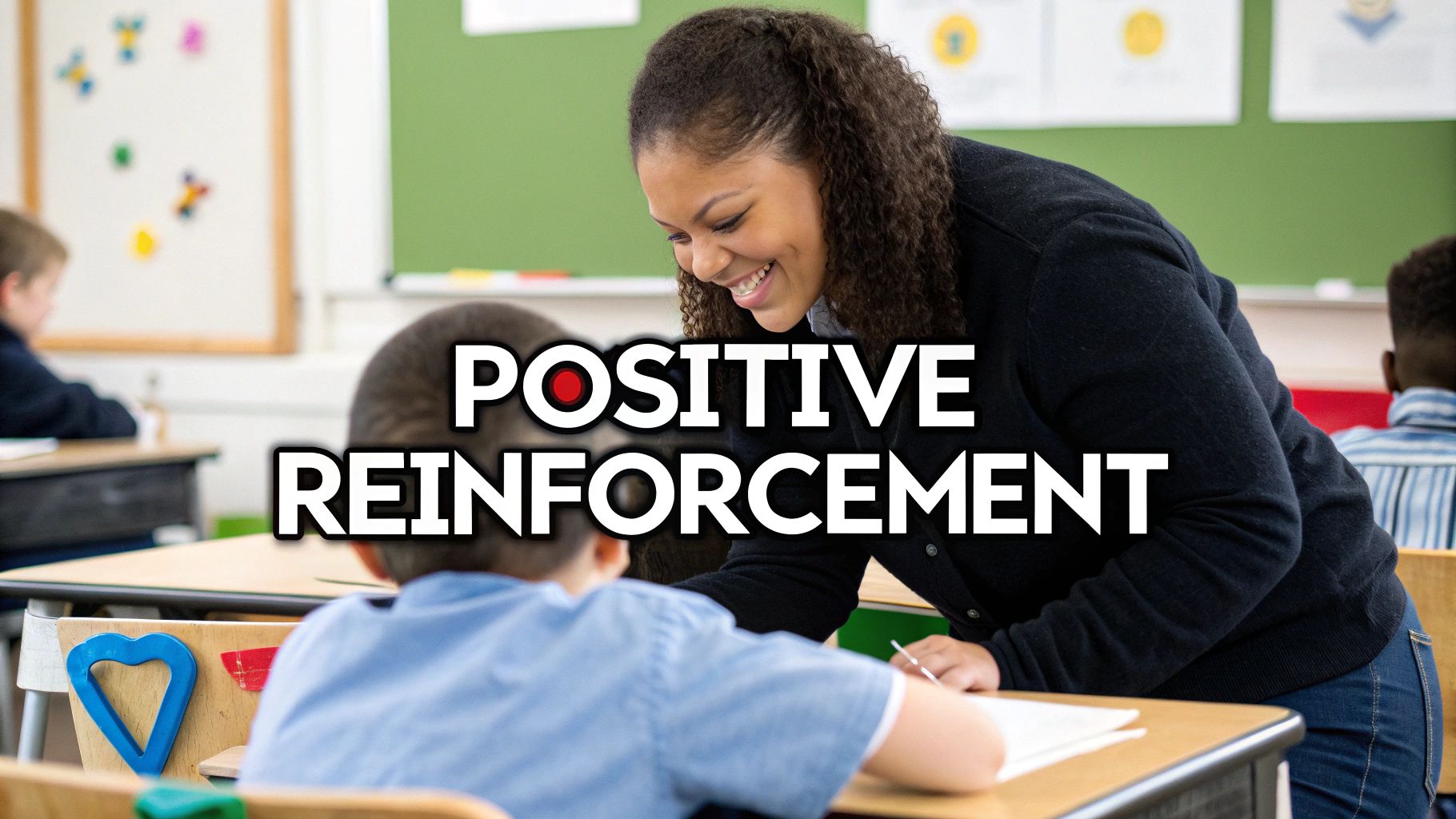
Positive reinforcement is more than just a behaviour management technique; it’s a powerful way to see, acknowledge, and nurture a child's inner world. It's about celebrating their effort, not just the outcome, and building a foundation of self-worth that lasts a lifetime. When we shift our focus from correcting mistakes to catching them doing something right, we build connection and foster genuine motivation. This approach transforms a child’s relationship with learning, challenges, and their own potential.
This guide moves beyond generic sticker charts to provide a deep dive into meaningful and practical positive reinforcement examples you can use immediately. We'll break down specific strategies for the primary classroom, secondary school, online learning, and home environments, including specialised tactics for learners with SEN or SEMH needs. You will find actionable advice, sample phrasing, and insights into avoiding common pitfalls that can accidentally undermine your efforts. To truly engage a child's heart and mind with positive reinforcement, it's essential to understand practical strategies to make learning genuinely fun. By putting the child's emotional needs at the centre of our approach, we can help them feel understood, capable, and excited to grow.
1. Verbal Praise and Recognition
Immediate verbal acknowledgment is one of the most powerful and readily available positive reinforcement examples. This foundational technique involves offering specific, authentic compliments that highlight a desired behaviour, validating a child's effort and showing them that their positive actions are seen and valued. It directly connects their action with a positive emotional response, strengthening the likelihood they will repeat the behaviour.
How It Works
Verbal praise taps into a child’s intrinsic need for connection and approval. When a parent says, "I really appreciate how you shared your toys with your brother just now; that was very kind," it does more than just reward. It labels the specific action (sharing) and attaches a positive character trait (kindness), helping the child build a positive self-concept. This specificity is crucial; it moves beyond a generic "good job" to provide a clear blueprint for future success.
Actionable Tips for Parents and Teachers
- Be Specific and Immediate: Instead of "You were good today," try "Thank you for putting your books away without being asked. It makes me feel so happy when we work together as a team." The immediacy reinforces the link between action and reward.
- Focus on Effort, Not Just Achievement: Praise the process. "I saw how hard you worked on that maths problem, even when it was tricky. Your perseverance is amazing!" This, as popularised by Carol Dweck's growth mindset research, builds resilience.
- Be Authentic: Children can sense insincerity. Deliver praise with genuine enthusiasm and warmth. Make eye contact and let your tone of voice reflect your words. A heartfelt "Wow, you did it!" can mean the world.
2. Token Economy Systems
A token economy is a structured system where individuals earn tokens, points, or stars for demonstrating specific desired behaviours. This tangible method is one of the most effective positive reinforcement examples for making abstract goals concrete. Children can physically see their progress, which helps them understand the direct link between their actions and positive outcomes, empowering them to take ownership of their behaviour.

How It Works
This system operates like a mini-economy, tapping into a child's understanding of earning and exchanging. When a child completes a target behaviour, such as tidying their room or finishing homework on time, they receive a pre-determined number of tokens. These tokens act as a secondary reinforcer and can be saved up and "spent" on a menu of meaningful rewards or privileges, such as extra screen time, a special outing, or a desired toy. This process teaches delayed gratification and goal-setting skills.
Actionable Tips for Parents and Teachers
- Define Clear Rules: Before starting, clearly outline which behaviours earn tokens and how many. For example, "Making your bed earns one token," and "Helping a sibling without being asked earns two tokens." Also, create a clear "menu" of rewards with their token costs.
- Start Small and Build: Initially, offer smaller, easily attainable rewards to build momentum and excitement. A child might earn five tokens for an extra bedtime story. As they become accustomed to the system, you can introduce larger, long-term goals that require more saving.
- Make It Collaborative: Involve the child in choosing the rewards. This ensures the incentives are genuinely motivating and gives them a sense of agency and investment in the system. Asking, "What special thing would you love to work towards?" puts their desires at the heart of the process.
3. Privilege and Activity-Based Rewards
Using access to preferred activities or special privileges as a reward is one of the most effective and sustainable positive reinforcement examples. This method links good behaviour with highly motivating, non-material outcomes, such as extra screen time or choosing the family film night movie. It teaches children that positive actions lead to greater autonomy and enjoyable experiences, making it a powerful and natural incentive.
How It Works
This technique leverages a child's intrinsic motivations by using their favourite activities as a direct consequence of desired behaviour. For instance, granting an extra 15 minutes of playtime for tidying up their room without being reminded connects the effort (tidying) with a personally meaningful reward (play). This is far more potent than a generic reward because it is tailored to what the child genuinely values, strengthening their internal drive to repeat the action. It helps them understand the concept of earning privileges through responsible actions.
Actionable Tips for Parents and Teachers
- Tailor the Reward: Discover what truly makes your child's heart sing. For some, it might be 20 minutes of uninterrupted one-on-one time building LEGO with you. For others, it could be a special one-on-one activity. Sometimes the most impactful rewards are unique experiences, such as a personalized call from Santa, which can be offered for achieving a significant goal.
- Match the Reward to the Effort: Ensure the size of the privilege aligns with the behaviour. A small, helpful act like setting the table might earn the right to choose the music in the car, while consistently completing homework all week could earn a trip to the park.
- Be Consistent and Clear: Define the expectations and the corresponding reward upfront. For example, "If you can finish your homework before 5 p.m., you can have 30 minutes of tablet time." This clarity removes ambiguity and helps the child see the direct link between their choices and the outcome.
4. Immediate Feedback and Progress Tracking
Providing real-time information on performance, often with visual charts or trackers, is a highly effective positive reinforcement example. This technique makes progress tangible and transparent, which helps maintain motivation. It shows a child that their efforts are directly translating into measurable forward movement, reinforcing the value of their hard work and consistency and making them feel proud of their journey.

How It Works
This method leverages the brain's desire for closure and achievement. When a student sees a progress bar fill up on an educational app or a sticker added to a weekly behaviour chart, it triggers a small release of dopamine. This creates a satisfying feedback loop where the act of completing a task is immediately rewarded with visible proof of accomplishment. This is particularly powerful for long-term goals, as it breaks the journey into manageable, rewarding steps.
Actionable Tips for Parents and Teachers
- Make it Visual and Simple: Use tools like a marble jar that fills up, sticker charts, or digital progress bars. A simple "tasks completed" list on a whiteboard works wonders. The visual cue should be easy to understand at a glance.
- Focus on Personal Growth: Frame progress in relation to the child's own starting point, not in comparison to peers. "Look how many more words you can read this week compared to last week! You must feel so proud of yourself." This builds self-esteem and an internal sense of competition.
- Celebrate Milestones: Acknowledge and celebrate when key checkpoints are reached. A high-five for finishing a page, or a special dance for completing a difficult worksheet, reinforces the effort invested and refuels motivation for the next stage. Timely updates and acknowledgements are central to effective assessment for education.
5. Social Recognition and Public Acknowledgment
Acknowledging a child's achievements in front of their peers or family is a powerful social form of positive reinforcement. This method leverages our innate desire for social connection and esteem, showing a child that their positive contributions are not just noticed, but celebrated by the wider group. It validates their effort on a larger scale and creates positive role models for others to emulate.

How It Works
Social recognition taps into a deep-seated need to belong and be valued within a social group. When a teacher praises a student's kind act in front of the class, or a family celebrates a child's achievement at the dinner table, it elevates the action's significance. This public validation sends a clear message: "What you did matters to us." It builds confidence and strengthens the child’s sense of identity within the group, making them feel seen and cherished.
Actionable Tips for Parents and Teachers
- Gauge Comfort Levels: Public praise can cause anxiety for some children. Always consider the individual's personality. For a shy child, a heartfelt whisper ("That was so brave of you") might feel more rewarding than a loud announcement.
- Be Specific and Inclusive: Instead of only praising top performers, recognise diverse contributions like great teamwork, kindness, or perseverance. At home, you could say, "Let’s all thank Sarah for being so patient while teaching her little brother to tie his shoes. It made him feel so supported."
- Create Rituals: Establish regular opportunities for recognition, such as a "star of the week" board in the classroom or a "weekly wins" segment during family meetings. This makes acknowledgement a consistent and expected part of the culture.
6. Rewards and Incentive Programs
Tangible rewards and structured incentive programmes represent a classic form of positive reinforcement examples. This direct approach involves offering concrete items or privileges, such as extra screen time, a special outing, or a small toy, in exchange for consistent positive behaviour. It creates a clear, transactional link between a child's actions and a desirable outcome, which can be highly motivating, especially when establishing new routines or tackling challenging tasks.
How It Works
This method leverages extrinsic motivation, where the drive to act comes from an external reward rather than an internal desire. When a child completes their homework every day for a week to earn a trip to the cinema, they are responding to a planned incentive. The reward serves as a powerful, immediate motivator that helps to build and solidify a habit. Over time, the goal is often for the positive feelings associated with the accomplishment itself to become rewarding, paving the way for intrinsic motivation to develop.
Actionable Tips for Parents and Teachers
- Make Rewards Meaningful: Ensure the reward is something the child genuinely values and connects with emotionally. A reward chart that leads to a family board game night might be more motivating than a generic sticker because it promises connection and fun.
- Keep it Proportional: The size of the reward should match the effort required. A significant achievement, like overcoming a major fear, warrants a more substantial reward than tidying up a bedroom.
- Transition to Intrinsic Motivation: Use tangible rewards to kick-start a behaviour, but pair them with verbal praise about the effort and the feeling of accomplishment. Ask, "How did it feel to finish that all by yourself?" The ultimate aim is for the positive behaviour to become its own reward.
7. Goal Setting and Achievement Celebration
Collaboratively setting clear, achievable goals and then explicitly celebrating their completion is a powerful form of positive reinforcement. This technique empowers a child by giving them ownership over their targets and creates meaningful, motivating experiences when those milestones are reached. It shifts the focus from simple task completion to a journey of personal achievement, building both competence and self-esteem.
How It Works
This method leverages the psychological principles of Edwin Locke's Goal-Setting Theory, which posits that specific and challenging goals lead to higher performance. When a child is involved in setting their own goal, such as "I will read one chapter of my book every night for a week," they develop intrinsic motivation. The celebration that follows, whether a family film night or simply a "happy dance" in the kitchen, acts as the positive reinforcer. It creates a satisfying emotional link between effort, achievement, and reward, encouraging a cycle of continued effort.
Actionable Tips for Parents and Teachers
- Make it Collaborative: Involve the child in the goal-setting process. Ask, "What's a small step we can take to get better at your times tables this week? What would feel like a win for you?" This fosters a sense of agency.
- Break It Down: Large goals can be intimidating. Break a target like "Tidy your room" into smaller steps like "Put all the LEGO in its box" and "Place books back on the shelf," celebrating each small victory with a high-five or a "Well done!"
- Celebrate the Process: Acknowledge the hard work along the way, not just the final outcome. "You have been so focused on your project this afternoon, that's brilliant to see! It shows how much you care." This builds resilience when faced with challenges.
8. Positive Role Modeling and Social Learning
Demonstrating desired behaviours is one of the most organic yet impactful positive reinforcement examples. This approach, rooted in Albert Bandura's social learning theory, involves adults or peers modeling positive actions, emotional regulation, and problem-solving skills. Children naturally observe and imitate the people around them, making role modeling a constant, powerful tool for shaping their character and choices without direct instruction.
How It Works
This method leverages a child's innate capacity for observational learning. When a child sees a parent handle a frustrating situation with calm patience ("Oops, I spilled the milk. It's okay, I'll just clean it up.") or an older student politely ask for help, their brain creates a mental blueprint for that behaviour. The observed positive outcome, such as a resolved conflict or a successfully completed task, acts as a vicarious reinforcer. This shows the child that these modelled actions are not only acceptable but also effective and rewarding, encouraging them to adopt the behaviours themselves.
Actionable Tips for Parents and Teachers
- Model the Process: Don't just show the successful outcome; let children see the effort. Say, "This is really tricky, so I'm going to take a deep breath before I try again." This models resilience.
- Narrate Your Actions: Make the connection explicit. For example, a parent could say, "I'm going to apologise to Daddy for being grumpy. It's important to say sorry when we make a mistake."
- Use Diverse Role Models: Expose children to a variety of positive examples, from family members and mentors to figures in books and media. This shows that positive behaviours are universally valuable.
- Be a "Think-Aloud" Model: Verbalise your thought process when solving a problem or managing emotions. This provides a clear, step-by-step guide for a child's internal monologue.
9. Choice and Autonomy Provision
Granting a degree of agency and decision-making power is a sophisticated form of positive reinforcement examples. This method involves offering controlled choices, which honours a child’s desire for independence and reinforces positive behaviour by making them an active participant in their own learning and development. It builds intrinsic motivation by respecting their preferences and fostering a sense of ownership over their actions.
How It Works
This technique taps into a person’s fundamental need for autonomy. When a teacher says, "You can present your history project as either a written essay or a short video," it validates the student's capabilities and personal style. The reward isn't an external prize but the empowering feeling of control. This approach frames compliance not as following a rule, but as making a responsible choice, which is especially effective for older children and teenagers who naturally seek more independence.
Actionable Tips for Parents and Teachers
- Offer Meaningful, Bounded Choices: Provide 2-4 realistic options that you are happy with. For instance, "It's time to get dressed. Would you like to wear the blue jumper or the red one?" Both options lead to the desired outcome.
- Explain the Boundaries: Clearly articulate why choices are limited. "We need to leave in 20 minutes, so you can choose a quick game to play until then." This teaches reasoning and respects their intelligence.
- Honour the Choice: Once a decision is made, respect it. This builds trust and shows that their input truly matters, encouraging them to become more of a self-directed learner.
10. Incremental Success and Scaffolding
Breaking down complex tasks into smaller, manageable steps and reinforcing progress at each stage is a profoundly effective technique. This approach, known as scaffolding, builds competence gradually and maintains a child’s motivation by providing a steady stream of achievable wins. It is one of the most supportive positive reinforcement examples because it prevents overwhelm and fosters a sense of accomplishment, which is vital for building long-term confidence and resilience.
How It Works
Scaffolding meets a child's fundamental need for competence and security. When a complex skill, like learning to ride a bike, is broken down into steps (balancing, pedalling, steering), and each step is mastered and celebrated, the child feels capable and motivated. The reinforcement isn't just for the final outcome but for the progress along the way. This method labels the specific achievement ("You kept your balance for five whole seconds! That's amazing!") and connects it to a feeling of success, building a powerful foundation for tackling future challenges.
Actionable Tips for Parents and Teachers
- Identify Natural Breaking Points: Before teaching a new skill, break it into logical, sequential steps. For example, a maths problem can be broken down into understanding the question, identifying the operation, doing the calculation, and checking the answer.
- Celebrate Each Sub-Goal: Offer enthusiastic praise or a small reward for mastering each part. "Wow! You’ve put on your own coat and zipped it up! That's a huge step. High five!"
- Gradually Reduce Support: As the child gains confidence and skill, slowly remove the supports. Provide immediate help when they are stuck on a step, but encourage them to try independently first. You can learn more about the principles of scaffolding in education here.
Comparison of 10 Positive Reinforcement Examples
| Method | Implementation Complexity 🔄 | Resource & Management ⚡ | Expected Impact 📊 | Ideal Use Cases 💡 | Key Advantages ⭐ |
|---|---|---|---|---|---|
| Verbal Praise and Recognition | Low 🔄 | Minimal ⚡ | Boosts confidence & engagement 📊 ⭐⭐ | Everyday interactions (home, class, team) | Immediate, cost-free, relational ⭐ |
| Token Economy Systems | High 🔄🔄🔄 | High (tracking & rewards) ⚡⚡⚡ | Clear, sustained behavior change; measurable 📊 ⭐⭐⭐ | Schools, therapy, structured workplaces | Visible progress; teaches planning ⭐ |
| Privilege & Activity-Based Rewards | Moderate 🔄🔄 | Low–Moderate ⚡⚡ | Builds intrinsic motivation; sustainable 📊 ⭐⭐⭐ | Long-term behavior change; youth & teams | Meaningful, cost-effective, durable ⭐ |
| Immediate Feedback & Progress Tracking | Moderate 🔄🔄 | Moderate (tools/monitoring) ⚡⚡ | Rapid corrections; sustained motivation 📊 ⭐⭐⭐ | Sales, learning platforms, fitness apps | Transparency; quick course-correction ⭐ |
| Social Recognition & Public Acknowledgment | Moderate 🔄🔄 | Moderate (events/coordination) ⚡⚡ | Strong social motivation; culture-building 📊 ⭐⭐⭐ | Team awards, assemblies, social media shout-outs | Powerful motivator; models behavior ⭐ |
| Rewards & Incentive Programs | Moderate 🔄🔄 | High (budget & admin) ⚡⚡⚡ | Effective short-term change; risk of dependency 📊 ⭐⭐ | Recruitment, sales, customer loyalty programs | Clear, flexible, widely applicable ⭐ |
| Goal Setting & Achievement Celebration | Moderate 🔄🔄 | Low–Moderate ⚡⚡ | Increases ownership; boosts long-term performance 📊 ⭐⭐⭐ | Projects, personal development, teams | Direction, autonomy, reinforced achievement ⭐ |
| Positive Role Modeling & Social Learning | Low–Moderate 🔄🔄 | Low ⚡ | Long-term adoption through observation 📊 ⭐⭐⭐ | Mentorship, coaching, parenting, training | Cost-effective; natural learning template ⭐ |
| Choice & Autonomy Provision | Moderate 🔄🔄 | Low ⚡ | Higher buy-in and intrinsic motivation 📊 ⭐⭐⭐ | Education, flexible workplaces, patient care | Empowers individuals; builds decision skills ⭐ |
| Incremental Success & Scaffolding | High 🔄🔄🔄 | Moderate (planning & monitoring) ⚡⚡ | Builds competence via small wins; reduces overwhelm 📊 ⭐⭐⭐ | Skill learning, training programs, therapy | Confidence-building; individualized progression ⭐ |
Putting It All Together: Your Quick-Start Checklist for Positive Change
Throughout this article, we have explored a wide array of positive reinforcement examples, from the immediate impact of specific verbal praise to the long-term motivation of a well-structured token economy. We have seen how these strategies can be adapted for the primary classroom, the secondary school environment, online learning spaces, and the unique dynamics of home life, particularly for learners with SEN or SEMH needs. The common thread connecting every successful application is a commitment to seeing the child first: their needs, their motivations, and their individual journey.
The goal is not to create a system of control, but to cultivate an environment of mutual respect and encouragement. When we shift our focus from correcting undesirable actions to celebrating positive ones, we do more than just manage behaviour. We build self-esteem, foster intrinsic motivation, and empower children to recognise their own capacity for growth and achievement. This approach is about nurturing a mindset where effort is valued, progress is celebrated, and learning becomes an adventure rather than a chore.
Your Actionable Checklist
Feeling ready to begin? You don't need to implement everything at once. True, lasting change starts with small, consistent steps. Use this quick-start checklist to guide your first moves towards creating a more positive and supportive environment for the young people in your life.
1. Start with Observation:
- Action: Spend a day consciously looking for the good. What is the child or teenager doing right? Note down at least three specific positive actions, no matter how small. Examples could be starting homework without being asked, helping a sibling, or persevering through a difficult maths problem.
- Why it Matters: This shifts your own mindset from "fault-finding" to "strength-spotting," making it easier and more natural to offer authentic praise.
2. Choose One Strategy to Master:
- Action: From the list of positive reinforcement examples covered, select just one to focus on for the next week. Perhaps it's using specific praise ("I was so impressed with how you organised your revision notes for science") instead of generic feedback ("Good job").
- Why it Matters: Trying to do too much can be overwhelming. Mastering one technique builds your confidence and ensures the approach is consistent, which is crucial for the child.
3. Define and Communicate Clear Expectations:
- Action: Sit down with your child or student and clearly define what a desired behaviour looks like. Instead of saying "be more responsible," you could say, "Responsibility this week means putting your school bag by the door each evening."
- Why it Matters: Children cannot meet expectations they do not understand. Clarity removes ambiguity and sets them up for success, making reinforcement possible.
4. Make Reinforcement Immediate and Sincere:
- Action: The moment you see the desired behaviour, acknowledge it. A quiet thumbs-up, a quick "Thank you for getting started so promptly," or placing a token in the jar has a far greater impact than praise saved for later.
- Why it Matters: Immediacy creates a strong mental link between the action and the positive outcome, making the behaviour more likely to be repeated.
By embracing these foundational steps, you are not just implementing a technique; you are building a stronger, more connected relationship. You are sending a powerful message that you see their effort, you value their contributions, and you believe in their potential. This is the heart of effective positive reinforcement, a force that can transform a child’s experience with learning and with life itself.
At Queens Online School, we integrate these principles into the very fabric of our virtual classrooms. Our specialist teachers are trained to use positive reinforcement to build confidence and nurture a love of learning in every student, including those with SEN/SEMH needs. Discover how our supportive, individualised approach can help your child thrive by visiting Queens Online School.