

Building a child’s confidence isn’t about grand gestures or constant praise. It’s about quietly nurturing their inner belief that they are capable, secure, and loved for who they are—not just for what they achieve. It’s the warm, reassuring feeling you create in your home, a safe space where they learn to value their effort far more than the outcome. Imagine your child’s self-belief as a small, tender plant; it doesn’t need a flood, just consistent, gentle care to grow strong.
Understanding What Truly Builds Confidence in Kids
Real confidence isn't the loud, boastful trait we sometimes see on the playground. It’s a quiet, steady feeling that lives inside a child. It's the little voice that whispers, "I can try this," even when their heart is pounding with fear, and "It's okay that I failed," when things don't go to plan, allowing them to feel the sting of disappointment without it crushing their spirit.
As parents and educators, our role isn't to build this confidence for them but to create the right conditions for it to grow naturally, like a gardener tending to soil.
Getting this right has never been more critical. The UK is facing what some are calling a youth confidence crisis, which is having a real impact on children's development and future opportunities. Research from the Listen Up report has revealed that over 2 million young people feel they have little to no confidence. That’s roughly 1 in 3 children in a typical classroom, each one carrying a silent weight of self-doubt.
This lack of self-belief often holds them back from joining clubs or community programmes—the very places where they could build the skills and friendships they need to thrive. Think of the child who desperately wants to join the football team but is too afraid of not being good enough to even try out. That is the feeling we are trying to soothe.
The Foundation of Earned Self-Worth
The journey to building genuine confidence starts with a simple but powerful shift: moving away from empty praise and towards meaningful acknowledgement that connects with your child’s heart.
Telling a child, "You're so smart!" feels good in the moment, but it can accidentally link their self-worth to an innate quality they can't control. This can create a deep-seated anxiety around any challenge that might threaten their "smart" label. What if I try this and fail? Does that mean I'm not smart anymore? This fear can be paralysing for a child.
Instead, we need to focus on what they can control: their effort, their courage, and their persistence.
"True confidence isn't about avoiding failure; it's about knowing you have the strength to get back up. By guiding them through disappointment, we give our children the most profound gift: the unshakeable belief in their own ability to navigate life's storms."
Think about the difference between these two scenarios from a child's perspective:
- Scenario 1 (Praising the Outcome): Your child scores a goal in their football match. You say, "You're a natural-born star!" The child feels a momentary rush of pride, but the praise is tied to success. What happens when they miss the next shot? The feeling of being a "star" can vanish, replaced by the fear of letting you down.
- Scenario 2 (Praising the Effort): Your child scores a goal. You say, "I saw how hard you were running to get into position for that shot. Your persistence really paid off!" Now, the praise is linked to their hard work—a value they can apply to every part of life, win or lose. They feel seen for their struggle and dedication, which feels much deeper and more secure.
This subtle shift helps them build what I call earned self-worth. It’s a type of confidence that comes from within, rooted firmly in their own actions and resilience.
Creating an Emotionally Safe Environment
A child's confidence blossoms in an environment where they feel emotionally secure. This means creating a home where feelings are validated, mistakes are treated as learning opportunities, and love is never, ever conditional on performance. It’s the feeling a child has when they run to you with a broken toy, crying, and your first reaction is a hug, not an annoyed sigh.
When a child knows they are loved for simply being themselves, they find the courage to venture out of their comfort zone and try new things. This safe base allows them to explore their identity without the constant, draining fear of judgment.
For a more comprehensive look at fostering this kind of self-assurance, this resource is excellent: A Parent's Guide to Building Your Child's Confidence.
Weaving Confidence into Your Daily Family Life
Real, lasting confidence isn't built in a single grand moment. It’s woven, thread by thread, into the fabric of everyday life. The small interactions, the daily routines, and the way your family communicates are the most powerful tools you have. This is where we turn theory into practical, heartfelt action.
The goal is to shape a home environment where your child feels seen, capable, and valued for who they are, not just what they achieve. It’s about shifting from a culture of correction to one of connection and growth, making your home the safest place for your child to try, feel the sting of failure, and learn that they are strong enough to get back up.
Turning Chores into Contributions
One of the quickest ways to build a sense of competence is to give children meaningful responsibilities. When a child genuinely contributes to the family, they receive a powerful message: "You are an important, capable member of this family. We rely on you." This isn’t just about ticking off a chore chart; it's about framing tasks as vital contributions that make them feel needed.
Start small and make sure it’s age-appropriate. The key is to give them real ownership and let them feel the pride of a job well done.
- For a five-year-old: Their special job might be watering one specific houseplant each morning. They become the "Plant Guardian." Imagine their little face lighting up when they see a new leaf grow, knowing they helped it happen. This teaches them about responsibility and the tangible result of their care.
- For a ten-year-old: They could be in charge of sorting the recycling every week. This teaches organisational skills and a quiet sense of civic duty, a feeling that they are part of something bigger than themselves.
- For a teenager: Challenge them to plan and cook one family meal a week. The process builds planning, budgeting, and life skills. But the real confidence booster comes when the whole family sits down to eat something they created, filling them with a genuine sense of accomplishment.
By doing this, you're helping them develop the skills for independence in learning and in life—a cornerstone of self-belief.
The Power of Your Words
The language we use day-to-day has a profound impact on how children see themselves. Shifting from generic praise to specific, effort-based feedback can change everything. It helps them internalise the idea that their hard work, not some fixed trait, is what truly matters, which is a message that soothes the fear of not being "enough."
Think about these common scenarios and how a small tweak in language can make a huge difference to your child's inner world:
| Instead of Saying… | Try Saying… | Why It Works for Your Child's Heart |
|---|---|---|
| "You're so smart for getting that right." | "I noticed you didn't give up on that tricky maths problem. Your persistence is what solved it." | Praises the process (persistence) over a fixed trait (being smart). Your child hears: "My effort matters more than being perfect," which encourages resilience. |
| "Good job on your drawing." | "I love the bright colours you chose for the sky! Can you tell me more about this part of your picture?" | Shows genuine interest and invites connection. Your child feels that their unique vision is seen and valued, not just judged as "good." |
| "Don't cry, it was just a game." | "I can see you're really disappointed about losing. It's okay to feel that way when you've tried so hard." | Validates their emotions. Your child learns that their feelings are normal and manageable, not something to be ashamed of or pushed away. |
This kind of communication turns moments of frustration into opportunities for growth and celebrates the messy, beautiful process of learning.
Creating Rituals That Build Connection
Family routines and rituals create a predictable, safe emotional space where confidence can flourish. These don't need to be complicated. In fact, consistency is far more important than complexity, because it’s the repetition that builds a child’s sense of security.
One simple yet powerful idea is to start a ‘Proud Of My Effort’ Jar. Keep a jar with some slips of paper and a pen nearby. Whenever anyone in the family—including you—tries something hard, overcomes a fear, or sticks with a difficult task, they write it down and pop it in the jar.
Reading these slips aloud once a month at a family dinner transforms the focus from results to resilience. Imagine your child hearing about the time they were scared to go down the big slide but did it anyway. It celebrates the courage to try, normalising the fact that effort itself is a victory worth honouring.
Another effective ritual is a short weekly family check-in. It can be just ten minutes on a Sunday evening. Each person shares one "win" (something they're proud of) and one "challenge" (something they found tricky) from their week. This simple act teaches children several key lessons:
- Everyone faces challenges: Hearing parents talk about their own struggles makes difficulty feel normal and less scary.
- It's safe to be vulnerable: It creates a space where asking for help or admitting a mistake is met with empathy, not judgment.
- Their experiences matter: It shows them that their own emotional highs and lows are important to the whole family.
These daily and weekly practices slowly but surely build an unshakeable foundation of confidence, rooted in contribution, connection, and the deep-seated belief that they are capable of navigating whatever comes their way.
Tailoring Your Approach for Every Age and Stage
Building a child’s confidence isn’t a one-size-fits-all job. As anyone who’s navigated a toddler’s tantrum and a teenager’s silent treatment in the same day knows, their emotional worlds are miles apart. The strategies that make a five-year-old puff out their chest with pride are completely different from what a fifteen-year-old needs to feel secure in themselves.
The key is to meet them where they are emotionally. This means tuning in to their developmental stage, whether it's the fierce independence of a pre-schooler wanting to do it “all by myself” or the quiet anxiety of a teen figuring out their place in the world. Your approach has to evolve right alongside them, always guided by empathy for their unique experience.
Nurturing Confidence in the Early Years (Ages 3-7)
For young children, confidence is built through doing. Their world is a giant, hands-on experiment, and every small act of independence feels like a massive victory. Play is their work, and it’s how they learn to trust their bodies, their minds, and their own decisions.
When they painstakingly stack blocks, they’re not just playing; they’re testing theories about balance and physics. When they insist on putting their own shoes on—even if it takes ten minutes and they end up on the wrong feet—they’re making a powerful statement about their own competence. Our job is simply to create a safe space for them to try, fail, and feel proud of their effort.
Exploring creative activities for toddlers is a fantastic way to spark their imagination and build that early self-belief through hands-on exploration.
Here are a few practical ways to support their budding independence:
- Offer contained choices. Instead of the overwhelming "What do you want to wear?", try "Do you want the red jumper or the blue one?" This gives their little spirit a sense of control without the paralysis of too many options.
- Narrate their effort, not just the result. Use simple language to describe what you see. "Wow, you are working so hard to climb up that slide! Your legs are pushing so strong!" This acknowledges their persistence and helps them connect physical effort with a feeling of pride.
- Use stories to model resilience. When a character in a book faces a setback, talk about it with feeling. "Oh, look! He fell down, that must have hurt. But he was so brave and got right back up." This plants the seeds of a growth mindset from the very beginning.
Navigating the Social World of Pre-Teens (Ages 8-12)
As children move towards their pre-teen years, their social world suddenly becomes the centre of their universe. Friendships get more complicated, and the pressure to fit in can feel immense. Their confidence is no longer just about what they can do, but about who they are in the eyes of their peers. The fear of being left out or judged can be all-consuming.
This is a critical time to help them build a strong sense of self that isn't completely reliant on what others think. The goal is to anchor their self-worth internally so it can ride out the stormy seas of playground politics and shifting friendship groups.
Your child's sense of self is like a ship. If it's only anchored to the shifting tides of friendships and social trends, it will be tossed about. Help them find deeper anchors—their unique interests, their family's values, their kindness—so they can stay steady even when the waters get choppy.
Simple, consistent daily habits can help reinforce this internal anchor. The following infographic highlights a few powerful actions you can take every day.
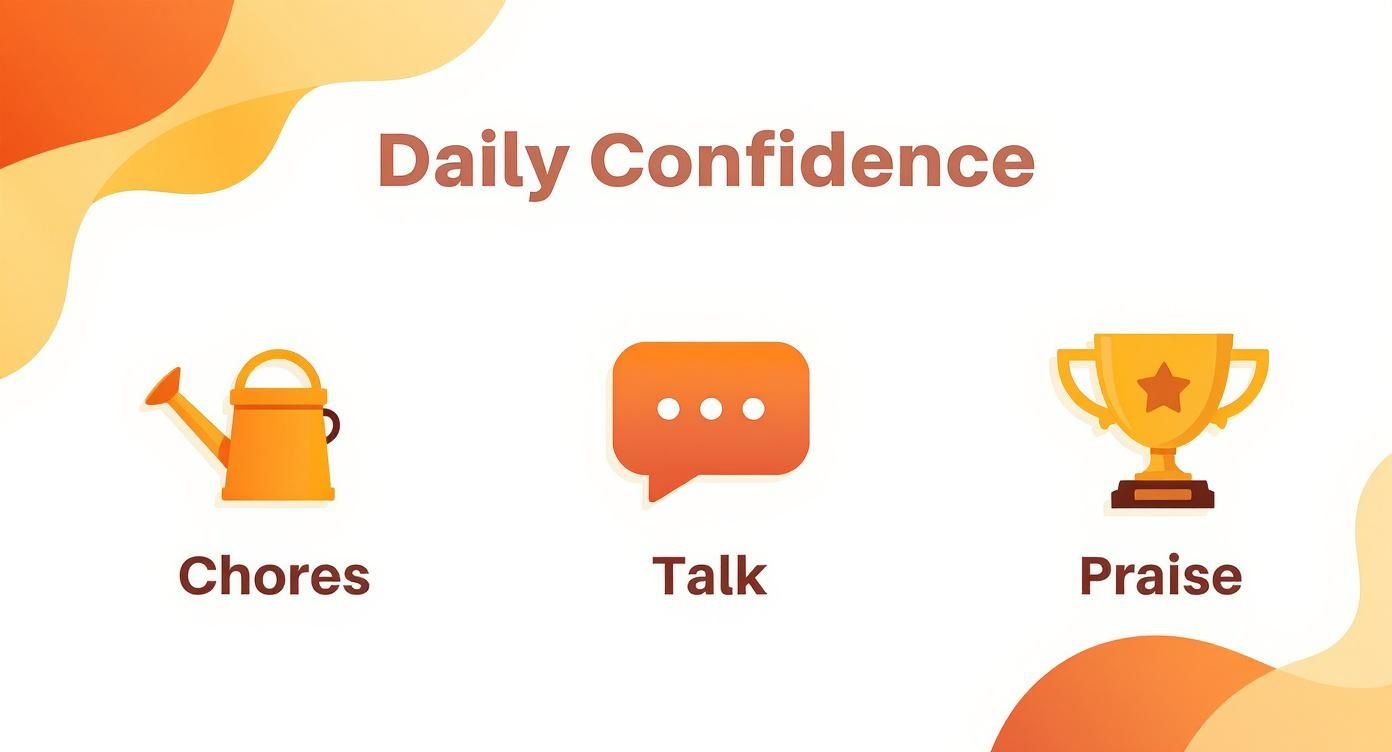
These daily touchpoints—giving them real responsibilities, making time for open chats about their feelings, and offering specific, meaningful praise—strengthen their sense of competence and belonging where it matters most: at home.
Fostering Self-Advocacy in Teenagers (Ages 13+)
The teenage years are all about the search for identity and independence. They are supposed to be pulling away from us; that’s their job. Our role naturally shifts from being the director of their lives to being a trusted consultant—a safe harbour they can return to after navigating the stormy seas of their own lives.
At this stage, confidence is about trusting their own judgement, speaking up for their needs, and feeling capable of tackling the future. They're facing real pressures, from exam stress to huge decisions about what comes next. The most powerful thing we can do is show them that we trust them to handle it, even if they stumble.
Here’s where to focus your energy to support their emotional needs:
- Become a problem-solving partner, not a fixer. When they come to you with a problem, fight the urge to jump in with a solution. Instead, start by validating their feelings: "That sounds really tough and stressful." Then ask, "What are some options you've been thinking about?" This shows you believe in their ability to find their own way.
- Genuinely respect their opinions. Ask for their thoughts on family decisions or even current events. Listen without immediately jumping in to correct or debate them. Feeling heard and respected at home gives them the confidence to use their voice out in the world, knowing it has value.
- Reframe failure as data. If they get a disappointing grade, meet their disappointment with empathy first. Then, help them see it as information, not a final judgement. Ask, "That result must feel awful. When you're ready, what did you learn from this? What could you try differently next time?" This builds the resilience they’ll need for the rest of their lives.
This table provides a quick summary of how you can adapt your support as your child grows, ensuring your efforts are always in tune with their developmental needs.
Confidence-Building Activities by Age Group
A summary of age-appropriate activities and parental focus areas designed to nurture confidence at different developmental stages.
| Age Group | Key Focus | Example Activity | Parental Role |
|---|---|---|---|
| 3-7 Years | Independence & Effort | Letting them dress themselves, even if it’s slow and mismatched, and celebrating their attempt. | Narrator & Choice-Giver |
| 8-12 Years | Internal Self-Worth & Competence | Giving them a meaningful household chore, like feeding a pet, so they feel needed. | Anchor & Listener |
| 13+ Years | Self-Advocacy & Resilience | Encouraging them to email a teacher themselves about a problem, after brainstorming with you. | Consultant & Coach |
Ultimately, tailoring your approach shows your child that you see them—not just a generic kid, but a unique person with changing needs and feelings. This recognition is one of the most powerful confidence boosters of all.
Championing Your Child Through School Challenges
School is often the first big arena where a child’s confidence is put to the test. It’s a complex world of friendships, academic hurdles, and social expectations that can feel overwhelming. As a parent, you become their chief advocate, their strategist, and their safe harbour through it all.
Your role isn't to clear every obstacle from their path, but to give them the emotional tools and support to navigate the journey themselves. A child who feels their parent is in their corner can face almost anything.
This means building a genuine partnership with their teachers and creating a supportive environment at home. It’s about ensuring the school experience is a place that builds them up, rather than one that chips away at their self-belief.
Building a Strong Partnership with Teachers
Your child’s teacher is your greatest ally in understanding their school life. A collaborative, open relationship can transform your child's experience, providing a consistent support system between home and the classroom.
The key is to approach these conversations not as a confrontation, but as a team meeting where you both have the same goal: helping your child feel happy and capable at school.
- Share unique insights. You know your child’s heart. Let the teacher know, "He's a very sensitive boy and can get quiet if he feels he's done something wrong," or "She absolutely lights up when she gets to work creatively in a small group."
- Ask specific, open-ended questions. Instead of asking, "How is my child doing?" try something more revealing. "Can you tell me about a moment this week where you saw my child feeling really proud of themselves?" or "What social dynamics have you noticed? Who do they connect with?"
- Work together on solutions. If your child is struggling, frame it as a shared challenge. "I've noticed they're getting anxious about reading aloud at home. It seems to be a real fear for them. Have you seen this in class? What strategies could we try together to help them feel safer?"
This kind of teamwork is vital, especially when a child has different educational needs. To get a better sense of how modern schools adapt, our guide on what is inclusive education is a great starting point for understanding supportive learning environments.
Nurturing Academic and Social Skills at Home
While the classroom is the main stage, the prep work at home can make all the difference. This isn’t about replicating schoolwork; it's about fostering the underlying abilities that fuel confidence and giving them a safe space to practise.
Self-expression is a big one. Research from the UK's National Literacy Trust found that only 26.6% of children aged 8 to 18 enjoy writing in their free time—the lowest level recorded since 2010. Writing is such a powerful tool for organising thoughts and expressing feelings. When a child lacks confidence here, it can feel like their inner world is trapped, affecting how they communicate across every subject. You can find more insights on children's writing engagement in the UK on the National Literacy Trust website.
Creating a safe space for your child to find their voice—whether through talking, writing, or creative projects—is one of the most powerful ways to build their confidence for the classroom and beyond. It tells them: "Your thoughts and feelings matter."
To gently build these skills without pressure, try some low-stakes, fun activities at home:
- The "Family Storyteller" Game: Once a week, get someone to start a story with just one sentence. Each person adds the next sentence, building a collaborative and often silly narrative. This removes the fear of the blank page and makes storytelling a joyful, shared experience.
- "Show and Tell" for Grown-Ups: Encourage your child to give a two-minute "presentation" on something they love—a video game, a favourite book, or their rock collection. This is public speaking practice in the safest possible environment, with their biggest fans as the audience, cheering them on.
Considering Different Educational Environments
Sometimes, despite everyone's best efforts, a traditional school environment just isn't the right fit. The social pressures, the pace of learning, or the sheer size of the school can be overwhelming, causing a child's sensitive spirit to wilt.
Recognising this isn't a failure—it's an act of powerful advocacy for your child’s wellbeing.
For some learners, an alternative like online schooling can be a game-changer. An environment with smaller class sizes and more direct teacher interaction can provide the quiet space a child needs to find their footing academically and socially, away from the intense pressures of a crowded playground.
By championing your child, you're not just helping them get through school; you're teaching them how to advocate for their own needs, a skill that will serve them for the rest of their lives.
Helping Your Child Bounce Back from Setbacks
Real, lasting confidence isn't about avoiding failure; it's about knowing you have the strength to get back up again. Setbacks, disappointments, and mistakes aren't just a part of life—they are essential for growth. By guiding children through these tough moments with empathy, we help them build resilience, the very core of self-belief.
Our role isn't to shield them from every fall. It's to sit with them in their disappointment, teach them how to land, dust themselves off, and take that next brave step forward. This process transforms challenges from things to be feared into opportunities to get stronger.
Reframing Failure as Feedback
The first, and most crucial, step is to change how your family talks and feels about failure. When a child sees a bad grade or a lost match as a verdict on who they are, their confidence plummets. We need to help them see it as simple, non-judgemental feedback—just data for their next attempt.
Imagine your child comes home, their face crumpled in despair after failing a spelling test. The old script might involve getting angry or immediately promising they’ll do better. A resilience-building script sounds very different.
Compassionate Script for a Bad Grade
You: (Kneeling down to their level) "Oh, honey. That result must feel so disappointing. I can see how hard you studied for this." (This validates their feelings first, connecting with their heart before their head).
Child: (Through tears) "I'm just bad at spelling."
You: "It feels that way right now, doesn't it? You're not bad at spelling; you just haven't found the right way to make the words stick yet. Let's be detectives. Which words were the trickiest? When you feel up to it, maybe we can try a new strategy, like drawing silly pictures or using colourful flashcards."
This approach gently separates their identity from the outcome. It frames the setback as a puzzle to be solved together, reinforcing that your love and support are unconditional.
Embracing a Growth Mindset
This leads directly to fostering what psychologists call a growth mindset—the belief that abilities can be developed through dedication and hard work. A child with a growth mindset understands they aren't stuck with the intelligence or talent they were born with; they can grow.
In contrast, a fixed mindset teaches that talent is innate, which makes any failure feel catastrophic and deeply personal. Here’s how you can model a growth mindset in everyday situations:
- Friendship issues: If a friendship hits a rough patch, avoid labelling the other child. Instead, focus on the skills involved. "Friendships can be so tricky sometimes, it's okay to feel hurt. What do you think you could try saying next time you see them?"
- A lost sports match: After a loss, shift the focus from the scoreboard to their personal progress and feelings. "The result wasn't what you hoped for, and it's okay to feel sad about that. But I saw you run faster than ever to get that ball. Your effort was incredible."
By consistently focusing on effort, strategy, and learning, you teach your child that setbacks are just part of the journey. It's also important to be aware of external factors. Recent data from the Centre for Young Lives shows that childhood vulnerabilities in the UK are rising, which can make it harder for children to bounce back. You can learn more about how to support vulnerable children on the Centre for Young Lives website.
Knowing When Setbacks Signal Something More
While most setbacks are normal parts of growing up, it's also vital to recognise when a pattern of social withdrawal or persistent sadness might point to a deeper issue. Difficulties bouncing back, especially from social challenges, can sometimes be linked to underlying problems at school. Understanding the signs of bullying is crucial, as this can severely undermine a child’s confidence and make them feel unsafe.
By creating an open dialogue about challenges, you not only build resilience for everyday disappointments but also ensure your child feels safe enough to tell you when something more serious is happening. This unshakeable belief in their own ability to navigate life's storms is the most profound gift we can give them.
Common Questions from Parents on Building Confidence
Navigating your child's journey to self-belief often throws up some tricky, heartfelt questions. You want to get it right, but sometimes you’re faced with a situation that feels completely unique. Here are some of the most common worries I hear from parents, answered with the child’s emotional needs front and centre.
My aim here is to offer clear, practical guidance that empowers you to respond with empathy and wisdom in those crucial moments.
How Do I Spot the Difference Between Healthy Confidence and Arrogance?
This is a brilliant question because it shows you’re thinking about the quality of confidence, not just the quantity. It’s a concern that touches the heart of what we want for our kids: for them to be strong, but also kind.
True confidence is internal. It's a quiet, steady belief in one's own ability to learn and grow. A genuinely confident child doesn’t need to shout about their worth because they feel it inside. They can celebrate a friend's success without feeling threatened, because another person’s light doesn’t dim their own. Their sense of self is secure.
Arrogance, on the other hand, is an external performance, often masking a deep-seated insecurity. It relies on feeling superior to others. An arrogant child might put others down to lift themselves up or boast constantly, because they need outside validation to feel okay. It's a cry for help, not a sign of strength.
To nurture genuine confidence, focus your praise on effort, kindness, and learning from mistakes. This helps your child build their self-worth from the inside out, on a foundation of their character, rather than on how they measure up against others.
Will These Strategies Work for My Very Shy or Introverted Child?
Absolutely. It’s so important to remember that confidence looks different for every child, and we must honour their unique temperament. The goal is not to turn an introvert into an extrovert. For a quiet or shy child, confidence isn't about suddenly becoming the loudest person in the room.
Instead, confidence for them might look like this:
- Quietly raising their hand in class to ask a question, even if their voice trembles a little.
- Mustering the courage to ask one new person to play during break time.
- Sharing an idea they are passionate about with a trusted family member, their eyes shining with excitement.
The goal is to help them feel capable and secure within their own temperament. Start with small, manageable steps in safe, low-pressure environments. When your shy child takes one of these brave little steps, acknowledge the feeling behind it. You could say, "I know that was scary for you, to go and talk to that new girl. It took a lot of courage, and I'm so proud of you for trying." This shows them that their brave acts are seen and valued, helping them build self-trust on their own terms.
What Should I Do When My Child Is Crushed About Not Winning?
This moment is such a powerful teaching opportunity, but it requires us to connect before we try to correct. When a child is overwhelmed with disappointment, their logical brain has switched off. The first and most important step is to validate their big, messy feelings.
Get down on their level, make eye contact, and use your words to build an emotional bridge. For example: "I see how heartbroken you are. It’s really hard to lose when you've tried your absolute best and wanted it so much." Then, just be quiet. Sit with them in their sadness. Let them feel that emotion without you rushing in to fix it. This sends a powerful message: "Your feelings are safe with me. You are not alone in your pain."
Once the emotional storm has passed and they feel heard, you can gently shift the focus towards resilience. You might ask, "What was one part of the game you felt really proud of?" or "What did you learn today that you could use next time?" This process teaches them that while disappointment is real and valid, their effort, growth, and the love that surrounds them are what truly matter in the long run.
At Queens Online School, we create a supportive and inclusive environment where every child’s confidence can flourish at their own pace. Our small class sizes and personalised approach ensure students feel seen, heard, and empowered to grow.
Discover how our unique online learning community can help build your child's self-belief by visiting us at https://queensonlineschool.com.