

Picture your child's eyes lighting up—not because they have to learn something, but because they genuinely want to. This is the magic of self-directed learning, an approach that puts your child back in the driver's seat of their own education, letting their natural curiosity lead the way instead of a rigid syllabus. It's about that feeling of wonder and empowerment that makes learning a joyful adventure, not a chore.
What Is Self-Directed Learning?
Have you ever watched a toddler figure out how to walk? There are no formal lessons, no homework, and certainly no tests. Just an unstoppable, internal drive to explore their world. You see the sheer determination in their eyes as they pull themselves up, take a wobbly step, tumble, and try again, fuelled purely by their own desire to move and discover. That feeling of triumph when they finally cross the room on their own two feet is pure, undiluted learning.
That powerful, innate instinct is the very essence of self-directed learning.
It flips the old script on its head. Instead of seeing a child as an empty vessel to be filled with facts, we recognise them as an active explorer, fully capable of charting their own educational journey. This approach puts your child's needs, passions, and unique questions right at the heart of the learning process. It trusts them.
Nurturing Your Child's Natural Curiosity
Now, self-directed learning isn't about leaving your child to figure everything out alone. Not at all. It’s about creating an environment where their curiosity becomes the curriculum. It’s built on the trust that children are born with a deep-seated desire to understand the world around them. Our role as parents and educators isn't to dictate their path, but to act as supportive guides on the sidelines, cheering them on.
Think of yourself as a gardener. You can't force a seed to grow, but you can provide the perfect conditions—rich soil, water, and sunlight—for it to flourish on its own terms. In the same way, we provide the resources, encouragement, and freedom for our children to blossom, honouring their individual pace and direction.
Self-directed learning is about honouring the incredible potential that already exists within every child. It’s a return to a more natural, joyful, and deeply personal way of discovering the world.
The Core Principles in Action
This whole philosophy is built on a few simple but profound ideas that you probably see in your child every single day:
- Autonomy: This is all about giving your child a real sense of control over what and how they learn, which feels incredibly empowering for them. Imagine the pride they feel when, instead of being assigned a book report, they get to choose any historical event that fascinates them and present their findings however they like—maybe through a stop-motion video, a detailed drawing of a battle, or a story written from a soldier's perspective.
- Curiosity: This means cherishing the "why" behind everything. When your child asks why the sky is blue, a self-directed approach transforms that question into a shared quest. Together, you might look for the answer in books, watch a science video, or even try a simple light-scattering experiment with a glass of water. A simple question instantly becomes a memorable learning adventure you experience together.
- Personal Drive: This is the secret sauce—tapping into what genuinely makes your child's heart beat faster. If they are completely obsessed with dinosaurs, their learning path could involve writing stories about a T-Rex, learning about palaeontology, or even designing their own dinosaur museum in a shoebox. Their passion becomes the engine for learning.
Ultimately, this approach is a powerful reminder that we don't need some radical new theory. We just need to trust and nurture the brilliant learner already inside every child.
The Pillars of Independent Learning
True self-directed learning isn't just about letting children do whatever they want. It’s a powerful approach built on a foundation of specific, interconnected skills. These three pillars work together to empower a child, turning their natural curiosity into a lifelong love of discovery. When we understand them, we can better support our children on their unique learning journeys, helping them feel capable and confident.
This diagram shows the core components that fuel a child's autonomy and curiosity.
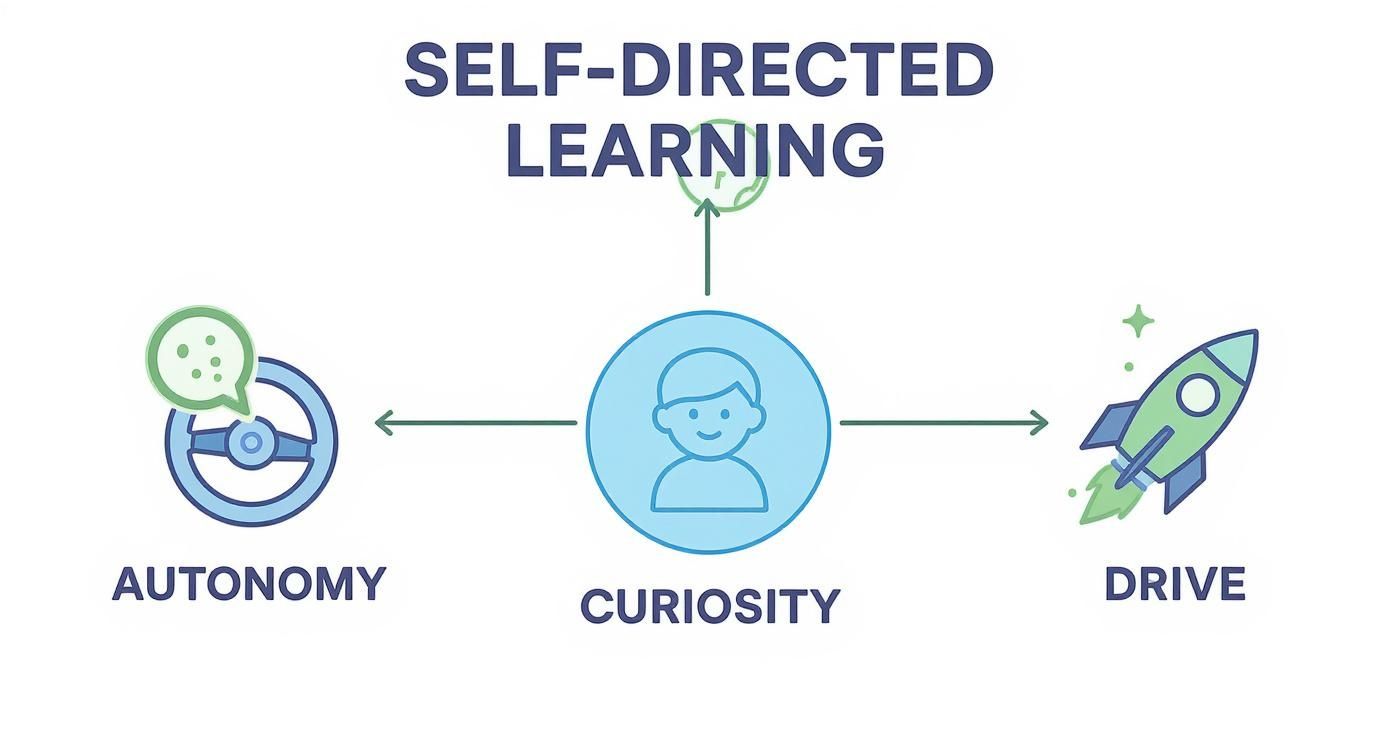
It places the child right at the centre, showing how personal drive, freedom, and curiosity come together to power their educational adventure.
The Spark of Intrinsic Motivation
The first and most crucial pillar is intrinsic motivation—the internal fire that fuels genuine passion. It’s the ‘why’ behind a child's actions when there are no external rewards like grades or praise on the line. This is learning for the pure joy and satisfaction of it, and it's a beautiful thing to witness.
Imagine a family visit to the Natural History Museum. Your young daughter stands mesmerised by the dinosaur exhibit. Back home, that spark ignites. She doesn’t wait for a school project; she independently starts devouring library books about the Jurassic period, watches documentaries with wide-eyed wonder, and meticulously builds dinosaur models.
No one is grading her efforts. Her reward is the thrill of discovery itself. This deep, personal investment is what makes learning stick. It feels less like a chore and more like an exciting quest she has chosen for herself.
The Compass of Metacognition
The second pillar is metacognition, which simply means ‘thinking about thinking’. It’s the ability for your child to step back and become aware of their own learning process. This is where they start to understand how they learn best, what they find challenging, and what strategies work for them, building a profound sense of self-awareness.
Think of your child as the captain of their own ship. Metacognition is their ability to read the maps, understand the weather (their own feelings and focus), check the compass, and steer their course with intention.
This essential skill helps a child move from being a passive passenger in their education to an active, confident navigator. They learn to ask themselves questions like, "Do I really understand this, or am I just reading the words?" or "This feels really hard, what could I do differently to solve this problem?" Helping your child develop these reflective habits is a core part of educational support, often called scaffolding. You can discover more about this concept in our detailed guide: https://queensonlineschool.com/what-is-scaffolding-in-education/.
The Roadmap of Goal Setting
Finally, the third pillar is goal setting. This is where motivation and metacognition come together to create a clear path forward. For a child, this isn't about five-year plans; it's about learning to create their own roadmap for something that matters to them right now, which gives them an incredible sense of purpose.
For instance, your son might decide he wants to learn a particular song on the piano. The thought of playing the whole thing feels huge and maybe even a little scary.
Together, you can help him break this big ambition down into smaller, manageable steps that feel achievable:
- This week, let's just master the right-hand melody for the first line.
- Next, we can practise the left-hand chords for that same line.
- Then, we can slowly try to play both hands together, just for that one part.
Each small success builds his confidence and a powerful sense of accomplishment, proving to him that he can achieve what he sets out to do. This desire for self-guided education is clearly on the rise. In 2020, 21% of Britons used non-course online materials for learning, showing a growing appetite for taking education into their own hands.
Practical Ways to Encourage Your Young Learner
Moving from theory to practice can feel like a huge leap, but encouraging self-directed learning isn't about becoming a trained teacher overnight. It’s about making small, heartfelt shifts in your daily interactions that show your child you trust their inner wisdom. You are already the expert on your child; these simple strategies just help you create more space for their natural curiosity to blossom.
The goal is to shift your role from an instructor to a supportive guide, gently steering them towards their own discoveries and celebrating their unique way of exploring the world.
Create an Invitation to Explore
Your home environment is one of the most powerful tools you have. By thoughtfully arranging spaces and materials, you send a clear, unspoken message: "Your curiosity is welcome here. Your ideas matter." This doesn't require a huge budget or a dedicated classroom.
It’s about creating irresistible invitations to explore that whisper to your child's imagination. Think of it like setting up a captivating shop window that entices your child to come inside and play.
Here are a few simple ideas to get started:
- A "Tinkering Tray": Place a collection of interesting, unrelated items on a tray—like old keys, pinecones, colourful yarn, and bottle caps. Don't give any instructions; just leave it out and feel the joy of seeing what incredible creations or stories emerge from their imagination.
- A Cosy Book Nook: You don't need a library. A few comfortable cushions, a soft blanket, and a small basket with a rotating selection of books tucked into a quiet corner can make reading feel like a magical escape, not a chore. It becomes their special sanctuary.
- An "Ask Me Anything" Jar: Fill a jar with pieces of paper, each containing an intriguing question ("What if humans could fly?"). Let your child pick one at dinnertime to spark fun, imaginative conversations that have no "right" answers, strengthening your family connection.
Ask Curious Questions, Not Demanding Ones
One of the most powerful shifts you can make is in the way you ask questions. Instead of directing or quizzing, aim to wonder alongside your child. This simple change transforms you from a tester into a co-conspirator in discovery, which builds a deep sense of connection and trust.
Your job isn't to have all the answers; it's to ask the best questions. This shows your child that the process of figuring things out is more valuable than knowing the answer immediately, and that it's okay not to know.
For instance, if your child is getting frustrated because their Lego tower keeps falling, resist the urge to say, "You need a wider base." That solves the problem for them, but it robs them of the chance to feel the victory of solving it themselves.
Instead, try asking gentle, open-ended questions that honour their effort:
- "Oh, that's frustrating! What do you notice happening right before it falls?"
- "I wonder what would happen if we tried a different kind of block at the bottom?"
- "What part feels the wobbliest to you?"
This approach empowers your child to become the problem-solver. It honours their intelligence and reinforces the idea that challenges are puzzles to be solved, not failures to be feared. This method is a key component of fostering independence in learning, allowing children to develop resilience and critical thinking skills.
Imagine your family's small garden patch isn’t growing as expected. Instead of searching for the answer online yourself, you could turn it into a shared investigation. Ask your child, "What do you think our plants might need?" Together, you could explore possibilities—sunlight, water, soil—and form a hypothesis to test. This beautiful, collaborative process is the very heart of self-directed learning.
Tailoring the Journey for Every Child
Every child is a universe of unique strengths, sensitivities, and ways of seeing the world. This is exactly why a one-size-fits-all approach to education can sometimes dim their natural light and make them feel unseen. The true beauty of self-directed learning lies in its incredible flexibility; it doesn’t force a child into a box but instead reshapes itself around them.
This isn’t about removing support. Far from it. It’s about providing a more thoughtful, personalised, and respectful kind of support—one that sees and celebrates your child for exactly who they are, building on their individual strengths rather than just focusing on their challenges.
Supporting Neurodivergent Learners
For a neurodivergent child who thrives on deep, intense focus, the open-ended nature of self-directed learning can be a perfect match. That said, unlimited choice can sometimes feel overwhelming. The key is to provide a sense of structure within their freedom, so they feel secure enough to explore.
Imagine a child with an intense passion for ancient Egypt. Instead of a vague instruction like, "learn about Egypt," which might feel too big, you could offer a curated menu of choices that connects with their interests.
- Would you like to build a model of a pyramid out of sugar cubes?
- Or would you prefer to create a story about a pharaoh's secret tomb?
- Perhaps you'd like to learn to write your name in hieroglyphs?
This approach honours their deep-focus abilities while giving them clear, manageable starting points. It lets them dive into their passion without the anxiety of a blank canvas, nurturing their strengths in a way that feels safe and genuinely exciting.
Creating a Safe Harbour for Anxious Children
For a child who struggles with anxiety, the fear of failure can be paralysing. Traditional school settings, with their constant tests and social pressures, often magnify these feelings. Self-directed learning offers a gentle, low-demand alternative where curiosity can flourish without judgement.
The goal is to create a safe harbour for their mind, a space where exploration is celebrated and mistakes are simply seen as interesting discoveries. It’s about removing the pressure to perform and replacing it with the simple joy of finding out.
This might look like creating a cosy corner in your home filled with art supplies and fascinating books, with no expectation for them to produce anything. The invitation is simply to be with the materials. For a child who loves nature but feels anxious in groups, it could mean quiet walks where you just notice things together—the shape of a leaf, the colour of a stone—without any quizzes. Over time, this pressure-free environment builds confidence, showing them that learning can be a source of comfort and personal satisfaction, not something to be feared.
Building Scaffolds for Executive Function
Some children find the organisational side of learning—planning, initiating tasks, and staying on track—to be a real challenge. For them, the whole idea of directing their own learning can seem daunting. Here, the adult’s role is to act as a supportive project manager, helping to build crucial scaffolding with patience and empathy.
This means breaking down a big, exciting goal into tiny, achievable micro-tasks. If your child wants to make a short stop-motion film, that can feel like a mountain to climb. You can help them map out the steps so it feels less overwhelming:
- Today: Let's just have fun thinking of a simple story for our characters. No pressure!
- Tomorrow: Let's create the characters out of clay. That's the only goal.
- The next day: We can practice taking just a few photos to see how it works.
By celebrating the completion of each tiny step, you build a powerful sense of momentum and accomplishment. This process doesn't just help them finish the project; it actively teaches them the executive function skills they need to bring their own incredible ideas to life in the future, fostering a belief in their own capabilities.
How Online Schools Foster Independent Learning
So, we’ve talked about the theory. But where does the magic of self-directed learning really happen? A supportive home is vital, of course, but the actual structure of a child's education plays an enormous role. This is where online schools come in, offering a powerful and nurturing alternative that creates the perfect setting for independent learning to flourish.
Think about it. The rigid bell schedules and one-size-fits-all lesson plans of a traditional school just don't work for every child. For some, it can feel constricting and stressful. An online environment, on the other hand, provides the very flexibility a self-directed learner needs. It offers a framework of support without the constraints that can so easily stifle a child's natural curiosity and pace.
Flexibility That Follows a Child's Passion
Let me tell you about Leo. He was a bright kid who always felt boxed in by the conventional school day. His mind would be buzzing with ideas about coding, but the 45-minute lesson would end just as he was getting into a really complex problem. It left him feeling frustrated and, eventually, completely disengaged from school. His spark was fading.
Switching to online school changed everything for him. He finally had the freedom to dedicate an entire morning to cracking a coding challenge that had captured his imagination. Guided by online tutorials and with a mentor just a message away, he had the time and space to go deep. This wasn't just about learning to code; it was about Leo reigniting a love for learning he thought he'd lost. He felt seen and understood.
An online environment empowers a student to align their education with their internal rhythm and passions, transforming learning from a passive chore into an active pursuit of joy and discovery.
A Rich Ecosystem of Resources
The right online setting isn't just about a flexible schedule; it's about providing a vast ecosystem of digital resources tailored to a child's interests. Children get instant access to virtual libraries, interactive simulations, educational videos, and expert articles. It allows them to follow their curiosity down fascinating rabbit holes whenever inspiration strikes, empowering them to become resourceful researchers.
This shift isn't just happening in schools. In UK higher education, online and self-directed learning models are steadily growing. The Higher Education Statistics Agency's latest data shows a consistent rise in students choosing online programmes, highlighting a major shift towards more flexible, independent education.
Structured Support for True Independence
Here’s a crucial point: true independence doesn't mean being left completely alone. The best online schools understand this balance perfectly. They offer a safety net of support that builds confidence rather than creating dependency. A student can work independently on a project for hours, safe in the knowledge that subject-specialist teachers are available during live lessons or for one-to-one guidance when they get stuck.
This blend of autonomy and support is what really makes the difference. It teaches children how to seek help strategically—a critical life skill. They learn to try first, identify their specific challenges, and then ask for targeted help, which is a huge confidence booster. It communicates, "We trust you to try, and we are here for you when you need us."
Ultimately, this model fosters resilience and resourcefulness, empowering children to become confident, happy, and truly independent learners.
Common Questions About Self-Directed Learning
Stepping into the world of self-directed learning can feel like exploring new territory, and it’s perfectly normal to have a few questions buzzing around. It’s a journey that asks for a little trust—in the process, and most importantly, in your child.
Your worries are completely valid; they come from a place of love and wanting the absolute best for your child. Let's walk through some of the most common concerns together, putting your child’s happiness and your peace of mind first.
How Do I Ensure They Learn Core Subjects?
This is often the number one concern for parents. If my child is following their own interests, how can I be sure they’ll ever learn essential skills like maths and reading? It's a fear that can feel very real.
The brilliant thing is that these subjects aren’t just confined to textbooks; they are woven into the very fabric of passionate, real-world exploration. They don't have to be taught in isolated, one-hour blocks.
Think about it. A child obsessed with baking is naturally doing maths when they measure ingredients, convert recipes for more cookies, or calculate cooking times. A young history buff fascinated by ancient Rome will happily dive into complex texts, boosting their reading comprehension and vocabulary far beyond what a worksheet could ever achieve because they care about the content.
The secret is to stop seeing learning as a checklist of subjects. Instead, picture it as an interconnected web. When a child follows a genuine interest, the "core subjects" become the very tools they need to dig deeper.
Your role shifts from formal teacher to a supportive facilitator. You can strew their path with inspiring resources—cookbooks, historical novels, or measuring tapes for a den-building project—that seamlessly blend these foundational skills into their passions.
What If My Child Only Wants to Play Video Games?
This question comes up a lot, and it's one that resonates with so many parents. It’s easy to look at screen time and feel a knot of worry, seeing it as wasted hours. But what if we reframed it? What if we saw it as a gateway to a world of incredible learning, driven by their genuine passion?
A love for video games often hides a deep interest in complex problem-solving, world-building, and creative design. Instead of seeing it as a dead end, think of it as a doorway to connect with your child's world.
- Storytelling & Writing: Ask them about the game's story. Could they write their own fan fiction or create a backstory for a new character they’ve imagined? This validates their interest and builds writing skills.
- Art & Design: Admire the art. Wonder with them about how it's made. Could they learn to design game assets using free software or sketch out maps for new levels?
- Strategy & Logic: Many games demand sophisticated strategic thinking. Chat with them about their tactics and the decisions they make. You'll likely be amazed by the complexity.
- Coding: This is the ultimate next step. You could inspire them to learn the basics of coding to build their very own simple game.
When you show genuine curiosity about their digital world, you validate their interest and strengthen your relationship. From there, you can gently guide them towards the powerful skills humming just beneath the surface.
Is This Approach Suitable for All Ages?
Absolutely. Self-directed learning isn’t a rigid, one-size-fits-all system. It’s a philosophy that flexes and grows right alongside your child, meeting them exactly where they are. The way it looks will change over the years, but the core principles of honouring their autonomy and curiosity always stay the same.
- For Toddlers: It looks like pure, uninterrupted play. This is learning through exploration, where they discover physics by stacking blocks until they tumble and social skills by navigating the playground. Your role is to provide a safe space and be a warm, reassuring presence.
- For Primary Schoolers: It might shift to become more interest-led. They could spend a whole month completely absorbed in learning about insects—building bug hotels, identifying species in the garden, and drawing what they find with intense focus.
- For Teenagers: This often evolves into project-based learning. They might decide to build a computer from scratch, start a small online shop for their handmade crafts, or organise a community event, managing the entire process from start to finish. They are learning to bring their own vision to life.
The level of support and scaffolding you offer will naturally change over time, but the goal is constant: to nurture your child’s innate drive to make sense of their world, on their own terms, so they grow into confident, capable adults who love to learn.
At Queens Online School, we believe in empowering students to become confident, independent learners. Our flexible structure and supportive mentors create the perfect environment for self-directed learning to flourish, helping your child follow their passions while achieving academic excellence. Discover how we can support your child's unique educational journey at https://queensonlineschool.com.