


Choosing the right A Level subject combinations is one of the first major decisions your child will make on their academic journey. It's a moment that feels enormous, filled with both excitement for the future and a touch of worry. It’s about so much more than just picking their favourite subjects; it’s about helping them carefully assemble a strategic toolkit that will unlock doors to their dream university courses and, eventually, a career that truly fulfils them.
Why A Level Subject Combinations Matter

That moment when your child has to decide on their A Levels can feel huge. For both of you, it’s a mix of excitement about the future and a little bit of anxiety about getting it right. The best way to approach it is to see this not as a set of limitations, but as the first deliberate step your child takes in building their own future, with your support right alongside them.
Think of their A Level choices as the foundational pillars of a bridge leading to where they want to go. A random collection of pillars won’t create a stable structure, but a carefully chosen set—one that reflects who they are—will build a strong, reliable bridge capable of carrying them straight to their destination. This choice is their blueprint for success.
Building a Strong Foundation for University
Universities don't just look at individual grades. They assess the coherence of a student's A Level choices, looking for proof that your child has the specific knowledge and skills needed to thrive on their chosen degree course. It's their way of seeing if your child is genuinely ready and passionate about the field they've chosen.
A student dreaming of becoming a vet, for instance, absolutely needs Chemistry and Biology. These aren't just arbitrary hurdles; they're the essential building blocks for a veterinary medicine degree. Without them, the bridge to that dream is simply incomplete. Imagine the heartbreak of discovering this too late.
Making a thoughtful choice now prevents a world of stress and disappointment down the line. By aligning A Level subjects with potential university pathways, you're helping your child build a foundation of confidence for the journey ahead, turning anxiety into a feeling of purpose.
The Current Landscape of A Level Choices
The popularity of certain subjects often mirrors wider trends in higher education and the job market. In recent years, we've seen a noticeable shift towards STEM subjects, which shows where many students see their future opportunities.
Recent data shows that Mathematics remains the most popular A Level, with 104,630 results issued. It's followed by Psychology with 72,930 results and Biology with 65,355, highlighting a clear interest in analytical and scientific fields.
Economics, Physics, and Chemistry have also seen a significant rise in uptake. While it's helpful to understand these trends, the most important factor will always be your child's individual passion, strengths, and goals. You can explore more about these A Level result trends to get a clearer picture of the current academic environment.
This initial stage is all about exploration and empowerment. By understanding why A Level combinations are so vital, you and your child can approach this decision not with anxiety, but with a shared sense of purpose, ready to build that strong bridge to a bright and exciting future.
How to Choose the Right A-Levels for Your Child
Choosing A-Levels is a big moment, and let’s be honest, the "right" combination isn't a one-size-fits-all formula you can just look up. It’s about moving beyond generic advice and putting your child’s unique passions, strengths, and well-being at the absolute centre of the conversation. This is where you help them connect what truly excites them with the practical steps needed for their future.
The goal is to have a supportive, open dialogue, helping your child balance their ambitions with university requirements without feeling crushed by outside pressure. Think of it as a journey of discovery you're taking together, not a test with a single correct answer.
Start with Their Passions and Strengths
The most powerful A-Level combinations are always built on a foundation of genuine interest and natural ability. When a child is passionate about a subject, they’re more motivated, more resilient when things get tough, and far more likely to achieve the grades they deserve. It's the difference between them dragging themselves to their desk and them losing track of time while studying.
So, where do you begin? Start by asking open-ended questions that get them thinking. What subjects make them lose track of time? What topics do they end up reading about or watching videos on in their free time? The answers often point directly to where their true interests lie. A crucial part of this involves understanding your child's learning behavior and profile, as this can give you incredible insight into how they process information and the environments where they'll truly thrive.
This self-awareness is the key to unlocking a combination that feels authentic and sustainable for them over two challenging but rewarding years.
Connecting Interests to Real-World Pathways
Once you've got a handle on their passions, the next step is to show them how those interests translate into exciting, real-world careers. This simple step makes the whole decision feel less abstract and more connected to a tangible future they can genuinely get excited about.
Let’s look at a couple of practical examples of how different interests can form a powerful A-Level subject combination:
-
For the child who loves gaming and art: A student who loves both art and technology might feel a bit torn. But a combination of Computer Science, Art, and Maths is a perfect blend. Computer Science provides the essential coding skills, Art develops their creative vision for character and world design, and Maths underpins the logic needed for game physics and complex programming. You can find out more about how an online Maths A-Level can fit into a flexible, creative curriculum.
-
For the child who wants to change the world: For a student passionate about justice and global issues, a fantastic combination would be History, Politics, and a Modern Language (like French or Spanish). History teaches them how to analyse past events and build a solid argument, Politics gives them the framework for understanding modern legal and governmental systems, and a language opens doors to international law and diplomacy.
These examples show how subjects that might seem quite different on the surface can work together to build a specialised and compelling skillset.
The best A-Level subject combinations tell a story about who your child is and where they want to go. They are not just a list of subjects, but a coherent narrative that showcases their unique blend of talents and ambitions.
Balancing Dreams with Practical Realities
Of course, it's also essential to have an honest chat about the practical side of A-Level choices. This means taking a good look at the entry requirements for university courses they might be interested in. The key is to frame this not as a set of limitations, but as smart, strategic planning that protects their dreams.
Here’s how you can approach this conversation together:
- Research as a Team: Spend some time browsing university websites and looking up specific course requirements. This empowers your child by making them an active part of the planning process, rather than just being told what to do.
- Identify the 'Non-Negotiables': For certain careers, like medicine or engineering, some subjects are simply non-negotiable. Chemistry for medicine, or Maths and Physics for engineering, are classic examples. It’s best to acknowledge these requirements early on.
- Find the 'Passion' Slot: If two subjects are essential for a degree, the third choice can often be one picked purely for enjoyment and interest. This is a brilliant way to ensure the combination remains motivating and doesn't feel like a chore. For example, a future engineer taking Maths and Physics could choose Music as their third A-Level if that's what they love—it shows universities a well-rounded individual.
By working together, you can find a balance that honours your child's passions while keeping their future options wide open. It turns a potentially stressful decision into an exciting, collaborative first step towards their future.
Proven A Level Combinations for Top University Courses
Choosing A Levels can feel like you're trying to solve a puzzle, but you haven't been given all the pieces yet. This is where we step in, turning those abstract ideas into a clear, tangible roadmap for your child's future. By looking at proven A level subject combinations, we can help them see exactly how the choices they make today will build the story of who they want to become tomorrow.
This guide gives you concrete examples tailored to popular university degrees. We’ll explore why certain subjects work so powerfully together, giving your child the best possible shot at securing a place on their dream course. It's all about making smart, informed choices that align their passion with a clear purpose.
This simple diagram shows the core elements to think about, placing your child's needs right at the very heart of the decision.
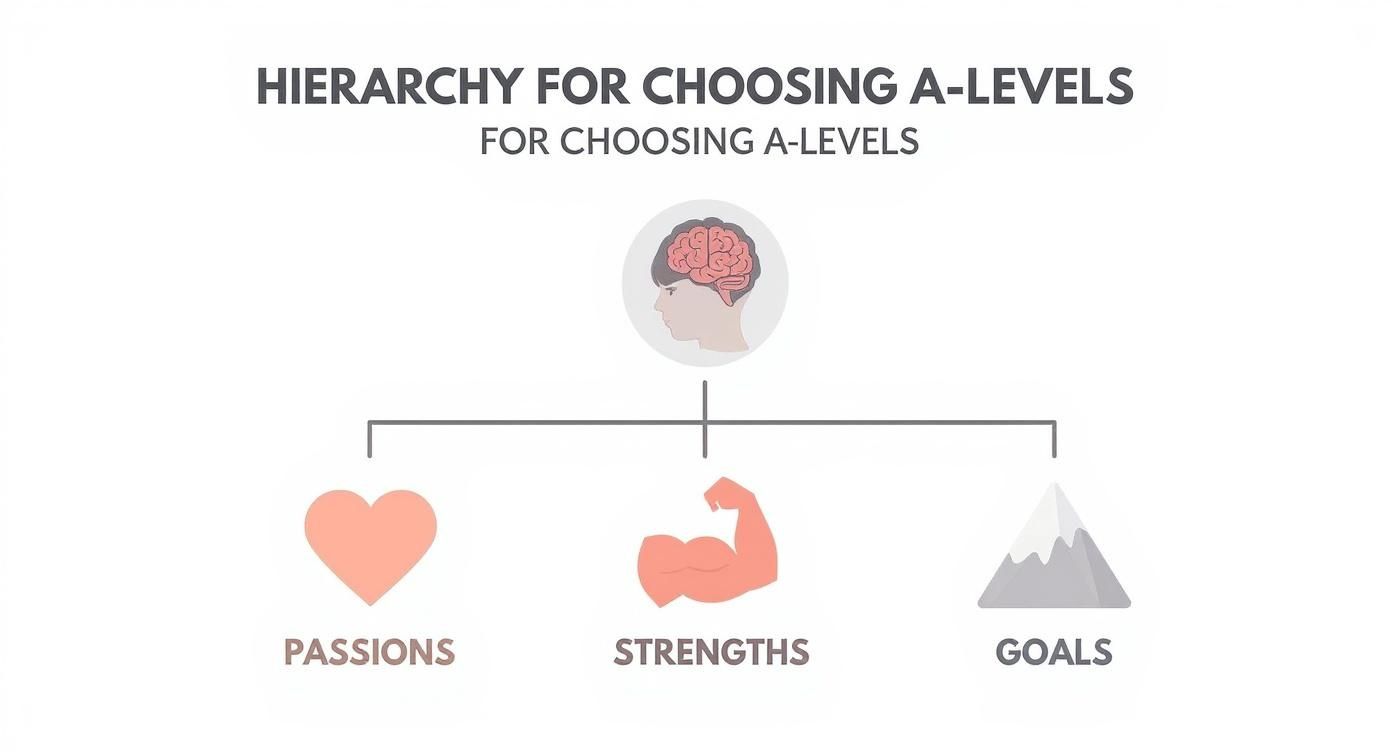
As the infographic illustrates, the strongest choices are always found where what your child loves, what they're good at, and where they want to go all intersect.
STEM Pathways: Medicine, Engineering, and Beyond
For many of the most competitive science and technology courses, the subject requirements are incredibly specific. These aren't just suggestions; they are the non-negotiable foundations your child will need to succeed at degree level. Helping them understand this early on is key to preventing disappointment down the line.
Let's break down some powerful STEM combinations:
- For Aspiring Medics: The classic combination is Chemistry, Biology, and either Maths or Physics. Chemistry and Biology are absolutely essential, forming the bedrock of medical science. Adding Maths or Physics sharpens the analytical and problem-solving skills that are not only tested in university entrance exams but are vital for a career in medicine.
- For Future Engineers: The go-to trio here is Maths, Physics, and Further Maths. This combination provides the deep mathematical and physical understanding required for nearly all engineering disciplines. Further Maths, in particular, gives students a significant edge and is often preferred by top-tier universities.
- For Computer Scientists: A really strong choice is Maths, Further Maths, and Computer Science. This blend equips students with advanced logical reasoning from Maths and the specific programming and computational thinking skills from Computer Science, setting them up perfectly for fields like AI and software development.
Humanities and Social Sciences Pathways
Humanities and Social Science degrees are all about understanding the human world, whether that's through literature, history, or the structures of society. The A Level combinations for these fields are designed to develop strong skills in essay writing, critical analysis, and building a compelling argument.
Here are a couple of effective combinations:
- For Law Applicants: A classic and highly respected combination is History, English Literature, and a third subject like Politics or Economics. History hones the ability to analyse evidence and form a coherent argument, while English Literature develops skills in close reading and understanding complex texts. These are the exact skills needed to succeed in a law degree.
- For Social Scientists (Psychology/Sociology): A fantastic trio is Psychology, Sociology, and Biology or Geography. This combination provides a brilliant overview of human behaviour from both a social and a biological perspective. For example, a student fascinated by why people behave the way they do gets the social context from Sociology and the biological underpinnings from Biology—a truly powerful mix.
Choosing the right A Level subjects is about more than just meeting entry requirements. It's about giving your child the intellectual toolkit they need to walk into their university lectures feeling prepared, confident, and ready to engage deeply with their chosen field. It's a gift of preparation.
Business and Creative Arts Pathways
The worlds of business and the creative arts demand a mix of analytical thinking and innovative flair. A Level choices here can be more flexible, allowing students to combine traditional academic subjects with more vocational ones to create a unique and compelling profile for their university applications.
Consider these dynamic combinations:
- For Business and Finance: A powerful mix is Maths, Economics, and Business Studies. Maths provides the essential quantitative skills needed for finance, while Economics and Business Studies offer the theoretical and practical frameworks for understanding markets and organisations.
- For the Creative Arts (Art/Drama/Media): Students can build a strong portfolio with Art, Drama, and Media Studies. This combination allows them to immerse themselves fully in creative practice. Adding a complementary subject like English Literature or History of Art can provide a deeper theoretical and contextual understanding, which is highly valued by universities.
Ultimately, the best a level subject combinations are those that not only open the right university doors but also fuel your child's curiosity and passion for learning. These choices will also contribute to their application profile, and it can be helpful to learn more about how universities define UCAS points to understand the full picture.
Navigating Gender Dynamics in Subject Choices
Choosing A-Levels is a deeply personal journey, but it’s impossible to ignore the subtle—and sometimes not-so-subtle—currents of society that can steer your child’s decisions. One of the most persistent is the traditional gender divide we still see in certain subjects. Our goal here isn’t to reinforce stereotypes, but to help you open up a supportive conversation that empowers every student to follow their passion, not a preconceived path.
It's a conversation that needs both sensitivity and honesty. Watching your child weigh their options can be emotional, as you want them to feel completely free to choose a future that genuinely lights them up, free from outdated expectations.
The data reveals some pretty clear patterns. While recent analysis shows boys have slightly outperformed girls at A-Level for the first time since 2018, the gender gap really shows up in specific A-Level subject combinations. Boys make up around three-quarters of all entries in subjects like Computing and Physics, while girls continue to lead the way in fields such as Health and Social Care and the performing arts. You can discover more about these A-Level trends and see how these patterns play out across the country.
These statistics aren't a judgement. They simply hold up a mirror to long-standing societal norms. The real question is how we can support our children to look beyond that reflection and see their own unique potential staring back.
Fostering Authentic Choices
The most important thing we can do is create a safe space for our children to explore what’s truly driving them. This is about helping them tune into their own voice above the noise of expectation from friends, family, or society at large.
Start by asking gentle, open questions that get them thinking more deeply about their choices:
- "What part of this subject makes you feel most excited?" This gets to the heart of their genuine passion and intellectual curiosity.
- "If you weren't worried about what anyone else thought, would this still be your top choice?" This helps them untangle external pressure from their own desires.
- "Let's imagine your future. What are you doing in that picture, and how do these subjects help get you there?" This connects their A-Levels to a personal vision of success.
By centring the conversation on their feelings and dreams, you empower them to make a choice that is truly their own.
An authentic A-Level choice is one that energises and inspires your child from within. It’s a combination that reflects not who they are ‘supposed’ to be, but who they truly are and aspire to become.
Championing Trailblazers and Breaking Moulds
One of the best ways to dismantle stereotypes is by showing your child they don’t have to be the first to break them. There’s a rich history of inspiring people who have excelled in fields not traditionally associated with their gender.
Think of Dr Maggie Aderin-Pocock, a leading space scientist who has become a powerful role model for young girls dreaming of careers in physics and engineering. Or consider Jamie Oliver, who challenged the idea that professional cooking was just for men and inspired a generation of boys to embrace the culinary arts.
These stories matter. They show our children that passion and talent have no gender. By sharing these examples, you’re not just providing inspiration; you’re giving them permission to follow their own path, wherever it may lead. The best A-Level subject combinations are, after all, the ones that make your child feel limitless.
Specialist Guidance for Every Student's Journey

The journey to choosing A Levels is unique for every child. For some, the path requires a little more thought and support. This is a moment to honour your child’s individual circumstances, making sure the choices made aren't just about academic fit, but about creating an environment where they feel seen, supported, and confident.
Every family's story is different. The right A Level subject combinations are those that celebrate your child's strengths while respecting their needs, building a foundation for success that feels both ambitious and achievable.
Compassionate Choices for SEN Learners
For students with Special Educational Needs (SEN), the decision-making process is a delicate balance. It's about finding subjects that ignite their passion while carefully managing cognitive load and potential stress points. The goal is to build a timetable that plays to their strengths, not one that constantly highlights their challenges.
This has to be a collaborative process. Open, honest conversations with your child’s school are vital. Discuss which subjects offer different assessment styles—coursework-heavy options, for instance, might be a much better fit than high-pressure, exam-only subjects.
A student with dyslexia, for example, might truly excel in a visual subject like Art or Photography where their creativity shines. This could be paired with a practical, real-world subject like Business Studies. This isn't about lowering expectations; it's about creating a pathway where their unique talents can flourish. The key is creating a supportive structure. You can learn more about how specialised programmes provide crucial support in our guide to online courses for SEN students. It's also crucial to address the unique needs of Twice Exceptional (2e) students, who are gifted but may also face learning difficulties.
Your child's well-being must always come first. The "best" A Level combination is the one that allows them to thrive academically, emotionally, and personally, creating a positive and empowering learning experience.
Guidance for International Students
For students joining the UK system from abroad, choosing A Levels can feel like bridging two different educational cultures. It’s a bit like learning a new language, but it's also an incredible opportunity to build a powerful academic profile recognised by top universities worldwide.
The first priority is making sure the chosen subjects meet specific UK university entry requirements. If your child is aiming for a competitive UK STEM course, for instance, taking Maths and the relevant sciences is non-negotiable, even if their previous curriculum was much broader.
A common and highly effective strategy is to combine a subject they excelled in back home with two new subjects that align with their UK university ambitions. This provides a familiar anchor of confidence while they get to grips with the A Level system. For example, a student from Spain who was strong in their native literature could take Spanish alongside Maths and Physics to keep all their options wide open and showcase their bilingual strengths.
Ultimately, this journey is about creating a flexible, supportive learning environment where every child—regardless of their background or needs—can succeed. It’s about ensuring they don’t just cope, but truly flourish.
Common A-Level Questions Answered
Choosing A-Levels often throws up a whirlwind of questions. It's completely normal to feel a mix of excitement and nerves as you and your child stand at this important crossroads. This is a time filled with "what ifs" and a genuine desire to make the best possible decisions for their future.
To help you find some clarity, we've pulled together the most common and pressing questions we hear from families. Our goal is to give you clear, practical, and supportive answers that build your confidence and help you guide your child with reassurance.
How Many A-Levels Should My Child Take?
This is nearly always the first question on a parent's mind. For UK university entry, the standard is three A-Levels. Taking three subjects allows students to really dive deep, giving them the focus needed to achieve the high grades that top universities are looking for.
Some students, especially those with a real flair for STEM subjects, might consider taking four, often with Further Maths as the fourth. But this is a decision that has to be about your child's well-being and capacity first and foremost. Is the extra pressure of a fourth subject going to help them shine, or will it risk burning them out?
The golden rule here is that three excellent grades are always more valuable than four mediocre ones. It’s a matter of quality over quantity, ensuring your child has a workload they can manage. This allows them to excel academically while still having time for the extracurriculars that make a university application truly stand out.
What Are Facilitating Subjects and Do They Still Matter?
You’ve probably heard the term "facilitating subjects" and wondered if they’re still relevant. In short, yes, they are. These are the A-Levels that top universities have traditionally viewed as fantastic preparation for a huge range of degree courses because they teach core academic skills.
Think of subjects like:
- Mathematics and Further Mathematics
- English Literature
- Physics, Biology, and Chemistry
- History
- Geography
- Modern Languages
While the official "Russell Group" list of these subjects isn't actively promoted anymore, the principle behind it is as strong as ever. These subjects are brilliant for developing skills in analysis, critical thinking, and building a coherent argument—abilities that are prized in any degree.
Picking one or two of these is a great strategy for keeping your child's university options as open as possible. The trick is to balance them with a subject they are genuinely passionate about. This creates a well-rounded and motivating A-Level subject combination.
What if My Child Has No Idea What Career to Pursue?
It’s incredibly common for a teenager to be unsure about their future career—and that is absolutely okay. While that uncertainty can feel daunting for them (and you!), it’s also a brilliant opportunity for exploration. If your child is undecided, the best strategy is to choose a combination of subjects that keeps their future options wide open.
This is where that mix of facilitating subjects can be a real lifeline. For example, a combination like Maths, History, and a science like Biology is wonderfully versatile. It covers analytical skills from Maths, essay-writing from History, and scientific principles from Biology, leaving a massive range of degree courses accessible down the line—from finance to law to environmental science.
The goal is to avoid specialising too early. Encourage your child to pick subjects they enjoy and are good at. Not only will this lead to better grades, but it will also keep them engaged and motivated as they naturally discover more about their interests over the next two years. It's all about building a strong, broad foundation from which they can launch in any direction they eventually choose.
Can My Child Change A-Level Subjects After Starting?
Yes, it’s possible, but the key is to act fast. Most schools and colleges have a specific window—usually the first few weeks of the autumn term—where students can switch if they realise they’ve made the wrong choice.
It’s so important to keep an open and supportive conversation going with your child as they start their A-Level journey. If you sense they’re struggling, unhappy, or feeling swamped by a subject, encourage them to speak up straight away. A quiet chat can often reveal that a subject just wasn't what they expected.
The next step is to contact their head of sixth form or academic advisor as soon as you can. The longer they wait, the harder it becomes to catch up on the work they’ve missed in a new subject. Proactive and honest communication with the school is the best way to ensure a smooth transition into an A-Level subject combination they can truly thrive in.
At Queen's Online School, we understand that every child's journey is unique. Our flexible online A-Level programmes are designed to support individual passions and ambitions, allowing for personalised subject combinations that open doors to top universities. Explore our A-Level courses and discover how we can help your child build their bridge to the future.