

Choosing an online Maths A Level is a huge decision, and it’s one that speaks volumes about your commitment to your child's unique journey. This isn’t just about finding an alternative to a traditional school; it’s about choosing a path that builds independence, nurtures self-discipline, and gives them the tools to thrive at university and beyond. It’s a choice that puts their needs, ambitions, and wellbeing right at the heart of their education.
Is an Online Maths A Level Right for Your Child?
Watching your child navigate their education can bring a mix of pride and worry. You want the best for them, but what does "best" really look like when their path doesn't quite fit the traditional mould? An online Maths A Level isn't a compromise; for many families, it's the perfect solution, a way to help their child flourish on their own terms.
This choice empowers students whose needs just aren't being met in a standard school environment. Imagine your child is a dedicated gymnast, training hours every day. A rigid school schedule feels like a constant battle. Online learning offers them the freedom to pursue their passion without their academic dreams taking a backseat. Or perhaps your child is a gifted actor who needs to attend auditions. Online study moves with them, not against them.

A Calmer, More Focused Environment
Now, think about the child who finds the noise and social pressures of a busy classroom overwhelming. For some, the constant distractions can make trying to concentrate on complex topics like calculus or mechanics feel completely impossible. It can be heartbreaking to watch your bright child shrink in an environment that doesn't suit them. An online setting offers a calm, focused space where they can finally breathe and learn at their own pace, free from that anxiety.
This personalised approach is fantastic for building confidence. Imagine this: your child is struggling with a tricky new formula. Instead of feeling self-conscious about asking the teacher to repeat themselves in front of everyone, they can simply pause the video lesson, re-watch the explanation as many times as they need, and reach out for one-to-one support without feeling judged or rushed.
A Strategic Step Towards University Success
An online A Level is also a powerful tool for students aiming for top university places. Whether they're retaking an exam to get the grade that truly reflects their ability or adding Maths to strengthen their UCAS application for a competitive course like Economics, the flexibility of online study is a huge advantage. It also shows a level of maturity and self-motivation that university admissions tutors really admire.
The demand for strong mathematical skills is only growing. The number of students taking A Level Maths is on the rise, with entries increasing by 4.4% in the past year alone. Choosing this subject prepares your child for a future in high-demand STEM fields, and studying it online shows they have the independent learning skills needed to excel in higher education. You can read more about the growing popularity of A Level Maths.
Decoding Syllabuses and Exam Boards
Stepping into the world of A Levels can feel like learning a new language, with mysterious codes like 'AQA 7357' or 'Edexcel 9MA0' thrown around. It’s completely natural to worry if an online course is somehow different or less rigorous than one taught in a physical school. You want to be sure you're making the right choice for your child's future.
Let’s put that worry to rest right away: an online Maths A Level follows the exact same official syllabus as its classroom-based equivalent. The qualification holds precisely the same weight with universities and employers. No difference.
This means your child will be learning the same content and sitting the same exams as every other student in the country. The only thing that changes is the delivery—offering the flexibility and personalised attention your child might need to truly excel. The academic standards are identical, ensuring their hard work earns them a qualification that is respected and valued everywhere.
What’s Inside the Maths A Level Syllabus?
Think of the A Level Maths syllabus as a powerful toolkit for solving complex problems. It’s built on three core pillars, each designed to develop a different kind of mathematical thinking, helping your child see the world in a new light.
- Pure Maths: This is the engine of mathematics. It’s the foundational beauty of algebra, calculus, and trigonometry. For your child, mastering Pure Maths is like learning the grammar of a new language; it gives them the essential skills to see how ideas connect and build, creating a solid base for everything else.
- Statistics: If Pure Maths is the engine, Statistics is the GPS. It’s about navigating the real world by collecting, analysing, and interpreting data. Imagine your child reading a news story about a new medical study. Statistics teaches them how to look past the headlines, question the data, and form their own informed opinions.
- Mechanics: This is where maths gets physical, bringing abstract concepts to life. It answers the questions that spark a child's curiosity: "How does a satellite stay in orbit?" or "What forces keep a bridge standing?" For a child who loves to know how things work, Mechanics makes maths tangible and exciting.
Understanding these components helps you see how the syllabus creates a well-rounded, powerful qualification. It’s not just about abstract numbers; it’s about giving your child a new way to understand and shape the world.
AQA vs Edexcel: What’s the Difference?
Most online providers will follow one of the two main exam boards in the UK: AQA or Pearson Edexcel. While both are highly respected and cover the same core content, they have slightly different styles. It's a bit like two authors writing a book on the same subject—the story is the same, but the way it's told feels different.
Knowing which board a provider uses is important, as it helps you choose the approach that best suits your child's learning style. For instance, both boards use three 2-hour exams, but the content is distributed slightly differently. One might be a better fit for a child who likes to see the bigger picture, while another might suit a child who prefers a step-by-step approach.
"The core content and difficulty level are equivalent across both AQA and Edexcel. The main distinctions lie in the question style and paper structure, which can suit different students' strengths. AQA often features more multi-step, problem-solving questions, while Edexcel may present concepts in a more structured, guided way."
A Quick Comparison of AQA and Edexcel A Level Maths
To help you and your child know what to expect, here’s a look at the subtle but important distinctions between the major UK exam boards.
| Feature | AQA (7357) | Edexcel (9MAO) |
|---|---|---|
| Paper 1 | Pure Maths | Pure Maths 1 |
| Paper 2 | Pure Maths and Mechanics | Pure Maths 2 |
| Paper 3 | Pure Maths and Statistics | Statistics and Mechanics |
| Question Style | Tends to feature longer, multi-step questions that require pulling together different topics. Good for students who enjoy problem-solving. | Often breaks down complex problems into smaller, guided steps. Can be more accessible for students who prefer a structured approach. |
| Content Split | Mechanics and Statistics are combined with Pure Maths in Papers 2 and 3, respectively. | Pure Maths is assessed across the first two papers, with the third paper dedicated entirely to the applied subjects. |
| Best For | Students who are confident in making links between different mathematical areas and enjoy tackling larger, less-scaffolded problems. | Students who appreciate clear signposting within questions and prefer to tackle applied and pure maths in separate exam sittings. |
Ultimately, neither board is "easier" than the other, and both lead to a qualification that is held in the same high regard. You can get a better sense of the nuances by exploring how A-Level grade boundaries are set for different boards. Always check the provider's website or prospectus to confirm their exam board details—it's a crucial piece of the puzzle in finding the perfect fit for your child.
How Online Maths A Level Learning Really Works
Imagining your child learning A Level Maths online can feel a bit abstract. You might picture them staring at a screen, isolated, trying to untangle complex ideas all on their own. It’s a natural worry. But the reality is a world away from that. It’s a dynamic and deeply supportive experience designed to adapt to your child, not the other way around.
Far from being a solitary grind, a typical study week is structured, interactive, and built around a blend of learning methods that cater to how your child actually absorbs information. The fear that they might get left behind just doesn’t square with the highly personalised nature of modern online schooling.
Live Classes Versus Self-Paced Learning
The structure of a good online Maths A Level usually combines two powerful approaches, giving your child the best of both worlds.
-
Live Interactive Classes: Picture a small, focused group of students in a virtual classroom with a subject-specialist teacher. There's real energy here. Your child isn't just a face on a screen; they can raise their hand digitally, ask questions about vectors in real-time, and even collaborate with peers in breakout rooms to solve a problem. This isn't passive screen-time; it's active, engaged learning that builds a sense of community.
-
Pre-recorded Lessons: Now, imagine it's evening, and your child is wrestling with a tricky calculus problem from that day's lesson. With a pre-recorded lesson, they can pause the explanation, rewind to hear the key steps again, and work through the example at their own speed. That moment of frustration turns into a moment of discovery, all because they have the freedom to learn without pressure.
This combination ensures students get direct, teacher-led instruction alongside the freedom to study independently when it suits them. It’s a flexible, tutor-supported model that gets fantastic results. In fact, some online A Level Maths courses report pass rates as high as 97%—a real testament to how effective this blended approach is. You can see how providers structure these successful courses and explore their resources to get a clearer picture of what works.
The infographic below shows the core components your child will encounter, whether they’re learning online or in a traditional school.
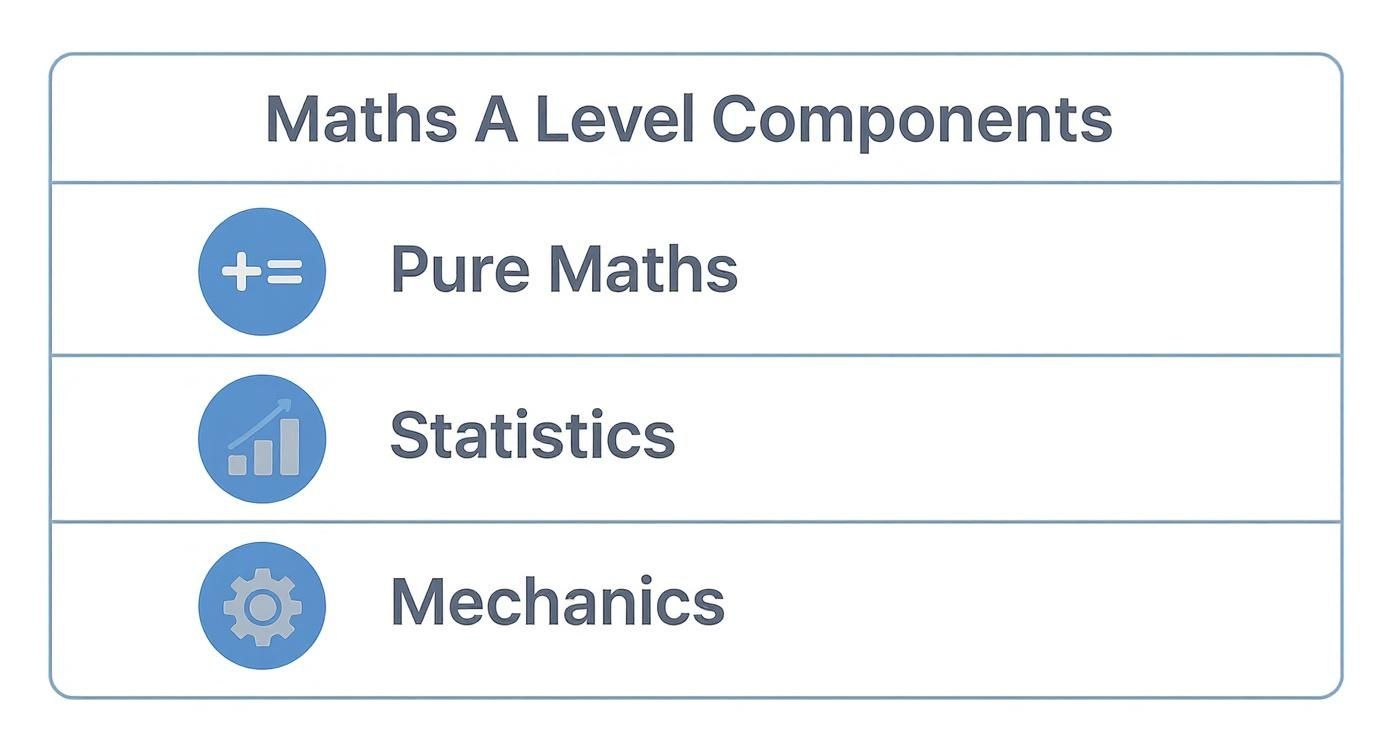
As you can see, Pure Maths, Statistics, and Mechanics form the heart of the A Level, with each element building a different set of crucial analytical skills.
The Power of One-to-One Tutoring
Perhaps the single biggest advantage of online learning is the access to personalised support precisely when it's needed most. This is where that fear of your child struggling alone truly melts away.
Imagine your child is stuck on a differential equation. Their confidence is dipping, and frustration is setting in. Instead of waiting for the next school day, they can schedule a one-to-one session with their tutor. In that dedicated time, it’s just them and the expert, working through the problem step-by-step on a shared digital whiteboard until the concept finally clicks. You can almost feel their relief and see the confidence return to their face.
This isn't just about getting the right answer; it's about building genuine confidence. The tutor can pinpoint exactly where your child is going wrong and offer targeted guidance that gets to the root of their misunderstanding. That kind of individual attention is incredibly difficult to replicate in a traditional classroom of 30 students.
A Learning Style That Fits Your Child
Ultimately, online learning works because it puts the student first. It recognises that every child learns differently and provides the tools to match their pace and style.
If your child thrives on social interaction and immediate feedback, the live classes provide that community and energy. If they are a more reflective learner who needs time to process things quietly, the library of recorded lessons and on-demand resources allows them to learn without pressure.
This adaptability puts your child right at the centre of their education. It empowers them to take ownership of their learning, identify when they need help, and build the independent study skills that are absolutely essential for success at university and beyond. It’s not about leaving them alone; it’s about giving them the support and flexibility they need to fly.
Finding the Best Online A‑Level Maths Provider
Choosing an online provider for your child's A‑Level Maths can feel like a huge responsibility. When you look past the glossy brochures and slick marketing, what you're really searching for is a partner—someone who sees your child as an individual and is genuinely invested in their success.
It’s easy to get lost in a sea of options. But if you focus on the right questions, you can cut through the noise. This decision is about so much more than course materials or pass rates; it's about finding an environment where your child feels supported, confident, and maybe even starts to see the beauty in maths.
A Checklist for Choosing the Right Provider
To make this process less overwhelming, it helps to have a clear set of criteria. Think of it as interviewing someone for one of the most important roles in your child's education. A good provider won't just tolerate your questions; they'll welcome them and give you honest, transparent answers.
Here are the critical areas to dig into:
- Tutor Qualifications and Experience: Who, exactly, will be teaching your child? Don't settle for vague answers. For example, ask: "Are your tutors qualified teachers with experience in the UK curriculum? What specific training do they have for teaching online?" The right person can ignite a passion for a subject; the wrong one can extinguish it.
- Timetabling and Flexibility: How are the lessons structured? Are they live and interactive, or is your child expected to learn from pre-recorded videos? What happens if they have to miss a class because of an appointment? The ideal setup often balances a consistent routine with enough flexibility to accommodate real life.
- Community and Social Interaction: For many parents, the fear of isolation is a major concern. Ask the provider practical questions: "How do you build a sense of community? Do you have virtual common rooms, student clubs, or group projects that help kids connect and form friendships?" You want your child to feel part of something.
- Progress Tracking: How will you know if your child is keeping up? A reputable school will have a clear system for monitoring progress, giving regular feedback, and scheduling parent-tutor meetings to discuss how things are going. You should never feel in the dark.
When you're looking at different schools, it can also be useful to understand the range of online course creation tools they use, as this often gives you a clue about the quality and interactivity of their lessons.
Crucial Support for SEN and SEMH Needs
This is non-negotiable. If your child has Special Educational Needs (SEN) or Social, Emotional, and Mental Health (SEMH) needs, you have to be absolutely sure the provider can support them properly. A generic "yes, we support all students" just isn't good enough.
You need to ask direct, specific questions that get to the heart of their approach. For instance, 'My child has dyscalculia. What specific strategies and tools do your maths tutors use to support students like them?' or 'How do you adapt your teaching for a student with ADHD who struggles with focus in a digital environment?'
Their answers will quickly tell you whether this kind of support is baked into their culture or just an afterthought. Look for providers who can share concrete examples of how they’ve helped students with similar needs to not just cope, but thrive. You might also want to explore our guide on the best online learning platforms to see what features support different learning styles.
Navigating Exam Centre Registration
This is the practical step that often causes the most anxiety for parents new to online schooling. Your child will need to sit their final exams in person at a registered exam centre as a private candidate. It sounds daunting, but a good online school will make this process completely painless.
Ask them directly: 'Do you have partnerships with exam centres?' or 'What practical guidance do you provide to help us find and register with a local centre?' The best providers will offer dedicated support, with some even handling the registration process for you. This kind of practical help is a huge weight off your shoulders, freeing you up to focus on supporting your child emotionally through their exams.
For instance, established providers like The National Extension College (NEC) have a long history of guiding students through this. Their online A‑Level Maths course, backed by decades of experience, reports a 78% pass rate and is designed for self-paced study with strong tutor support, making it an accessible option without formal entry requirements.
This screenshot from the NEC course page clearly lays out key details like the awarding body (Pearson Edexcel) and UCAS points. This is the kind of transparency you should look for—it shows a trustworthy provider who gives you the essential information you need, right up front.
Breaking Down the Costs and Finding Value
Let’s talk about the money side of things. It can feel a bit daunting, can’t it? You want the absolute best for your child, but it also has to work for your family’s budget. Understanding the cost of an online Maths A Level isn't about finding a single price tag; it's about seeing the real value you're getting for your investment.
This isn’t just a course fee. It’s an investment in your child’s confidence, their university ambitions, and frankly, your peace of mind. By looking at the costs clearly and honestly, we can move past the initial sticker shock and find a provider that delivers genuine, lasting value.
What’s Actually Included in the Course Fee?
When you see a price for an online A Level, the first question to ask is: what am I actually paying for? A good provider will be completely transparent about this, but it’s always wise to double-check the fine print. The headline fee, which can range anywhere from £1,000 to over £6,000 for the full two-year course, usually covers:
- Tuition: This is your child's access to all the live lessons, recorded classes, and core learning materials.
- Tutor Support: Direct lines to subject-specialist tutors for questions, feedback, and sometimes even one-to-one check-ins.
- Resources: Digital textbooks, libraries of past papers, and any interactive practice software.
- Progress Tracking: Regular assessments, detailed reports, and meetings between parents and tutors.
Think of it like buying a car. The base price gets you the engine, seats, and steering wheel – all the essentials to get your child moving forward.
Uncovering the Hidden Extras
But just like with that car, there are often optional extras or necessary add-ons that aren’t part of the initial price. These hidden costs can turn a seemingly cheap course into a much more expensive one down the line. It's so important to ask about these before you sign up.
One of the biggest and most frequently overlooked costs is the exam centre fee. Your child has to sit their final exams in person at a registered centre. This isn’t included in the course fee and typically costs between £150 to £250 per paper. For A-Level Maths, that’s three papers, so you could be looking at an additional £450 to £750 that you hadn't budgeted for.
Other potential costs to keep an eye out for include:
- Registration Fees: Some providers have a one-off admin fee just to get started.
- Extra Tutoring: While a good level of support should be included, intensive one-to-one help might come with an extra charge.
- Specialist Textbooks or Software: Make sure all the resources your child needs are part of the main package.
Looking for True Value, Not Just the Lowest Price
It’s natural to be drawn to the cheapest option, but this can often be a false economy. A provider with a higher initial fee might actually offer far better value because everything is bundled in.
Here’s a practical example:
Imagine Provider A costs £2,500 and Provider B costs £4,000. On the surface, Provider A looks like the clear winner. But what if they offer no help finding an exam centre, charge £50 an hour for extra tutor support, and don't include digital textbooks? Suddenly, you're spending hours on the phone trying to find an exam venue and worrying about the mounting cost of extra help for your child.
Provider B, on the other hand, includes exam booking support, unlimited access to tutors, and all required materials. Once you tally up the potential extras for Provider A, the "cheaper" option could easily cost you more in the long run—not just in money, but in stress and hassle for your family.
Choosing the right online Maths A-Level provider is about finding a partner who is open about their costs and genuinely invested in your child's success. Asking these direct questions ensures there are no nasty surprises, allowing you to budget with confidence and invest in an education that truly puts your child first.
Building a Study Plan for Success at Home
The freedom of an online Maths A Level is a massive plus, but let’s be honest—it can feel a bit daunting for a teenager used to the structure of a school day. Suddenly, they're in charge of their own time. As a parent, you might worry about how to help them build a routine without becoming a full-time micromanager.
The secret isn’t about recreating a rigid school timetable. It’s about working with your child to create a framework that balances focused study with the very flexibility that makes online learning so powerful. It’s about helping them turn their desk into a personal launchpad for success, a space where they feel capable and in control.

When you approach it collaboratively, you empower them. Home learning stops being a source of conflict and becomes a rewarding experience they can truly own.
Creating a Weekly Framework
A predictable routine is comforting. It cuts down the daily mental drain of your child figuring out what to do next. The aim is to build a weekly rhythm that feels natural, freeing up precious brainpower for the tough stuff, like integration or probability.
Sit down with your child and map out a schedule that covers all the bases:
- Fixed Commitments: Start by slotting in their live online classes. These are the non-negotiable anchors of their week.
- Focused Study Blocks: Schedule dedicated 1-2 hour blocks for independent work. For example, Monday and Wednesday mornings could be for Pure Maths, while Tuesday afternoon is for tackling a Statistics chapter.
- Past Paper Practice: This is non-negotiable for A-Level Maths. Set aside at least one session a week—say, Friday morning—to tackle past papers under timed conditions. It builds their exam stamina and shows them exactly where they need more practice.
- Crucial Downtime: This is just as vital as study time. It's so important that they schedule proper breaks, hobbies, and time with friends. A rested mind is a productive mind, and you don't want them to burn out.
For parents helping to build a study plan, it can be really useful to look at what's working in the wider world of online education. Resources like 9 Online Education Best Practices for 2025 offer some fantastic insights.
Overcoming Procrastination and Loneliness
Two of the biggest hurdles for any online learner are the temptation to procrastinate and the creeping sense of isolation. A good plan can tackle both head-on.
First, help your child set up a dedicated, distraction-free study space. This doesn't have to be a whole room; a quiet corner of the dining room can work just as well. The key is that this space becomes psychologically linked to learning. When they sit down there, their brain knows it's time to focus. All phones should be in another room.
Next, you have to actively combat the loneliness. Encourage them to connect with classmates and form virtual study groups. For example, they could arrange a weekly video call with two friends from their course to work through tricky problems together. This builds a real sense of camaraderie and shared purpose. That peer support is incredibly motivating.
A common mistake is to treat online learning like a sprint. It’s a marathon. Building in short, regular breaks and social connection is essential for preventing burnout and maintaining long-term motivation. It's about sustainable success, not just cramming for exams.
Maths-Specific Revision Techniques
Studying for A-Level Maths demands active revision, not passive. Simply re-reading notes is one of the least effective things your child can do. Instead, encourage them to properly engage with the material using proven techniques. For a deeper dive, check out our guide on effective A-Level revision strategies.
One of the most powerful methods out there is the Feynman Technique. Here's a practical example of how your child could use it:
- Choose a Concept: They pick something specific they find tricky, like trigonometric identities.
- Teach It: They explain it to you out loud as if you're a complete beginner. "Okay, so a trigonometric identity is like a rule that's always true for angles…"
- Identify Gaps: They'll quickly stumble. You'll see them get stuck or start using confusing jargon. "Then you have to… um… use the thing with the squares…"
- Review and Simplify: At that point, they go back to their textbook to fill in that gap. Then, they try explaining it again, this time much more clearly. "Right, the key identity is sin²θ + cos²θ = 1. Let me show you how it works…"
This simple process turns them from a passive sponge into an active teacher, ensuring they genuinely understand the concepts, not just memorise the formulas.
Your Questions Answered
Stepping into online learning can feel like uncharted territory. It’s a big decision, one that will shape your child’s future, so of course, you’ll have questions. You want to feel completely confident in the path you’re choosing.
Let’s walk through some of the most common worries parents have about the online Maths A Level. Getting clear on the facts is the best way to feel reassured. It’s also a huge relief to know you’re not the only one asking these things – every parent wants the best for their child.
How Do Universities View Online A Levels?
This is often the number one concern, and the answer is refreshingly straightforward. UCAS and universities view an accredited online A Level as identical to one earned at a bricks-and-mortar school. There is absolutely no distinction made in the application process.
In fact, many admissions tutors see the experience of studying online as a major plus. It proves a student has already developed the self-discipline, time management, and independent motivation that are crucial for thriving at university. For example, when your child writes their personal statement, they can talk about how they structured their own learning week and managed their deadlines—powerful proof they're ready for higher education.
Can My Child Still Get Exam Access Arrangements?
Yes, absolutely. Your child’s right to support doesn't disappear just because their classroom is virtual. If they are eligible for exam access arrangements—like 25% extra time, a reader, or the use of a laptop—this can be organised for their final exams.
The process is straightforward. The online school will work with you to gather the necessary evidence, such as an educational psychologist's report. They'll then help you complete the forms and coordinate with your chosen exam centre to get these arrangements locked in, ensuring your child has a fair chance to show what they know. You will not be left to figure this out alone.
It's a fundamental right for your child to receive the support they need to perform at their best. A good online school understands this completely and will guide you through every step, taking the administrative weight off your shoulders.
What Support Is There If My Child Falls Behind?
It’s a parent’s biggest fear: what if my child starts to struggle and nobody notices? This is where the best online providers truly shine, often offering more robust safety nets than you’d find in a busy traditional school. They know that catching a small wobble before it becomes a major problem is the key to keeping a child’s confidence intact.
If your child does start to fall behind, a multi-layered support system kicks in:
- Proactive Tutor Outreach: Teachers keep a close eye on progress and will reach out if they notice a lower-than-usual mark on an assignment or a missed deadline.
- On-Demand Help: Many schools offer drop-in sessions or one-to-one meetings that are easy to book. So if your child is completely stuck on a mechanics problem, they don't have to wait a week for help.
- Progress Tracking Tools: Both you and your child can see their performance on a dashboard, making it easy to spot areas that need a bit more focus.
Imagine your child is finding a topic tricky. In an online school, they could instantly re-watch a recorded lesson, message their tutor with a specific question, and join an after-school support clinic—all before a small doubt has time to grow into real anxiety. It ensures they always feel supported and are never left to struggle on their own.
At Queens Online School, we believe that a supportive, flexible, and academically rigorous environment is the key to unlocking your child's potential. Our live, interactive classes and dedicated teacher support ensure every student has the tools they need to succeed. Discover how we can help your child achieve their A Level goals.