


Navigating the world of autism and schooling for the first time can feel like you've been handed a map to a country where you don't speak the language. It can be overwhelming, but you're not alone. The most important thing to remember is that your child’s unique way of experiencing the world is a strength, and with the right support, they can absolutely shine.
Feeling in control starts with understanding your first few steps. This guide is here to walk alongside you, offering not just information, but reassurance.
Your First Steps in Autism and Schooling
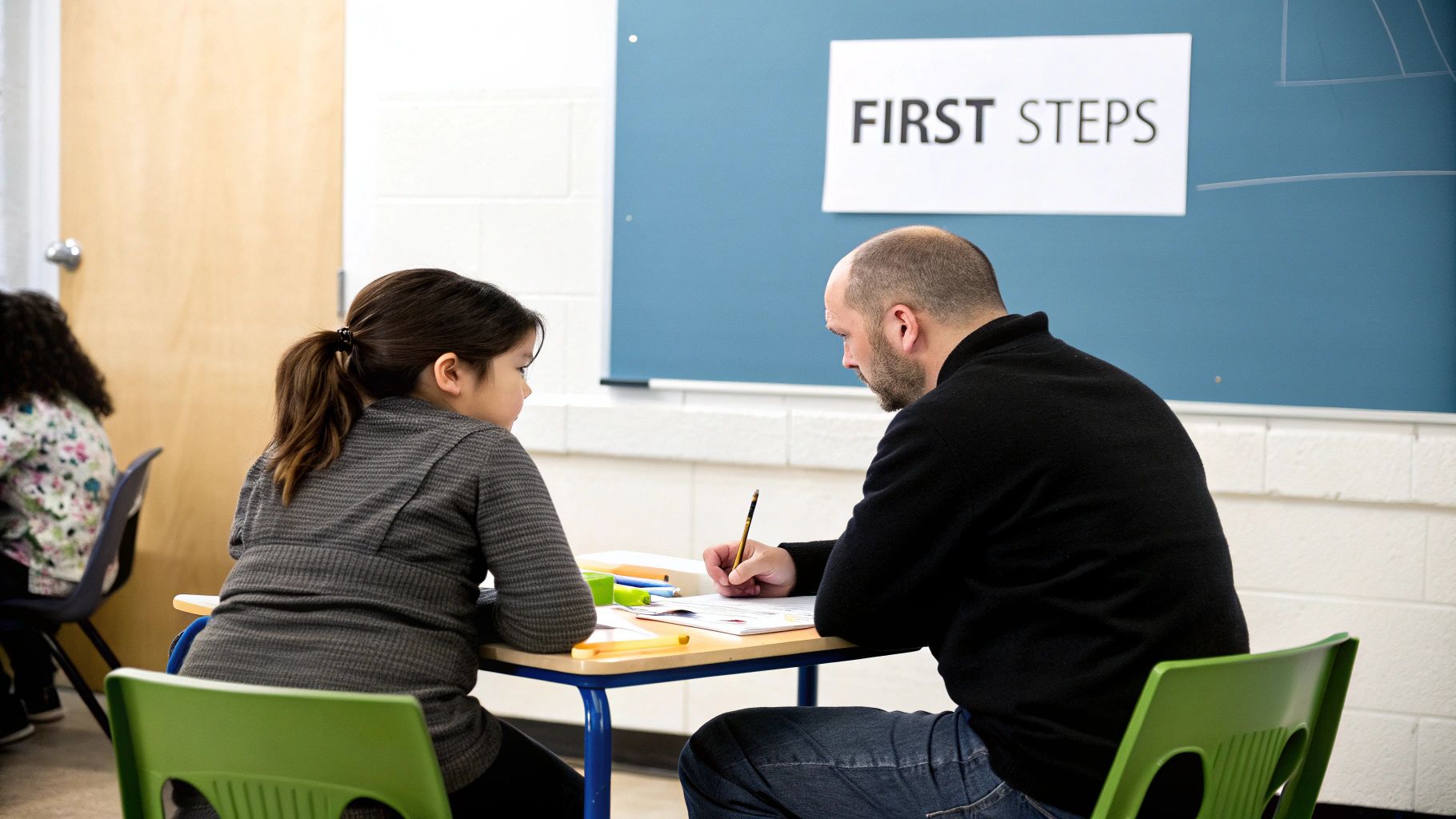
That first conversation with your child's teacher can feel monumental, a delicate balance of hope and anxiety. You know your child better than anyone on this planet—their secret joys, their silent struggles. This guide is here to be your starting point, helping you walk into that room with the confidence that comes from knowing you are their best and most powerful advocate.
The world of educational support can feel buried under a mountain of confusing acronyms. At its heart, though, it’s all about one simple, emotional goal: getting the right help for your child so they can thrive. Let's put the jargon aside. This is about making sure your child feels safe, understood, and happy in a place that celebrates exactly who they are.
Demystifying the SEN System
In the UK, support for children with additional needs comes under the umbrella of Special Educational Needs (SEN). This isn't a label to be afraid of; think of it as a key that unlocks the door to extra resources and understanding for your child. If your child is autistic, they have a right to support designed around their specific way of learning and communicating.
This support generally falls into a few key tiers. Here’s a quick overview to help you understand where your child might fit.
Key Support Tiers in UK Schools at a Glance
| Support Level | What It Means for Your Child | Who It's For |
|---|---|---|
| Universal Support | High-quality teaching and a supportive classroom that benefits all pupils. For example, a teacher using visual aids benefits everyone, but is essential for your child. | Every child in the school. |
| SEN Support | Targeted help from within the school, like small group work to build social confidence, access to a quiet corner, or sensory breaks when they feel overwhelmed. | Children who need more specific help than what's provided to everyone. |
| Education, Health and Care (EHC) Plan | A legally binding plan detailing specific, often intensive, support. This could mean one-on-one support or access to therapies like speech and language during the school day. | Children and young people with complex needs that can't be met by the school's own resources. |
An EHC plan is for children and young people whose needs go beyond what a school can provide through its standard SEN Support. It’s a legal document that maps out every piece of the support puzzle your child requires, ensuring it's not just a suggestion, but a requirement.
It’s worth noting that the number of autistic pupils in UK schools has grown significantly. In fact, autistic spectrum disorder is now the most common type of need for children with an EHC plan. This isn't just a statistic; it’s a clear signal to schools that they must be ready to support your child. With over 1.7 million pupils in England now having some form of special educational need, you are part of a huge community of parents fighting for the best for their children. You can explore the latest data on special educational needs from the UK government.
"Advocacy isn't about fighting a battle; it's about building a bridge. Your unique, heartfelt understanding of your child is the most powerful tool you have to connect with their school and create a supportive team."
Preparing for That First Meeting
Walking into your first school meeting can feel intimidating. The real aim, though, is to build a partnership, and being prepared is the best way to make that happen. You don't need all the answers; you just need to be able to share your child's world from your heart.
Start by jotting down your own observations at home. Think about what a day in their life really looks like—what brings them pure joy, and what causes their world to feel overwhelming?
A few key areas to consider, putting your child at the centre:
- Strengths and Passions: What truly lights them up? Is it the precise way they can line up their toy cars, their incredible memory for dinosaur facts, or the detailed worlds they create in drawings? These aren't just hobbies; they are the keys to unlocking their learning.
- Communication Style: How do they tell you what they need when words fail? Maybe they pull you by the hand to the kitchen, or perhaps a specific stimming motion means they're feeling anxious.
- Sensory Needs: Think about their environment through their eyes. A buzzing fluorescent light that you barely notice might feel like a deafening siren to them. A scratchy jumper can be a massive barrier to concentration. For example: "The hand dryers in public toilets make him cry; he needs paper towels."
- Social Interactions: How do they connect with others? Do they prefer to watch from a distance, absorbing everything? Do they play alongside peers, happy in their shared space? Understanding this helps the school foster positive connections.
Bringing this insight to the table transforms the conversation. It stops being a discussion about "problems" and becomes a creative, collaborative plan for your child's success, built entirely around their wellbeing and happiness.
Navigating the EHC Plan and Assessment Process
Waiting for an autism assessment, and potentially an Education, Health and Care (EHC) plan, can be one of the most draining, heart-wrenching experiences a parent can go through. You're caught in limbo, knowing your child needs help but stuck in a system that feels impossibly slow. This feeling is tough, but this period doesn't have to be passive.
This is your guide to turning that anxious wait into a time of proactive, empowered advocacy for your child. The key is to shift your focus from waiting for a label to gathering undeniable proof of your child’s needs. The journey through the autism and schooling system is a marathon, not a sprint, but you can use this time to build the strongest possible case for the support your child so deeply deserves.
From Feeling Helpless to Taking Action
It's completely normal to feel helpless when faced with bureaucracy, but your role is too vital to take a back seat. Waiting times for autism assessments in the UK have ballooned into a crisis. As of September 2024, the number of children waiting had soared to over 204,000.
Worse still, an incredible 89% of those children had been waiting longer than the recommended 13 weeks for their first appointment. For far too many families, this wait stretches into years, creating a direct barrier to essential support in school. The fallout is serious: delayed help is directly linked to poorer mental health and a higher chance of school exclusion for autistic children.
This stark reality means your proactive involvement isn't just helpful—it's critical. You are the expert on your child, and the detailed records you keep will become the bedrock of any successful application for support.
"The system may move slowly, but your child’s needs don't wait. Every day is an opportunity to document their world, turning your unique parental insight into the most compelling evidence there is."
Start a dedicated notebook or a digital document today. Think of it less like a diary and more like an evidence log that brings your child's reality to life for professionals who only get a brief, clinical snapshot of who they are.
How to Document Your Child’s World
Meticulous documentation is your most powerful tool. Don't worry about using formal language—just write from the heart. The aim is to paint a vivid, detailed picture of your child’s day-to-day life, highlighting their unique strengths, their emotional challenges, and what support truly helps them feel safe.
Here’s what to focus on with practical examples:
- Specific Examples of Challenges: Instead of saying "he struggles with transitions," write down what really happened. "This morning, when I said it was time for school shoes, Leo lay on the floor crying for 15 minutes. He kept repeating 'not the shoes'. This happens most days unless I get out his visual timetable first."
- Sensory Sensitivities: Note their real-life reactions. For example: "In the supermarket, Mia covers her ears and hides when the tannoy goes off. The bright, fluorescent lights also seem to hurt her eyes, and she often asks to leave after just a few minutes."
- Social Interactions: Describe exactly what you see. For instance: "At the park, Ben stood and watched the other children for 20 minutes. When another child ran up to him and shouted 'let's play!', he turned his back and walked away without saying anything. He seemed overwhelmed."
- What Actually Works: This is just as important as the challenges. "When he's feeling overwhelmed, a weighted blanket calms his breathing down within five minutes." This shows you're already using effective strategies and gives a clear indication of what could work at school. Our guide on what SEN support looks like in practice offers more great insights here.
When looking at the bigger picture of support, it can also be incredibly helpful to research available federal grants for autism programs, as these can provide vital funding for tailored educational resources.
By gathering this evidence piece by piece, you turn vague difficulties into concrete, undeniable facts. When you finally sit down in those meetings, you won’t just be talking about your feelings; you'll be presenting a well-organised, evidence-based case that puts your child's needs front and centre. This ensures you are not just a participant in the process, but its most important driver.
Creating an Autism-Friendly School Day
A successful school day isn’t built on grand gestures. It’s woven together from a series of small, thoughtful adjustments that whisper to a child, "You are seen, you are understood, you are safe here." For a child navigating the world of autism and schooling, these details are everything. This is where we move beyond theory and into the practical, day-to-day strategies that can make a profound, emotional difference.
It’s about turning potential flashpoints into moments of calm connection. Imagine a visual timetable transforming a chaotic, tearful morning into a predictable, comforting sequence. Or a deep love for dinosaurs becoming the key that unlocks a history lesson they'll never forget. It’s about putting your child’s needs at the very centre of their education, creating a day that works for them, not against them.
Structuring the Day for Success
For many autistic children, the unknown is a source of intense anxiety. The school day, full of transitions and unexpected changes, can feel deeply unsettling. The most powerful tool to counteract this is to make their day as predictable and visually clear as possible.
A visual timetable is a classic but incredibly effective tool. It’s not just a schedule; it’s a roadmap for the day that a child can hold onto, reducing the mental energy they spend just trying to figure out what’s next.
For example, this could be a simple strip on their desk with picture cards for each lesson: Maths (a calculator icon), then Playtime (a swing icon), then English (a book icon). As each activity is completed, the card can be moved to a "finished" pocket, giving a tangible sense of progress and control that can feel deeply reassuring.
Tapping into Passions for Deeper Learning
Every child has something that makes their eyes light up. For an autistic child, these deep interests—often called special interests—are not just hobbies; they are powerful gateways to their world and to learning. Integrating these passions into lessons is a way to build a bridge from what they love to what they need to learn.
Imagine a child who is fascinated by the London Underground. A geography lesson isn't just about maps; it's about them designing their own fantasy tube lines across the UK. A maths lesson isn't just about numbers; it's about using train timetables to calculate journey times. This approach validates their passion and makes learning feel relevant and joyful, not like a chore.
A key part of tailoring education is understanding personalized learning, an approach that focuses on your child’s individual needs and strengths. It moves away from a one-size-fits-all model towards a more empathetic and effective educational experience.
Managing the Sensory Environment
The school environment can feel like a sensory minefield. The echo in the lunch hall, the flickering fluorescent lights, the scratchy material of a uniform—these can be overwhelming and even painful for a child with sensory sensitivities. Creating a sensory-friendly day is about spotting these triggers and offering practical, compassionate solutions.
For a child who struggles with noise, this could mean:
- Providing noise-cancelling headphones they can wear during assemblies or wet playtimes, giving them control over their auditory world.
- Allowing them to eat their lunch in a quieter space, like a small classroom or library with a friend, away from the clatter and chaos of the main hall.
- Establishing a designated calm-down corner in the classroom—not for punishment, but as a safe retreat where they can go when feeling overwhelmed, without judgement.
The process of formally documenting these needs is often a key part of securing support, such as an Education, Health and Care (EHC) plan. This flowchart shows the basic steps involved in the process.
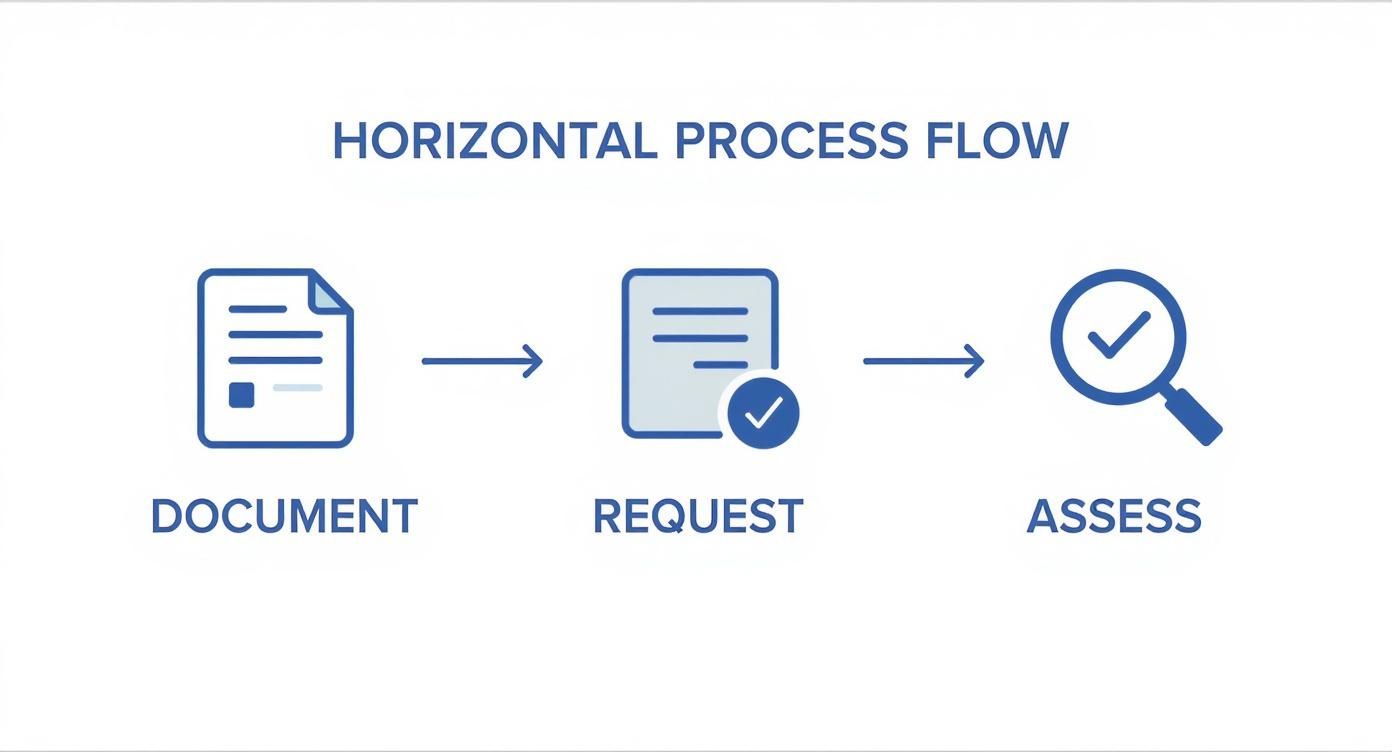
This visual guide simplifies the initial journey, showing how documenting your child's needs is the first step towards getting a formal assessment.
The educational outcomes for autistic children in the UK are shaped by both the availability of support and the inclusivity of school environments. Unfortunately, current learning environments often create sensory overwhelm, which can hinder progress and wellbeing. Research shows that autistic children can thrive when their needs are supported early, but delays are linked to higher rates of school exclusion and poorer mental health.
"An autism-friendly classroom isn’t about silence and stillness. It’s about choice and control—giving a child the tools they need to regulate their own body so they have the emotional and physical energy left to learn."
To help translate these ideas into action, we've created a quick-reference guide. It connects common challenges with straightforward strategies you can discuss with the school.
Practical Supports for Common Schooling Challenges
| Common Challenge | Why It Happens | Practical Support Strategy |
|---|---|---|
| Anxiety around transitions | The shift between activities can feel abrupt and unpredictable, causing deep stress. | Use a visual timetable. Give verbal countdowns ("Five minutes until we tidy up, so you can finish your drawing"). |
| Difficulty starting tasks | The task may seem too big, instructions might be unclear, or there's an intense fear of getting it wrong. | Break the task into tiny, manageable steps on a checklist. Provide a "finished" example they can copy. |
| Sensory overload in busy spaces | Noisy halls, bright lights, or crowds can be physically painful for a sensitive nervous system. | Allow noise-cancelling headphones. Offer a pass to a designated quiet space when they feel that bubble-up of panic. |
| Struggles with social interaction | Unwritten social rules can be confusing and feel like a test you can't pass, leading to misunderstandings. | Role-play specific scenarios at home. Use social stories. Set up structured group activities with clear roles. |
These strategies are just a starting point. The key is to observe your child, listen to what their behaviour is telling you, and create a supportive partnership between home and school.
Ultimately, creating an inclusive school environment benefits every student, not just those with identified needs. You can learn more by exploring what inclusion in schools really means in our detailed guide. These creative, child-centred solutions honour your child’s experience, helping them feel understood, respected, and ready to embrace their school day with confidence.
Building a Strong Parent and School Partnership
You are, without a doubt, the world’s leading expert on your child. That deep, intuitive knowledge is the most powerful tool you have when navigating the world of autism and schooling. The relationship between you and your child's school shouldn't feel like a battleground; it needs to be a powerful, collaborative alliance built on one shared, heartfelt goal—your child's happiness and wellbeing.
When communication breaks down, it’s often because everyone feels unheard and unappreciated. Shifting this dynamic starts with changing the approach, moving conversations away from conflict and towards constructive, child-centred problem-solving. This section is about making every meeting and email a productive step forward, ensuring your voice is not just heard, but valued.
From Conflict to Collaboration
It’s all too easy for meetings to become focused on what's going wrong. The emotional weight of seeing your child struggle can make these conversations feel defensive and incredibly stressful. The key to breaking this cycle is to frame every interaction around a shared purpose. Before any meeting, take a deep breath and remind yourself—and them—that you are all on the same side.
A powerful way to start is by expressing genuine appreciation. For example, "Thank you so much for letting me know Maya enjoyed the art project. She was so proud to show me her painting, and it was lovely to see her so excited about school." This simple act immediately lowers defences and sets a collaborative, human tone.
"True partnership isn’t about always agreeing. It's about maintaining mutual respect and a relentless focus on the child, even when you disagree on the method."
This approach transforms the dynamic. It moves from a 'parent versus school' mindset to one where you are joint problem-solvers, putting your heads together to figure out what's best for the child you both care about.
Preparing for Productive Meetings
Annual reviews can feel overwhelming. To make them effective, preparation is everything. Going in with a clear structure ensures you cover your key points and aren't derailed by emotion. An effective strategy is to organise your thoughts into a simple, positive framework.
Consider structuring your notes this way:
- What's Working Well: Always start with the positives. "The visual timetable on his desk has made mornings so much calmer for him. He seems less anxious." Celebrating successes reinforces what's working and encourages more of it.
- Current Challenges: Be specific, using real-life examples. Instead of, "He's unhappy," try, "I've noticed he comes home exhausted and emotionally drained on PE days. He's told me the noise and rush in the changing rooms feels 'too buzzy'."
- Suggested Solutions: Come to the table with ideas. For instance, "I was wondering if we could explore him changing five minutes before the other children? Or perhaps he could wear his ear defenders while changing?"
This structured approach shows you are an engaged, proactive partner. It shifts the conversation from simply listing problems to actively building solutions together, making the school feel like a capable and trusted ally.
Communicating Effectively with Teachers
Day-to-day communication is just as important as those formal meetings. A simple home-school communication book can be a lifeline, offering a low-pressure way to exchange quick, vital updates, especially for a child who may not be able to tell you about their day.
Here's what a simple daily entry might look like:
Morning Entry (From Parent):
"Good morning, Leo had a very restless night and seems a little more anxious than usual today. He might need a few extra movement breaks. He’s really looking forward to the science experiment you mentioned."
Afternoon Entry (From Teacher):
"Hi, thanks for the heads-up. We gave Leo a wobble cushion, which really helped him focus. The science experiment was a huge hit! He was a bit overwhelmed during assembly but calmed down quickly in the quiet corner."
This brief exchange provides invaluable context for both sides. It allows the teacher to understand the child's emotional state and helps you understand their day, preventing small issues from escalating. It's a simple yet powerful tool for wrapping a consistent, supportive environment around your child.
Choosing the Right School Environment
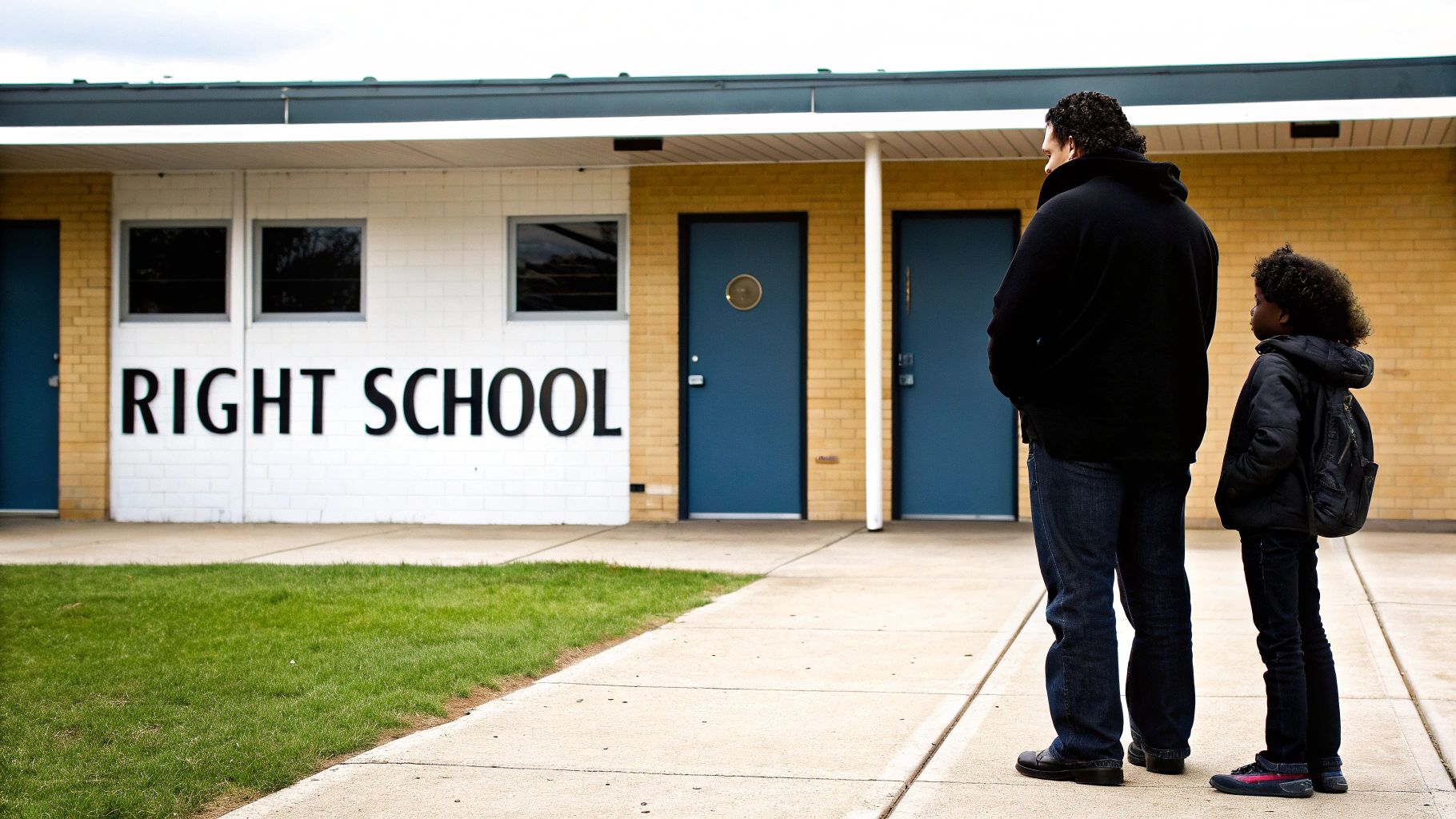
Picking the right school for your child is one of the most emotional and significant choices you’ll ever make. It’s a journey that goes way beyond league tables. It's about finding a place where your child isn’t just academically supported, but truly seen, accepted, and given the room to be their authentic self.
The question of mainstream versus specialist provision isn’t a simple one, because there's no single "best" environment for every autistic child. The right path is the one that fits your child’s unique spirit. This is your compassionate guide to navigating that deeply personal decision.
Exploring Your Options
The landscape of autism and schooling in the UK offers several different pathways. Each has its own culture, benefits, and potential drawbacks. Understanding these is the first step toward making a choice that feels right in your heart.
You’ll likely be looking at three main settings:
- Mainstream Schools: Your local state or independent schools. Many have dedicated SEN support, and some have specialised units attached, offering a blend of integrated and targeted help for your child.
- Specialist Schools: These schools are specifically designed for pupils with special educational needs. You’ll find much smaller class sizes, highly trained staff who 'get it', and therapies like speech and language built into the school day.
- Alternative Provisions: This broad category includes everything from hospital schools to pupil referral units and, increasingly, flexible online schooling.
For some families, the very structure of a traditional school day is the biggest barrier. Exploring flexible options like dedicated online courses for SEN students can provide a personalised, low-sensory environment right from home, which might just be the perfect fit for your child.
A Framework for Your Decision
Instead of a generic pros-and-cons list, use a set of questions centred entirely on your child's experience. This lets you evaluate each potential school through the lens of what truly matters for their wellbeing. As you visit schools, trust your gut and reflect on these key areas.
The Sensory Profile
How does your child process the world? A school is a sensory whirlwind, and finding a good match here is critical for their ability to learn.
- Noise and Space: As you walk the corridors, does it feel calm, or is it loud and echoey? A large, bustling secondary school might be exciting for one child but physically painful for one with auditory sensitivities.
- Visual Environment: Look at the classroom walls. Are they visually chaotic with bright, distracting displays, or are they more muted? For your child, too much visual information can be a major barrier to concentration.
- Quiet Areas: Is there an accessible, designated quiet space where a child can go to decompress without feeling like they are in trouble?
"The right school isn’t just about what a child learns; it's about whether they feel safe enough in their own body to learn at all. A sensory-supportive environment is the foundation for everything else."
The Social and Emotional Landscape
Think about how a school fosters connection and emotional safety. This goes much deeper than an anti-bullying poster.
- Approach to Social Skills: Does the school actively teach social skills with kindness, or is there an expectation that children should just figure it out?
- Community and Belonging: How does the school talk about difference? Do you get a genuine feeling that neurodiversity is understood and respected by staff and pupils? Does it feel like a place your child could belong?
- Peer Group: Will your child be one of very few autistic pupils, or will they be part of a larger neurodivergent peer group where they can find a sense of shared identity and feel less alone?
The Academic and Learning Style
Finally, look at how the teaching is delivered. A school's philosophy must align with how your child thinks and learns.
- Flexibility: How adaptable is the curriculum? Can the school support a child who is years ahead in maths but needs significant help with writing?
- Support Integration: Is extra help a natural part of the classroom, or is it something that happens separately down the corridor? True inclusion means support is woven into the very fabric of the day.
This journey is about finding a community where your child is celebrated for exactly who they are. Trust your intuition. When you walk into the right school, you will feel it—a sense of peace, acceptance, and a place where you can picture your child not just coping, but truly thriving.
Supporting Your Child's Wellbeing Beyond School
A happy school life is just one part of a happy childhood. The world of autism and schooling doesn't stop when the final bell rings. Your child’s emotional wellbeing, friendships, and sense of self are nurtured just as much in the safety of your home and community as they are in the classroom.
It’s in these quiet moments, away from academic pressures, that they can truly recharge, drop the mask, and grow into themselves. This is about looking beyond grades and homework to see the whole child—building their resilience, celebrating their identity, and creating a world outside the school gates where they feel just as safe, understood, and deeply loved.
This isn't about just coping; it's about thriving.
Nurturing Self-Esteem and Managing Anxiety
For many autistic children, the constant effort of navigating a neurotypical world is exhausting. It often leads to anxiety and can slowly chip away at their self-esteem. Your home must be their sanctuary—the one place where they can finally stop performing and be their authentic selves without fear of judgement.
One of the most powerful things you can do is validate their feelings. When your child comes home overwhelmed, a simple "that sounds incredibly difficult and tiring" is far more comforting than "you'll be okay." It shows you see their struggle and, most importantly, that you believe them.
"A child’s wellbeing is not built on praise for conforming, but on the unconditional acceptance of who they are. When they know they are loved for their true self, they build a foundation of self-esteem that school pressures cannot break."
Fostering Friendships Outside of School
Building friendships can feel like trying to solve a puzzle with no instructions. The unwritten social rules of the playground are often confusing and overwhelming for autistic children. Outside of school, however, you have the power to create more predictable and successful social opportunities.
The key is to focus on shared interests. If your child loves Minecraft, connecting them with another child online or in a small gaming club provides a natural, low-pressure platform for interaction. The rules are clear, and the focus is on a shared passion.
Consider these practical steps:
- Start small. A one-on-one meet-up at a quiet park for 30 minutes is far less intimidating than a loud, chaotic birthday party.
- Be the social guide. Gently help them navigate social cues. For instance, you could quietly say, "It looks like your friend has finished talking. It's our turn to ask a question now." This isn't about forcing them, but offering a gentle scaffold.
- Embrace parallel play. Don't worry if they play alongside a friend rather than directly with them. Simply sharing the same space calmly is a deeply meaningful form of connection and a vital first step.
Remember, you are not alone on this journey. Connecting with brilliant organisations like the National Autistic Society can provide invaluable resources and link you to local support networks, offering a community of parents who truly understand the emotional rollercoaster you're on.
Frequently Asked Questions
Navigating the world of autism and schooling can bring up a thousand questions, often when you’re wide awake at 3 a.m. worrying. This section is here to give you clear, direct answers to some of the most common concerns we hear from parents.
What’s the First Step if I Think My Child Needs More Support at School?
The very first thing you should do is request a meeting with the school's Special Educational Needs Coordinator (SENCo). Before you go, jot down specific, real-world examples of your child's challenges and—just as importantly—their unique strengths. For example, "He finds the noisy lunch hall very distressing, but he is incredibly focused and calm during one-on-one reading time."
The school can, and should, start providing what's known as 'SEN support' straight away. This means making practical adjustments right now, even before any formal diagnosis is in place. You don't have to wait for an official label to ask for help for your child.
Can My Child Get an EHC Plan Without a Formal Autism Diagnosis?
Yes, absolutely. An Education, Health and Care (EHC) plan is based entirely on a child's needs, not a specific diagnosis. If your child's needs are significant enough to require support beyond what a mainstream school can typically provide, they may be eligible for an EHC needs assessment.
While a diagnosis can strengthen your case, the local authority has a legal duty to look at all the evidence of your child's difficulties. Your detailed log of their day-to-day struggles is powerful proof.
The system can feel fixated on labels, but your child’s lived experience is the most powerful evidence you have. An EHC plan is about securing the right help for your child, not just ticking a diagnostic box.
How Can I Help My Child Manage Sensory Overload at School?
The best approach is to work with the school to create a simple, practical sensory plan that puts your child's needs first. Often, small changes can make a massive difference to their ability to get through the day.
For example, this could include:
- Noise Management: Providing noise-cancelling headphones for loud assemblies or allowing them to leave five minutes early to avoid the crush of bodies and noise in the corridor.
- Movement Breaks: Allowing them to use a wobble cushion or take a short walk in a quiet corridor when they feel fidgety and overwhelmed.
- Personal Space: Ensuring their desk is positioned in a calmer part of the classroom, away from the door or a distracting, bright window.
At home, protecting their downtime is just as vital. After a day of holding it all together at school, your child needs a calm, predictable space to decompress and recharge their emotional and sensory batteries for the next day.
At Queens Online School, we create learning environments that are built around the individual needs of every child. If you're looking for a flexible, supportive educational path that celebrates your child’s unique strengths, explore how our online British curriculum can make a difference. Learn more at https://queensonlineschool.com.