

Watching your child face their GCSE Chemistry revision can be tough. It isn't just about memorising facts; it's about helping them find a smart plan, the right learning techniques, and, most importantly, a positive mindset. The secret is to help them break down tricky topics into bite-sized pieces that feel manageable, use methods that actually make their brain work (like trying to teach a concept to you), and build their confidence by nailing one small area at a time.
Conquering GCSE Chemistry Begins with Confidence
For many students, the thought of revising for GCSE Chemistry feels like a huge weight on their shoulders. It's a subject filled with abstract ideas like molar calculations and a mountain of content to get through. It’s no wonder so many feel completely overwhelmed before they even open a textbook, a feeling that often leads straight to anxiety and procrastination.
And that feeling is completely understandable. Chemistry is tough; it demands that students link theoretical knowledge with practical skills and mathematical precision. But this is also what makes it so rewarding. It’s a subject where dedicated, well-prepared students can achieve incredible results. In the summer 2025 exam series, an amazing 46.4% of entries were graded at 7-9, making it the subject with the highest proportion of top grades. You can learn more about these GCSE results trends and see just how well focused students can perform.
Turning Anxiety into Action
Instead of seeing this difficulty as a roadblock, let's help your child reframe it. Think of it as a puzzle to be solved. The real challenge isn’t the content itself, but the emotions that come with it—the self-doubt that whispers "I can't do this," or the panic that leads to staring blankly at a page.
Your role here is to help create a positive space where your child feels capable and supported. Success in GCSE Chemistry comes from a smart, consistent plan, not from being a "genius." It's about turning that feeling of being overwhelmed into small, actionable steps they can actually take.
The first step isn’t memorising the periodic table; it’s believing you can. Building this confidence is the foundation for every other revision technique that follows. It transforms the journey from an impossible climb into a series of manageable steps.
Building a Foundation of Self-Belief
Let’s put this into practice with a real example. Imagine your child is struggling with balancing chemical equations. It feels like an impossible task, and they're shutting down. Don't set a vague goal to "revise chemical equations." That’s far too big and intimidating.
Instead, try this approach:
- Acknowledge the feeling: "I can see this topic is making you feel stressed. It's completely normal; lots of people find it tough at first."
- Shrink the task: "Let’s just focus on one simple equation today. We'll just try to balance H₂ + O₂ → H₂O. We can ignore the rest for now."
- Celebrate the win: As soon as they solve it, make it a moment of success. "See? You can do it. That's one step forward. I'm proud of you for sticking with it."
This simple process helps break the cycle of fear and avoidance. It proves to your child that progress is possible, one step at a time, building a foundation of confidence that will carry them through their entire revision journey. By tackling the emotion first, you empower them to finally say, "Okay, I know where to start."
Building a Revision Plan That Actually Fits Your Child's Life
A generic revision timetable downloaded from the internet is destined to fail. Why? Because it wasn’t made for your child, with their unique schedule, energy levels, and life outside of school. The secret to revising for Chemistry GCSE effectively is to build a personalised plan that feels manageable, not punishing.
This all starts with an honest assessment of where they actually stand. Forget trying to revise everything at once; that’s a direct path to feeling overwhelmed. Instead, introduce them to the 'topic traffic light' system. It’s a simple, visual way to take back control and soothe their anxiety.
Using the Topic Traffic Light System
Ask your child to list every single topic from their chemistry specification. Then, right next to each one, they'll colour-code it based on how they feel about it:
- Red: These are the topics that make their stomach drop. The ones they find really difficult or just don't understand at all (e.g., "I hate quantitative chemistry," or "I can never remember mole calculations"). These are the absolute priority.
- Amber: Topics they feel okay about but know they need more practice on (e.g., "I sort of get electrolysis, but the exam questions are tricky").
- Green: These are the topics they feel confident with and consistently score well on (e.g., "I'm good at atomic structure," or "Separating mixtures is easy"). These require only a light-touch review later on.
This simple exercise immediately makes the mountain feel more like a series of small, climbable hills. It provides a clear, visual starting point and ensures their precious energy is spent where it will make the biggest difference—tackling those difficult red topics first, which in turn builds the most confidence.
A plan isn't about filling every hour with work; it's about making the hours you do work count. By prioritising the hardest topics, your child builds momentum and proves to themselves that they can conquer the things they once feared.
The next step is to set specific, achievable goals. Vague targets like "Revise Topic 2" are impossible to measure and just lead to procrastination. Instead, help them break it down. For instance, instead of the fuzzy goal "Revise Covalent Bonding," a much better goal would be, "This evening, I'm just going to learn how to draw dot-and-cross diagrams for methane, ammonia, and water from memory." That’s a concrete task they can actually complete and tick off, giving them a real sense of accomplishment.
This infographic shows how moving from a state of anxiety to a structured plan directly builds confidence and a sense of control.
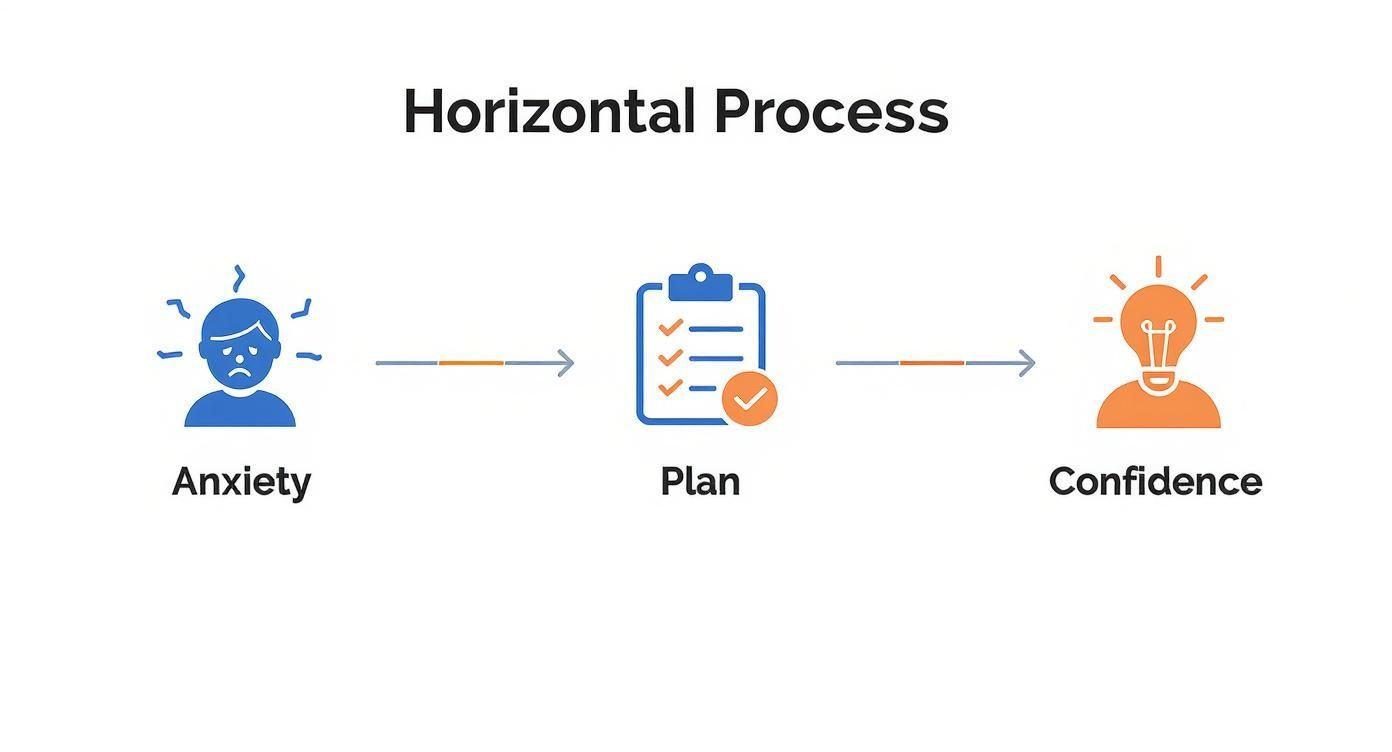
As the visual flow demonstrates, a clear plan acts as the bridge between feeling overwhelmed by the subject and feeling empowered to succeed.
Creating a Sustainable Schedule
Once they have their priorities and specific goals, it's time to integrate them into their actual life. A revision plan has to work around football practice, hobbies, and essential downtime. Forgetting to factor in rest is the single biggest cause of burnout, leaving them feeling exhausted and resentful.
Believe it or not, a short, focused 30-minute session on a tricky red topic is far more valuable than three hours of exhausted, passive reading. For more general advice on striking this balance, our guide offers some excellent revision tips for GCSE students that can help build a healthy routine.
Here’s a quick look at how you could structure just a few focused blocks of revision into a busy week, making sure to include time for their wellbeing.
Sample Weekly Revision Block for a GCSE Student
| Day | Time Slot | Chemistry Focus (30 Mins) | Activity | Wellbeing Check-in |
|---|---|---|---|---|
| Monday | 7:00 – 7:30 PM | Red Topic: Mole Calculations | Watch a 10-min tutorial video, then attempt 3 practice questions. | Go for a 20-minute walk afterwards to clear their head. |
| Wednesday | 6:30 – 7:00 PM | Amber Topic: Electrolysis | Create a mind map of the key terms and processes. | Chat with a friend (not about exams!). |
| Friday | 5:00 – 5:30 PM | Red Topic Review: Re-do Monday's mole calculation questions | Mark answers against the mark scheme and make notes on any errors. | Enjoy a movie night with no guilt. |
| Sunday | 11:00 – 11:30 AM | Green Topic: Atomic Structure | Complete a quick 15-question multiple-choice quiz online. | Spend the afternoon on a hobby they love. |
This isn't about filling every gap, but about making the time they do use count for something specific and meaningful.
By building a plan that respects their whole life, you're not just creating a timetable; you're developing a sustainable routine. This puts your child in control, reduces that last-minute panic, and builds the resilience they need to walk into their exam feeling prepared and calm.
Using Active Revision Methods That Make Knowledge Stick
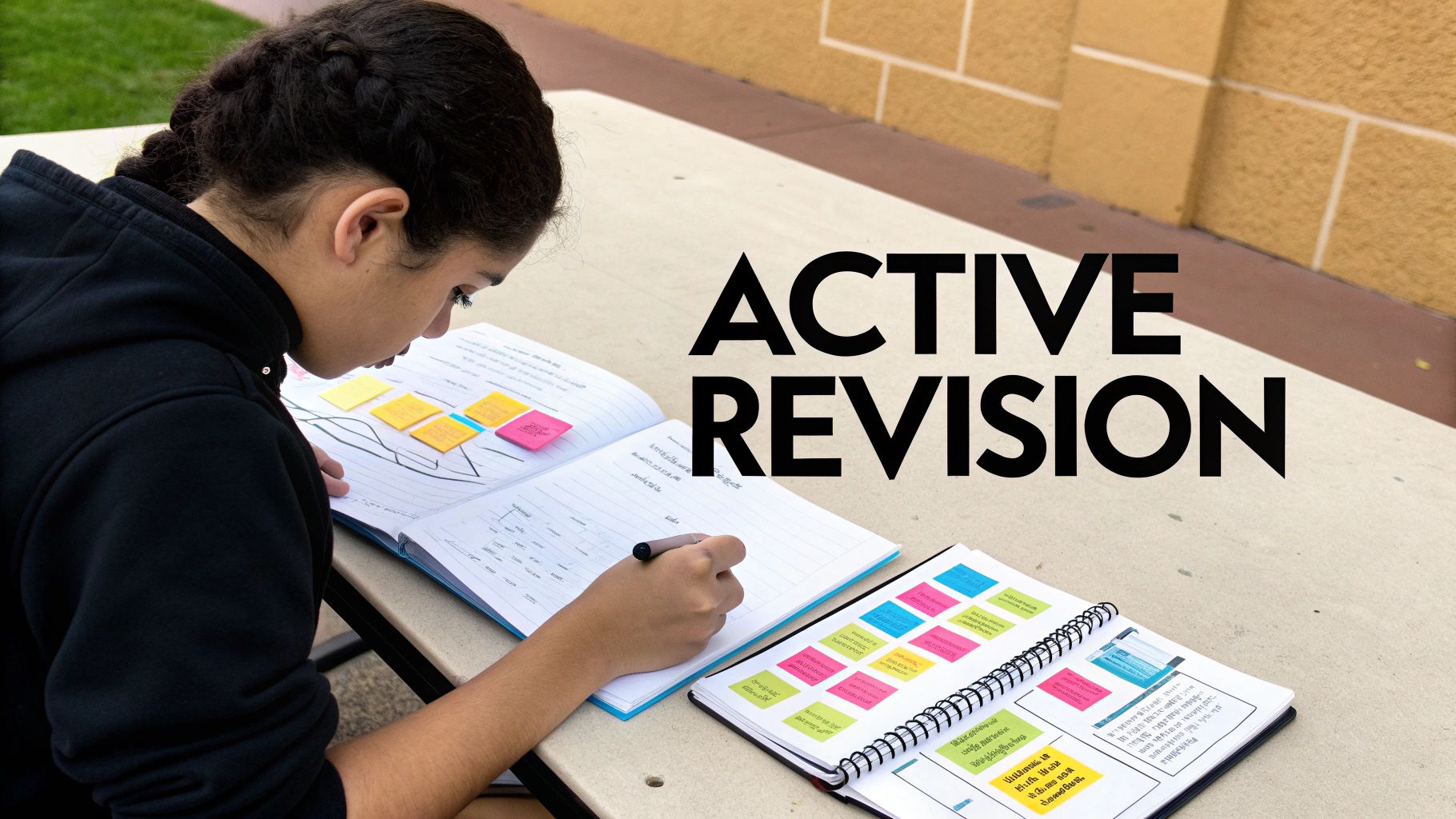
If your child’s revision involves silently reading a textbook or highlighting their notes, they’ve fallen into the most common trap of all: passive learning. The brain is fantastic at tricking us into feeling productive, but simply looking at information doesn’t make it stick.
To truly learn how to revise for chemistry gcse, we need to shift from passive reviewing to active recall. This means doing things that force the brain to actively retrieve information. It feels harder, and that’s the point—it’s the mental equivalent of lifting a weight. This struggle builds the strong neural pathways needed for genuine understanding and long-term memory.
The Power of Explaining It Simply
One of the most effective active methods is the Feynman Technique. The concept is brilliantly simple: if your child can't explain something in basic terms, they don't really understand it. Ask them to pick a tricky topic, like electrolysis, and explain it to you or a younger sibling as if they were ten years old.
They can't hide behind complex jargon like 'anode' or 'cathode' without first explaining what they are and why they matter. For example, they might say, "Imagine it's like a sorting machine for tiny charged particles. The positive particles go to the negative side (cathode), and the negative ones go to the positive side (anode)." This exercise quickly reveals the gaps in their own knowledge and helps them build real understanding.
True understanding isn’t about reciting a textbook definition. It’s about owning the knowledge so completely that you can translate it into your own words. This is the moment when information transforms into wisdom.
Blurting Your Way to Better Recall
Another fantastic technique is blurting. It’s messy, quick, and incredibly revealing. Here’s how it works:
- First, your child chooses a specific sub-topic, like 'Crude Oil and Fractional Distillation'.
- Next, they put their books and notes away completely. No peeking. This part can feel scary, but it's essential.
- For 5-10 minutes, they write down absolutely everything they can remember about it on a blank piece of paper.
- Once the time is up, they compare their 'blurt' sheet to their official notes, using a different coloured pen to correct mistakes and add missing details.
This process shines a harsh, honest light on what they actually know versus what they think they know. That sheet of corrections then becomes a powerful, personalised revision guide for that specific topic, showing them exactly what to focus on next.
Using Past Papers as a Diagnostic Tool
Finally, it’s vital to see past papers not as mock exams, but as diagnostic tools. The goal isn't just to get a grade; it's to find weaknesses. After completing a paper, the most important work begins. Your child should go through it with the mark scheme and analyse every single lost mark.
- Was it a simple recall error they could fix with a flashcard? (e.g., "I forgot the test for chlorine.")
- Did they misread the question under pressure? (e.g., "I missed the word 'not' in the question.")
- Was it a specific maths skill, like rearranging equations, that they struggled with? (e.g., "I got the mole calculation wrong again.")
This forensic analysis turns a disappointing result into a precise action plan. They’re no longer just 'revising chemistry'; they’re fixing a specific weakness in calculating concentration. It's a far more efficient approach that builds confidence by tackling problems head-on.
Many of these active methods can be adapted for digital tools. To get the most out of screen time, it's worth integrating the best practices for online learning into their routine.
Mastering the Maths and Practical Skills in Chemistry
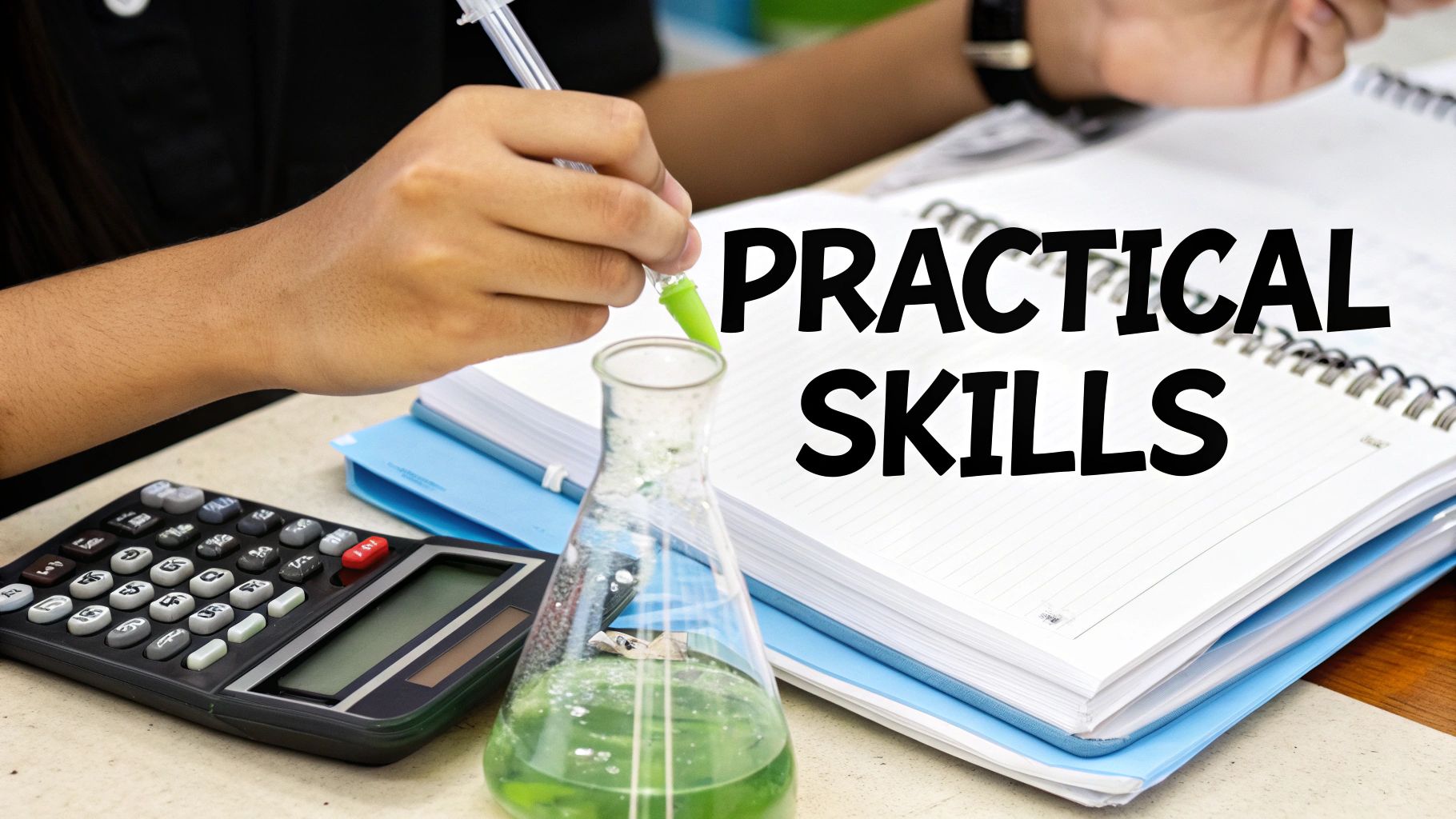
For many students, the confidence they've carefully built up in Chemistry can shatter the moment a maths question appears. Suddenly, the subject feels less like science and more like a cruel maths test they weren’t prepared for. This is a common and deeply frustrating experience, but it’s a hurdle that can absolutely be overcome with a focused approach.
The key is to treat the maths in Chemistry not as a separate, scary subject, but as just another tool in the Chemistry toolbox. These questions aren't there to trick your child; they’re designed to test their understanding of core principles like moles, concentrations, and reaction yields in a practical way.
Breaking Down the Maths Barrier
Instead of seeing "quantitative chemistry" as one big, intimidating topic, help your child break it down into specific skills. They don't need to be a maths prodigy, but they do need to be comfortable with a few key operations.
Confidence in these areas is crucial, and if your child needs extra support, exploring specific strategies on how to revise for Maths GCSE can provide a solid foundation for these chemistry-specific calculations.
Start by isolating each mathematical concept and practising it with worked examples. Focus on mastering one thing at a time:
- Balancing Equations: Treat it like a puzzle. Start with a simple one, like making water (H₂ + O₂ → H₂O). Use a pencil, and remind them it's okay to make mistakes and start over. It's about getting the number of atoms for each element the same on both sides.
- Calculating Moles: This is the absolute cornerstone of Chemistry maths. Work through the formula: Moles = Mass / Molar Mass. Use flashcards to remember the formula triangle until it becomes second nature. Practice finding the mass of 2 moles of water, then 0.5 moles, until it feels automatic.
- Titration Calculations: This often feels like the final boss of Chemistry maths. The trick is to break it down into clear, repeatable steps: write the balanced equation, calculate the moles of the known solution, use the ratio to find the moles of the unknown, and finally, calculate the concentration. Do this step-by-step for the same question multiple times.
The secret to the maths is repetition. It’s about building muscle memory so that when your child sees a calculation question in an exam, their brain doesn’t panic—it follows a familiar, well-practised path.
Making Sense of the Required Practicals
The other area that often causes anxiety is the required practicals. Many students fall into the trap of trying to memorise the method for each one, word-for-word. This is not only inefficient but also misses the entire point of the exercise.
Examiners want to see that your child understands why each step is performed. So, it's best to focus revision on these 'why' questions:
- Why is a specific indicator used in that titration? (Because it changes colour at the exact pH of the neutralisation point).
- Why is the flask swirled constantly? (To ensure all the reactants mix and react completely).
- What are the common sources of error in a calorimetry experiment? (Heat loss to the surroundings is the biggest one. You could ask them, "How could we reduce that?").
Understanding the reasoning behind the method is what allows a student to tackle those tricky 6-mark questions. These questions are designed to test the application of knowledge, asking students to evaluate a method or suggest improvements.
By shifting focus from rote memorisation to genuine understanding, your child will be equipped to explain their thinking clearly and logically, securing every possible mark.
Choosing the Best Digital Tools for Chemistry Revision
https://www.youtube.com/embed/KeSyKl7zHG0
With countless apps, websites, and videos all promising exam success, it's easy for your child to feel busy without actually being productive. The goal isn't to ditch paper and pens entirely. Instead, it’s about strategically using technology to supercharge active revision, turning what could be passive screen time into powerful, effective learning.
It really comes down to quality over quantity. A few high-quality resources, used consistently, are far more valuable than a dozen flashy apps that get opened once and forgotten. The key is to guide them away from aimless browsing towards trusted, structured platforms that genuinely help.
Curated Resources for Focused Learning
A good starting point is to stick with the essentials—the platforms proven to align with the GCSE curriculum and designed for proper learning, not just passing the time.
- BBC Bitesize: This should be the first port of call. It’s reliable, free, and breaks down the entire chemistry specification into digestible chunks. The mix of concise notes, clear diagrams, and quick tests makes it perfect for plugging those specific knowledge gaps that pop up after tackling a past paper.
- Seneca Learning: If you’re worried about information going in one ear and out the other, Seneca is fantastic. It’s built around interactive quizzes and spaced repetition, a technique that forces students to actively retrieve information. This is far more effective for building long-term memory than just re-reading notes.
- Specialist YouTube Channels: For visual learners, some YouTube channels are absolute game-changers. Channels like Freesciencelessons offer short, sharp videos that stick directly to the specification. They're brilliant for clarifying complex processes like organic chemistry mechanisms or electrolysis in a dynamic way a static textbook just can't match.
The best digital tools are the ones that demand interaction. If your child is just passively watching a video, they aren’t truly revising. You want resources that make them think, answer questions, and actively engage with the material.
Using Technology to Support Active Revision
It’s crucial to remember that these tools are a means to an end, not the end itself. Chemistry GCSE remains one of the most popular and important qualifications. With approximately 44% of all GCSE exams in England being in STEM subjects, its role is critical, and that makes effective revision completely non-negotiable.
To help your child organise their notes and streamline their study process, you could explore some of the best note-taking apps for digitising flashcards or mind maps. For students who find they need more personalised guidance to navigate these complex topics, a specialist can make all the difference. You might want to look into the benefits of online tutoring for science for that extra layer of focused support.
Ultimately, before your child dives into a new app or website, get them to ask one simple question: "How will this help me do something?" Will it test their knowledge? Will it help them create flashcards? Will it let them practise a specific skill? If the only answer is, "I'll watch it," it’s probably not the best use of their precious revision time.
Your GCSE Chemistry Revision Questions Answered
As the exam dates creep closer, it’s completely normal for a few questions (and maybe a bit of panic) to bubble up. The final stretch of revision can feel like a pressure cooker for both you and your child. Let's tackle some of the most common worries head-on with some practical, reassuring advice to get you through this period with confidence.
Knowing how to revise for chemistry GCSE often comes down to having clear answers to these nagging questions.
How Many Hours a Day Should My Child Revise?
This is the question every parent asks, but honestly, the answer has nothing to do with the clock. It's all about quality over quantity.
A single, highly focused 25-minute session using an active method like blurting or dissecting a past paper is worth more than two hours of passively re-reading a textbook. The brain simply can’t absorb information indefinitely. Pushing past the point of concentration only leads to frustration, not learning.
Think in terms of one or two of these intense, focused blocks on a revision day. It's the consistent, daily effort that builds real knowledge and confidence, not those last-minute marathon cramming sessions that just cause burnout and tears.
What Is the Best Way to Memorise Equations and Definitions?
The real goal here is understanding, not just reciting from memory. Examiners are brilliant at spotting the difference between a student who has just memorised a phrase and one who actually gets the science behind it.
Here’s a much better approach:
- For equations: Don't just stare at them. Get a blank piece of paper and practise balancing them from scratch, over and over again. Cover up the answer and work through it. This active process is what builds the kind of 'muscle memory' needed to perform under exam pressure.
- For definitions: You can't beat physical flashcards. Get your child to write the term on one side and the definition in their own words on the other. For 'catalyst', instead of the textbook definition, they might write "Something that speeds up a reaction but doesn't get used up itself." The simple act of writing it out, combined with the active recall of testing themselves, forges much stronger memory pathways than just reading from a list.
My Child Got a Low Mark on a Past Paper and Is Devastated. What Now?
First things first, reassure them that this is actually a good thing. It feels dreadful in the moment, I know, but a low-scoring past paper is a gift. It isn't a final judgment; it's a diagnostic tool. It has perfectly pinpointed exactly where to focus their precious revision time.
Sit down with them, the paper, and the mark scheme. Go through each lost mark and figure out the 'why'. Was it a specific topic they just don't get? A silly maths error? Did they misread the question? This analysis is absolute gold dust. It tells you exactly how to build a targeted, effective revision plan.
Frame it not as a failure, but as feedback. The past paper has literally handed them a treasure map showing where all the marks are buried. Now they just need to go and dig them up.
This simple shift in perspective can turn a moment of despair into a powerful opportunity for growth. It puts them back in control and helps them focus their energy where it will make the biggest difference.
At Queens Online School, we understand that every child's learning journey is unique. If you're looking for expert, personalised support to help your child build confidence and excel in GCSE Chemistry, explore our flexible online learning programmes. Find out more at https://queensonlineschool.com.